
A sentence can tell us what someone is doing, has done, can do, or will do. But the main verb often needs support to express the exact meaning. This is where a helping verb becomes important.
Words such as is, am, are, was, were, has, have, had, do, does, did, will, can, should, and must can help a main verb. For example, in “She is working,” the word is helps the main verb working show an ongoing action.
People search for Helping Verb because these words can be confusing. A helping verb may show tense, time, possibility, ability, permission, obligation, or emphasis. Some helping verbs can also work as main verbs in other sentences. For example, have is a helping verb in “I have finished,” but it is a main verb in “I have a car.”
In this guide, you will learn the Helping Verb definition, types, examples, British and American usage, common mistakes, everyday examples, and simple grammar rules. You will also learn how to identify helping verbs quickly.
Helping Verb – Quick Answer
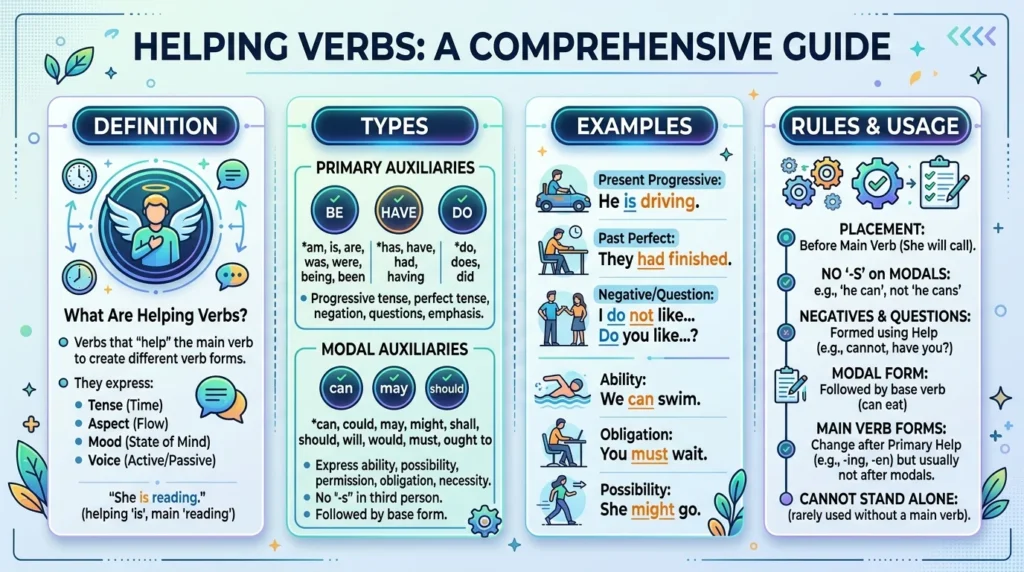
A helping verb is a verb that works with a main verb to give more information about an action or state.
Helping verbs can show:
- Time
- Tense
- Possibility
- Ability
- Permission
- Necessity
- Obligation
- Emphasis
Examples
She is reading a book.
Is is the helping verb, and reading is the main verb.
They have finished the work.
Have helps the main verb finished.
He can swim.
Can helps swim and shows ability.
We will travel tomorrow.
Will helps travel and shows future time.
Main Helping Verbs
The three primary helping verbs are:
- Be — am, is, are, was, were, be, being, been
- Have — have, has, had
- Do — do, does, did
Modal helping verbs include:
- can
- could
- may
- might
- shall
- should
- will
- would
- must
The Origin of Helping Verb
The term helping verb comes from the basic function of these verbs: they help another verb.
The word help comes from Old English helpan, meaning to assist or support. The word verb comes from Latin verbum, meaning “word.”
Together, the term helping verb describes a verb that supports another verb in a sentence.
In traditional grammar, helping verbs are often called auxiliary verbs. The word auxiliary comes from Latin auxiliarius, meaning “helping” or “supporting.”
Why Are Helping Verbs Important?
English uses helping verbs to express ideas that cannot always be shown clearly by the main verb alone.
Compare:
She works.
and:
She is working.
The first sentence describes a general or regular action. The second shows an action in progress.
The helping verb is changes the structure and meaning of the sentence.
Another example:
He finished the work.
He has finished the work.
The helping verb has creates the present perfect structure.
British English vs American English Spelling
There is no spelling difference in the term helping verb between British and American English.
Both varieties use:
helping verb
However, some helping-verb structures can have different preferences in British and American English.
| Feature | American English | British English |
|---|---|---|
| Helping verb | helping verb | helping verb |
| Auxiliary verb | Common | Common |
| Do/does/did | Common | Common |
| Have/has/had | Common | Common |
| Modal verbs | Common | Common |
| “Have got” | Less common in some contexts | Very common |
| Shall | Less common | More common in some formal uses |
Have vs Have Got
Both varieties can use have to show possession.
American English:
I have a car.
British English may also say:
I have a car.
But British English commonly uses:
I have got a car.
Both forms are understood across English varieties.
Shall
Shall is a helping verb used to express future meaning or suggestions.
In modern American English, will is much more common in everyday speech:
I will call you tomorrow.
British English can also use shall, especially with I and we in certain contexts:
We shall see.
However, will is also completely normal in British English.
Which Spelling Should You Use?
The spelling helping verb is the same in US and UK English, so there is no spelling choice to make.
The important thing is to use grammar structures that fit your audience and writing style.
For US Audiences
Use common American structures such as:
I have a new phone.
She will arrive tomorrow.
Do you need help?
For UK Audiences
British English also uses these structures, but you may see:
I have got a new phone.
She will arrive tomorrow.
Do you need help?
The differences are usually about usage and preference, not the term helping verb itself.
For Commonwealth Countries
English usage varies between countries. Many Commonwealth varieties share features with British English, but local usage can differ.
For Global Audiences
Use simple and widely understood structures.
For educational content, consistency is more important than trying to mix different regional styles.
Common Mistakes With Helping Verb
Helping verbs are easy to understand once you know their purpose, but several mistakes are common.
Mistake 1: Forgetting the Helping Verb
❌ She working today.
✅ She is working today.
The present continuous form needs a form of be.
Mistake 2: Using the Wrong Form of Be
❌ They is working.
✅ They are working.
The helping verb must agree with the subject.
Mistake 3: Using Two Helping Verbs Incorrectly
❌ He is can swim.
✅ He can swim.
Do not place helping verbs together in a way that creates an incorrect structure.
Mistake 4: Using “Do” With Be
❌ Do you are ready?
✅ Are you ready?
When be is the main verb, English normally forms questions by moving be before the subject.
Mistake 5: Confusing a Helping Verb With a Main Verb
Consider:
I have a car.
Here, have is the main verb.
Now compare:
I have finished my work.
Here, have is a helping verb, and finished is the main verb.
Mistake 6: Using “Does” With a Third-Person Verb Incorrectly
❌ She does works here.
✅ She does work here.
After does, the main verb normally uses its base form.
Helping Verb in Everyday Examples
Helping verbs appear in emails, conversations, news, social media, and formal writing.
In Emails
I have attached the requested document.
We will send the report tomorrow.
Could you please review the file?
These helping verbs add information about completion, future action, and polite requests.
In News Articles
The company has announced a new policy.
Officials are investigating the incident.
The government will introduce new rules.
Helping verbs help writers describe when events happen and whether they are continuing or completed.
On Social Media
I am waiting for the weekend!
We have finally finished the project.
You should try this!
These are common informal uses of helping verbs.
In Formal Writing
The results have shown a clear trend.
The system can reduce energy use.
The equipment must be inspected regularly.
Helping verbs are important in technical and professional writing because they help express conditions, requirements, and conclusions.
In Everyday Conversation
Can you help me?
I am going home.
She has already left.
We will call you later.
Types of Helping Verbs
Helping verbs are generally divided into primary auxiliary verbs and modal auxiliary verbs.
Primary Helping Verbs
The three primary helping verbs are be, have, and do.
Be
Forms of be include:
- am
- is
- are
- was
- were
- be
- being
- been
Example:
They are working.
Forms of be are commonly used to create continuous tenses and passive constructions.
The machine is running.
The machine was repaired.
Have
Forms of have include:
- have
- has
- had
They help form perfect tenses.
She has finished her work.
They had completed the test.
Do
Forms of do include:
- do
- does
- did
They are commonly used to form questions, negatives, and emphatic statements.
Do you understand?
He does not agree.
I did finish the work.
Modal Helping Verbs
Modal verbs express ideas such as ability, possibility, permission, advice, or necessity.
Common modal helping verbs include:
- can
- could
- may
- might
- shall
- should
- will
- would
- must
Examples:
She can drive.
It might rain.
You should study.
We must leave now.
They will arrive soon.
Helping Verb vs Main Verb
Understanding the difference between a helping verb and a main verb is important.
| Feature | Helping Verb | Main Verb |
|---|---|---|
| Function | Supports another verb | Carries the main meaning |
| Example | is | working |
| Sentence | She is working. | She is working. |
| Can stand alone? | Sometimes | Yes, usually |
| Shows action/state | Supports it | Usually expresses it |
Example
John is playing football.
- is = helping verb
- playing = main verb
But:
John is happy.
Here, is is the main verb because there is no separate main verb.
Helping Verb Variations Comparison Table
| Helping Verb | Main Use | Example |
|---|---|---|
| am | Present state/continuous | I am working. |
| is | Present state/continuous | She is reading. |
| are | Present state/continuous | They are playing. |
| was | Past state/continuous | He was sleeping. |
| were | Past state/continuous | They were working. |
| have | Perfect tense | I have finished. |
| has | Perfect tense | She has arrived. |
| had | Past perfect | They had left. |
| do | Questions/emphasis | Do you agree? |
| does | Questions/negatives | Does he work here? |
| did | Past questions/emphasis | Did she call? |
| can | Ability | He can swim. |
| could | Past ability/possibility | She could help. |
| may | Permission/possibility | You may leave. |
| might | Possibility | It might rain. |
| should | Advice/duty | You should study. |
| will | Future | We will return. |
| would | Conditional/polite use | I would help. |
| must | Necessity | You must stop. |
Helping Verb – Google Trends and Usage Data
The keyword Helping Verb is commonly searched by students, teachers, English learners, and people studying grammar.
Searches often include related phrases such as:
- helping verb definition
- what is a helping verb
- helping verbs examples
- list of helping verbs
- auxiliary verbs
- helping verb and main verb
- primary helping verbs
- modal helping verbs
Why Is Helping Verb a Popular Search?
Helping verbs are taught at an early stage of English grammar, but they can become difficult when students begin studying:
- Verb tenses
- Passive voice
- Questions
- Negative sentences
- Modal verbs
- Perfect tenses
- Continuous tenses
The search term is therefore useful for both beginners and advanced learners.
Search Interest by Country
Because English is taught worldwide, searches for helping verb can come from many countries.
Interest is often strong in places where English is taught as a second language.
Exact search popularity changes over time. For current country-by-country data, Google Trends should be checked using a specific country and date range.
FAQs About Helping Verb
1. What is a helping verb?
A helping verb is a verb that supports a main verb and adds information about tense, time, possibility, ability, or other meanings.
2. What are the main helping verbs?
The primary helping verbs are be, have, and do. Their forms include am, is, are, was, were, has, have, had, does, and did.
3. What are examples of helping verbs?
Common examples include:
is, am, are, was, were, has, have, had, do, does, did, can, could, may, might, should, will, would, and must.
4. What is the difference between a helping verb and a main verb?
A helping verb supports another verb, while the main verb carries the main action or meaning.
Example:
She is running.
Is is the helping verb, and running is the main verb.
5. Is “is” always a helping verb?
No. Is can be a helping verb or a main verb.
She is running. — helping verb
She is happy. — main verb
6. Is “have” a helping verb?
It can be.
I have finished my work.
Here, have is a helping verb.
But:
I have a car.
Here, have is the main verb.
7. Is “can” a helping verb?
Yes. Can is a modal helping verb.
She can swim.
It shows ability.
8. What is the difference between an auxiliary verb and a helping verb?
In grammar, auxiliary verb and helping verb generally refer to the same type of verb. “Helping verb” is often easier for beginners to understand.
9. How can I find a helping verb?
First, find the main verb. Then look for a verb that supports it.
Example:
They are studying English.
Studying is the main verb, while are is the helping verb.
10. Are modal verbs helping verbs?
Yes. Modal verbs such as can, could, may, might, should, will, and must can function as helping verbs.
Conclusion
A helping verb is a key part of English grammar. It works with a main verb to show information such as tense, time, ability, possibility, permission, advice, or necessity. Common helping verbs include be, have, do, and modal verbs such as can, could, may, should, will, and must.
The easiest way to understand them is to look at the relationship between two verbs. In “She is working,” is supports working. In “They have finished,” have supports finished. However, some helping verbs can also act as main verbs, so their role depends on the sentence.
There is no British-American spelling difference in helping verb. The term is written the same way in both varieties. Some grammar preferences can differ, but the basic rules remain the same.
Learning helping verbs will make it easier to understand verb tenses, questions, negatives, passive voice, and modal expressions. Once you can identify the helping verb and main verb, many English grammar rules become much easier to understand.
Meta Description: Learn Helping Verb definitions, types, examples, grammar rules, common mistakes, primary and modal verbs, and simple English usage for beginners.