
A sentence can contain several verbs, but not every verb has the same job. Some verbs support another verb, while one verb usually carries the main action or meaning. This important word is called the main verb.
For example, in the sentence “She is reading a book,” there are two verbs: is and reading. The word is is a helping verb, while reading is the main verb. In “They have completed the project,” have supports completed, making completed the main verb.
People search for Main Verb because it is easy to confuse a main verb with a helping verb. This confusion can make verb tenses, sentence structure, and grammar rules harder to understand. Learning how to identify the main verb gives you a strong foundation for English grammar.
In this guide, you will learn the Main Verb definition, how main verbs work, their types, common mistakes, everyday examples, British and American usage, and the difference between main and helping verbs. The explanations are simple and useful for students, teachers, and English learners.
Main Verb – Quick Answer
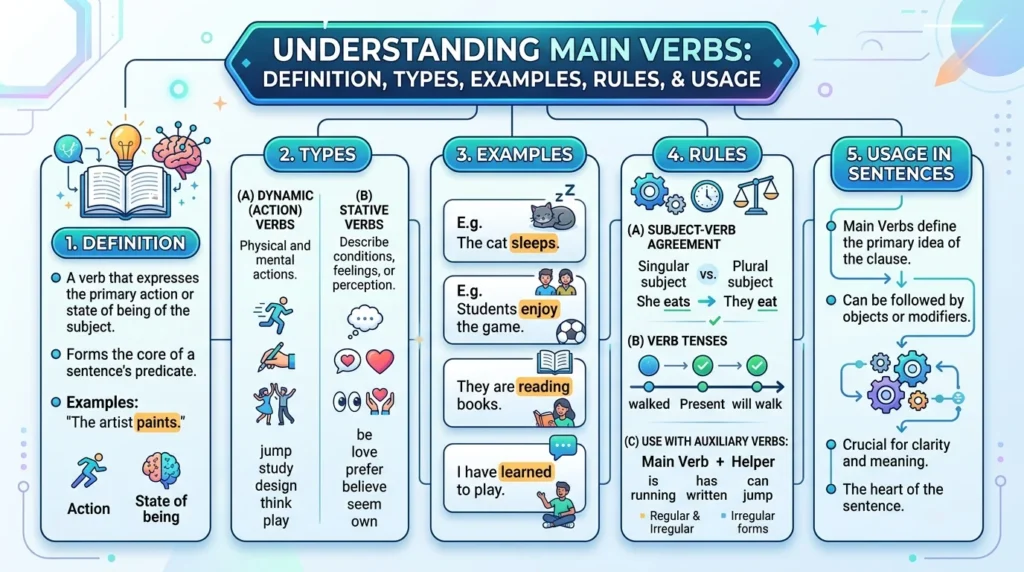
A main verb is the verb that carries the primary meaning of a sentence or verb phrase. It usually tells us what the subject does, feels, thinks, has, or is.
Examples
Sarah writes every day.
Writes is the main verb because it shows Sarah’s action.
He is working today.
Working is the main verb, while is is the helping verb.
They have finished the project.
Finished is the main verb, while have is the helping verb.
She can swim very well.
Swim is the main verb, while can is the modal helping verb.
Simple Definition
You can remember it this way:
Main verb = the verb that carries the main meaning.
A sentence can have a main verb without a helping verb:
The children played outside.
It can also have one or more helping verbs:
The children have been playing outside.
Here, playing is the main verb.
The Origin of Main Verb
The term main verb is made from two simple words: main and verb.
The word main comes from Old French and ultimately has roots connected with the idea of something being chief, primary, or principal.
The word verb comes from the Latin verbum, meaning “word.” In grammar, it refers to a word that expresses an action, state, event, or condition.
The term main verb therefore refers to the primary verb in a sentence or verb phrase.
Main Verb vs Helping Verb
English grammar often uses helping verbs to add information to a main verb.
Compare:
She works here.
There is only one verb, so works is the main verb.
Now compare:
She is working here.
- is = helping verb
- working = main verb
The helping verb supports the main verb, but the main verb carries the central meaning.
British English vs American English Spelling
There is no spelling difference between Main Verb in British and American English.
Both use:
main verb
The word verb and the phrase main verb are spelled the same in both varieties.
However, individual verbs can have different spellings in British and American English.
| Verb | American English | British English |
|---|---|---|
| Organize | organize | organise |
| Realize | realize | realise |
| Analyze | analyze | analyse |
| Travel, past tense | traveled | travelled |
| Cancel, past tense | canceled | cancelled |
| Practice, noun | practice | practice |
| Practise, verb | practice | practise |
-ize and -ise
American English commonly uses -ize:
organize
realize
recognize
British English often uses -ise:
organise
realise
recognise
However, -ize is also accepted in some British English styles.
Double Consonants
British English often doubles the final consonant when adding certain endings.
American English:
traveled
British English:
travelled
American English:
canceled
British English:
cancelled
These differences do not change the meaning of the main verb.
Which Spelling Should You Use?
The phrase main verb itself does not change between US and UK English.
The best approach is to choose the English style that matches your audience.
For US Audiences
Use standard American English spelling.
For example:
The engineer analyzed the results.
For UK Audiences
Use British English spelling where appropriate.
The engineer analysed the results.
For Commonwealth Countries
Many Commonwealth countries use British-style spelling, although local preferences can vary.
For Global Audiences
Choose one spelling system and stay consistent.
If your website targets US readers, American English is usually the best choice. If it targets UK readers, use British English.
Common Mistakes With Main Verb
Understanding the main verb is simple, but learners often make several mistakes.
Mistake 1: Calling Every Verb the Main Verb
❌ In “She is working,” both is and working are main verbs.
✅ Working is the main verb, while is is the helping verb.
Mistake 2: Thinking the First Verb Is Always the Main Verb
The first verb in a verb phrase is not necessarily the main verb.
They have been studying English.
- have = helping verb
- been = helping verb
- studying = main verb
Mistake 3: Forgetting That a Main Verb Can Stand Alone
A main verb does not always need a helping verb.
He runs every morning.
Runs is the main verb.
Mistake 4: Confusing a Helping Verb With a Main Verb
Some words can work as either.
She has finished her work.
Here, has is a helping verb.
She has a new computer.
Here, has is the main verb.
Mistake 5: Incorrect Subject-Verb Agreement
❌ He work every day.
✅ He works every day.
The main verb must agree with the subject in standard English.
Mistake 6: Using the Wrong Verb Form
❌ She is go to school.
✅ She is going to school.
After is in a continuous structure, use the -ing form.
Main Verb in Everyday Examples
Main verbs are found in almost every type of English communication.
In Emails
I attached the report.
We need more information.
The team completed the project.
The bold words carry the main meaning of each sentence.
In News Articles
The company launched a new product.
Officials investigated the incident.
The government announced new measures.
Main verbs help news writers describe events clearly.
On Social Media
I love this photo!
We finished the project!
She looks amazing.
Simple main verbs are very common in social media posts.
In Formal Writing
The study examines workplace safety.
The results indicate a significant change.
The system reduces energy consumption.
Precise main verbs make professional writing stronger and easier to understand.
In Everyday Conversation
I need help.
They live nearby.
We want pizza.
Each sentence has a clear main verb.
Types of Main Verbs
Main verbs can be grouped into several useful categories.
Action Main Verbs
Action verbs show something the subject does.
Examples:
- run
- write
- build
- read
- repair
- drive
Example:
The technician repaired the motor.
Repaired is the main verb.
Linking Main Verbs
Linking verbs connect the subject to information about it.
Common examples include:
- be
- seem
- become
- appear
- feel
- look
Example:
The machine is ready.
Here, is is the main verb because it connects machine with ready.
Transitive Main Verbs
A transitive main verb takes a direct object.
She opened the door.
Opened is the main verb, and door is its object.
Intransitive Main Verbs
An intransitive main verb does not take a direct object.
The baby slept.
The sentence is complete without an object.
Regular Main Verbs
Regular verbs usually form their past tense with -ed.
Examples:
- work → worked
- clean → cleaned
- repair → repaired
Irregular Main Verbs
Irregular verbs form their past tense in different ways.
Examples:
- go → went
- eat → ate
- write → wrote
- take → took
- see → saw
These forms must often be learned individually.
Main Verb and Helping Verb Comparison
Understanding the difference between main verb and helping verb is one of the easiest ways to improve your grammar.
| Feature | Main Verb | Helping Verb |
|---|---|---|
| Main function | Carries the main meaning | Supports the main verb |
| Describes action/state | Usually yes | Supports the meaning |
| Example | working | is |
| Sentence | She is working. | She is working. |
| Can appear alone | Usually yes | Sometimes |
| Examples | run, write, eat | is, have, can, will |
Example 1
John is studying.
- is = helping verb
- studying = main verb
Example 2
John studies every day.
There is only one verb:
- studies = main verb
Example 3
John has completed his homework.
- has = helping verb
- completed = main verb
Main Verb Variations Comparison Table
| Sentence | Helping Verb | Main Verb |
|---|---|---|
| She works here. | None | works |
| She is working. | is | working |
| They have finished. | have | finished |
| He can swim. | can | swim |
| We will travel. | will | travel |
| She was reading. | was | reading |
| They had arrived. | had | arrived |
| I do understand. | do | understand |
Main Verb – Google Trends and Usage Data
The keyword Main Verb is mainly searched by people learning English grammar.
Common related searches include:
- main verb definition
- what is a main verb
- main verb examples
- main verb and helping verb
- main verb definition and examples
- main verb in a sentence
- types of main verbs
- main verb vs auxiliary verb
Who Searches for Main Verb?
The topic is useful for:
- School students
- English learners
- ESL students
- Teachers
- Grammar students
- Exam candidates
- Writers
- Parents helping children with homework
Why Is Main Verb Important?
Students often learn helping verbs and main verbs together.
Understanding the difference makes it easier to study:
- Verb tenses
- Continuous forms
- Perfect forms
- Passive voice
- Modal verbs
- Sentence structure
Search interest can vary by country and time of year, especially around school and examination periods. Exact Google Trends results should be checked for a specific location and date range when current data is needed.
FAQs About Main Verb
1. What is a main verb?
A main verb is the verb that carries the main meaning of a sentence or verb phrase.
Example:
She runs every morning.
2. What is an example of a main verb?
Examples include run, eat, write, work, study, repair, think, and sleep.
3. What is the difference between a main verb and a helping verb?
A main verb carries the primary meaning, while a helping verb supports it.
She is working.
Is is the helping verb, and working is the main verb.
4. Can a sentence have more than one main verb?
Yes. A sentence can have multiple clauses, and each clause can have its own main verb.
John cooked dinner and Mary washed the dishes.
Here, cooked and washed are main verbs.
5. Can “is” be a main verb?
Yes.
The room is quiet.
Here, is is the main verb.
But:
The room is changing.
Here, is is a helping verb, and changing is the main verb.
6. Can a main verb appear without a helping verb?
Yes.
She writes every day.
Writes is the main verb and does not need a helping verb.
7. Is the main verb always an action verb?
No. A main verb can express an action, state, feeling, thought, possession, or condition.
I know the answer.
Here, know is a main verb, but it does not describe a physical action.
8. How do I find the main verb?
First, find the verb or verb phrase. Then identify the word that carries the main action or state.
Example:
They have been working all day.
Working is the main verb.
9. What are common main verbs?
Common main verbs include:
be, have, do, go, come, make, take, work, study, write, read, eat, sleep, run, and think.
Their grammatical role depends on how they are used.
Conclusion
A main verb is the most important verb in a sentence or verb phrase because it carries the primary meaning. It can describe an action, state, thought, feeling, possession, or event. Examples include run, write, work, know, sleep, and repair.
The easiest way to identify a main verb is to look at the complete verb phrase. In “She is working,” is is the helping verb and working is the main verb. In “She works,” works is the main verb because there is no helping verb.
Main verbs can be action, linking, transitive, intransitive, regular, or irregular verbs. Some verbs, such as be, have, and do, can act as either main verbs or helping verbs depending on the sentence.
There is no British-American spelling difference in the term main verb. However, individual verbs may have different regional spellings. Learning how main verbs work will help you understand tenses, sentence structure, helping verbs, and English grammar more easily.