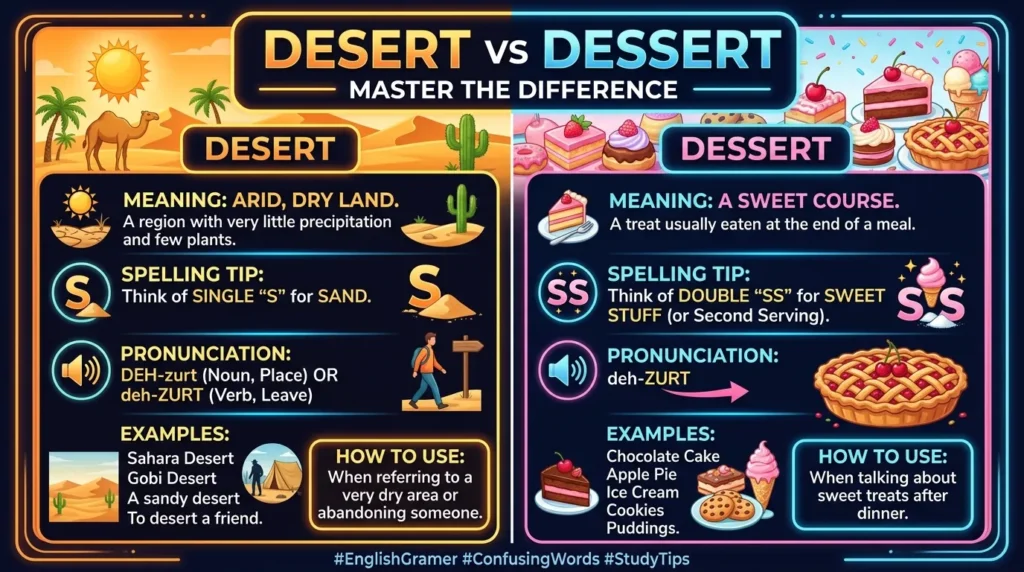

Desert vs dessert is one of the most common English spelling questions. The two words look very similar, but they have completely different meanings. The difference is just one letter, yet using the wrong word can change the meaning of a sentence completely.
A desert is a dry area of land that receives very little rain. The Sahara is a famous example of a desert. The word can also be used as a verb, although this use is less common. For example, “The soldiers deserted their post” means they left it without permission.
A dessert is the sweet food served after a meal. Cakes, ice cream, pudding, and fruit pies are common desserts.
People often search for desert vs dessert because the words are pronounced differently in many situations but have very similar spellings. English learners, students, writers, and professionals may confuse them when writing.
This guide explains the difference between desert and dessert with simple rules, examples, common mistakes, history, and easy memory tricks.
Desert vs Dessert – Quick Answer
The basic difference is:
- Desert = a dry area of land.
- Dessert = sweet food eaten after a meal.
Desert Examples
The Sahara is a huge desert.
Many animals live in the desert.
We traveled across the desert.
Here, desert refers to a dry geographical area.
Dessert Examples
We had chocolate cake for dessert.
What would you like for dessert?
Ice cream is my favorite dessert.
Here, dessert refers to sweet food served after a meal.
Easy Memory Trick
Remember:
Desert = one S → dry land
Dessert = two S’s → sweet food
A popular memory trick is:
Dessert has two S’s because you always want seconds.
This can help you remember that dessert has the extra s.
The Origin of Desert vs Dessert
The words desert and dessert come from different historical sources, even though they look similar.
Origin of Desert
The noun desert, meaning a dry and barren area, comes through Old French from Latin desertum, meaning an abandoned or deserted place.
The idea was that such land was empty or uninhabited.
Over time, desert became associated with dry, barren regions.
For example:
The explorers crossed the desert.
Desert as a Verb
Desert can also be a verb meaning to leave or abandon.
The soldier deserted his post.
The village was deserted after the disaster.
This meaning is related to the older idea of leaving something behind.
Origin of Dessert
Dessert comes from French desservir, which referred to clearing the table after a meal. Over time, the word became associated with the food served after the main meal.
English adopted dessert as the word for a sweet course served at the end of a meal.
For example:
We ordered dessert after dinner.
Why Are They Confused?
The words have very similar spellings:
desert
dessert
The main visual difference is the second s.
Their meanings, however, are completely different.
| Word | Meaning | Memory |
|---|---|---|
| Desert | Dry land | One S |
| Dessert | Sweet food | Two S’s |
British English vs American English Spelling
There is no major spelling difference between British and American English for desert and dessert.
Both varieties use:
- desert for dry land
- dessert for sweet food
The meanings are also the same.
Comparison Table
| Meaning | British English | American English | Example |
|---|---|---|---|
| Dry area of land | desert | desert | The desert is very dry. |
| Abandon | desert | desert | He deserted his post. |
| Sweet food after a meal | dessert | dessert | We ordered dessert. |
| Sweet course | dessert | dessert | Dessert was delicious. |
British English Examples
The Sahara is a vast desert.
We had ice cream for dessert.
American English Examples
The Sahara is a vast desert.
We had ice cream for dessert.
The spelling remains the same in both forms of English.
Which Spelling Should You Use?
Your choice depends on what you mean, not on whether you are writing American or British English.
Use Desert for Dry Land
Use desert when referring to a dry geographical region.
The camel can survive in the desert.
They crossed the desert by car.
The desert receives very little rainfall.
Use Dessert for Sweet Food
Use dessert when referring to sweet food served after a meal.
We ordered chocolate cake for dessert.
She made a delicious dessert.
Would you like some dessert?
Use Desert as a Verb Carefully
Desert can also mean to abandon someone or something.
The soldiers deserted their posts.
The town was deserted.
This use is completely different from the noun desert.
For US Readers
American English uses the same spellings:
desert = dry land
dessert = sweet food
For UK and Commonwealth Readers
British and Commonwealth English use the same distinction.
For Global English
Remember:
One S = desert
Two S’s = dessert
Common Mistakes with Desert vs Dessert
Mistake 1: “Ice Cream Is My Favorite Desert”
Incorrect:
Ice cream is my favorite desert.
Correct:
Ice cream is my favorite dessert.
Ice cream is sweet food, so use dessert.
Mistake 2: “The Sahara Is a Dessert”
Incorrect:
The Sahara is a huge dessert.
Correct:
The Sahara is a huge desert.
The Sahara is a dry region, so use desert.
Mistake 3: “We Had Desert After Dinner”
Incorrect:
We had desert after dinner.
Correct:
We had dessert after dinner.
The word for sweet food is dessert.
Mistake 4: “Desert Climate”
Correct:
The region has a desert climate.
The sentence refers to a climate associated with dry land.
Mistake 5: “Chocolate Desert”
If you mean a sweet chocolate dish, write:
Chocolate dessert
Not:
Chocolate desert
Desert vs Dessert in Everyday Examples
In Emails
Desert:
The research team will travel through the desert next week.
Dessert:
The restaurant will provide dessert after dinner.
In News
Desert:
Heavy rainfall affected parts of the desert region.
Dessert:
The restaurant introduced several new dessert options.
On Social Media
Desert:
Beautiful sunset in the desert! 🌅
Dessert:
This chocolate dessert is amazing! 🍰
In Formal Writing
Desert:
Desert regions often experience very low annual rainfall.
Dessert:
The menu includes several traditional dessert options.
In Everyday Conversation
Have you ever visited a desert?
What are you having for dessert?
The desert can become extremely cold at night.
Chocolate cake is my favorite dessert.
Desert vs Dessert – Comparison Table
| Word | Part of Speech | Meaning | Example |
|---|---|---|---|
| Desert | Noun | Dry, barren land | The camel crossed the desert. |
| Desert | Verb | To abandon | He deserted his post. |
| Deserted | Adjective | Empty or abandoned | The road was deserted. |
| Desert | Adjective | Related to a desert | The area has a desert climate. |
| Dessert | Noun | Sweet food after a meal | We ordered dessert. |
| Desserts | Noun | More than one dessert | The restaurant offers many desserts. |
Desert vs Dessert: Pronunciation Difference
Unlike some English homophones, desert and dessert are usually pronounced differently when they have their common meanings.
Desert as Dry Land
The noun desert is commonly pronounced with stress on the first syllable:
DEZ-ert
The desert is hot.
Dessert
Dessert is pronounced with stress on the second syllable:
dih-ZERT
The dessert was delicious.
Desert as a Verb
The verb desert is also pronounced with stress on the second syllable:
dih-ZERT
He decided to desert the army.
This creates an important distinction:
- DEZ-ert = dry land
- dih-ZERT = sweet food
- dih-ZERT = abandon
How to Remember Desert vs Dessert
The easiest trick is:
Desert = One S
Think of a dry desert as a place where there is less of something, such as water.
desert = dry land
Dessert = Two S’s
Remember:
Dessert has two S’s because you want seconds.
You may want another serving of cake, ice cream, or pudding.
Another Simple Test
Ask yourself:
Am I talking about land?
Use desert.
Am I talking about food?
Use dessert.
For example:
We traveled across the desert.
Land → desert
We ate cake for dessert.
Food → dessert
Desert vs Dessert – Google Trends & Usage Data
Search interest for desert vs dessert is mainly related to spelling, vocabulary, English learning, grammar, and writing.
The topic is popular because the two words are visually similar, while their meanings and common pronunciations differ. Students and English learners often search for the difference when writing school assignments, articles, emails, menus, or social media posts.
Desert is commonly discussed in geography, travel, climate, science, and environmental topics. Dessert is common in food, cooking, restaurants, recipes, menus, and lifestyle content.
Search interest can vary by country and time period. English-speaking countries and regions where English is widely taught may have significant interest in this vocabulary question.
Google Trends results change over time and by location, so exact search-volume figures should be checked directly before publishing numerical claims. The consistent search intent is simple: users want to know whether desert or dessert is correct.
FAQs About Desert vs Dessert
1. What is the difference between desert and dessert?
Desert means a dry area of land. Dessert means sweet food served after a meal.
The Sahara is a desert.
We had cake for dessert.
2. Is the Sahara a desert or dessert?
The correct word is desert.
The Sahara is a large desert.
3. Is cake a desert or dessert?
Cake served as a sweet course is a dessert.
Chocolate cake is my favorite dessert.
4. Why does dessert have two S’s?
A useful memory trick is that you often want seconds of dessert. The word therefore has two s letters.
5. Is desert pronounced differently from dessert?
Yes, in their common meanings.
Desert meaning dry land is usually pronounced DEZ-ert.
Dessert is pronounced dih-ZERT.
6. Can desert be used as a verb?
Yes. Desert can mean to abandon someone or something.
The soldiers deserted their posts.
7. What is the easiest way to remember desert vs dessert?
Remember:
Desert = dry land = one S
Dessert = sweet food = two S’s
You can also remember: dessert has two S’s because you want seconds.
Conclusion
The difference between desert vs dessert becomes easy when you connect each spelling with its meaning. Desert usually means a dry area of land with very little rainfall. Dessert means sweet food served after a meal.
For example, “The travelers crossed the desert” describes a dry geographical region. In contrast, “We ordered ice cream for dessert” describes food. The extra s in dessert is the key spelling difference.
A simple memory trick is to remember that dessert has two S’s because you want seconds. If you are talking about land, use desert with one S. If you are talking about cake, ice cream, pudding, or another sweet dish, use dessert with two S’s.
British and American English use the same spellings and basic meanings, so there is no regional spelling issue. Desert can also be used as a verb meaning to abandon, which has a different pronunciation from the noun referring to dry land.
When you are unsure, ask one simple question: Am I talking about a dry place or sweet food? Dry place means desert; sweet food means dessert. This quick test will help you avoid the most common spelling mistakes.