
Connect a large three-phase motor directly to the supply and flip the switch, and two things happen: the lights dim across the building, and the motor experiences a mechanical hammer blow as it jerks from standstill to full speed. That violent start is why motor starters exist — and why choosing the wrong type leads to tripped breakers, burnt windings and damaged couplings.
A motor starter does three jobs: it switches the motor on and off safely, it limits the enormous starting current, and it protects the motor against overloads. There are four mainstream types — DOL, star-delta, soft starter and VFD — and each suits different motor sizes, budgets and applications. This guide compares them all so you can select with confidence.
Why Do Motors Need a Starter?
At the instant of starting, an induction motor’s rotor is stationary, so the slip is 100% and the motor looks almost like a short circuit to the supply. The starting (inrush) current is typically 6 to 8 times the full-load current — a 20 A motor can briefly draw 140 A.
This inrush causes three problems: severe voltage dips that disturb other equipment, thermal stress on the windings, and mechanical shock on shafts, belts and couplings. Small motors (usually below 5 HP / 3.7 kW) can tolerate direct starting, but anything larger needs its starting current managed. That is the entire reason the different types of motor starters were developed — each one is a different strategy for taming that first violent second.
DOL Starter (Direct-On-Line)
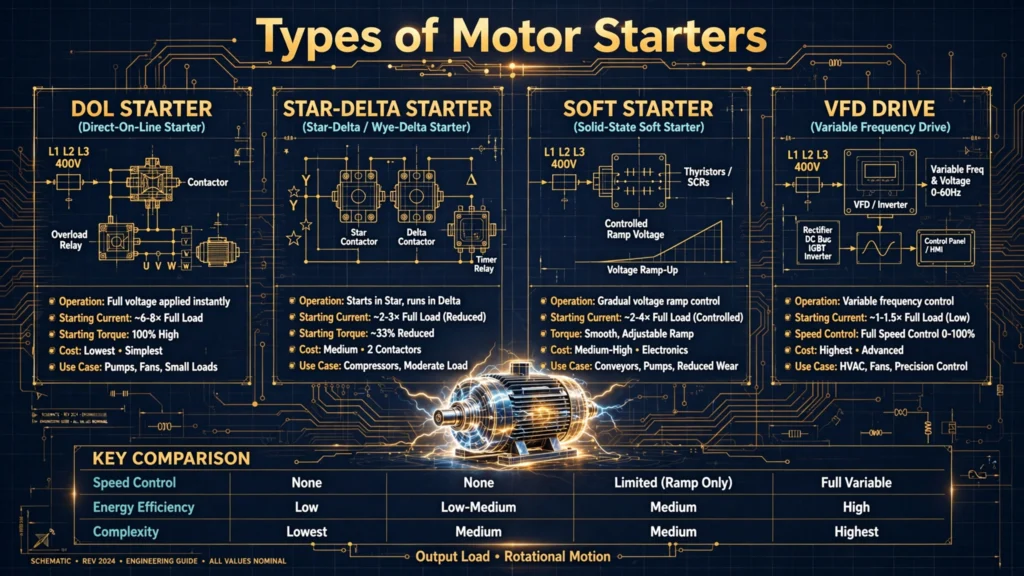
The DOL starter is the simplest type: it connects the motor directly to full line voltage through a contactor, with overload relays for protection. There is no current limiting at all — the motor draws whatever inrush it wants.
Advantages: cheapest option, simplest wiring, smallest panel footprint, full starting torque available, minimal maintenance.
Disadvantages: 6–8× inrush current, maximum mechanical shock, large voltage dips on weak supplies.
Best for: small motors up to about 5 HP, pumps, fans and compressors on stiff supplies where the network can absorb the inrush. If your motor is small and the supply is strong, DOL is all you will ever need.
Star-Delta Starter
The star-delta starter exploits a clever trick of three-phase windings. It first connects the motor windings in star, which applies only 58% (1/√3) of line voltage to each winding. After the motor accelerates — typically a few seconds — a timer switches the contactors to delta, applying full voltage for normal running.
Because starting current scales with voltage, star starting cuts the inrush to roughly one-third of DOL current (about 2–2.5× full-load current). The catch: starting torque also drops to one-third, so the motor must start light or unloaded. Our detailed article on the star-delta connection explains the winding arrangement behind this trick.
Advantages: big inrush reduction at low cost, no electronics to fail, well understood by every electrician.
Disadvantages: only one-third starting torque, a brief current transient during the star-to-delta changeover, needs six motor terminals, cannot start under heavy load.
Best for: medium motors (roughly 5–25 HP) driving fans, centrifugal pumps and other light-starting loads on cost-sensitive projects.
Soft Starter
A soft starter replaces the contactor’s bang with electronics: back-to-back thyristors (SCRs) in each phase gradually ramp the voltage up over an adjustable time (typically 5–30 seconds). Current rises smoothly instead of slamming in, and many units include a bypass contactor that shorts out the thyristors once the motor is up to speed, eliminating heat losses during running.
Advantages: smooth, stepless acceleration; adjustable ramp time and current limit; built-in soft stop (great for pumps — eliminates water hammer); compact; less mechanical stress than star-delta.
Disadvantages: reduced starting torque during the ramp, thyristors generate heat (bypass contactor needed for continuous duty), higher cost than star-delta, no speed control — once started, the motor runs at full speed.
Best for: conveyors, crushers, large pumps and fans where smooth starting matters but variable speed does not. (We have a full dedicated guide on soft starters if you want the deep dive.)
VFD (Variable Frequency Drive)
A variable frequency drive is the most capable — and most expensive — option. It rectifies the AC supply to DC, then inverts it back to AC at a controlled frequency and voltage, so the motor accelerates along an ideal ramp with barely more than full-load current. As a bonus, it provides continuous speed control, which can slash energy consumption on variable-torque loads like fans and pumps.
Advantages: lowest starting current (often just 1–1.5× FLC), full control of acceleration, energy savings through speed control, rich protection and communication features.
Disadvantages: highest cost, generates electrical harmonics (may need filters), can stress motor insulation on long cable runs, more complex to commission.
Best for: applications needing speed control, large motors started frequently, and energy-saving retrofits on pumps, fans and compressors.
Comparison Table: All Four Starter Types Side by Side
| Feature | DOL Starter | Star-Delta | Soft Starter | VFD |
|---|---|---|---|---|
| Starting current | 6–8 × FLC | ~2–2.5 × FLC | 2–4 × FLC (adjustable) | 1–1.5 × FLC |
| Starting torque | 100% | ~33% | Reduced (adjustable) | 100%+ controllable |
| Speed control | No | No | No | Yes |
| Cost | Lowest | Low | Medium | Highest |
| Complexity | Very simple | Moderate (3 contactors + timer) | Electronic, easy setup | Electronic, needs commissioning |
| Mechanical stress | Highest | Medium | Low | Lowest |
| Typical motor size | Up to ~5 HP | ~5–25 HP | ~10–500 HP | Any size |
How to Choose the Right Motor Starter
Work through these questions in order:
1. How big is the motor? Below ~5 HP on a strong supply, stop here — use DOL. The extra cost of anything else buys you nothing.
2. Can the load start light? Fans and centrifugal pumps can; loaded conveyors and crushers cannot. If the answer is yes and the budget is tight, star-delta is the classic answer for medium three-phase induction motors.
3. Does the process need smooth starting or stopping? Water hammer in pipelines, product spillage on conveyors and belt slap all argue for a soft starter’s controlled ramp and soft stop.
4. Do you need speed control or energy savings? If yes, the VFD pays for itself on variable-torque loads — a pump running at 80% speed uses roughly half the energy.
5. What does the supply tolerate? On a weak rural supply or a generator, even a medium motor’s DOL inrush can collapse the voltage. When in doubt, measure the voltage dip during a test start.
Frequently Asked Questions
Can I run a three-phase motor without any starter?
Technically a tiny motor can be switched directly, but it is bad practice. Without overload protection, a stalled or overloaded motor will burn out, and without inrush management, larger motors disturb the whole installation. Always use at least a DOL starter with overload relay.
What is the difference between DOL and star-delta starter?
A DOL starter applies full voltage instantly, drawing 6–8× full-load current with full starting torque. A star-delta starter begins in star (reduced voltage, ~2× current, one-third torque) and switches to delta for running. Star-delta is gentler and cheaper than electronics but cannot start heavy loads.
Is a VFD the same as a soft starter?
No, though both start motors smoothly. A soft starter only ramps voltage during starting and stopping — the motor then runs at fixed full speed. A VFD controls frequency continuously, so it also provides variable speed, better energy savings and far more features, at a higher price.
Which starter is best for a submersible pump?
For most submersible pumps, a DOL starter (small pumps) or star-delta (larger pumps) is standard. If water hammer is a problem in long pipelines, a soft starter with soft stop is worth the premium. A VFD makes sense when you also want pressure/flow control.
Why does my motor trip the breaker on starting even with a starter?
Common causes: the starter is undersized for the motor, the overload relay is set below full-load current, the star-delta timer changes over too early (motor not up to speed), or the supply voltage sags excessively. Check settings against the motor nameplate before suspecting the starter itself.
Do single-phase motors need starters?
Small single-phase motors usually just need a switch and overload protection, often built into the appliance. Larger single-phase motors (e.g. 3–5 HP compressors) benefit from the same starter logic, though the starter types discussed here are primarily a three-phase topic.
Final Thoughts
There is no single “best” motor starter — only the right one for the job. DOL wins on simplicity and cost for small motors, star-delta is the budget-friendly classic for medium motors starting light, soft starters bring smooth electronic control without the price of a drive, and VFDs do everything including speed control. Size the starter to the motor, respect the inrush your supply can handle, and always include overload protection. Get those three decisions right and your motors will start reliably for decades.