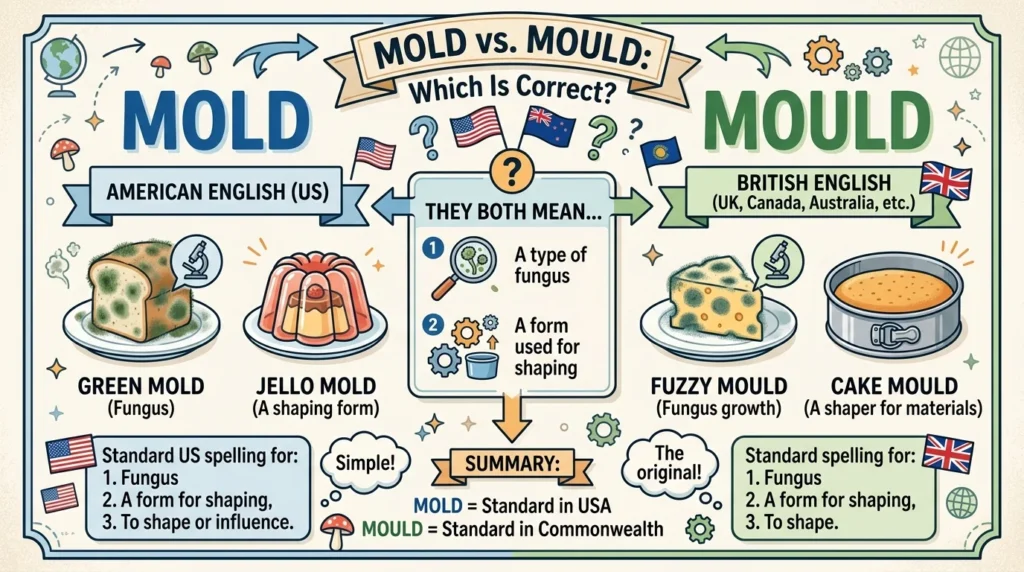

When you see mold and mould, the spelling can look confusing. Are they different words, or are they simply two ways to spell the same word? The answer depends mainly on the type of English you are using.
Both mold and mould are correct English spellings. Mold is the standard spelling in American English, while mould is more common in British English and many other varieties of English. The words have the same basic meanings, whether they refer to fungus, a container or shape used to make something, or the process of shaping a material.
People often search for this spelling because they write for international audiences, switch between US and UK English, or are unsure which form to use in school, business, or online content. Knowing the difference helps you avoid spelling mistakes and keep your writing consistent.
In this guide, we will explain mold vs mould, their origin, British and American usage, common mistakes, everyday examples, usage trends, and which spelling you should choose.
Mold vs Mould – Quick Answer
Mold and mould are both correct spellings of the same word.
- Mold = American English
- Mould = British English
- Mold is also common in some international contexts influenced by American English.
- Mould is widely used in the UK, Australia, New Zealand, and other Commonwealth varieties.
Examples
American English:
There is mold growing on the bathroom wall.
British English:
There is mould growing on the bathroom wall.
The meaning is exactly the same.
Mold and Mould as a Fungus
Both spellings can describe a type of fungus that grows on damp food, walls, wood, and other materials.
- Mold can grow on old bread.
- Mould can grow on old bread.
Mold and Mould as a Shape
The word can also refer to a container or form used to shape a material.
- The factory uses a mold to make plastic parts. — US English
- The factory uses a mould to make plastic parts. — UK English
Mold and Mould as a Verb
The word can also mean to shape or form something.
- The artist molded the clay by hand. — US English
- The artist moulded the clay by hand. — UK English
The Origin of Mold and Mould
The words mold and mould have a long history in English.
The word comes from older Germanic language forms related to ideas of shape, form, or substance. Over time, related forms developed in English and other Germanic languages.
The spelling mould became established in British English, while mold became the preferred spelling in American English.
This is similar to other spelling differences between British and American English, such as:
- colour / color
- favour / favor
- honour / honor
- centre / center
The difference does not mean that one spelling is correct and the other is wrong.
Why Does the Spelling Differ?
American English spelling was influenced by efforts to simplify and standardize English spelling.
American dictionaries and writers increasingly favored shorter spellings in some words.
As a result:
British English: mould
American English: mold
The pronunciation and basic meaning remained essentially the same.
British English vs American English Spelling
The main difference is simple:
| English Variety | Preferred Spelling | Example |
|---|---|---|
| American English | mold | Mold can grow in damp areas. |
| British English | mould | Mould can grow in damp areas. |
| Australian English | mould | Mould can damage walls. |
| New Zealand English | mould | Mould can appear in wet rooms. |
| Canadian English | mold/mould | Both forms can be found. |
| International English | Depends on audience | Choose one style and stay consistent. |
American English
American English normally uses mold.
Examples:
- mold growth
- mold removal
- mold inspection
- plastic mold
- mold spores
American writers also use forms such as:
- molded
- molding
British English
British English normally uses mould.
Examples:
- mould growth
- mould removal
- mould inspection
- plastic mould
- mould spores
British English commonly uses:
- moulded
- moulding
Comparison Table
| Meaning | American English | British English |
|---|---|---|
| Fungus | mold | mould |
| A shaping form | mold | mould |
| To shape | mold | mould |
| Past tense | molded | moulded |
| Present participle | molding | moulding |
| Removal | mold removal | mould removal |
Which Spelling Should You Use?
The best spelling depends on your target audience.
For US Audiences
Use mold.
For example:
The homeowner discovered mold in the basement.
If you are writing an American-focused website, product description, school assignment, or business document, mold is usually the best choice.
For UK Audiences
Use mould.
For example:
The homeowner discovered mould in the basement.
This is the standard spelling in British English.
For Commonwealth Countries
Countries such as Australia and New Zealand generally use mould.
British-style spelling is also common in many other Commonwealth contexts.
For Canadian Audiences
Both forms can appear in Canadian English. Usage can vary by context, industry, and editorial style.
If you are writing for Canada, check the style guide used by your organization.
For Global Audiences
Choose the spelling that matches your main audience.
The most important rule is consistency.
Do not randomly switch between:
mold
and
mould
within the same article unless you are specifically discussing the spelling difference.
Common Mistakes With Mold vs Mould
Understanding the spelling is easy, but several mistakes are common.
Mistake 1: Thinking Mould Is Incorrect
❌ Mould is a spelling mistake.
✅ Mould is the standard British spelling.
Both mold and mould are legitimate English words.
Mistake 2: Thinking Mold Is Always Incorrect
❌ Mold is wrong because British English uses mould.
✅ Mold is the standard American spelling.
American English normally drops the u.
Mistake 3: Mixing Styles
❌ The building has mold, but the company offers mould removal services.
✅ The building has mold, but the company offers mold removal services.
Or, in British English:
✅ The building has mould, but the company offers mould removal services.
Mistake 4: Mixing Derived Forms
American English:
- mold
- molded
- molding
British English:
- mould
- moulded
- moulding
Choose one spelling system and use it consistently.
Mistake 5: Assuming the Meaning Is Different
❌ Mold and mould have completely different meanings.
✅ They generally have the same meanings; the main difference is regional spelling.
Mold vs Mould in Everyday Examples
Both spellings appear in many types of writing.
In Emails
American English:
Please arrange a mold inspection for the building.
British English:
Please arrange a mould inspection for the building.
In News Articles
American English:
Officials warned residents about mold after the flooding.
British English:
Officials warned residents about mould after the flooding.
On Social Media
American English:
I found mold in my old apartment.
British English:
I found mould in my old flat.
In Formal Writing
American English:
Excess moisture can encourage mold growth.
British English:
Excess moisture can encourage mould growth.
In Manufacturing
American English:
The technician replaced the damaged plastic mold.
British English:
The technician replaced the damaged plastic mould.
In Food Writing
American English:
The cheese developed mold after several days.
British English:
The cheese developed mould after several days.
Mold vs Mould – Google Trends and Usage Data
Search interest for mold and mould is strongly influenced by geography and language variety.
American users are more likely to search for mold, while users in the UK and many other countries that follow British English are more likely to search for mould.
The search context also affects demand.
Common Mold Searches
In the United States, people commonly search for terms such as:
- mold removal
- mold inspection
- mold in house
- bathroom mold
- black mold
- mold testing
Common Mould Searches
In British English contexts, common searches include:
- mould removal
- mould on walls
- bathroom mould
- mould prevention
- black mould
- mould treatment
Why Search Volume Differs
Search engines reflect the language habits of their users.
A US homeowner is more likely to type:
mold in bathroom
A UK homeowner may type:
mould in bathroom
The search intent is almost identical, but the spelling follows regional English.
Because search trends change over time, exact popularity should be checked in Google Trends for a specific country and date range rather than treated as a permanent ranking.
Mold vs Mould Comparison Table
| Feature | Mold | Mould |
|---|---|---|
| Main usage | American English | British English |
| Pronunciation | Same | Same |
| Fungus | Yes | Yes |
| Shaping form | Yes | Yes |
| Verb | Yes | Yes |
| Common past form | molded | moulded |
| Common -ing form | molding | moulding |
| US websites | Very common | Less common |
| UK websites | Less common | Very common |
| Australian English | Less common | Common |
| New Zealand English | Less common | Common |
FAQs About Mold vs Mould
1. Is it mold or mould?
Both are correct. Mold is the standard American spelling, while mould is the standard British spelling.
2. Is mould British or American?
Mould is mainly associated with British English and is also common in Australian, New Zealand, and other varieties influenced by British English.
3. Is mold American English?
Yes. Mold is the standard spelling in American English.
4. Do mold and mould mean the same thing?
Yes. They generally have the same meanings. Both can refer to fungus, a form used for shaping materials, or the process of shaping something.
5. Is mould a spelling mistake?
No. Mould is a correct English spelling.
6. Is mold wrong in British English?
It is not necessarily impossible to encounter mold in British contexts, especially in technical, international, or American-influenced material. However, mould is the standard British spelling.
7. Which spelling is better for SEO?
Neither spelling is universally better. Use the version that matches your target audience and search intent.
For US readers, mold is usually appropriate.
For UK readers, mould is usually appropriate.
8. Is it molded or moulded?
Both are correct regional spellings.
- Molded = American English
- Moulded = British English
9. Is molding or moulding correct?
Both are correct.
- Molding = American English
- Moulding = British English
10. Can I use both mold and mould in one article?
You can, but it is usually better to choose one spelling based on your target audience and use it consistently.
Conclusion
Mold and mould are both correct English spellings, but they belong mainly to different regional varieties of English. Mold is the preferred spelling in American English, while mould is standard in British English and widely used in countries such as Australia and New Zealand.
The two words have the same basic meanings. They can describe fungal growth, a form used to shape materials, or the process of shaping something. Their related forms also follow regional spelling patterns, such as molded/moulded and molding/moulding.
If you write for a US audience, choose mold. If your readers use British English, choose mould. For international content, either can work, but consistency is important.
The simplest rule is: use mold for American English and mould for British English. Knowing this difference will help you write more accurately in school, business, technical, and online content.