
Words are the building blocks of every English sentence. But each word has a job. Some words name people or things. Some show actions. Others describe, connect, or add detail. These groups are called parts of speech.
If you have ever wondered why a word is called a noun, verb, adjective, or adverb, you are learning about parts of speech. Many students and English learners search for “parts of speech” because they want a simple way to understand English grammar. Knowing these categories makes it easier to build sentences, find grammar mistakes, and choose the right words.
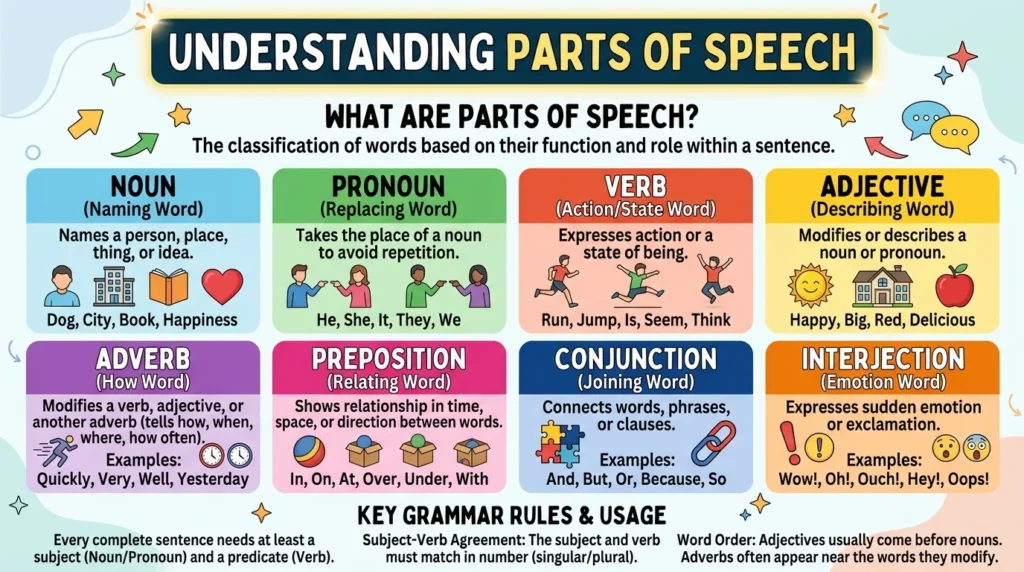
In traditional English grammar, there are eight main parts of speech: nouns, pronouns, verbs, adjectives, adverbs, prepositions, conjunctions, and interjections. Some modern grammar systems use different categories or divide them further, but the traditional eight-part system remains widely taught.
This guide explains the parts of speech in simple English. You will learn what each type means, see clear examples, understand common mistakes, and learn how these word classes work in everyday writing.
Parts of Speech – Quick Answer
Parts of speech are categories that describe the job a word does in a sentence.
The traditional eight parts of speech are:
- Noun – names a person, place, thing, or idea.
- Pronoun – takes the place of a noun.
- Verb – shows an action or state.
- Adjective – describes a noun or pronoun.
- Adverb – describes a verb, adjective, or another adverb.
- Preposition – shows a relationship between words.
- Conjunction – connects words, phrases, or clauses.
- Interjection – expresses a sudden feeling or reaction.
Simple Example
Consider this sentence:
Wow! Sarah quickly opened the old door, and she walked into the room.
Each word has a role:
- Wow = interjection
- Sarah = noun
- quickly = adverb
- opened = verb
- old = adjective
- door = noun
- and = conjunction
- she = pronoun
- into = preposition
- room = noun
The same word can sometimes belong to different parts of speech depending on how it is used.
For example:
I work every day. — verb
My work starts at 8 a.m. — noun
So, parts of speech are based on how a word functions in a sentence, not only on the word itself.
The Origin of Parts of Speech
The idea of dividing words into grammatical categories is very old. Ancient Greek grammarians studied different kinds of words and how they worked in sentences. Later, Roman grammarians developed similar systems using Latin.
The English term part of speech refers to a category or class of words based on their grammatical function.
The word part comes from Latin pars, meaning “part” or “portion.” The word speech comes from Old English spǣċ, meaning speech or language.
Over time, English grammar books adopted systems that classified words into groups such as nouns, verbs, adjectives, and adverbs.
The traditional eight parts of speech became a common way to teach English grammar:
- noun
- pronoun
- verb
- adjective
- adverb
- preposition
- conjunction
- interjection
Modern linguistics can use more detailed systems. For example, determiners are often treated as their own word class rather than being grouped under adjectives. Still, the traditional eight-part model remains useful for basic English grammar.
There is no British or American spelling difference in the phrase parts of speech.
British English vs American English Spelling
Parts of speech is spelled the same way in British and American English.
| Feature | British English | American English |
|---|---|---|
| Singular | part of speech | part of speech |
| Plural | parts of speech | parts of speech |
| Common spelling | parts of speech | parts of speech |
| Example | Learn the parts of speech. | Learn the parts of speech. |
| Spelling difference | None | None |
Part of Speech vs Parts of Speech
The singular and plural forms have different meanings:
A noun is a part of speech.
Nouns, verbs, and adjectives are parts of speech.
Use part of speech when talking about one category.
Use parts of speech when talking about two or more categories or the system as a whole.
Common Spelling Mistakes
These forms are incorrect:
❌ parts off speech
❌ parts of speach
❌ part’s of speech
The correct form is:
✅ parts of speech
Notice that of is not capitalized unless it appears in a title where your chosen title style requires it.
Which Spelling Should You Use?
There is no spelling choice between British and American English.
Use:
parts of speech
for all standard English audiences.
For US English
Use parts of speech in:
- school assignments
- textbooks
- websites
- business writing
- grammar lessons
For UK and Commonwealth English
Use the same spelling:
parts of speech
The phrase is standard in British English and other varieties influenced by British English.
For Global English
Parts of speech is the safest choice for an international audience.
If you are writing an English-learning article, use the phrase consistently and explain each category with simple examples.
The main difference you may encounter is not spelling but grammar terminology. Modern grammar books may classify some words differently from traditional grammar books.
Common Mistakes with Parts of Speech
Understanding parts of speech can prevent many grammar mistakes. Here are some common problems.
Mistake 1: Thinking Every Word Has Only One Job
A word can change its grammatical role depending on the sentence.
Compare:
They clean the room.
Here, clean is a verb.
The room is clean.
Here, clean is an adjective.
The word itself does not always tell you its part of speech.
Mistake 2: Confusing Adjectives and Adverbs
An adjective usually describes a noun or pronoun.
She is a careful driver.
An adverb can describe a verb.
She drives carefully.
A common mistake is:
❌ She drives careful.
Better:
✅ She drives carefully.
Mistake 3: Confusing Nouns and Verbs
Some words can be both nouns and verbs.
I email my manager every day.
Here, email is a verb.
I sent an email to my manager.
Here, email is a noun.
Mistake 4: Calling Every Describing Word an Adjective
Adjectives describe nouns or pronouns.
It is a beautiful house.
But adverbs can modify verbs, adjectives, and other adverbs:
She sings beautifully.
It is very beautiful.
In the second sentence, very is an adverb.
Mistake 5: Confusing Prepositions and Conjunctions
A preposition usually introduces a noun phrase:
We walked after lunch.
A conjunction can introduce a clause:
We walked after we finished lunch.
The word after can perform different grammatical functions depending on what follows it.
Mistake 6: Treating “To” as Always a Preposition
Compare:
She went to school.
Here, to is a preposition.
She wants to study.
Here, to introduces an infinitive rather than functioning as a preposition.
Parts of Speech in Everyday Examples
Parts of speech are not only grammar-book terms. They appear in every sentence you read or write.
In Emails
Consider:
Hi, I carefully reviewed the new report, and I sent it to the manager.
Examples of word functions include:
- Hi = interjection
- carefully = adverb
- reviewed = verb
- new = adjective
- and = conjunction
- sent = verb
- to = preposition
- manager = noun
In News
The company quickly launched a new product after the market changed.
- company = noun
- quickly = adverb
- launched = verb
- new = adjective
- after = conjunction or preposition, depending on its use
- market = noun
- changed = verb
In Social Media
Wow! I really love this new phone.
- Wow = interjection
- really = adverb
- love = verb
- new = adjective
- phone = noun
In Formal Writing
The research team carefully analyzed the available data before publishing the report.
This sentence contains several parts of speech working together:
- research team = noun phrase
- carefully = adverb
- analyzed = verb
- available = adjective
- data = noun
- before = conjunction
- publishing = verb form
- report = noun
Parts of speech help writers understand how these words fit together.
The Eight Parts of Speech Explained
1. Noun
A noun names a person, place, thing, or idea.
Examples:
- teacher
- city
- computer
- happiness
- book
Sentence:
The teacher opened the book.
2. Pronoun
A pronoun replaces or refers to a noun.
Examples:
- I
- you
- he
- she
- it
- we
- they
- this
- that
Sentence:
Maria is a doctor. She works at a hospital.
3. Verb
A verb shows an action, event, or state.
Examples:
- run
- write
- eat
- work
- become
- seem
- is
Sentence:
They work every morning.
4. Adjective
An adjective describes or modifies a noun or pronoun.
Examples:
- big
- small
- blue
- interesting
- careful
Sentence:
She bought a blue car.
5. Adverb
An adverb can modify a verb, adjective, another adverb, or sometimes a whole clause.
Examples:
- quickly
- slowly
- very
- carefully
- yesterday
Sentence:
He ran quickly.
6. Preposition
A preposition shows a relationship involving a noun phrase or pronoun.
Examples:
- in
- on
- at
- under
- between
- from
- with
- to
Sentence:
The keys are on the table.
7. Conjunction
A conjunction connects words, phrases, or clauses.
Examples:
- and
- but
- or
- because
- although
- if
Sentence:
I wanted to go, but I was busy.
8. Interjection
An interjection expresses a feeling or sudden reaction.
Examples:
- wow
- oh
- ouch
- hey
- hooray
- oops
Sentence:
Wow! That was amazing.
Parts of Speech Comparison Table
| Part of Speech | Main Function | Examples | Example Sentence |
|---|---|---|---|
| Noun | Names something | book, city, teacher | The teacher smiled. |
| Pronoun | Replaces a noun | he, she, they | She smiled. |
| Verb | Shows action or state | run, eat, is | They run daily. |
| Adjective | Describes a noun | big, blue, happy | A blue car passed. |
| Adverb | Modifies a word or clause | quickly, very | He ran quickly. |
| Preposition | Shows a relationship | in, on, under | It is under the bed. |
| Conjunction | Connects ideas | and, but, because | I tried, but I failed. |
| Interjection | Shows emotion | wow, ouch, hey | Wow! That is great. |
Parts of Speech Keyword Variations Side by Side
| Keyword Variation | Meaning | Example |
|---|---|---|
| parts of speech | The full grammar category system | Learn the parts of speech. |
| part of speech | One grammatical category | A noun is a part of speech. |
| parts of speech in English | English word categories | Study the parts of speech in English. |
| 8 parts of speech | Traditional eight-category system | English traditionally has 8 parts of speech. |
| eight parts of speech | Written-out form | Learn the eight parts of speech. |
| types of parts of speech | Categories of words | What are the types of parts of speech? |
| parts of speech examples | Examples of each category | Read these parts of speech examples. |
| parts of speech in grammar | Grammar-focused meaning | Parts of speech in grammar help classify words. |
Parts of Speech – Google Trends & Usage Data
The keyword “parts of speech” has strong educational intent. Students, teachers, parents, English learners, and writers often search for it when studying basic grammar.
It is an evergreen keyword because the topic remains useful throughout the year. Search interest may increase during school terms, exam periods, homework seasons, and English-learning courses.
Users may also search for related terms such as:
- parts of speech
- 8 parts of speech
- parts of speech in English
- parts of speech examples
- parts of speech definition
- types of parts of speech
- parts of speech with examples
- English grammar parts of speech
Search behavior can vary by country. Countries with large school-age populations or strong demand for English learning can generate significant interest in basic grammar topics.
Google Trends does not provide one permanent worldwide search-volume number for this keyword. Results change based on the country, time range, search type, and comparison keywords selected. For this reason, SEO writers should avoid giving a fixed global search volume unless the research settings are clearly stated.
From an SEO perspective, parts of speech is a broad informational keyword. It can also support a strong content cluster because each major category can become its own article, such as what is a noun, what is a verb, what is an adjective, and what is a preposition.
FAQs About Parts of Speech
1. What are the parts of speech?
The traditional eight parts of speech are nouns, pronouns, verbs, adjectives, adverbs, prepositions, conjunctions, and interjections.
2. What is the most important part of speech?
There is no single “most important” part of speech. Different word classes perform different jobs.
For example, verbs help form the core of clauses, while nouns often identify people, places, things, or ideas.
3. What are the 8 parts of speech?
The traditional eight are:
- Noun
- Pronoun
- Verb
- Adjective
- Adverb
- Preposition
- Conjunction
- Interjection
4. Can one word have more than one part of speech?
Yes. A word can have different grammatical roles in different sentences.
Example:
I work here. — verb
My work is difficult. — noun
5. Is “the” a part of speech?
In traditional grammar, the is often called an article. In many modern grammar systems, the is classified as a determiner.
It is not normally included in the traditional eight parts of speech.
6. How can I identify the part of speech of a word?
Look at the word’s function in the sentence.
Ask questions such as:
- Does it name something? → noun
- Does it show an action or state? → verb
- Does it describe a noun? → adjective
- Does it modify a verb or adjective? → adverb
- Does it connect ideas? → conjunction
Context is important because some words can perform different jobs.
7. Why are parts of speech important?
Parts of speech help you understand how sentences work. They can make it easier to write correctly, identify grammar mistakes, and understand sentence structure.
Conclusion
Parts of speech are basic categories that explain how words work in English sentences. The traditional system has eight main parts of speech: nouns, pronouns, verbs, adjectives, adverbs, prepositions, conjunctions, and interjections. Each category has a different role, from naming things to showing actions, describing ideas, connecting clauses, and expressing emotions.
Learning these categories is useful for students, English learners, teachers, and writers. It helps you understand sentence structure and makes common grammar problems easier to spot. However, remember that a word does not always have the same part of speech. Its role can change based on the sentence.
There is also no British or American spelling difference. Parts of speech is correct in both varieties of English. Modern grammar may use additional categories, such as determiners, but the traditional eight-part system remains a simple and useful starting point.
The best way to learn is through examples. Read sentences, identify what each word does, and practice creating your own examples. With regular practice, the parts of speech become much easier to recognize and use.