
Breakers tripping when the microwave and toaster run together? Lights dimming when the AC kicks on? Classic signs of too many heavy loads sharing one circuit. Some loads need a circuit all to themselves — and in several cases, the National Electrical Code requires it. Here is which appliances and rooms need dedicated circuits, and which ones simply benefit from one.
What “Dedicated Circuit” Means in NEC Terms
The NEC’s Article 100 defines an individual branch circuit as one supplying only a single piece of utilization equipment — what electricians call a “dedicated circuit.” It runs from its own breaker straight to one appliance or one defined set of outlets, with nothing else connected. The full circuit capacity is reserved for one load, so nothing else can overload it.
Circuits the NEC Requires in Dwellings
NEC 210.11(C) mandates these branch circuits in every dwelling unit:
| Required circuit | NEC section | Rating | Key rule |
|---|---|---|---|
| Small-appliance branch circuits (kitchen, pantry, dining room) | 210.11(C)(1), 210.52(B) | Two or more 20A, 120V | Serve countertop and refrigeration receptacles; no other outlets allowed |
| Laundry branch circuit | 210.11(C)(2), 210.52(F) | At least one 20A, 120V | Supplies only laundry-area receptacles; no other outlets |
| Bathroom branch circuit | 210.11(C)(3), 210.52(D) | At least one 20A, 120V | Supplies bathroom receptacles; no other outlets (an exception lets it serve all outlets of a single bathroom) |
| Garage branch circuit | 210.11(C)(4), 210.52(G) | At least one 20A, 120V | Supplies garage receptacles; no other outlets except readily accessible outdoor receptacles |
Note that “no other outlets” is strict: you cannot extend the laundry circuit to the hallway or feed garage lighting from the garage receptacle circuit. Learn how these circuits are protected in our circuit breaker types guide and MCB home wiring guide.
Major Appliances That Need Individual Circuits
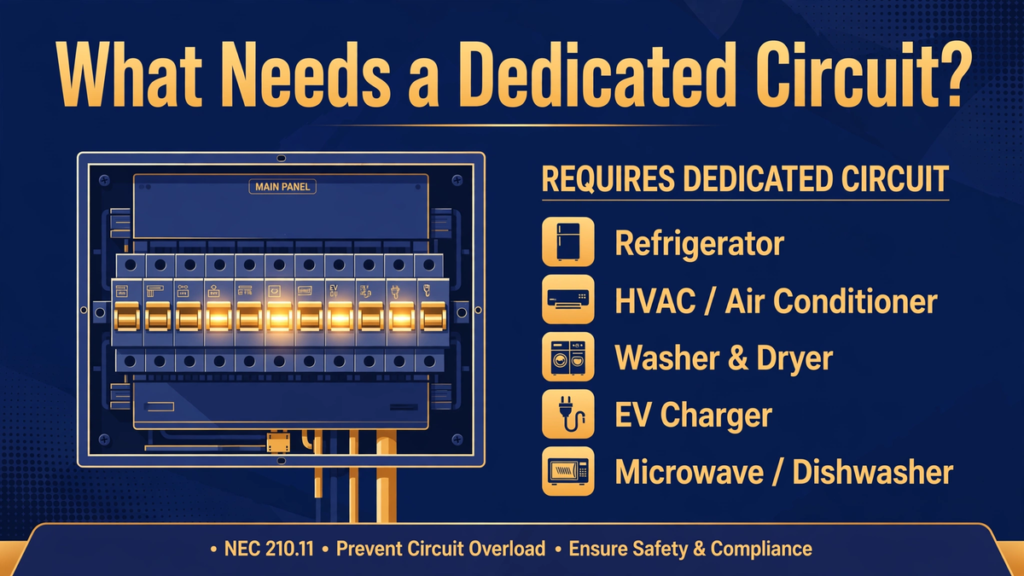
Beyond the room-based circuits above, large fixed appliances need their own circuits — required by the NEC, the appliance listing, or both. Size each from the nameplate per Article 422 (appliances) and Article 440 (air-conditioning equipment):
| Appliance | Typical dedicated circuit | Why |
|---|---|---|
| Electric range / cooktop | 40–50A, 240V | Draws 8,000–12,000W; nameplate-sized per 422 |
| Electric clothes dryer | 30A, 240V | Heating element plus motor load |
| Electric water heater | Typically 30A, 240V | Continuous load (sized at 125% per 422.13) |
| Central AC / heat pump | Per nameplate MCA/MOCP | Article 440; compressor locked-rotor current is high |
| Dishwasher | 15 or 20A, 120V | Heating element cycles; manufacturers usually require a dedicated circuit |
| Garbage disposal | 15 or 20A, 120V | Motor starting current; often paired with dishwasher on a split circuit |
| Built-in microwave | 20A, 120V | Can draw 1,500W+; individual circuit permitted by 210.52(B)(1) Exception 2 |
| Refrigerator | 15A, 120V individual (or on a small-appliance circuit) | 210.52(B)(1) Exception 2 permits an individual 15A-or-greater circuit |
| EV charger (Level 2) | 40–60A, 240V | Continuous load per Article 625; sized at 125% of charger rating |
“Typical” sizes above are common practice — always follow the equipment nameplate and listing, which legally override any table.
Why Dedicated Circuits Matter
Three reasons drive the requirement. Safety: a 1,500-watt space heater plus a 1,500-watt hair dryer on one 20-amp circuit draws 25 amps — repeated overloads heat connections and age the wiring. Reliability: nobody wants the freezer or sump pump going dark because someone ran a vacuum on the same circuit. Code compliance: inspectors check the 210.11(C) circuits on every new home and major remodel, and missing ones fail inspection.
A whole-house load calculation is the professional way to confirm your service and circuits can carry everything at once.
Loads That Benefit From (But Don’t Always Require) a Dedicated Circuit
- Sump pump — not code-required, but a tripped shared breaker during a storm means a flooded basement.
- Freezer (chest or upright) — same reliability logic as a refrigerator.
- Garage door opener — must be on the 20A garage circuit with GFCI protection (210.8); a dedicated circuit avoids nuisance trips from shop tools.
- Home office / server equipment — computers hate the voltage dips caused by shared motor loads.
- Window air conditioners and space heaters — portable 1,500W loads that routinely overload general-purpose circuits.
If you are adding backup power, a home backup generator plan should prioritize exactly these critical dedicated loads.
Does a refrigerator need a dedicated circuit?
Not strictly. NEC 210.52(B)(1) Exception 2 permits the refrigerator receptacle on an individual 15-amp-or-greater circuit, but it may also share one of the two required 20-amp small-appliance branch circuits. Best practice in new work is a dedicated 15- or 20-amp circuit so a tripped kitchen breaker never kills the fridge.
Does a dishwasher need its own circuit?
In practice, yes. Most dishwasher manufacturers require a dedicated 15- or 20-amp, 120-volt circuit in their installation instructions, which are part of the product listing the NEC enforces (110.3(B)). It is commonly run as a dedicated circuit or as half of a split-wired receptacle shared with the garbage disposal.
Can two bathrooms share one 20-amp circuit?
Yes. One 20-amp branch circuit may supply the required receptacles in multiple bathrooms, but then it can supply only receptacles — no lights or fans (210.11(C)(3)). Alternatively, a single 20-amp circuit may serve all outlets within one bathroom, including lighting, under the exception.
Does a washing machine need a dedicated circuit?
It needs the dedicated 20-amp laundry branch circuit required by 210.11(C)(2). That circuit may also supply other receptacles in the laundry area (for a gas dryer or iron), but nothing outside the laundry area.
Does an EV charger need a dedicated circuit?
Yes. Article 625 treats EV charging as a continuous load on an individual branch circuit, sized at 125% of the charger’s maximum current. A 48-amp charger needs a 60-amp circuit, for example.
Conclusion
The NEC requires dedicated-style circuits for kitchens (two 20A small-appliance circuits), laundry, bathrooms, and garages (one 20A each), while major appliances — ranges, dryers, water heaters, HVAC, dishwashers, and EV chargers — need individual circuits sized from their nameplates. Critical or heavy loads like sump pumps and freezers deserve one for reliability even when the Code does not demand it. Confirm your area’s NEC edition and consult a licensed electrician before adding circuits.