
Imagine turning on a light switch at home—the bulb glows instantly. Or think about a mobile phone charging smoothly from a socket. Behind all these everyday actions lies electricity, one of the most important discoveries in human history. But electricity is not just one simple form. It exists in different types, each with its own behavior and applications.
Understanding types of electricity is very important for electrical students, engineers, and technicians because it forms the foundation of all electrical systems. Whether you are studying circuits, designing machines, or troubleshooting faults, this knowledge is essential.
In this article, you will learn what electricity is, its working behavior, different types, components involved, advantages, disadvantages, applications, and future trends. Everything is explained in simple and practical language.
What is Types of Electricity?
Electricity is the flow of electric charge, usually through a conductor like a wire. It powers homes, industries, and modern technology.
Simple Explanation
Electricity is like water flowing through a pipe. The movement of electric charge creates energy that we use in our daily life.
Practical Example
When you switch on a fan, electric current flows through the circuit, converting electrical energy into mechanical motion.
Working Principle of Electricity
The working principle of electricity is based on the movement of electrons from one point to another.
Step-by-Step Explanation
- Source of Energy
Electricity is generated in power stations using mechanical, solar, or chemical energy. - Electron Flow
Electrons move through conductors due to voltage difference. - Closed Circuit
Current flows only when the circuit is complete. - Energy Conversion
Electrical energy converts into light, heat, or motion.
Easy Analogy
Electricity works like traffic flow:
- Voltage = Pressure pushing cars
- Current = Flow of cars
- Resistance = Traffic jam
Types / Classification of Electricity
Electricity is mainly classified into two major types:
1. Static Electricity
Static electricity is the electric charge that remains at rest on the surface of a material.
Example
When you rub a balloon on your hair, it sticks due to static charge.
Key Features
- No continuous flow
- Accumulates on surfaces
- Sudden discharge possible
2. Current Electricity
Current electricity is the continuous flow of electric charge through a conductor.
Example
Electricity flowing in household wiring.
Key Features
- Continuous movement of electrons
- Used in all electrical devices
- Controlled and stable
3. Direct Current (DC Electricity)
DC flows in one direction only.
Example
Batteries, solar panels.
Characteristics
- Constant polarity
- Stable voltage
- Used in electronics
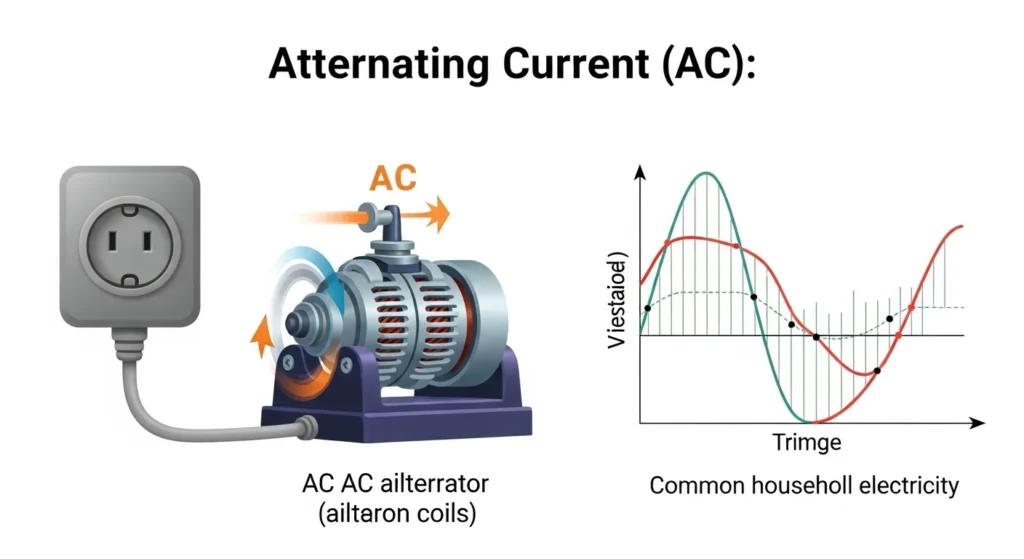
4. Alternating Current (AC Electricity)
AC changes direction periodically.
Example
Household electricity supply.
Characteristics
- Changes direction 50/60 times per second
- Efficient for long-distance transmission
- Used in homes and industries
Main Components of Electricity Systems
Electricity systems consist of several important components:
- Power Source
Generates electricity (generator, battery, solar panel) - Conductors
Carry electric current (copper wires) - Load
Uses electrical energy (fan, bulb, motor) - Switches
Control the flow of current - Protective Devices
Fuses and circuit breakers for safety
Each component plays a vital role in safe and efficient operation.
Advantages of Electricity
- Easy to transmit over long distances
- Clean and efficient energy source
- Powers modern technology
- Can be converted into other forms easily
- Widely available worldwide
- Supports industrial development
Electricity is the backbone of modern life.
Disadvantages / Limitations
- Can be dangerous if mishandled
- Risk of electric shock
- Power losses during transmission
- Requires proper safety systems
- Dependent on generation sources
Proper design and safety reduce these risks significantly.
Applications of Electricity
Home Applications
- Lighting systems
- Fans and air conditioners
- Kitchen appliances
Industrial Applications
- Motors and machines
- Production systems
- Automation equipment
Modern Technology
- Computers and smartphones
- Electric vehicles
- Renewable energy systems
Electricity applications are almost unlimited in today’s world.
Comparison: AC vs DC Electricity
| Feature | AC Electricity | DC Electricity |
|---|---|---|
| Direction | Changes periodically | One direction only |
| Source | Power plants | Batteries, solar cells |
| Transmission | Efficient for long distance | Limited range |
| Usage | Homes and industries | Electronics devices |
| Conversion | Easy to transform voltage | Difficult to transform |
Both types are equally important in electrical systems.
Selection Guide (Understanding Electricity Usage)
When working with electricity systems:
- Choose AC for household power supply
- Use DC for electronics and batteries
- Select proper voltage ratings
- Ensure safety devices are installed
- Understand load requirements
Proper selection improves efficiency and safety.
Common Problems & Solutions
Power Fluctuation
- Cause: Unstable supply
- Solution: Use voltage stabilizer
Short Circuit
- Cause: Faulty wiring
- Solution: Repair insulation and use breakers
Overloading
- Cause: Too many devices
- Solution: Distribute load properly
Electric Shock Risk
- Cause: Poor grounding
- Solution: Install proper earthing system
Regular maintenance ensures safety.
Future Trends in Electricity
Electricity systems are evolving rapidly:
- Smart grids for efficient distribution
- Renewable energy (solar, wind) expansion
- Wireless electricity transmission research
- Electric vehicles growth
- Energy storage improvements
The future of electricity is clean, smart, and highly efficient.
Conclusion
Understanding types of electricity is essential for anyone studying or working in electrical fields. Electricity mainly exists as static and current, while current electricity further divides into AC and DC. Each type has unique properties and applications in homes, industries, and modern technology.
We explored the working principle, classifications, components, advantages, disadvantages, and real-world applications in simple terms. We also compared AC and DC systems and discussed future trends.
Electricity is the foundation of modern civilization. A strong understanding of its types helps engineers design safer and more efficient systems. As technology grows, electricity will continue to play an even more powerful role in shaping the future.