
Imagine watching a large wind turbine spinning continuously to generate electricity or seeing a crane rotate smoothly while lifting heavy loads. Have you ever wondered how electrical power or signals continue flowing to these rotating parts without the wires becoming twisted or breaking? The answer lies in a simple but essential electrical device called a slip ring.
Slip rings are widely used in generators, motors, wind turbines, cranes, radar systems, medical equipment, and many other rotating machines. They provide a continuous electrical connection between stationary and rotating parts, allowing equipment to rotate freely while transmitting power and electrical signals. Without slip rings, many modern electrical and industrial machines would have limited movement and reduced efficiency.
In this guide, you will learn what a slip ring is, understand the slip ring working principle, explore its different types, discover its main components, and see why it is an important part of modern electrical engineering. Whether you are an electrical student, technician, engineer, or beginner, this article will help you build a strong foundation in this essential electrical component.
2. What Is Slip Ring?
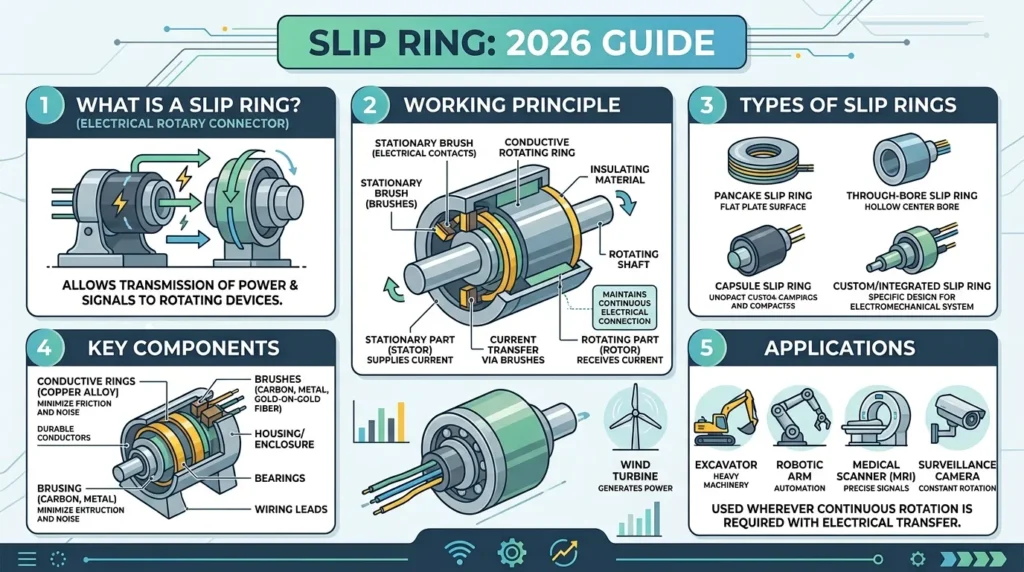
A slip ring is an electromechanical device that transfers electrical power, control signals, or data between a stationary part and a rotating part of a machine without twisting or damaging the wires.
In simple words, a slip ring acts like a rotating electrical connector. It allows equipment to rotate continuously while maintaining an uninterrupted electrical connection.
Slip rings are commonly used in machines that rotate continuously, such as:
- AC generators
- Alternators
- Wind turbines
- Slip ring induction motors
- Cranes
- Radar systems
- Packaging machines
- Medical imaging equipment
Unlike a commutator, a slip ring does not change the direction of current. Its main job is simply to transfer electricity or signals between fixed and rotating parts.
Practical Example
Think of a revolving restaurant. People inside can enjoy a full 360-degree view because the building rotates smoothly. If electrical cables were directly connected without a slip ring, they would twist and eventually break. A slip ring solves this problem by providing continuous electrical contact during rotation.
3. Slip Ring Working Principle
The slip ring working principle is based on maintaining continuous electrical contact between stationary brushes and rotating conductive rings.
Imagine placing your hand on a spinning bicycle wheel. Your hand stays in contact with the wheel while the wheel continues rotating. A slip ring works in a similar way. The stationary carbon or metal brushes remain in contact with the rotating rings, allowing electricity to flow continuously.
Step-by-Step Working Principle
Step 1: Power Supply
Electrical power or signals come from the stationary electrical system.
Step 2: Current Reaches the Brush
The electrical current flows into the stationary carbon brush or metal contact.
Step 3: Brush Touches the Slip Ring
The stationary brush presses gently against the rotating conductive ring using spring pressure.
This constant contact maintains a reliable electrical connection.
Step 4: Current Transfers to the Rotating Ring
The rotating slip ring receives electrical current from the stationary brush.
Step 5: Power Reaches the Rotating Equipment
The current continues through internal wiring connected to the rotating component, such as:
- Motor winding
- Generator rotor
- Crane mechanism
- Wind turbine blade control system
Step 6: Continuous Rotation
As the machine rotates, the brush slides smoothly on the slip ring while continuously transferring electrical power.
This allows unlimited rotation without twisting cables.
Why Slip Rings Are Important
Without a slip ring:
- Wires would twist during rotation.
- Electrical connections would fail.
- Equipment movement would be limited.
- Maintenance costs would increase.
Slip rings eliminate these problems by providing continuous electrical contact during rotation.
4. Types of Slip Rings
Different applications require different slip ring designs. Engineers select the appropriate type based on speed, current capacity, voltage, available space, and environmental conditions.
Capsule Slip Ring
Capsule slip rings are compact and lightweight devices designed for small equipment.
Features
- Small size
- Easy installation
- Low maintenance
- High reliability
Applications
- CCTV cameras
- Robotics
- Medical equipment
- Small automation systems
Through Bore Slip Ring
A through bore slip ring has a hollow center.
The central hole allows shafts, pipes, cables, or hydraulic lines to pass through.
Features
- Hollow shaft design
- Supports large rotating systems
- Flexible installation
Applications
- Packaging machines
- Wind turbines
- Industrial robots
- Rotary tables
Pancake Slip Ring
A pancake slip ring has a flat disc-shaped design instead of a cylindrical shape.
Features
- Low height
- Compact profile
- Suitable for limited vertical space
Applications
- Rotating platforms
- Radar equipment
- Medical scanners
Mercury Slip Ring
Instead of using brushes, mercury slip rings use liquid mercury to transfer electrical current.
Features
- Very low electrical resistance
- Minimal electrical noise
- Smooth operation
Applications
- Laboratory equipment
- Precision instruments
- Specialized industrial systems
Note: Due to mercury’s environmental and health concerns, these slip rings are becoming less common.
Fiber Optic Slip Ring
Fiber optic slip rings transfer optical signals instead of electrical power.
Features
- High-speed data transmission
- No electromagnetic interference
- Excellent signal quality
Applications
- Military equipment
- Communication systems
- Broadcasting
- Medical imaging
High Current Slip Ring
These slip rings are specially designed to carry large electrical currents.
Features
- Heavy-duty construction
- Excellent heat resistance
- High power capacity
Applications
- Steel plants
- Mining equipment
- Large generators
- Heavy industrial machinery
Hybrid Slip Ring
Hybrid slip rings combine electrical circuits with fiber optic channels, pneumatic lines, or hydraulic systems.
Features
- Multiple transmission methods
- Compact design
- High flexibility
Applications
- Offshore platforms
- Advanced automation
- Aerospace systems
- Industrial robotics
5. Main Components of a Slip Ring
A slip ring consists of several carefully designed components that work together to provide continuous electrical contact during rotation.
Conductive Rings
Conductive rings are circular metal rings mounted on the rotating shaft.
Functions
- Carry electrical current
- Rotate with the machine
- Maintain electrical continuity
Copper, brass, or precious metal alloys are commonly used due to their excellent conductivity.
Brushes
Brushes remain stationary while pressing against the rotating rings.
Functions
- Transfer electrical current
- Maintain continuous contact
- Reduce electrical resistance
Brushes may be made from:
- Carbon
- Graphite
- Copper graphite
- Precious metal alloys
The material depends on the operating current and application.
Brush Holder
The brush holder keeps the brushes correctly positioned against the rotating rings.
Functions
- Supports brush alignment
- Prevents vibration
- Ensures smooth brush movement
- Maintains consistent electrical contact
Spring Mechanism
A spring applies constant pressure between the brush and the slip ring.
Functions
- Maintains reliable electrical contact
- Compensates for brush wear
- Reduces sparking
- Improves current transfer
Proper spring pressure is essential for long service life and stable operation.
Insulating Material
Insulating materials separate individual conductive rings from one another.
Functions
- Prevent electrical short circuits
- Improve operational safety
- Maintain circuit isolation
High-strength engineering plastics and epoxy materials are commonly used.
Housing
The outer housing protects the slip ring assembly from dust, moisture, vibration, and accidental damage.
Functions
- Mechanical protection
- Environmental sealing
- Improved durability
- Increased equipment reliability
Industrial slip rings often use aluminum or stainless-steel housings for enhanced strength.
Why These Components Matter
Each component of a slip ring contributes to reliable power and signal transmission. Conductive rings transfer electricity, brushes maintain contact, springs ensure consistent pressure, insulation prevents short circuits, and the housing protects the entire assembly. Together, they allow rotating machines to operate safely and efficiently for long periods with minimal interruption.
6. Advantages of Slip Ring
Slip rings offer a simple and reliable solution for transferring electrical power and signals to rotating equipment. Their ability to maintain continuous electrical contact makes them an important component in many electrical and industrial systems.
Continuous 360° Rotation
The biggest advantage of a slip ring is that it allows equipment to rotate continuously without twisting electrical cables.
Benefits
- Unlimited rotation
- No cable damage
- Smooth machine operation
- Increased equipment reliability
Reliable Power Transmission
Slip rings provide a stable electrical connection between stationary and rotating parts.
Benefits
- Continuous power supply
- Reduced power interruptions
- Improved machine performance
- Better operational safety
Supports Signal Transmission
Modern slip rings can transmit not only electrical power but also control signals, communication signals, and high-speed data.
Benefits
- Supports automation systems
- Reliable communication
- Suitable for smart industrial equipment
Reduces Cable Wear
Without a slip ring, rotating cables would twist and eventually fail.
Using a slip ring eliminates this problem.
Benefits
- Longer cable life
- Lower maintenance costs
- Fewer unexpected breakdowns
Compact and Flexible Design
Slip rings are available in many sizes and designs.
Engineers can choose compact models for small devices or heavy-duty models for industrial machines.
Easy Installation
Most slip rings are designed for quick installation and simple maintenance.
This reduces machine downtime during servicing.
Suitable for Harsh Environments
Industrial slip rings are available with protection against:
- Dust
- Moisture
- Oil
- Vibration
- High temperatures
This makes them suitable for demanding industrial applications.
Long Service Life
High-quality slip rings can operate for millions of revolutions when properly maintained.
This improves equipment reliability and reduces operating costs.
7. Disadvantages of Slip Ring
Although slip rings provide many advantages, they also have certain limitations that engineers should consider.
Brush Wear
The brushes remain in constant contact with the rotating rings.
Over time, this causes normal wear.
Result
- Periodic replacement
- Regular inspection
- Planned maintenance
Requires Maintenance
Unlike wireless power transfer systems, slip rings require routine servicing.
Typical maintenance includes:
- Cleaning
- Brush inspection
- Spring adjustment
- Ring polishing
Electrical Noise
Poor contact between the brush and ring can create electrical noise.
This may affect sensitive electronic equipment.
Friction Loss
Because brushes slide on the rotating rings, a small amount of friction is always present.
This causes:
- Minor energy loss
- Heat generation
- Mechanical wear
Dust Generation
Carbon brushes gradually produce carbon dust during operation.
If cleaning is neglected, dust may reduce performance.
Limited Brush Life
Brushes are wearable components.
Eventually, they must be replaced to maintain reliable electrical contact.
Slip Ring Advantages and Disadvantages
| Advantages | Disadvantages |
|---|---|
| Allows continuous rotation | Brushes wear over time |
| Prevents cable twisting | Requires maintenance |
| Reliable power transfer | Produces friction |
| Supports signal transmission | Generates carbon dust |
| Long service life | Electrical noise may occur |
| Easy installation | Brush replacement required |
8. Slip Ring Applications
Slip rings are used in almost every industry where electrical power or signals must pass through rotating equipment.
Wind Turbines
Modern wind turbines use slip rings to transfer electrical power and control signals between rotating blades and the stationary tower.
They help:
- Control blade pitch
- Monitor sensors
- Improve power generation
Electric Generators
Slip rings are widely used in AC generators and alternators.
They transfer electrical current between the rotating rotor and stationary external circuits.
Slip Ring Induction Motors
Slip rings are an important part of wound rotor induction motors.
They allow external resistance to be connected during motor starting.
This provides:
- Higher starting torque
- Lower starting current
- Smooth acceleration
Cranes
Industrial cranes rotate continuously while lifting heavy loads.
Slip rings supply electrical power to:
- Hoist motors
- Control panels
- Lighting systems
- Safety devices
Robotics
Industrial robots require continuous rotation for accurate movement.
Slip rings help transfer:
- Power
- Control signals
- Sensor data
Medical Equipment
Many medical machines use slip rings to provide uninterrupted electrical connections.
Examples include:
- CT scanners
- MRI support systems
- Rotating X-ray equipment
Radar Systems
Military and airport radar systems rotate continuously.
Slip rings provide reliable electrical connections without twisting cables.
Packaging Machines
Automatic packaging equipment uses slip rings to power rotating filling, labeling, and sealing systems.
Offshore Equipment
Marine and offshore platforms use heavy-duty slip rings for:
- Cranes
- Cable reels
- Winches
- Drilling systems
Aerospace Industry
Aircraft and satellite systems use high-performance slip rings where continuous rotation and reliable signal transmission are essential.
9. Difference Between Slip Ring and Commutator
Many beginners confuse a slip ring with a commutator because both use brushes and rotating electrical contacts. However, they perform different functions.
A slip ring transfers electrical power or signals without changing the direction of current. A commutator, on the other hand, reverses the current direction in the armature winding of a DC machine to maintain continuous torque.
Slip Ring vs Commutator Comparison
| Feature | Slip Ring | Commutator |
|---|---|---|
| Main Function | Transfers electrical power or signals | Reverses current direction |
| Current Type | AC or signal transmission | DC machines |
| Ring Design | Continuous circular rings | Split-ring segments |
| Current Reversal | No | Yes |
| Brush Contact | Continuous | Changes segments during rotation |
| Used In | Alternators, slip ring motors, wind turbines | DC motors and DC generators |
| Construction | Simple | More complex |
| Maintenance | Lower | Slightly higher |
Which One Should You Choose?
- Choose a slip ring when continuous power or signal transfer is required during rotation.
- Choose a commutator when current reversal is necessary, such as in DC motors and DC generators.
10. Slip Ring Selection Guide
Choosing the correct slip ring improves machine performance, reliability, and service life.
Determine the Application
Identify where the slip ring will be used.
Examples:
- Wind turbine
- Generator
- Robot
- Crane
- Medical equipment
Each application has different electrical requirements.
Check Current Rating
Choose a slip ring that can safely carry the required current without overheating.
Consider Voltage Requirements
Ensure the voltage rating matches your electrical system.
Using an underrated slip ring may cause insulation failure.
Count the Number of Circuits
Different machines require different numbers of electrical circuits.
Always select enough channels for:
- Power
- Control signals
- Communication
- Sensors
Evaluate Operating Speed
High-speed rotating equipment requires specially designed slip rings with low friction and excellent balance.
Consider Environmental Conditions
For harsh environments, choose a slip ring with suitable protection against:
- Dust
- Water
- Oil
- Corrosion
- High temperatures
An appropriate IP rating improves durability.
Choose the Right Brush Material
Brush materials include:
- Carbon
- Graphite
- Copper graphite
- Precious metal alloys
The correct choice depends on current, speed, and operating conditions.
Buy from a Trusted Manufacturer
High-quality slip rings provide:
- Longer operating life
- Better electrical performance
- Lower maintenance
- Greater reliability
11. Common Problems & Solutions
Like any electrical component, slip rings can develop faults over time. Most problems occur due to wear, poor maintenance, incorrect installation, or harsh operating conditions. Regular inspection and preventive maintenance can greatly improve the performance and lifespan of a slip ring.
Problem 1: Excessive Sparking
Possible Causes
- Worn brushes
- Low brush pressure
- Dirty slip rings
- Loose electrical connections
- Incorrect brush material
Solution
- Replace worn brushes.
- Clean the slip ring surface.
- Check and adjust spring pressure.
- Tighten all electrical connections.
- Use the recommended brush material.
Problem 2: High Operating Temperature
Possible Causes
- Overloading
- Poor electrical contact
- High friction
- Continuous operation without cooling
Solution
- Reduce the electrical load.
- Improve ventilation.
- Clean the contact surface.
- Replace damaged brushes if necessary.
Problem 3: Uneven Brush Wear
Possible Causes
- Misaligned brush holder
- Uneven spring pressure
- Poor installation
- Damaged slip ring surface
Solution
- Align the brush holder correctly.
- Replace weak springs.
- Inspect the ring surface.
- Install the brush according to the manufacturer’s recommendations.
Problem 4: Electrical Noise or Signal Loss
Possible Causes
- Dirty contact surface
- Loose wiring
- Brush vibration
- Low-quality slip ring
Solution
- Clean the conductive rings.
- Tighten wiring connections.
- Replace damaged brushes.
- Use a high-quality slip ring for sensitive equipment.
Problem 5: Slip Ring Surface Damage
Possible Causes
- Excessive friction
- Poor lubrication
- Wrong brush material
- Dust contamination
Solution
- Polish or replace damaged rings.
- Install the correct brush grade.
- Clean the assembly regularly.
- Follow the recommended maintenance schedule.
Problem 6: Equipment Stops Rotating Properly
Possible Causes
- Mechanical damage
- Internal wiring failure
- Broken brush holder
- Excessive wear
Solution
- Inspect the entire slip ring assembly.
- Replace damaged components.
- Test electrical continuity.
- Repair or replace the slip ring if required.
Maintenance Tips for Longer Service Life
Regular maintenance helps improve reliability and reduce unexpected machine failures.
Follow these simple maintenance practices:
- Inspect brushes regularly.
- Clean conductive rings with a lint-free cloth.
- Remove dust and debris from the housing.
- Check spring pressure.
- Tighten electrical terminals.
- Replace worn brushes before complete failure.
- Inspect insulation for damage.
- Follow the manufacturer’s maintenance schedule.
A well-maintained slip ring can operate reliably for millions of revolutions.
Frequently Asked Questions (FAQs)
What is the main purpose of a slip ring?
The main purpose of a slip ring is to transfer electrical power, signals, or data between stationary and rotating parts without twisting or damaging cables.
What is the difference between a slip ring and a commutator?
A slip ring transfers electrical current continuously without changing its direction. A commutator reverses the current direction in DC machines to maintain continuous torque.
Where are slip rings commonly used?
Slip rings are commonly used in:
- Wind turbines
- AC generators
- Slip ring induction motors
- Cranes
- Robots
- Radar systems
- Medical equipment
- Packaging machines
Can a slip ring transfer data as well as power?
Yes. Modern slip rings can transmit electrical power, control signals, Ethernet, fiber optic signals, video signals, and communication data at the same time.
How long does a slip ring last?
The service life depends on operating conditions, load, speed, and maintenance. High-quality industrial slip rings can last for millions of revolutions with proper care.
What happens if a slip ring fails?
A failed slip ring can cause:
- Loss of electrical power
- Signal interruption
- Machine downtime
- Reduced efficiency
- Equipment malfunction
Regular maintenance helps prevent these problems.
Do all electric motors use slip rings?
No. Only certain machines, such as wound rotor induction motors and alternators, use slip rings. Most squirrel cage induction motors and brushless motors do not require them.
12. Future Trends in Slip Ring Technology
Slip ring technology continues to improve as industries demand higher performance, greater reliability, and lower maintenance. Modern designs focus on increasing efficiency while supporting advanced automation systems.
Smart Slip Rings
Many manufacturers now produce smart slip rings with built-in monitoring systems.
These systems can monitor:
- Temperature
- Brush wear
- Electrical resistance
- Operating hours
- Maintenance intervals
This supports predictive maintenance and reduces unexpected equipment failures.
Fiber Optic Integration
As industries require faster communication, fiber optic slip rings are becoming more popular.
Benefits include:
- High-speed data transmission
- No electromagnetic interference
- Better communication reliability
- Higher bandwidth
These are widely used in defense, telecommunications, and medical imaging systems.
Wireless Power Transfer
Researchers are developing contactless rotary power transfer systems that reduce mechanical wear.
Although conventional slip rings remain the preferred solution for many industrial applications, wireless technology may become more common in specialized equipment.
Improved Materials
Modern conductive materials provide:
- Lower electrical resistance
- Better corrosion resistance
- Longer service life
- Reduced maintenance
Advanced brush materials also reduce friction and improve efficiency.
Compact Designs
Manufacturers continue developing smaller slip rings for:
- Robotics
- Drones
- Medical devices
- Automation equipment
- Compact industrial machines
Miniaturization allows high performance in limited spaces.
Industry 4.0 Compatibility
Future slip rings are increasingly designed to support Industry 4.0 by integrating with smart factories and automated production systems.
Features include:
- Real-time condition monitoring
- Remote diagnostics
- Predictive maintenance
- Improved operational efficiency
These technologies help reduce downtime and improve productivity.
13. Conclusion
Slip rings are essential electromechanical devices that provide continuous electrical power and signal transmission between stationary and rotating parts. They are widely used in generators, slip ring induction motors, wind turbines, cranes, robotics, medical equipment, and many other industrial systems where unrestricted rotation is required.
Understanding the slip ring working principle, types of slip rings, main components, applications, and advantages and disadvantages enables electrical students, technicians, and engineers to select the right slip ring and maintain it properly. Regular inspection, correct installation, and timely maintenance help improve reliability, extend service life, and reduce costly downtime. As technology advances, smart monitoring, fiber optic communication, and improved materials will continue to make slip rings more efficient, durable, and suitable for modern electrical and automation systems.