
Imagine using a power drill to make a hole in a wall or watching an electric train move smoothly along the tracks. Inside these machines, a small but essential component called a carbon brush helps transfer electrical current to moving parts. Although it is small and often hidden from view, the carbon brush plays a vital role in the reliable operation of many electric motors and generators.
Carbon brushes are found in household appliances, industrial machines, automotive systems, power tools, and electrical generators. Without them, many DC motors and universal motors would not be able to operate efficiently. Because carbon brushes wear out over time, understanding how they work is important for every electrical student, engineer, and technician.
In this guide, you will learn what a carbon brush is, its working principle, different types of carbon brushes, their main components, and why they are widely used in electrical equipment. By the end of this article, you will have a clear understanding of this important electrical component and its role in modern electrical systems.
2. What Is Carbon Brush?
A carbon brush is a small electrical component made mainly of carbon and graphite. It transfers electric current between the stationary and rotating parts of an electrical machine.
In simple words, a carbon brush acts like a bridge that allows electricity to flow from a fixed power source to a rotating shaft without interrupting the electrical connection.
Carbon brushes are commonly used in:
- DC motors
- Universal motors
- DC generators
- Alternators
- Slip ring motors
- Automotive electrical systems
- Industrial machinery
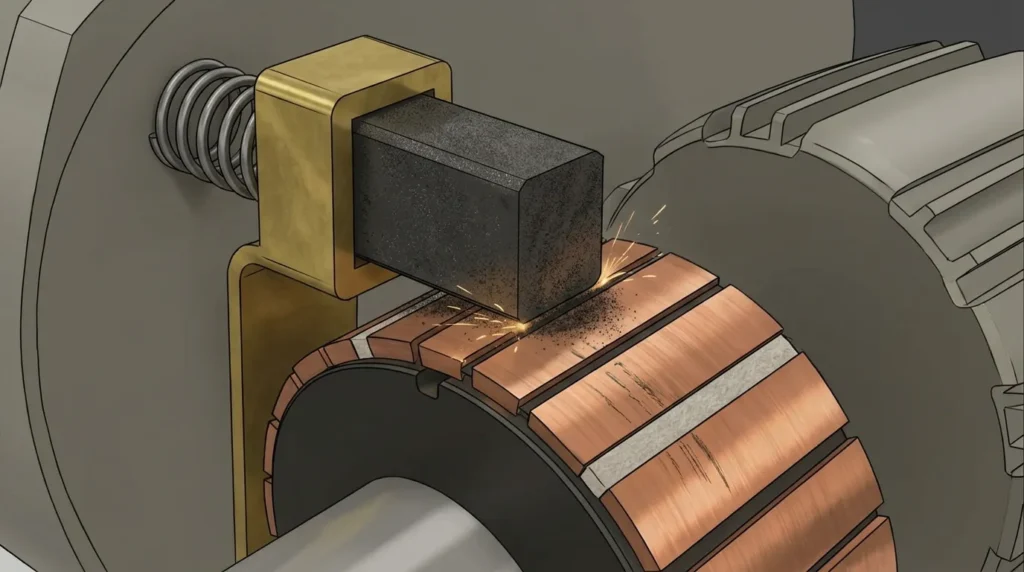
The carbon brush remains in contact with a rotating commutator or slip ring while the machine is operating. Even though the rotating part moves continuously, the brush maintains electrical contact through gentle pressure.
Practical Example
Think about a ceiling fan with a remote-controlled DC motor or an electric drill. As the motor rotates, electricity must still reach the rotating armature. The carbon brush makes this possible by sliding smoothly over the rotating commutator while carrying electrical current.
Without carbon brushes, many rotating electrical machines would lose power during operation.
3. Carbon Brush Working Principle
The carbon brush working principle is based on maintaining continuous electrical contact between stationary and rotating parts.
Imagine writing on paper with a pencil. The pencil touches the paper while moving across it. In a similar way, a carbon brush remains in contact with the rotating commutator or slip ring while allowing electric current to pass continuously.
Step-by-Step Working Principle
Step 1: Power Supply
Electrical power enters the stationary part of the motor through external wiring.
Step 2: Current Reaches the Carbon Brush
The current flows into the carbon brush through a flexible copper lead attached to the brush.
Step 3: Brush Touches the Commutator
A spring pushes the carbon brush gently against the rotating commutator or slip ring.
This constant pressure ensures reliable electrical contact.
Step 4: Current Transfers to the Rotating Armature
The brush transfers electrical current to the rotating commutator.
The commutator then distributes the current to the armature windings.
Step 5: Motor Produces Rotation
The energized armature interacts with the magnetic field, producing torque that rotates the motor shaft.
Step 6: Continuous Sliding Contact
As the motor rotates, the brush slides smoothly on the commutator surface while maintaining electrical contact.
Because carbon has self-lubricating properties, friction and wear remain relatively low.
Why Carbon Is Used Instead of Copper
Many beginners ask why carbon brushes are not made from copper.
The answer is simple.
Carbon:
- Produces less friction
- Reduces sparking
- Protects the commutator from damage
- Handles high temperatures better
- Is self-lubricating
- Wears gradually without damaging expensive machine parts
If copper brushes were used, the commutator would wear out much faster due to excessive friction.
4. Types of Carbon Brushes
Different electrical machines require different brush materials. Manufacturers produce several types of carbon brushes depending on current capacity, speed, voltage, and operating conditions.
Graphite Carbon Brush
Graphite brushes contain a high percentage of graphite, making them soft and highly lubricating.
Features
- Low friction
- Quiet operation
- Long service life
- Excellent lubrication
Applications
- Small motors
- Household appliances
- Fans
- Vacuum cleaners
- Low-load equipment
Electrographite Carbon Brush
Electrographite brushes are produced by heat-treating carbon at very high temperatures.
Features
- High electrical conductivity
- Excellent heat resistance
- Low wear
- Good performance at high speeds
Applications
- Industrial motors
- Large DC machines
- High-speed generators
- Heavy-duty equipment
Metal Graphite Brush
These brushes combine graphite with metals such as copper or silver.
Features
- Very high conductivity
- Low electrical resistance
- High current carrying capacity
Applications
- Automotive starters
- Welding equipment
- Battery-powered machines
- Slip ring motors
Carbon Graphite Brush
Carbon graphite brushes provide a balance between strength and electrical performance.
Features
- Moderate conductivity
- Good wear resistance
- Reliable operation
- Affordable cost
Applications
- Medium-size motors
- Industrial machinery
- Power tools
- Pumps
Silver Graphite Brush
Silver graphite brushes contain silver particles for extremely high electrical conductivity.
Features
- Very low resistance
- High efficiency
- Excellent corrosion resistance
Applications
- Aerospace equipment
- Medical devices
- Precision instruments
- High-performance electrical systems
5. Main Components of a Carbon Brush
Although a carbon brush appears simple, it consists of several important parts that work together to ensure reliable electrical contact.
Carbon Block
The carbon block is the main body of the brush.
Its functions include:
- Conducting electrical current
- Reducing friction
- Protecting the commutator
- Providing smooth sliding contact
The material composition depends on the motor’s operating requirements.
Flexible Copper Shunt (Lead Wire)
A flexible copper wire connects the carbon block to the external electrical circuit.
Functions
- Carries electrical current
- Allows free movement of the brush
- Prevents wire damage during operation
Without this flexible lead, the brush would not move properly inside the brush holder.
Spring
The spring applies constant pressure on the carbon brush.
Its main functions are:
- Maintaining continuous contact
- Preventing electrical interruptions
- Reducing sparking
- Improving current transfer
Correct spring pressure is essential. Too much pressure increases wear, while too little pressure causes poor electrical contact.
Brush Holder
The brush holder keeps the carbon brush correctly aligned with the commutator or slip ring.
Functions
- Holds the brush securely
- Guides brush movement
- Prevents vibration
- Ensures even wear
A properly designed brush holder increases brush life and improves machine reliability.
Terminal Connector
The terminal connector links the brush assembly to the machine’s electrical wiring.
Functions
- Provides a secure electrical connection
- Reduces resistance
- Simplifies maintenance and replacement
Why These Components Matter
Each component plays an important role in ensuring efficient current transfer, reducing wear, and extending the life of both the carbon brush and the electrical machine.
A failure in any one of these parts can lead to excessive sparking, overheating, poor motor performance, or even complete machine failure.
6. Carbon Brush Advantages
Carbon brushes have been used in electrical machines for many decades because they provide a reliable and cost-effective way to transfer electrical current. Their unique material properties make them suitable for many industrial and household applications.
Low Friction
Carbon has natural self-lubricating properties. This allows the brush to slide smoothly over the commutator or slip ring with minimal friction.
Benefit:
- Reduces wear on rotating parts.
- Improves motor efficiency.
- Extends equipment life.
Protects the Commutator
Carbon brushes are softer than copper and most metals. Instead of damaging the commutator, the brush slowly wears away during normal operation.
Benefit:
- Protects expensive motor components.
- Reduces maintenance costs.
- Makes brush replacement easier than replacing a commutator.
Good Electrical Conductivity
Although carbon is not as conductive as copper, it carries electrical current efficiently for most motors and generators.
Benefit:
- Provides stable current flow.
- Supports reliable motor performance.
- Minimizes power interruption.
High Temperature Resistance
Carbon brushes can operate at high temperatures without melting or losing their electrical properties.
Benefit:
- Suitable for heavy-duty motors.
- Performs well under continuous operation.
- Works reliably in industrial environments.
Reduces Sparking
Modern carbon brushes are designed to minimize electrical arcing between the brush and the commutator.
Benefit:
- Improves motor safety.
- Extends commutator life.
- Reduces electrical noise.
Easy to Replace
Carbon brushes are considered wearable parts and are designed for quick replacement.
Benefit:
- Simple maintenance.
- Lower repair costs.
- Reduced machine downtime.
Cost-Effective
Compared with replacing major motor components, carbon brushes are inexpensive.
Benefit:
- Affordable maintenance.
- Lower operating expenses.
- Long-term savings.
Suitable for Many Machines
Carbon brushes are available in many sizes and material grades.
They can be used in:
- Electric drills
- Grinders
- Washing machines
- Vacuum cleaners
- DC motors
- Alternators
- Generators
- Industrial equipment
7. Carbon Brush Disadvantages
Despite their many advantages, carbon brushes also have some limitations. Understanding these disadvantages helps technicians choose the right motor for different applications.
Wear Over Time
Carbon brushes gradually wear because they remain in continuous contact with rotating parts.
Result:
- Regular inspection is required.
- Brushes must be replaced periodically.
Produce Carbon Dust
As the brush wears, small carbon particles are released.
Problems:
- Dust can accumulate inside machines.
- Cleaning may be required.
- Excessive dust can affect sensitive equipment.
Requires Maintenance
Unlike brushless motors, brushed motors require routine maintenance.
Typical maintenance includes:
- Brush inspection
- Cleaning
- Spring checking
- Brush replacement
Electrical Sparking
If brushes become worn or damaged, sparking may occur.
This can lead to:
- Heat generation
- Reduced efficiency
- Commutator damage
- Electrical noise
Noise During Operation
Some brushed motors produce more electrical and mechanical noise than brushless motors.
This is especially noticeable in:
- Power tools
- Vacuum cleaners
- Industrial machines
Lower Efficiency Compared to Brushless Motors
Because friction exists between the brush and commutator, a small amount of energy is lost.
As a result:
- More heat is generated.
- Efficiency decreases slightly.
- Component wear increases.
Carbon Brush Advantages and Disadvantages Summary
| Advantages | Disadvantages |
|---|---|
| Low friction | Wears over time |
| Protects commutator | Requires maintenance |
| Easy replacement | Produces carbon dust |
| Cost-effective | Can cause sparking |
| High temperature resistance | Slightly lower efficiency |
| Good conductivity | Mechanical wear |
8. Carbon Brush Applications
Carbon brushes are used wherever electrical current must pass between stationary and rotating parts. They are essential in many industries and everyday electrical devices.
Household Applications
Many home appliances use brushed motors because they are reliable and economical.
Examples include:
- Washing machines
- Vacuum cleaners
- Food mixers
- Electric drills
- Hair dryers
- Sewing machines
Industrial Applications
Heavy industrial equipment depends on carbon brushes for continuous operation.
Examples include:
- DC motors
- Industrial generators
- Conveyor systems
- Cranes
- Rolling mills
- Machine tools
Automotive Applications
Vehicles use carbon brushes in several electrical systems.
Common examples include:
- Starter motors
- Alternators
- Windshield wiper motors
- Electric cooling fans
- Power window motors
Renewable Energy Systems
Some wind turbines and hydroelectric generators use carbon brushes to transfer electrical power.
Applications include:
- Wind generators
- Slip ring assemblies
- Hydroelectric generators
Transportation Industry
Carbon brushes are widely used in electric transportation systems.
Examples:
- Electric trains
- Metro systems
- Trams
- Electric buses
Aerospace Industry
High-quality carbon brushes are used in:
- Aircraft generators
- Aircraft motors
- Ground support equipment
Special silver graphite brushes are often selected for these applications.
Medical Equipment
Certain medical devices require compact motors fitted with precision carbon brushes.
Examples include:
- Surgical equipment
- Medical pumps
- Laboratory instruments
Power Tools
Carbon brushes are commonly found in:
- Angle grinders
- Circular saws
- Rotary hammers
- Electric sanders
- Impact drills
These tools operate at high speeds, making durable carbon brushes essential.
9. Difference Between Carbon Brush and Graphite Brush
Many beginners confuse these two terms. The truth is that graphite brushes are actually a type of carbon brush, but they contain a higher percentage of graphite.
Graphite provides better lubrication, while standard carbon brushes may offer greater strength depending on their composition.
Carbon Brush vs Graphite Brush Comparison
| Feature | Carbon Brush | Graphite Brush |
|---|---|---|
| Material | Carbon with additives | High graphite content |
| Lubrication | Good | Excellent |
| Friction | Low | Very low |
| Electrical Conductivity | Good | Better |
| Wear Rate | Moderate | Lower |
| Operating Speed | Medium | High |
| Heat Resistance | Good | Excellent |
| Cost | Lower | Slightly higher |
| Common Applications | General motors | High-speed motors |
Which One Is Better?
Neither is universally better.
- Choose carbon brushes for general-purpose electrical machines.
- Choose graphite brushes for high-speed, high-temperature, or low-friction applications.
The correct choice depends on the motor design, operating speed, electrical load, and manufacturer recommendations.
10. Carbon Brush Selection Guide
Choosing the correct carbon brush improves motor performance, reduces maintenance, and increases equipment life.
Check the Motor Type
Different motors require different brush materials.
Examples:
- DC motors
- Universal motors
- Alternators
- Slip ring motors
Always select a brush designed for your specific machine.
Match the Original Material
Never replace a graphite brush with a metal graphite brush unless recommended by the manufacturer.
Using the wrong material may cause:
- Excessive sparking
- Increased wear
- Poor performance
- Commutator damage
Consider Operating Speed
High-speed motors require brushes with:
- Better lubrication
- Lower friction
- Higher heat resistance
Electrographite brushes are often the best choice for these conditions.
Check Current Rating
High-current machines require brushes with greater electrical conductivity.
For heavy-duty applications, metal graphite brushes are commonly used.
Inspect Brush Dimensions
Always match:
- Length
- Width
- Thickness
An incorrect size can cause poor contact and uneven wear.
Examine Spring Pressure
Proper spring pressure ensures stable electrical contact.
Too much pressure causes rapid wear.
Too little pressure causes sparking and poor current transfer.
Buy Quality Products
Choose brushes from trusted manufacturers.
High-quality brushes:
- Last longer
- Produce less dust
- Reduce maintenance
- Improve motor efficiency
11. Common Problems & Solutions (Troubleshooting Guide)
Like any wearable electrical component, carbon brushes can develop problems over time. Regular inspection and timely replacement help keep motors running efficiently and prevent costly repairs.
Problem 1: Excessive Sparking
Possible Causes
- Worn carbon brushes
- Weak spring pressure
- Dirty or rough commutator
- Incorrect brush grade
- Loose electrical connections
Solution
- Replace worn brushes.
- Clean and polish the commutator.
- Check spring tension.
- Install the correct brush material recommended by the manufacturer.
- Tighten all electrical connections.
Problem 2: Rapid Carbon Brush Wear
Possible Causes
- High motor load
- Poor brush quality
- Misaligned brush holder
- Rough commutator surface
- Excessive spring pressure
Solution
- Reduce motor overloading.
- Use high-quality carbon brushes.
- Align the brush holder correctly.
- Smooth the commutator surface.
- Adjust spring pressure.
Problem 3: Motor Overheating
Possible Causes
- Poor electrical contact
- Dirty brushes
- Continuous overload
- Worn brushes
- Incorrect brush material
Solution
- Clean the brushes regularly.
- Replace damaged brushes.
- Inspect the motor load.
- Improve ventilation around the motor.
Problem 4: Carbon Dust Build-Up
Possible Causes
- Normal brush wear
- Poor ventilation
- Low-quality brushes
Solution
- Clean the motor periodically using dry compressed air or a soft brush.
- Replace low-quality brushes with reliable products.
- Follow the recommended maintenance schedule.
Problem 5: Uneven Brush Wear
Possible Causes
- Incorrect installation
- Bent brush holder
- Uneven spring pressure
- Damaged commutator
Solution
- Reinstall the brush correctly.
- Replace damaged holders.
- Check spring alignment.
- Repair or replace the commutator if necessary.
Problem 6: Motor Does Not Start
Possible Causes
- Carbon brush completely worn out
- Broken copper lead
- No electrical contact
- Burned commutator
Solution
- Inspect the brushes first.
- Replace damaged brushes immediately.
- Check wiring connections.
- Test the commutator for damage.
Maintenance Tips for Longer Brush Life
Follow these simple practices to increase the service life of carbon brushes:
- Inspect brushes regularly.
- Replace brushes before they become too short.
- Keep the commutator clean.
- Avoid overloading the motor.
- Use the correct brush material.
- Replace both brushes together when required.
- Follow the manufacturer’s maintenance recommendations.
Regular maintenance not only extends brush life but also improves motor efficiency and reduces unexpected downtime.
Frequently Asked Questions (FAQs)
How long does a carbon brush last?
The lifespan depends on the motor type, operating conditions, and maintenance. In normal applications, carbon brushes may last from several hundred to several thousand operating hours.
Can a motor run without a carbon brush?
No. A brushed DC motor or universal motor cannot transfer electrical current to the rotating armature without carbon brushes.
How do I know if a carbon brush needs replacement?
Common signs include:
- Excessive sparking
- Reduced motor power
- Strange noises
- Frequent overheating
- Difficulty starting the motor
- Visible brush wear
Why are carbon brushes made from carbon instead of copper?
Carbon provides lower friction, produces less sparking, protects the commutator, and has self-lubricating properties. Copper would wear the commutator much faster.
Are carbon brushes used in brushless motors?
No. Brushless motors operate without carbon brushes by using electronic controllers to switch the current electronically.
Can carbon brushes be repaired?
In most cases, no. Carbon brushes are inexpensive wear parts and should be replaced rather than repaired.
What happens if carbon brushes are not replaced?
Ignoring worn carbon brushes can lead to:
- Severe sparking
- Commutator damage
- Reduced motor efficiency
- Unexpected motor failure
- Higher repair costs
Replacing brushes on time is much cheaper than replacing the entire motor.
12. Future Trends in Carbon Brush Technology
Although brushless motor technology is becoming more popular, carbon brushes continue to play an important role in many industrial and heavy-duty electrical systems. Manufacturers are also improving brush materials to increase efficiency and reduce maintenance.
Advanced Carbon Materials
Modern carbon brushes use improved carbon and graphite blends that offer:
- Higher electrical conductivity
- Better heat resistance
- Lower friction
- Longer service life
These materials improve motor performance while reducing wear.
Smart Condition Monitoring
Many industrial machines now include sensors that monitor brush condition in real time.
These systems can:
- Detect excessive wear
- Monitor temperature
- Measure vibration
- Predict maintenance requirements
This approach, known as predictive maintenance, helps prevent unexpected equipment failures.
Improved Eco-Friendly Manufacturing
Manufacturers are focusing on environmentally friendly production methods by:
- Reducing manufacturing waste
- Using recyclable materials
- Lowering energy consumption
- Improving product sustainability
Better Performance in Electric Transportation
Electric trains, metro systems, and large industrial generators continue to use high-performance carbon brushes designed for:
- Higher speeds
- Greater electrical loads
- Longer operating life
- Reduced maintenance
Hybrid Motor Technologies
Some modern machines combine traditional brush systems with advanced electronic controls to improve efficiency while maintaining reliable current transfer where brushes are still required.
Higher Reliability
Future carbon brushes are expected to provide:
- Lower electrical resistance
- Less carbon dust
- Reduced sparking
- Longer maintenance intervals
- Greater reliability under harsh operating conditions
These innovations will keep carbon brushes relevant in industries where robust and dependable performance is essential.
13. Conclusion
A carbon brush is a small but essential component used in many electrical machines to transfer current between stationary and rotating parts. Despite its simple design, it plays a major role in the reliable operation of DC motors, generators, universal motors, and many industrial systems.
Understanding the carbon brush working principle, different types of carbon brushes, their applications, and their advantages and disadvantages helps students, technicians, and engineers maintain electrical equipment more effectively. Choosing the correct brush material, performing regular inspections, and replacing worn brushes on time can significantly improve motor performance and extend equipment life.
While brushless technology is expanding in some industries, carbon brushes remain the preferred solution for many heavy-duty and high-current applications because of their reliability, affordability, and proven performance. Building a strong understanding of carbon brushes is an important step for anyone studying or working in electrical engineering.