
Imagine a 3D printer creating a detailed object layer by layer. Each tiny movement must be extremely precise. The printer head moves a small distance, stops, then moves again with perfect accuracy. This precise movement is made possible by a device called a stepper motor.
Stepper motors are widely used in modern electronics, automation systems, robotics, and industrial machines. Unlike normal electric motors that rotate continuously, a stepper motor moves in small controlled steps. This allows engineers to control the exact position, speed, and rotation angle of a machine.
For electrical students, technicians, and engineers, understanding stepper motors is very important. Many modern devices rely on accurate motion control systems, and stepper motors play a key role in achieving this precision.
In this article, you will learn what a stepper motor is, the stepper motor working principle, different types of stepper motors, major components, and practical stepper motor applications. We will also discuss stepper motor advantages and disadvantages, common problems, and future trends. This guide is written in simple language so beginners can clearly understand this important electrical machine.
2. What Is a Stepper Motor?
Definition
A stepper motor is a special type of electric motor that rotates in small, fixed angular steps instead of spinning continuously. Each electrical pulse sent to the motor moves its shaft by a specific angle, allowing highly accurate control of position, speed, and direction without requiring a complex feedback system.
Unlike conventional electric motors that rotate continuously when power is applied, a stepper motor moves one step at a time. This unique characteristic makes it an excellent choice for applications where precise positioning and repeatable motion are essential.
Because every pulse produces a predictable movement, engineers can control the motor’s rotation simply by controlling the number and frequency of electrical pulses.
Simple Explanation
In simple words, a stepper motor does not rotate continuously like a standard AC or DC motor. Instead, it moves in a series of small, precise steps.
Each electrical pulse advances the motor shaft by one fixed step.
For example:
- 1 pulse = 1 step
- 10 pulses = 10 steps
- 200 pulses = 1 complete revolution (for a typical 1.8° stepper motor)
This pulse-by-pulse movement allows extremely accurate control over the motor’s position without needing expensive position sensors.
How Does a Stepper Motor Work?
The operation of a stepper motor is based on the principle of electromagnetic attraction and repulsion.
Inside the motor are several stator windings (coils) arranged into different phases and a specially designed rotor. When electrical pulses energize these windings in a specific sequence, they generate a rotating magnetic field.
The rotor continuously aligns itself with the energized magnetic field. As each new pulse activates the next coil, the magnetic field shifts, causing the rotor to move one fixed step. Repeating this sequence produces smooth and controlled rotation.
The motor’s:
- Position depends on the number of input pulses.
- Speed depends on the pulse frequency.
- Direction depends on the order in which the coils are energized.
This precise control is one of the biggest advantages of stepper motors in automation systems.
Where Are Stepper Motors Used?
Stepper motors are widely used in machines that require accurate positioning and controlled movement.
Common applications include:
- 3D printers
- CNC machines
- Robotic arms
- Camera positioning systems
- Medical equipment
- Laser engraving machines
- Plotters
- Pick-and-place machines
- Textile machines
- Packaging equipment
Practical Example
In a CNC machine, the stepper motor precisely controls the movement of the cutting tool along the X, Y, and Z axes. Each electrical pulse moves the tool by a very small distance, allowing accurate cutting, drilling, and engraving with minimal error.
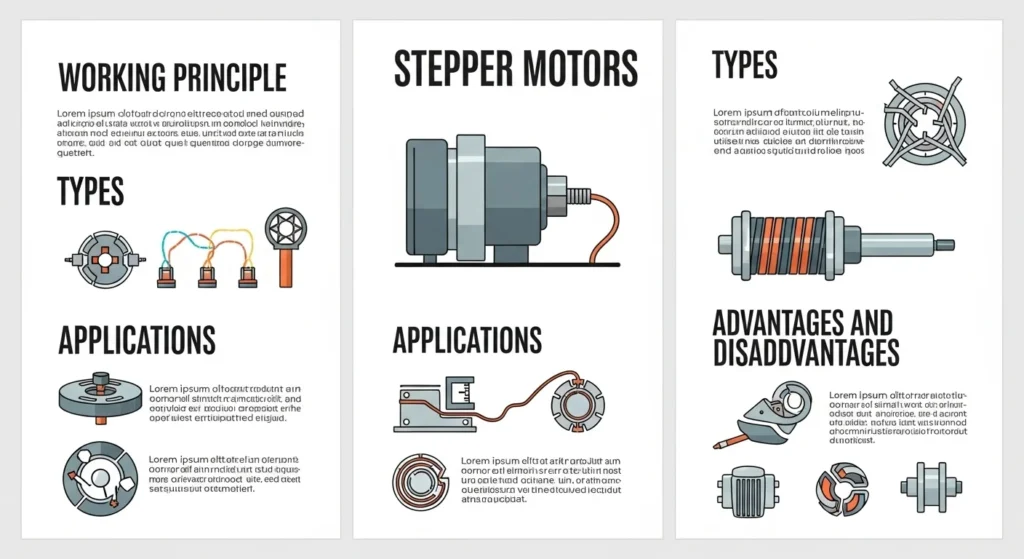
Types of Stepper Motors
Stepper motors are available in several designs, each suitable for different applications.
- Permanent Magnet (PM) Stepper Motor – Uses a permanent magnet rotor and provides good torque at low speeds.
- Variable Reluctance (VR) Stepper Motor – Uses a soft iron rotor and operates based on changing magnetic reluctance.
- Hybrid Stepper Motor – Combines the advantages of PM and VR motors, offering high accuracy, better torque, and finer step resolution.
Among these, the hybrid stepper motor is the most widely used because it delivers excellent performance in industrial automation, CNC machines, and 3D printers.
Advantages of a Stepper Motor
- High positioning accuracy
- Excellent repeatability
- Simple digital control
- No feedback sensor required in many applications
- Good holding torque
- Reliable and durable construction
- Easy integration with microcontrollers and PLCs
Limitations of a Stepper Motor
- Lower efficiency than some other motor types
- Can lose steps if overloaded
- Produces vibration at high speeds
- Limited maximum speed
- Consumes power even while holding position
Key Features of a Stepper Motor
- Rotates in fixed angular steps
- Controlled using electrical pulses
- Precise position and speed control
- Operates without brushes
- Suitable for open-loop control systems
- Ideal for automation and motion control applications
A stepper motor is a precision electric motor that converts electrical pulses into controlled mechanical movement. Because it rotates in fixed steps rather than continuously, it provides accurate position, speed, and directional control. These features make it one of the most important motors used in modern automation, robotics, CNC machines, 3D printers, and other precision motion-control systems.
3. Stepper Motor Working Principle
The working principle of a stepper motor is based on electromagnetic attraction and repulsion. When electrical pulses are applied to the stator windings in a specific sequence, they create a rotating magnetic field. The rotor follows this magnetic field by moving one fixed step at a time. By continuously switching the energized coils, the rotor rotates in precise, controlled increments instead of spinning continuously.
Since each pulse produces one step, the motor’s position can be accurately controlled simply by counting the number of input pulses.
Main Components Involved
The working of a stepper motor mainly depends on the following parts:
- Stator – Contains multiple windings arranged in different phases.
- Rotor – A permanent magnet, soft iron, or hybrid rotor that follows the magnetic field.
- Driver Circuit – Supplies current to the windings in the correct sequence.
- Controller – Generates electrical pulses that determine position, speed, and direction.
Step-by-Step Working Process
Step 1: Electrical Pulse Input
A microcontroller, PLC, or stepper driver sends electrical pulses to the motor windings.
Each pulse represents one movement command.
Step 2: Coil Energization
The first stator winding receives current and becomes an electromagnet.
A strong magnetic field is produced around the energized coil.
Step 3: Rotor Alignment
The rotor is attracted toward the energized magnetic pole and rotates to align with it.
This movement completes one precise step.
Step 4: Sequential Switching
The controller switches off the first winding and energizes the next winding in the sequence.
The magnetic field shifts to a new position.
Step 5: Rotor Moves to the Next Step
The rotor follows the new magnetic field and rotates by another fixed angle.
Each pulse moves the shaft one additional step.
Step 6: Continuous Rotation
As electrical pulses continue, the controller energizes the windings one after another.
The rotor keeps moving in small, accurate steps until the required position is reached.
Direction Control
The direction of rotation depends on the sequence of energized windings.
- Clockwise sequence → Clockwise rotation
- Reverse sequence → Counterclockwise rotation
Changing only the pulse sequence changes the motor’s direction instantly.
Speed Control
The speed of a stepper motor depends on the pulse frequency.
- Low pulse frequency → Slow rotation
- High pulse frequency → Fast rotation
Increasing the pulse rate increases the motor speed.
Position Control
The motor position depends on the total number of pulses.
For example, in a 1.8° stepper motor:
- 1 pulse = 1.8°
- 50 pulses = 90°
- 100 pulses = 180°
- 200 pulses = 360° (one complete revolution)
This makes stepper motors ideal for applications requiring precise positioning.
Simple Analogy
Imagine crossing a river using stepping stones.
Instead of jumping across in one big leap, you move carefully from one stone to the next. A stepper motor works in the same way—it reaches its final position by taking many small, controlled steps rather than rotating continuously.
4. Types of Stepper Motors
Stepper motors are classified according to their rotor construction, operating principle, and performance characteristics. Although all stepper motors convert electrical pulses into precise mechanical movement, each type has a different design that affects its accuracy, torque, speed, efficiency, and applications.
The three main types of stepper motors are:
- Permanent Magnet (PM) Stepper Motor
- Variable Reluctance (VR) Stepper Motor
- Hybrid Stepper Motor
Each type is designed for specific applications depending on the required level of precision, torque, and operating speed.
4.1 Permanent Magnet (PM) Stepper Motor
What Is a Permanent Magnet Stepper Motor?
A Permanent Magnet (PM) Stepper Motor uses a permanent magnet rotor that rotates in response to the magnetic fields produced by the stator windings. Unlike other stepper motors, the rotor itself is permanently magnetized with north and south poles.
When electrical current flows through the stator coils, a magnetic field is generated. The rotor is attracted to this field and rotates by a fixed step angle. As the controller energizes different coils in sequence, the rotor continues moving step by step until it reaches the desired position.
Permanent magnet stepper motors are widely used in low-cost applications where moderate accuracy and torque are sufficient.
Construction of a Permanent Magnet Stepper Motor
A PM stepper motor mainly consists of the following components:
- Stator: Contains multiple coils arranged into phases.
- Rotor: Made from a permanent magnet with alternating north and south poles.
- Motor Shaft: Transfers rotational movement to the connected load.
- Bearings: Support smooth shaft rotation.
- Housing: Protects the internal components.
The permanent magnet rotor eliminates the need for magnetic induction within the rotor, making the motor simple and reliable.
Working Principle
The operation of a permanent magnet stepper motor is based on magnetic attraction and repulsion.
Step 1: Electrical Pulse is Applied
The motor driver sends an electrical pulse to the first stator winding.
Step 2: Magnetic Field is Created
The energized winding becomes an electromagnet.
Step 3: Rotor Aligns
The permanent magnet rotor aligns with the energized magnetic pole.
Step 4: Next Coil Energizes
The controller energizes the next winding.
Step 5: Rotor Takes Another Step
The magnetic field shifts, causing the rotor to rotate by another fixed angle.
Step 6: Continuous Rotation
Repeating this process produces accurate step-by-step rotation.
Features
- Permanent magnet rotor
- Simple construction
- Good holding torque
- Moderate positioning accuracy
- Easy to control
- Low manufacturing cost
- Suitable for low-speed applications
Advantages
- Simple design
- Affordable price
- Reliable operation
- Good low-speed torque
- Easy maintenance
- Long service life
Limitations
- Lower accuracy than hybrid motors
- Larger step angles
- Lower operating speed
- Reduced efficiency at high speeds
Applications
Permanent magnet stepper motors are commonly used in:
- Inkjet printers
- Scanners
- Security cameras
- Home automation devices
- Medical instruments
- Small robotic systems
- Ticket vending machines
- Office equipment
4.2 Variable Reluctance (VR) Stepper Motor
What Is a Variable Reluctance Stepper Motor?
A Variable Reluctance (VR) Stepper Motor uses a soft iron rotor that does not contain permanent magnets. Instead of magnetic attraction between permanent magnets, the rotor moves because it always tries to align with the stator position that offers the lowest magnetic reluctance (least magnetic resistance).
The rotor has specially shaped teeth. When different stator windings are energized one after another, the rotor teeth continuously align with the strongest magnetic field, producing step-by-step rotation.
Because the rotor contains only soft iron, it is lightweight and has very low inertia, allowing faster acceleration than many other stepper motors.
Construction
The main parts include:
- Laminated stator with multiple windings
- Soft iron toothed rotor
- Motor shaft
- Bearings
- Protective frame
Unlike PM motors, the rotor has no permanent magnets.
Working Principle
The operation follows these steps.
Step 1: Coil Energization
Current flows through the first stator winding.
Step 2: Magnetic Field Formation
The energized coil produces a magnetic field.
Step 3: Rotor Movement
The rotor teeth align with the energized stator poles to minimize magnetic reluctance.
Step 4: Next Coil Activation
The controller energizes the next stator winding.
Step 5: Rotor Advances
The rotor moves to the next aligned position.
Step 6: Continuous Stepping
The sequence repeats, creating continuous step-by-step motion.
Features
- Soft iron rotor
- No permanent magnets
- Lightweight rotor
- High operating speed
- Fast acceleration
- Simple construction
Advantages
- High-speed capability
- Quick response
- Low rotor inertia
- Simple manufacturing
- Long operating life
- Low maintenance
Limitations
- Lower holding torque
- Less torque than hybrid motors
- Lower positioning accuracy
- Limited use in heavy-load applications
Applications
Variable reluctance stepper motors are commonly used in:
- Industrial positioning equipment
- Textile machinery
- Measuring instruments
- Packaging machines
- Valve control systems
- Laboratory equipment
- Precision actuators
4.3 Hybrid Stepper Motor
What Is a Hybrid Stepper Motor?
A Hybrid Stepper Motor combines the best features of Permanent Magnet (PM) and Variable Reluctance (VR) stepper motors. It uses both a permanent magnet rotor and finely toothed rotor poles, allowing it to produce higher torque, greater accuracy, smoother operation, and smaller step angles.
Hybrid stepper motors are the most widely used type today because they provide excellent performance in modern automation systems.
Most industrial CNC machines, robotic systems, and 3D printers use hybrid stepper motors due to their outstanding precision and reliability.
Construction
A hybrid stepper motor contains:
- Multi-phase stator windings
- Permanent magnet rotor
- Fine rotor teeth
- Precision bearings
- Motor shaft
- High-strength housing
The toothed rotor allows very fine positioning compared to other stepper motors.
Working Principle
Step 1: Pulse Generation
The controller sends electrical pulses to the driver.
Step 2: Sequential Coil Energization
The driver energizes stator windings one after another.
Step 3: Rotating Magnetic Field
The energized windings create a rotating magnetic field.
Step 4: Rotor Alignment
The permanent magnet rotor aligns with the magnetic field while its teeth lock into precise positions.
Step 5: Fine Step Movement
The rotor moves by a very small angle, often 1.8° or even 0.9° per step.
Step 6: Continuous Precision Rotation
As pulses continue, the motor rotates smoothly while maintaining excellent positional accuracy.
Features
- Permanent magnet and toothed rotor
- Small step angles
- High torque
- Excellent accuracy
- Smooth operation
- High holding torque
- Long operational life
Advantages
- Highest positioning accuracy
- Excellent repeatability
- Strong holding torque
- Smooth movement
- Reliable performance
- Suitable for microstepping
- Ideal for industrial automation
Limitations
- Higher cost than PM and VR motors
- More complex construction
- Can generate heat during continuous holding
- Requires a quality motor driver for best performance
Applications
Hybrid stepper motors are widely used in:
- CNC machines
- 3D printers
- Industrial robots
- Pick-and-place machines
- Laser engraving machines
- Semiconductor manufacturing equipment
- Medical imaging systems
- Camera sliders
- Textile machinery
- Automated packaging systems
Comparison of Different Types of Stepper Motors
| Feature | Permanent Magnet (PM) | Variable Reluctance (VR) | Hybrid |
|---|---|---|---|
| Rotor Type | Permanent Magnet | Soft Iron | Permanent Magnet + Toothed Rotor |
| Torque | Moderate | Low to Moderate | High |
| Position Accuracy | Moderate | Good | Excellent |
| Step Angle | Larger | Medium | Very Small |
| Speed Capability | Moderate | High | High |
| Holding Torque | Good | Low | Excellent |
| Construction | Simple | Simple | Complex |
| Cost | Low | Moderate | Higher |
| Efficiency | Moderate | Moderate | High |
| Common Applications | Printers, Scanners | Measuring Equipment | CNC Machines, Robotics, 3D Printers |
Which Type of Stepper Motor Is Best?
The best type of stepper motor depends on the application.
- Choose a Permanent Magnet Stepper Motor for simple, low-cost devices that require moderate accuracy.
- Choose a Variable Reluctance Stepper Motor for applications requiring high speed and quick acceleration with lighter loads.
- Choose a Hybrid Stepper Motor when high precision, strong holding torque, smooth operation, and reliable performance are essential.
For most modern industrial automation, robotics, CNC machines, and 3D printing systems, the Hybrid Stepper Motor is considered the best choice because it offers the ideal balance of precision, torque, speed, and durability.
5. Main Components of a Stepper Motor
A stepper motor is made up of several mechanical and electrical components that work together to convert electrical pulses into precise rotational movement. Each component has a specific function, and the performance of the motor depends on how efficiently these parts interact.
Understanding the main components of a stepper motor helps in learning its construction, working principle, maintenance, and troubleshooting.
The major components of a stepper motor include:
- Stator
- Rotor
- Windings (Coils)
- Shaft
- Bearings
- Frame (Housing)
- Controller / Driver
5.1 Stator
What Is the Stator?
The stator is the stationary (non-moving) part of a stepper motor. It forms the outer section of the motor and contains multiple electromagnetic windings arranged in different phases.
When electrical current passes through these windings, they generate magnetic fields that control the movement of the rotor.
The stator is manufactured using laminated steel to reduce energy losses caused by eddy currents and to improve magnetic efficiency.
Construction of the Stator
A typical stator consists of:
- Laminated steel core
- Multiple stator poles
- Copper windings
- Insulation material
- Mounting frame
The number of stator poles depends on the motor design and directly affects the motor’s step angle and positioning accuracy.
Functions of the Stator
The stator performs several important tasks.
- Holds the electromagnetic windings.
- Produces magnetic fields when energized.
- Controls the rotor position.
- Determines the motor’s step sequence.
- Supports accurate movement.
- Provides magnetic flux for motor operation.
Without the stator, the rotor cannot receive the magnetic forces required for step-by-step rotation.
Importance of the Stator
The stator is considered the heart of the magnetic system because it generates the rotating magnetic field that drives the motor.
5.2 Rotor
What Is the Rotor?
The rotor is the rotating part located inside the stator. It is directly connected to the output shaft and rotates whenever the stator windings are energized in sequence.
Depending on the type of stepper motor, the rotor may be:
- A permanent magnet
- Soft iron with teeth
- A hybrid design combining permanent magnets and toothed poles
The rotor always attempts to align with the strongest magnetic field produced by the stator.
Construction of the Rotor
The rotor generally consists of:
- Permanent magnet or soft iron core
- Rotor teeth (in hybrid motors)
- Central shaft
- Precision balancing
- High-strength magnetic material
The number of rotor teeth determines the motor’s resolution and positioning accuracy.
Functions of the Rotor
The rotor performs the following functions:
- Rotates in response to magnetic fields.
- Produces precise step-by-step movement.
- Converts magnetic energy into mechanical motion.
- Maintains accurate positioning.
- Delivers torque to the output shaft.
Importance of the Rotor
The rotor is responsible for converting electromagnetic energy into controlled rotational movement, making it the primary moving component of the motor.
5.3 Windings (Coils)
What Are Windings?
Windings are insulated copper coils wound around the stator poles. These coils become electromagnets when electrical current flows through them.
The controller energizes these windings in a specific sequence to create a rotating magnetic field.
Most stepper motors contain two or more winding phases depending on their design.
Construction of Windings
The windings are made from:
- High-quality insulated copper wire
- Heat-resistant insulation
- Multiple winding phases
- Carefully arranged coil turns
Proper insulation prevents electrical short circuits and improves motor reliability.
Functions of Windings
The windings perform several essential functions.
- Generate magnetic fields.
- Control rotor movement.
- Determine the direction of rotation.
- Control motor speed.
- Produce holding torque.
- Enable precise stepping.
Without energized windings, the motor cannot operate.
Importance of Windings
The quality of the windings directly affects:
- Torque
- Efficiency
- Heat generation
- Reliability
- Motor lifespan
5.4 Shaft
What Is the Shaft?
The shaft is a steel rod connected directly to the rotor. It extends outside the motor and transfers the motor’s rotational movement to external mechanical devices.
The shaft is designed to withstand continuous rotation while maintaining precise alignment.
Functions of the Shaft
The shaft performs several important functions.
- Transfers rotational motion.
- Delivers mechanical power.
- Drives connected equipment.
- Supports couplings and gears.
- Maintains accurate positioning.
Applications of the Shaft
The shaft may be connected to:
- Gears
- Lead screws
- Timing belts
- Pulleys
- Couplings
- Conveyor systems
5.5 Bearings
What Are Bearings?
Bearings support the motor shaft and allow it to rotate smoothly with minimum friction.
High-quality bearings improve motor life and reduce vibration.
Functions of Bearings
- Support the rotating shaft.
- Reduce friction.
- Maintain shaft alignment.
- Minimize vibration.
- Improve efficiency.
- Extend service life.
5.6 Frame (Housing)
What Is the Motor Frame?
The motor frame is the outer casing that protects all internal components.
It also helps dissipate heat generated during operation.
Most frames are made from aluminum or steel for strength and durability.
Functions of the Frame
- Protects internal parts.
- Provides structural support.
- Dissipates heat.
- Reduces mechanical damage.
- Allows easy mounting.
5.7 Controller / Driver
What Is a Stepper Motor Driver?
The stepper motor driver is an electronic circuit that receives signals from a controller and supplies electrical pulses to the motor windings.
The driver converts low-power control signals into the current required by the motor.
Without a driver, a stepper motor cannot operate properly.
How the Driver Works
- The controller sends pulse signals.
- The driver receives the pulses.
- The driver energizes the correct winding.
- The magnetic field changes.
- The rotor moves one step.
- The process repeats until the required position is reached.
Functions of the Driver
The driver performs many important functions.
- Controls motor direction.
- Controls motor speed.
- Controls step position.
- Regulates motor current.
- Protects against overheating.
- Supports microstepping.
- Improves smoothness of operation.
Why Is the Driver Important?
A high-quality driver improves:
- Accuracy
- Torque
- Efficiency
- Smooth movement
- Reliability
- Motor lifespan
Summary of Stepper Motor Components
| Component | Main Function |
|---|---|
| Stator | Generates the rotating magnetic field |
| Rotor | Rotates and produces mechanical movement |
| Windings | Create electromagnetic fields |
| Shaft | Transfers rotational motion to the load |
| Bearings | Reduce friction and support the shaft |
| Frame | Protects internal components and dissipates heat |
| Controller/Driver | Controls pulses, speed, direction, and position |
6. Advantages of a Stepper Motor
Stepper motors are among the most widely used motors in automation and motion control because they offer excellent positioning accuracy, simple digital control, and reliable performance. Unlike conventional motors that require feedback systems for accurate positioning, stepper motors can often operate effectively in an open-loop system, making them cost-effective and easy to control.
These advantages make stepper motors ideal for CNC machines, robotics, medical equipment, 3D printers, packaging systems, and many other precision applications.
6.1 High Positioning Accuracy
One of the biggest advantages of a stepper motor is its ability to move by a fixed angle for every electrical pulse.
Since each pulse corresponds to one precise step, the motor can repeatedly reach the same position with excellent accuracy.
This makes it suitable for applications requiring precise movement.
6.2 Excellent Repeatability
Stepper motors can return to the same position repeatedly with minimal error.
This repeatability is essential in automated production lines and precision manufacturing.
6.3 Open-Loop Control
Most stepper motors do not require position sensors or feedback devices.
The controller simply counts electrical pulses to determine the motor’s position.
This reduces system complexity and cost.
6.4 Simple Digital Control
Stepper motors can be easily controlled using:
- Microcontrollers
- PLCs
- CNC controllers
- Motion controllers
- Embedded systems
Digital pulse signals make programming straightforward.
6.5 Good Holding Torque
Even when stationary, a stepper motor can maintain its position while energized.
This holding torque allows the motor to resist external forces without moving.
6.6 Reliable and Durable
Stepper motors have a simple brushless design with fewer wearing parts.
As a result, they offer:
- Long service life
- Low maintenance
- Reliable operation
- Consistent performance
6.7 Precise Speed Control
Changing the pulse frequency allows accurate speed adjustment without mechanical gear changes.
6.8 Accurate Direction Control
Changing the sequence of electrical pulses instantly changes the motor’s direction.
6.9 Easy Integration
Stepper motors integrate easily with modern automation equipment, making them popular in Industry 4.0 and smart manufacturing.
6.10 Cost-Effective Solution
For many positioning applications, stepper motors provide high precision at a lower cost than servo systems.
Summary of Advantages
- High positioning accuracy
- Excellent repeatability
- Open-loop operation
- No feedback sensor required
- Good holding torque
- Reliable brushless construction
- Simple digital control
- Easy speed and direction control
- Low maintenance
- Affordable for many automation applications
7. Disadvantages and Limitations of a Stepper Motor
Although stepper motors offer many advantages, they also have several limitations that should be considered before selecting them for a specific application. Understanding these drawbacks helps engineers choose the most suitable motor for their system.
7.1 Lower Efficiency
Stepper motors continuously draw current to maintain holding torque, even when they are not rotating.
This results in lower overall efficiency compared to some other motor types.
7.2 Limited High-Speed Performance
Stepper motors perform best at low and medium speeds.
At very high speeds, torque decreases significantly, reducing their effectiveness for fast-motion applications.
7.3 Risk of Losing Steps
If the load becomes too heavy or acceleration is too high, the rotor may fail to follow the commanded pulse sequence.
This causes missed steps and positioning errors.
7.4 Vibration and Noise
Stepper motors may produce noticeable vibration and audible noise, particularly at low speeds or during resonance.
Using microstepping drivers can reduce these effects.
7.5 Heat Generation
The motor continues consuming electrical power while holding position, causing heat to build up during continuous operation.
Proper ventilation or cooling may be required.
7.6 Lower Power Density
Compared to servo motors, stepper motors generally produce less torque for their size.
7.7 Resonance Problems
Certain operating speeds can create resonance, leading to unstable motion and increased vibration.
Summary of Limitations
- Lower efficiency
- Reduced high-speed torque
- Possible missed steps
- Vibration and noise
- Heat generation
- Limited overload capability
- Resonance at certain speeds
8. Applications of a Stepper Motor
Because of their high accuracy, excellent repeatability, and simple control, stepper motors are widely used across numerous industries. They are especially valuable in systems where precise positioning and controlled motion are more important than high rotational speed.
8.1 Industrial Applications
Stepper motors are extensively used in industrial automation for precise positioning and motion control.
Common industrial applications include:
- CNC milling machines
- CNC lathes
- Laser cutting machines
- Pick-and-place machines
- Packaging equipment
- Conveyor positioning systems
- Textile machinery
- Semiconductor manufacturing
- Labeling machines
- Automated assembly lines
These machines rely on the motor’s ability to move accurately to predetermined positions.
8.2 Home and Office Applications
Stepper motors are also found in many everyday devices.
Examples include:
- Inkjet printers
- Laser printers
- Flatbed scanners
- Plotters
- Security cameras
- Smart door locks
- Automatic blinds
- Vending machines
- ATM machines
- Photocopiers
In these devices, precise movement ensures smooth and reliable operation.
8.3 Robotics Applications
Robotics requires highly accurate motion, making stepper motors an ideal choice.
They are commonly used in:
- Robotic arms
- Mobile robots
- Educational robots
- Robotic grippers
- Inspection robots
- Automated guided vehicles (AGVs)
8.4 Medical Applications
Many medical devices require precise and repeatable movement.
Stepper motors are used in:
- Syringe pumps
- Infusion pumps
- MRI support equipment
- CT scanners
- Laboratory automation
- Blood analysis machines
- Diagnostic equipment
8.5 Modern Technology Applications
Stepper motors play a key role in advanced technologies.
They are widely used in:
- 3D printers
- Camera stabilization systems
- Drone gimbals
- Laser engraving machines
- PCB drilling machines
- Automated laboratory equipment
- Precision optical instruments
- Smart manufacturing systems
8.6 Automotive Applications
In the automotive industry, stepper motors help control various systems.
Examples include:
- Instrument clusters
- Headlight leveling systems
- HVAC actuators
- Electronic throttle systems
- Fuel gauge mechanisms
Why Stepper Motors Are Popular
Stepper motors remain one of the most popular motion-control solutions because they combine precision, repeatability, reliability, and ease of digital control. Whether in industrial automation, medical equipment, office machines, or consumer electronics, they provide accurate positioning without the complexity of many closed-loop systems, making them an essential component of modern electromechanical technology.
9. Comparison Section
Difference Between Stepper Motor and Servo Motor
| Feature | Stepper Motor | Servo Motor |
|---|---|---|
| Control | Open-loop control | Closed-loop control |
| Accuracy | Good | Very high |
| Cost | Lower | Higher |
| Speed | Moderate | High |
| Feedback System | Usually not required | Required |
Understanding the difference between stepper motor and servo motor helps engineers choose the correct motor for specific applications.
10. Stepper Motor Selection Guide
Selecting the right stepper motor is one of the most important steps in designing a reliable motion control system. A motor that is too small may lose steps or overheat, while an oversized motor can increase the overall cost and consume more power than necessary.
The ideal stepper motor should provide enough torque, speed, accuracy, and reliability to meet the application’s requirements. Before selecting a motor, engineers must carefully evaluate the load, operating conditions, and control system.
A well-selected stepper motor ensures:
- Smooth and accurate movement
- Better efficiency
- Longer service life
- Lower maintenance
- Improved system reliability
10.1 Determine the Required Torque
Torque is the rotational force produced by the motor. It is one of the most important factors when choosing a stepper motor.
The selected motor must generate enough torque to move the load safely under all operating conditions.
Consider the Following
- Weight of the load
- Friction in the system
- Acceleration and deceleration
- Gear ratio (if used)
- External forces acting on the mechanism
Recommendation
Choose a motor with 20–50% more torque than the calculated requirement. This safety margin helps prevent missed steps and improves reliability during sudden load changes.
10.2 Select the Correct Step Angle
The step angle determines how much the motor rotates with each electrical pulse.
Common step angles include:
| Step Angle | Steps per Revolution |
|---|---|
| 1.8° | 200 |
| 0.9° | 400 |
| 7.5° | 48 |
| 15° | 24 |
Selection Tips
- Smaller step angles provide higher positioning accuracy.
- Larger step angles are suitable for simple positioning tasks.
For most CNC machines, robots, and 3D printers, 1.8° is the most common choice.
10.3 Consider Operating Speed
Stepper motors produce their highest torque at low speeds. As speed increases, available torque decreases.
When selecting a motor, determine:
- Maximum operating speed
- Average operating speed
- Required acceleration
- Duty cycle
Choose a motor that can maintain sufficient torque at the required operating speed.
10.4 Check the Power Supply
Every stepper motor is designed to operate with a specific voltage and current.
Ensure that the power supply can provide:
- Correct voltage
- Required current
- Stable output
- Adequate power capacity
A properly sized power supply improves motor performance and prevents unexpected shutdowns.
10.5 Choose a Compatible Driver
A stepper motor requires a driver to convert control signals into the correct current for the windings.
The driver should match the motor’s:
- Rated current
- Operating voltage
- Number of phases
- Step resolution
- Control interface
Modern drivers also offer features such as:
- Microstepping
- Overcurrent protection
- Overtemperature protection
- Adjustable current settings
- Smooth acceleration and deceleration
10.6 Consider Load Inertia
High load inertia requires more torque during acceleration and deceleration.
If the driven load is heavy or rotates quickly, select a motor with sufficient torque or use a gearbox to improve performance.
10.7 Evaluate Environmental Conditions
The operating environment affects motor reliability.
Consider:
- Ambient temperature
- Dust
- Moisture
- Vibration
- Corrosive chemicals
For harsh environments, choose motors with appropriate protection ratings and durable construction.
10.8 Consider Holding Torque
Some applications require the motor to hold its position even when stationary.
Examples include:
- CNC machines
- Camera positioning systems
- Robotic joints
- Vertical lifting mechanisms
Select a motor with adequate holding torque to prevent unwanted movement.
10.9 Evaluate Motor Size
Motor size should match the available installation space while providing the required performance.
Common frame sizes include:
- NEMA 14
- NEMA 17
- NEMA 23
- NEMA 24
- NEMA 34
Larger motors generally provide higher torque but require more installation space.
10.10 Budget and Maintenance
The cheapest motor is not always the best option.
Consider:
- Purchase cost
- Driver cost
- Maintenance requirements
- Energy consumption
- Expected lifespan
A high-quality motor often provides better long-term value through improved reliability and lower maintenance costs.
Tips for Beginners
If you are selecting a stepper motor for your first project, follow these practical guidelines:
- Select a motor with at least 20–50% extra torque.
- Use a compatible high-quality driver.
- Choose the correct power supply voltage and current.
- Avoid overloading the motor.
- Use microstepping for smoother operation.
- Ensure proper ventilation and cooling.
- Mount the motor securely to reduce vibration.
- Test the motor before installing it in the final system.
Quick Selection Checklist
Before purchasing a stepper motor, confirm the following:
✔ Required torque calculated
✔ Step angle selected
✔ Speed requirements identified
✔ Driver compatibility verified
✔ Power supply matched
✔ Holding torque checked
✔ Environmental conditions considered
✔ Installation space measured
✔ Cooling requirements evaluated
✔ Safety margin included
11. Common Stepper Motor Problems and Solutions
Although stepper motors are known for their reliability and precision, they can sometimes experience performance issues due to incorrect wiring, improper driver settings, excessive loads, or environmental conditions. Understanding these common problems and their solutions helps maintain smooth operation and extend the motor’s service life.
Problem 1: Why Does a Stepper Motor Vibrate?
Possible Causes
Stepper motors may vibrate because of:
- Mechanical resonance
- Incorrect pulse frequency
- Improper driver settings
- Low-quality driver
- Loose mounting
- Rapid acceleration
Symptoms
- Noticeable shaking
- Loud humming noise
- Rough rotation
- Reduced positioning accuracy
Solutions
- Use a microstepping driver.
- Adjust the operating speed to avoid resonance.
- Reduce acceleration.
- Tighten the motor mounting.
- Use vibration dampers if necessary.
- Upgrade to a better driver.
Problem 2: Why Does the Motor Lose Steps?
A stepper motor loses steps when it cannot keep up with the incoming pulse commands.
Possible Causes
- Overloaded motor
- High acceleration
- Insufficient torque
- Incorrect current settings
- Mechanical binding
Symptoms
- Incorrect positioning
- Missed movements
- Reduced accuracy
- Unexpected stopping
Solutions
- Reduce the mechanical load.
- Increase the motor current within the manufacturer’s limits.
- Select a higher-torque motor.
- Reduce acceleration and speed.
- Check for mechanical obstructions.
Problem 3: Why Does the Stepper Motor Overheat?
Stepper motors normally become warm during operation, but excessive heat can reduce performance and shorten motor life.
Possible Causes
- High current settings
- Continuous holding current
- Poor ventilation
- High ambient temperature
- Overloaded motor
Symptoms
- Motor housing becomes extremely hot
- Reduced efficiency
- Thermal shutdown of the driver
- Burnt insulation smell
Solutions
- Reduce the driver current setting.
- Improve airflow around the motor.
- Install cooling fans if required.
- Lower the holding current when idle.
- Avoid continuous overloading.
Problem 4: Why Is the Motor Not Rotating?
If the motor does not rotate at all, the issue is often electrical rather than mechanical.
Possible Causes
- Loose wiring
- Incorrect wiring sequence
- Driver failure
- No controller pulses
- Power supply problem
Solutions
- Check all wiring connections.
- Verify the winding connections.
- Confirm that the power supply is working correctly.
- Test the driver.
- Ensure the controller is sending pulse signals.
Problem 5: Why Does the Motor Make Excessive Noise?
Possible Causes
- Resonance
- High stepping frequency
- Poor mounting
- Low-quality driver
Solutions
- Enable microstepping.
- Reduce speed.
- Improve mounting rigidity.
- Use vibration dampers.
Problem 6: Why Does the Motor Have Low Torque?
Possible Causes
- Incorrect current settings
- High operating speed
- Low supply voltage
- Heavy mechanical load
Solutions
- Increase the driver current (within safe limits).
- Use a higher supply voltage if supported.
- Reduce speed.
- Upgrade to a larger motor.
Troubleshooting Summary
| Problem | Possible Cause | Recommended Solution |
|---|---|---|
| Motor vibrates | Resonance, incorrect driver settings | Use microstepping, adjust speed |
| Motor loses steps | Overload, insufficient torque | Reduce load, use higher-torque motor |
| Motor overheats | High current, poor cooling | Lower current, improve ventilation |
| Motor not rotating | Wiring or driver fault | Check connections and controller signals |
| Excessive noise | Resonance, poor mounting | Use dampers and microstepping |
| Low torque | High speed or incorrect settings | Reduce speed and optimize driver settings |
12. Future Trends in Stepper Motor Technology
As automation, robotics, and smart manufacturing continue to advance, stepper motor technology is evolving to deliver greater precision, higher efficiency, smoother operation, and improved connectivity. Modern stepper motors are becoming more intelligent and energy-efficient, making them an essential component of next-generation motion control systems.
12.1 Smart Stepper Motor Drivers
Modern stepper motor drivers now include advanced electronic features that significantly improve motor performance.
These smart drivers provide:
- Automatic current adjustment
- Built-in diagnostics
- Microstepping control
- Overcurrent protection
- Overtemperature protection
- Communication interfaces with PLCs and industrial networks
These improvements reduce vibration, increase efficiency, and simplify system integration.
12.2 Integration with Robotics
Robotics is one of the fastest-growing applications for stepper motors.
Future robotic systems require:
- Higher positioning accuracy
- Faster response
- Compact motor designs
- Reliable long-term operation
Stepper motors will continue to play a key role in:
- Industrial robots
- Collaborative robots (Cobots)
- Surgical robots
- Educational robots
- Service robots
- Warehouse automation
12.3 Energy-Efficient Designs
Manufacturers are developing new motor designs that reduce energy consumption while maintaining high performance.
Future improvements include:
- Lower power loss
- Reduced heat generation
- Improved magnetic materials
- Optimized winding designs
- More efficient drivers
These innovations help lower operating costs and support environmentally friendly automation.
12.4 Miniature Precision Stepper Motors
The demand for compact electronic devices has led to the development of miniature stepper motors with exceptional precision.
These small motors are increasingly used in:
- Medical devices
- Wearable technology
- Camera modules
- Portable laboratory equipment
- Optical instruments
- Aerospace electronics
Despite their compact size, these motors provide excellent positioning accuracy and reliability.
12.5 Industry 4.0 and Smart Manufacturing
Modern factories are becoming more connected through Industry 4.0 technologies.
Future stepper motor systems will support:
- Real-time monitoring
- Predictive maintenance
- IoT connectivity
- Remote diagnostics
- Cloud-based performance analysis
These capabilities improve productivity and reduce machine downtime.
12.6 Improved Materials and Manufacturing
Advances in materials and manufacturing processes are leading to:
- Stronger permanent magnets
- Better insulation materials
- Higher-quality bearings
- Lower mechanical losses
- Longer service life
These improvements increase both reliability and overall motor performance.
12.7 Artificial Intelligence in Motion Control
Artificial Intelligence (AI) is beginning to influence motor control systems.
Future controllers may automatically:
- Optimize speed profiles
- Adjust current levels
- Detect abnormal operation
- Prevent missed steps
- Improve energy efficiency
AI-driven motion control can make stepper motor systems more adaptive and reliable.
Future Outlook
The future of stepper motor technology is focused on higher precision, smarter control, improved efficiency, and seamless integration with advanced automation systems. As industries continue to embrace robotics, IoT, AI, and Industry 4.0, stepper motors will remain a critical solution for applications that demand accurate, repeatable, and dependable motion control. With ongoing advancements in motor design, driver electronics, and intelligent control, stepper motors are expected to become even more capable, efficient, and versatile in the years ahead.
13. Conclusion
Stepper motors are essential components in modern motion control systems. Unlike conventional motors, they rotate in precise steps, allowing accurate control of position, speed, and movement. This unique capability makes them ideal for applications that require high precision.
In this article, we explained what a stepper motor is, the stepper motor working principle, its different types, and major components. We also discussed stepper motor advantages and disadvantages, along with practical stepper motor applications in industries, robotics, and automation systems.
Understanding the operation of stepper motors helps electrical students, engineers, and technicians design efficient control systems. With proper selection, installation, and maintenance, stepper motors provide reliable and accurate performance.
As automation, robotics, and smart manufacturing continue to grow, the importance of stepper motors will increase even further. Learning about this technology is a valuable step for anyone entering the electrical or electronics engineering field.