
Imagine riding an electric train or using a cordless power drill. These machines rely on electric motors to convert electrical energy into mechanical motion. But have you ever wondered how the motor keeps spinning in one direction even though the current inside its coil changes continuously? The answer lies in a small but essential component called the commutator.
The commutator has been one of the most important inventions in electrical engineering. It allows DC motors to produce continuous rotation and enables DC generators to deliver direct current to external circuits. Without a properly functioning commutator, many traditional electrical machines would not operate efficiently.
Whether you are an electrical engineering student, technician, electrician, or beginner, understanding the commutator working principle is essential for learning how DC machines operate. In this guide, you’ll learn what a commutator is, how it works, its types, components, applications, advantages, disadvantages, common problems, and how to select the right commutator for different electrical systems.
2. What Is a Commutator? Definition, Working Principle, Function, and Practical Example
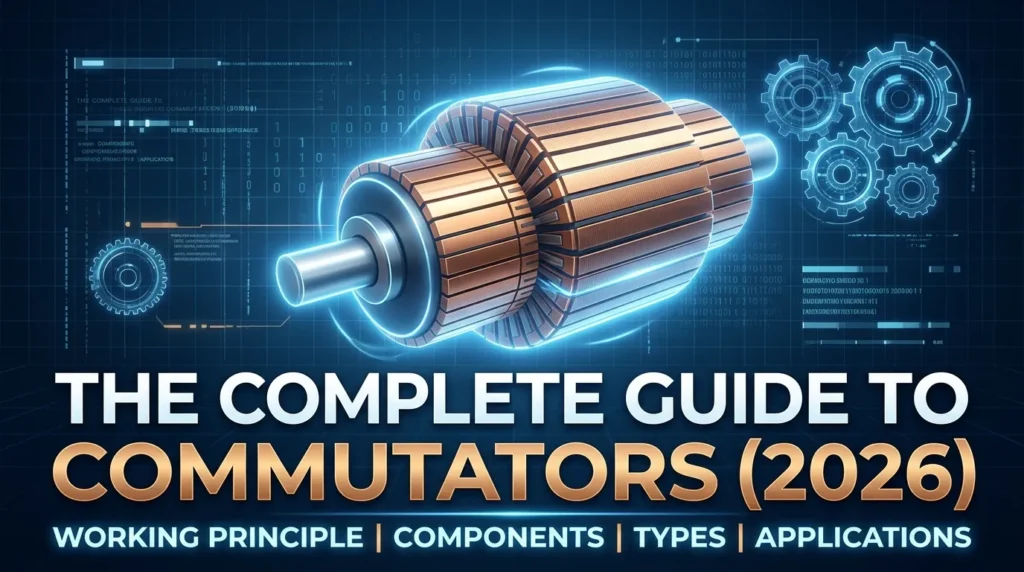
A commutator is a mechanical switching device used primarily in DC motors and DC generators. It is mounted on the armature shaft and works together with carbon brushes to control the direction of current flowing through the armature winding. Its main purpose is to reverse the current at the correct time, allowing a DC motor to produce continuous rotational torque and enabling a DC generator to deliver direct current (DC) at its output.
The commutator is made up of multiple copper segments insulated from each other by thin layers of mica insulation. As the armature rotates, stationary carbon brushes remain in contact with these copper segments, allowing electrical current to flow while automatically reversing its direction every half rotation.
Without a commutator, a DC motor would stop after a partial turn because the magnetic force would reverse direction. Likewise, a DC generator would produce alternating current instead of direct current. Therefore, the commutator is one of the most important components of DC machines, ensuring efficient, smooth, and continuous operation.
Definition
A commutator is a rotating mechanical switch that periodically reverses the direction of current in the armature winding of a DC motor or converts the internally generated alternating current into direct current in a DC generator.
Simple Explanation
Imagine pushing a child on a playground swing. To keep the swing moving in the same direction, you must push it at the correct moment during every cycle. If you push at the wrong time, the swing slows down or changes direction.
A commutator performs a similar function in a DC motor. It automatically changes the direction of electrical current every half rotation so that the magnetic force continues pushing the armature in the same rotational direction. This keeps the motor running smoothly and continuously.
In simple words, the commutator acts like an automatic electrical switch that changes the current direction at exactly the right time.
Practical Example
A battery-powered toy car uses a small DC motor to rotate its wheels. Inside the motor, the battery supplies direct current through carbon brushes to the commutator.
As the motor shaft rotates:
- The carbon brushes remain in contact with the commutator segments.
- The commutator automatically reverses the current flowing through the armature winding after every half rotation.
- The magnetic field continues producing torque in the same direction.
- The motor shaft keeps spinning continuously, driving the toy car forward.
Without the commutator, the motor would lose its continuous torque and could not rotate smoothly.
3. Commutator Working Principle
The commutator working principle is based on the automatic reversal of current in the armature winding whenever the rotating coil completes half a revolution (180°). This periodic current reversal ensures that the direction of electromagnetic force remains unchanged, allowing the motor to produce continuous torque and uninterrupted rotation.
In a DC generator, the commutator performs the opposite function. Although alternating current is induced in the rotating armature, the commutator mechanically rectifies it, converting it into a unidirectional direct current (DC) at the output terminals.
Step-by-Step Working Principle
1. DC Power Is Supplied
A DC power source supplies current to the motor through the stationary carbon brushes.
2. Current Flows Through the Commutator
The carbon brushes transfer current to the rotating commutator segments, which are connected to the armature winding.
3. Magnetic Field Is Produced
Current flowing through the armature conductors creates a magnetic field that interacts with the magnetic field of the stator or field poles.
4. Armature Begins Rotating
The interaction of magnetic fields produces electromagnetic force, generating torque that rotates the armature.
5. Current Reverses Automatically
After every half rotation (180°), the commutator switches the connections of the armature coil, reversing the direction of current flowing through the winding.
6. Continuous Torque Is Maintained
Although the armature current reverses, the direction of the electromagnetic torque remains the same. As a result, the motor continues rotating smoothly without changing direction.
Why Current Reversal Is Necessary
If the current were not reversed after every half revolution:
- The electromagnetic force would reverse.
- The armature would stop rotating or oscillate back and forth.
- Continuous mechanical rotation would not be possible.
The commutator solves this problem by automatically changing the current direction at precisely the correct instant.
Working Principle in a DC Generator
In a DC generator:
- Rotating armature conductors generate alternating current (AC) through electromagnetic induction.
- The commutator reverses the armature connections every half rotation.
- This mechanical switching converts the internally generated AC into a pulsating direct current (DC) at the output terminals.
Thus, the commutator acts as a mechanical rectifier in DC generators.
Key Points
Without a commutator, a DC motor cannot maintain continuous rotation, and a DC generator cannot produce direct current efficiently.
The commutator is a mechanical switching device used in DC machines.
It works with carbon brushes to transfer current to the rotating armature.
It reverses the armature current after every 180° rotation.
In DC motors, it ensures continuous torque and smooth rotation.
In DC generators, it converts internally generated AC into DC.
Step-by-Step Working Process
- Electrical current enters the motor through the carbon brushes.
- The brushes touch the rotating commutator segments.
- Current flows into the armature winding.
- The armature creates its own magnetic field.
- The magnetic field interacts with the stator field.
- This interaction produces rotational force (torque).
- As the armature rotates 180°, the commutator reverses the current direction.
- The magnetic forces continue pushing the armature in the same rotational direction.
- This cycle repeats continuously while power is supplied.
Easy Analogy
Imagine two people pushing a revolving door. Every time the door reaches halfway, they quickly switch sides but continue pushing in the same direction. The door never stops rotating.
That is exactly what the commutator does inside a DC motor.
4. Types of Commutators Used in DC Motors and DC Generators
Commutators are available in different designs to meet the requirements of various DC motors and DC generators. The type of commutator used depends on factors such as motor size, operating voltage, current capacity, speed, efficiency, and application. Although all commutators perform the same basic function of reversing current or converting AC to DC, their construction and performance characteristics vary significantly.
Small educational motors generally use simple commutators, while industrial machines require robust designs capable of handling high current, high speed, and continuous operation.
The following are the most common types of commutators used in electrical engineering.
4.1 Split Ring Commutator
The split ring commutator is the simplest and most basic type of commutator. It consists of two semicircular copper segments mounted on the motor shaft and insulated from each other using mica or another insulating material.
Each copper segment is connected to one end of the armature coil. As the armature rotates, stationary carbon brushes remain in contact with the rotating copper segments. After every 180° rotation, the brushes switch from one segment to the other, automatically reversing the current flowing through the armature winding.
This current reversal keeps the electromagnetic force acting in the same direction, allowing continuous motor rotation.
Construction
A split ring commutator consists of:
- Two semicircular copper segments
- Mica insulation between the segments
- Carbon brushes
- Armature winding connections
- Rotating shaft
Features
- Very simple construction
- Easy to manufacture
- Low production cost
- Easy to understand and maintain
- Suitable for low-power DC motors
- Commonly used for educational purposes
Advantages
- Low manufacturing cost
- Simple operation
- Easy maintenance
- Reliable for small applications
- Ideal for learning the working principle of DC motors
Limitations
- Not suitable for high-current applications
- Produces more sparking at higher speeds
- Lower efficiency than segmented commutators
- Limited mechanical strength
Applications
Split ring commutators are commonly used in:
- School laboratory experiments
- Educational demonstration models
- Small battery-operated DC motors
- Science project kits
- Toy motors
- Miniature electrical machines
4.2 Cylindrical (Segmented) Commutator
The cylindrical commutator, also called the segmented commutator, is the most widely used type in commercial and industrial DC machines.
Instead of only two copper segments, this commutator consists of many copper segments arranged around a cylindrical structure. Each segment is insulated from the next using thin sheets of mica insulation and connected to individual armature coils.
As the armature rotates, carbon brushes continuously slide over multiple copper segments, producing smooth current transfer and reducing sparking.
This design provides much better performance than the split ring commutator and is suitable for high-power applications.
Construction
A cylindrical commutator includes:
- Multiple copper segments
- Mica insulation
- Steel hub
- Armature winding connections
- Carbon brushes
- Rotating shaft
Features
- Smooth current commutation
- High mechanical strength
- Long operating life
- Low maintenance
- Suitable for heavy electrical loads
- Excellent current distribution
Advantages
- Higher efficiency
- Reduced sparking
- Better electrical contact
- Improved reliability
- Suitable for high-speed operation
- Longer service life
Limitations
- More expensive than split ring commutators
- Complex manufacturing process
- Requires precision assembly
Applications
Cylindrical commutators are widely used in:
- Industrial DC motors
- DC generators
- Electric cranes
- Rolling mills
- Mining equipment
- Electric traction systems
- Heavy manufacturing machinery
- Machine tools
4.3 Drum-Type Commutator
The drum-type commutator is specially designed for large DC machines that contain many armature coils. It consists of a cylindrical arrangement with a large number of copper segments connected to individual armature windings.
Because each armature coil has its own commutator segment, current distribution becomes more uniform, resulting in smoother operation and improved electrical performance.
Drum-type commutators are commonly used in heavy industrial equipment where continuous operation and high reliability are essential.
Construction
The drum-type commutator consists of:
- Large cylindrical body
- Numerous copper segments
- High-quality mica insulation
- Heavy-duty steel hub
- Multiple armature coil connections
- Carbon brush assembly
Features
- Excellent current distribution
- High current carrying capacity
- Suitable for continuous operation
- Reduced electrical losses
- Improved mechanical balance
Advantages
- Better current distribution
- Reduced sparking
- Higher efficiency
- Improved cooling
- Longer brush life
- Increased machine reliability
- Suitable for high-power applications
Limitations
- High manufacturing cost
- Larger physical size
- More complex maintenance
- Requires precise alignment
Applications
Drum-type commutators are commonly used in:
- Large industrial DC motors
- Heavy-duty DC generators
- Steel rolling mills
- Mining machines
- Large cranes
- Electric locomotives
- Marine electrical systems
- Power generation equipment
4.4 High-Speed Precision Commutator
The high-speed precision commutator is designed for applications where motors operate at extremely high rotational speeds and require exceptional mechanical balance and electrical accuracy.
These commutators are manufactured with high-quality copper segments, precision machining, and excellent dynamic balancing to minimize vibration, sparking, and electrical losses.
They are commonly used in advanced technologies where reliability and precision are critical.
Construction
A high-speed precision commutator includes:
- Precision-machined copper segments
- High-grade insulation material
- Balanced rotating assembly
- Wear-resistant contact surfaces
- High-strength mechanical support
Features
- Extremely accurate construction
- Excellent mechanical balance
- Low vibration
- Minimal sparking
- High rotational speed capability
- Superior electrical performance
Advantages
- Very smooth operation
- High efficiency
- Reduced maintenance
- Longer service life
- Excellent reliability
- Suitable for precision applications
- Low electrical noise
Limitations
- Expensive manufacturing process
- Requires precision installation
- Specialized maintenance
- Higher replacement cost
Applications
High-speed precision commutators are widely used in:
- Aerospace equipment
- Medical devices
- Precision robotics
- CNC machines
- High-speed industrial motors
- Laboratory equipment
- Defense systems
- Aviation electrical systems
- High-performance automation equipment
Comparison of Different Commutator Types
| Commutator Type | Construction | Best For | Main Advantages |
|---|---|---|---|
| Split Ring Commutator | Two copper segments | Small DC motors and educational models | Simple, low-cost, easy to understand |
| Cylindrical (Segmented) Commutator | Multiple insulated copper segments | Commercial and industrial DC machines | Smooth commutation, high efficiency, long life |
| Drum-Type Commutator | Large cylindrical structure with many segments | Heavy-duty industrial motors and generators | Better current distribution, reduced sparking |
| High-Speed Precision Commutator | Precision-balanced segmented design | High-speed and precision applications | High reliability, minimal vibration, excellent performance |
How to Choose the Right Commutator
The selection of a commutator depends on several important factors, including:
- Motor or generator rating
- Operating voltage
- Current carrying capacity
- Rotational speed (RPM)
- Mechanical strength
- Required efficiency
- Maintenance requirements
- Application environment
- Expected service life
- Cost and reliability
For small educational or battery-operated motors, a split ring commutator is usually sufficient. For industrial DC motors and generators, the cylindrical (segmented) commutator is the preferred choice due to its smooth operation and higher efficiency. Drum-type commutators are ideal for heavy-duty industrial machinery, while high-speed precision commutators are best suited for aerospace, robotics, medical equipment, and other high-performance applications that demand exceptional accuracy and reliability.
5. Main Components of a Commutator
A commutator is made up of several carefully designed components that work together to ensure the efficient transfer of electrical current between the stationary and rotating parts of a DC machine. Each component has a specific function that contributes to smooth motor operation, reliable current commutation, and long service life.
The quality and condition of these components directly affect the efficiency, reliability, and lifespan of DC motors and DC generators.
5.1 Copper Segments
Copper segments are the most important part of a commutator. They are made from high-conductivity copper and are arranged around the commutator in a cylindrical shape. Each segment is connected to one or more armature coils and insulated from adjacent segments by mica.
As the armature rotates, the stationary carbon brushes slide over these copper segments, allowing electrical current to flow continuously. The arrangement of the segments enables the commutator to reverse the current in the armature winding at the correct time, ensuring continuous torque in a DC motor and direct current output in a DC generator.
Functions
- Conduct electrical current between the brushes and armature winding
- Reverse the direction of current every half rotation
- Connect individual armature coils
- Ensure smooth current commutation
- Minimize power losses during operation
Importance
- High electrical conductivity
- Good mechanical strength
- Excellent wear resistance
- Reliable current transfer
5.2 Mica Insulation
Mica insulation consists of thin sheets of high-quality insulating material placed between adjacent copper segments. Mica is widely used because it has excellent electrical insulation properties, high mechanical strength, and can withstand high temperatures without deteriorating.
The insulation prevents electrical contact between neighboring copper segments while allowing the commutator to operate safely under high voltage and current conditions.
Functions
- Electrically insulates adjacent copper segments
- Prevents short circuits
- Reduces electrical leakage
- Maintains safe operation
- Supports proper current commutation
Advantages
- Excellent electrical insulation
- High heat resistance
- Long service life
- Strong mechanical stability
- Resistant to electrical arcing
5.3 Shaft
The shaft is the rotating mechanical component on which the armature core and commutator are securely mounted. It transmits mechanical power between the motor and the connected load while ensuring that the commutator rotates smoothly with the armature.
The shaft is typically manufactured from high-strength steel to withstand continuous rotation, vibration, and mechanical stress.
Functions
- Supports the commutator assembly
- Rotates together with the armature
- Transfers mechanical power
- Maintains proper alignment of rotating components
- Ensures smooth rotational movement
Importance
- High mechanical strength
- Precise alignment
- Reduced vibration
- Reliable long-term operation
5.4 Carbon Brushes
Carbon brushes are stationary electrical contacts that press gently against the rotating commutator. They provide a continuous electrical connection between the external power supply and the rotating armature winding.
Carbon is used instead of metal because it offers good electrical conductivity, produces less sparking, reduces wear on the commutator, and has self-lubricating properties.
As the commutator rotates, the brushes slide smoothly over the copper segments while maintaining continuous electrical contact.
Functions
- Transfer electrical current to and from the rotating commutator
- Maintain continuous sliding electrical contact
- Reduce electrical sparking
- Minimize wear on commutator segments
- Support smooth motor operation
Advantages
- Low friction
- Good electrical conductivity
- Self-lubricating properties
- Reduced commutator wear
- Easy replacement during maintenance
5.5 Brush Holder
The brush holder is a mechanical support that securely holds the carbon brushes in the correct position against the rotating commutator. It applies the proper spring pressure to maintain constant electrical contact while allowing the brushes to move slightly as they wear over time.
A properly designed brush holder ensures reliable current transfer, minimizes sparking, and extends both brush and commutator life.
Functions
- Holds the carbon brushes securely
- Maintains correct contact pressure
- Prevents unnecessary brush movement
- Ensures continuous electrical contact
- Supports smooth current transfer
Importance
- Stable brush positioning
- Uniform contact pressure
- Reduced sparking
- Longer brush life
- Improved commutator performance
How These Components Work Together
The operation of a commutator depends on the coordinated functioning of all its components:
- The shaft rotates the armature and commutator together.
- The copper segments conduct electrical current to the armature winding.
- Mica insulation separates adjacent copper segments and prevents short circuits.
- Carbon brushes maintain continuous electrical contact with the rotating commutator.
- The brush holder keeps the brushes firmly pressed against the commutator with the correct spring pressure.
- As the armature completes each half rotation, the commutator automatically reverses the current, producing continuous torque in a DC motor or supplying direct current (DC) from a DC generator.
Together, these components ensure efficient current commutation, reliable electrical contact, reduced sparking, smooth motor operation, and long service life, making the commutator an essential part of every DC machine.
5.6 Armature Winding Connections
The armature winding connections are the electrical links between the armature coils and the copper segments of the commutator. Each armature coil is connected to one or more commutator segments, allowing electrical current to flow through the winding as the armature rotates.
As the commutator turns with the armature, these connections automatically switch the current from one coil to another at the correct instant. This automatic current reversal is essential for maintaining continuous torque in a DC motor and producing direct current in a DC generator.
Without proper armature winding connections, the commutator cannot perform its switching function, and the machine will not operate efficiently.
Functions
- Supply electrical current to the armature coils.
- Automatically reverse the current every half rotation.
- Produce continuous electromagnetic torque in DC motors.
- Transfer generated current from the armature to the commutator.
- Ensure smooth and efficient commutation.
- Maintain continuous electrical output in DC generators.
- Improve overall machine performance and efficiency.
Importance
- Provides a reliable electrical path between the commutator and armature.
- Ensures proper current distribution among the coils.
- Reduces uneven current flow.
- Supports smooth motor operation with minimal sparking.
- Improves the efficiency and reliability of DC machines.
6. Advantages of a Commutator
A commutator is one of the most important components of DC motors and DC generators. By automatically reversing the current in the armature winding, it enables continuous rotation in motors and direct current output in generators. Although modern brushless technologies are becoming more common, commutators are still widely used because of their simplicity, reliability, and effective performance.
The following are the major advantages of using a commutator.
1. Produces Continuous Motor Rotation
The commutator continuously reverses the armature current after every half revolution, ensuring that the electromagnetic torque always acts in the same direction. This allows the motor shaft to rotate smoothly without stopping.
2. Automatically Reverses Armature Current
One of the biggest advantages of a commutator is that it performs automatic current reversal without requiring any external switching device.
This automatic switching:
- Maintains continuous torque.
- Prevents reverse rotation.
- Improves motor performance.
3. Enables DC Generators to Produce Direct Current
Although alternating current is generated inside the rotating armature, the commutator mechanically converts it into direct current (DC) before it reaches the output terminals.
For this reason, the commutator is often called a mechanical rectifier in DC generators.
4. Simple and Proven Operating Principle
The commutator operates using a simple mechanical switching mechanism that has been successfully used in electrical machines for more than a century.
Its straightforward design makes it:
- Easy to understand
- Easy to manufacture
- Easy to troubleshoot
- Reliable under normal operating conditions
5. Reliable for Industrial Applications
Commutators have been used successfully in numerous industrial applications, including:
- Cranes
- Hoists
- Rolling mills
- Electric traction systems
- Machine tools
- DC generators
Their proven reliability makes them suitable for many heavy-duty applications.
6. Easy Maintenance and Repair
Compared with many advanced electronic control systems, commutators are relatively easy to inspect, repair, and replace.
Routine maintenance generally includes:
- Cleaning the commutator surface.
- Replacing worn carbon brushes.
- Inspecting copper segments.
- Checking brush pressure.
7. Excellent Speed Control
DC motors equipped with commutators provide excellent speed control over a wide operating range.
This makes them ideal for applications requiring:
- Variable speed
- Smooth acceleration
- Precise positioning
- Adjustable torque
8. Supports Variable-Speed Operation
Unlike many AC motors operating at fixed speed, commutator-based DC motors can easily operate at different speeds by adjusting the supply voltage or field current.
This flexibility is valuable in industrial automation and motion control systems.
9. Works Efficiently with Carbon Brushes
The commutator is specifically designed to operate with carbon brushes, providing:
- Good electrical conductivity
- Low contact resistance
- Reduced sparking
- Smooth current transfer
- Long operating life
10. Widely Available and Cost-Effective
Commutator-based DC machines have been manufactured for decades, making replacement parts readily available and maintenance relatively economical.
7. Disadvantages and Limitations of a Commutator
Although commutators provide many advantages, they also have several limitations due to their mechanical construction and continuous physical contact with carbon brushes.
Understanding these disadvantages helps engineers determine whether a brushed DC machine or a brushless motor is the better choice for a particular application.
1. Carbon Brushes Wear Over Time
Carbon brushes remain in constant contact with the rotating commutator, causing gradual wear due to friction.
As the brushes wear:
- Electrical contact quality decreases.
- Maintenance becomes necessary.
- Brush replacement is required periodically.
2. Requires Regular Maintenance
Unlike brushless motors, commutator-based machines require routine maintenance to ensure reliable operation.
Maintenance includes:
- Cleaning the commutator.
- Replacing carbon brushes.
- Inspecting copper segments.
- Checking brush spring pressure.
3. Sparking During Commutation
Small electrical sparks may occur when the carbon brushes move from one copper segment to another.
Excessive sparking can:
- Damage the commutator surface.
- Reduce efficiency.
- Increase brush wear.
- Create electrical interference.
4. Mechanical Friction Causes Energy Loss
Continuous sliding contact between the carbon brushes and commutator creates mechanical friction.
This friction:
- Reduces efficiency.
- Generates heat.
- Causes gradual wear.
- Increases maintenance requirements.
5. Not Suitable for Extremely High-Speed Machines
At very high rotational speeds, the mechanical contact between the brushes and commutator becomes less reliable.
High-speed operation may result in:
- Increased sparking.
- Higher brush wear.
- Mechanical imbalance.
- Reduced service life.
For this reason, brushless motors are often preferred for ultra-high-speed applications.
6. Generates Electrical Noise
The switching action of the commutator can produce electrical noise and electromagnetic interference (EMI), which may affect nearby sensitive electronic equipment.
Additional filtering or shielding may be required in certain applications.
7. Copper Segments Can Become Damaged
Over time, the copper segments may experience:
- Wear
- Pitting
- Burning
- Cracking
- Surface roughness
Damaged segments reduce current transfer efficiency and may require machining or replacement.
8. Requires Periodic Cleaning
Dust, oil, moisture, and carbon particles can accumulate on the commutator surface.
Regular cleaning helps:
- Improve electrical contact.
- Reduce sparking.
- Increase efficiency.
- Extend component life.
9. Carbon Brush Dust Can Contaminate the Motor
As brushes wear, they produce fine carbon dust that may accumulate inside the motor.
Excessive dust can:
- Reduce insulation resistance.
- Increase maintenance.
- Affect cooling.
- Cause electrical leakage if not cleaned regularly.
10. Higher Maintenance Than Brushless Motors
One of the biggest disadvantages of commutators is their higher maintenance requirement compared to brushless DC (BLDC) motors.
Brushless motors eliminate:
- Carbon brushes
- Mechanical commutators
- Brush wear
- Sparking
- Frequent maintenance
As a result, brushless motors generally offer longer service life, higher efficiency, and greater reliability in modern applications.
A commutator remains an essential component of traditional DC motors and DC generators, providing automatic current reversal and continuous operation. However, because it relies on mechanical contact with carbon brushes, it requires regular maintenance and is less suitable for very high-speed or maintenance-free applications. Engineers evaluate these advantages and limitations carefully when selecting the most appropriate motor technology for a specific application.
Commutator Applications
The commutator applications cover many industries where DC machines are still widely used.
8. Applications of a Commutator
Commutators are widely used in DC motors and DC generators across residential, commercial, industrial, transportation, automotive, educational, and renewable energy applications. Their primary function of reversing armature current or converting internally generated AC into DC makes them an essential component in many electrical machines.
Although many modern systems now use brushless motors, commutator-based machines are still preferred in applications requiring high starting torque, simple speed control, cost-effectiveness, and reliable DC operation.
The following are the major applications of commutators.
8.1 Home Applications
Many household devices use small brushed DC motors equipped with commutators because they are compact, inexpensive, and easy to control.
Common Home Applications
Battery-Operated Toys
Toy cars, toy trains, remote-controlled vehicles, and battery-powered robots use small DC motors with commutators to provide continuous rotary motion.
Vacuum Cleaners
Many portable and domestic vacuum cleaners use high-speed brushed DC motors that rely on commutators for efficient operation and strong suction.
Portable Power Tools
Power tools such as electric drills, screwdrivers, angle grinders, sanders, and rotary tools commonly use commutator-based DC motors because they provide high starting torque and variable speed control.
Small Household Appliances
Several household appliances use brushed motors, including:
- Hair dryers
- Electric mixers
- Blenders
- Food processors
- Electric shavers
- Portable fans
- Sewing machines
These appliances benefit from the simple construction and reliable performance of commutator-based motors.
8.2 Industrial Applications
Industrial machinery often requires motors capable of delivering high starting torque and smooth speed control. DC motors with commutators are well suited for these demanding applications.
Common Industrial Applications
Cranes
Provide precise lifting and lowering control while handling heavy loads.
Elevators
Older DC elevator systems use commutator motors for smooth acceleration and accurate speed regulation.
Rolling Mills
Steel and metal rolling mills use large DC motors because of their excellent torque characteristics and speed control.
Conveyor Systems
Industrial conveyor belts use DC motors to transport materials efficiently with adjustable speed.
Printing Machines
Printing presses require accurate motor speed control to maintain print quality and production efficiency.
Mining Equipment
Mining machines, hoists, drilling equipment, and heavy-duty conveyors use commutator-based motors because of their high starting torque and rugged construction.
Other industrial applications include:
- Machine tools
- Textile machinery
- Paper mills
- Material handling systems
- Industrial automation equipment
8.3 Transportation Applications
Commutators have played an important role in transportation systems for many decades.
Common Transportation Applications
Electric Locomotives (Older Designs)
Many traditional electric locomotives used large DC traction motors with commutators for reliable speed control and powerful acceleration.
Battery-Powered Vehicles
Small electric vehicles, golf carts, mobility scooters, and utility vehicles often use brushed DC motors because they are economical and easy to control.
Electric Forklifts
Electric forklifts require high starting torque for lifting and transporting heavy loads, making DC motors with commutators a suitable choice.
Railway Traction Systems
Earlier railway traction systems used commutator-based DC motors to provide smooth acceleration, efficient braking, and reliable operation.
8.4 Renewable Energy Applications
Commutators are also used in small-scale renewable energy systems where direct current generation is required.
Common Renewable Energy Applications
Small DC Generators
Portable wind turbines, bicycle generators, and hand-operated generators use commutators to convert internally generated AC into direct current.
Educational Wind Turbines
Training models and educational renewable energy systems often use commutator-based generators to demonstrate the principles of electricity generation.
Experimental Power Generation
Research laboratories and engineering institutions use small DC generators for testing, demonstrations, and prototype development.
8.5 Laboratory and Educational Applications
Educational institutions use commutator-based machines extensively to teach the working principles of DC motors and generators.
Common Laboratory Applications
Engineering Training Kits
Students learn motor operation, current commutation, and electromagnetic induction using demonstration models.
Educational Motors
Small DC motors are widely used in schools, colleges, and universities to explain electrical machine fundamentals.
Testing Machines
Laboratories use commutator-based machines to perform experiments involving speed control, efficiency, torque, current measurement, and performance analysis.
Other educational applications include:
- Electrical machine laboratories
- Industrial training centers
- Research institutes
- Science demonstration equipment
8.6 Automotive Industry Applications
Many automotive systems still use small brushed DC motors because they provide reliable operation, compact size, and high starting torque.
Common Automotive Applications
Starter Motors
Starter motors use powerful DC motors to crank the engine during vehicle startup.
Windshield Wiper Motors
Commutator-based motors drive windshield wipers at different speeds to ensure clear visibility during rain.
Power Window Motors
Electric window mechanisms use brushed DC motors to raise and lower vehicle windows smoothly.
Power Seat Adjustment Motors
Modern vehicles use multiple DC motors to adjust seat position, height, inclination, lumbar support, and headrests.
Additional automotive applications include:
- Electric mirrors
- Door lock actuators
- HVAC blower motors
- Radiator cooling fans
- Fuel pumps
- Sunroof motors
- Windshield washer pumps
8.7 Other Important Applications
Commutators are also used in many specialized electrical systems, including:
- Portable DC generators
- Marine electrical equipment
- Aerospace training equipment
- Medical laboratory devices
- Robotics and automation prototypes
- Battery charging systems
- Scientific research equipment
- Hobby electronics and DIY projects
Why Commutators Are Still Used
Despite the increasing popularity of Brushless DC (BLDC) motors, commutators remain widely used because they offer:
- High starting torque
- Simple speed control
- Low manufacturing cost
- Easy maintenance and repair
- Reliable operation
- Proven technology
- Good performance in variable-speed applications
For these reasons, commutators continue to play an important role in DC motors and DC generators used in homes, industries, transportation, renewable energy systems, laboratories, and automotive applications.
Difference Between Commutator and Slip Ring
Many beginners confuse these two electrical components. Understanding the difference between slip ring and commutator is important.
| Feature | Commutator | Slip Ring |
|---|---|---|
| Purpose | Reverses current direction | Transfers current without reversing |
| Shape | Split copper segments | Continuous circular rings |
| Used In | DC motors and generators | AC motors, alternators |
| Current Direction | Changes automatically | Remains unchanged |
| Brushes | Carbon brushes | Carbon brushes |
| Maintenance | Higher | Lower |
| Sparking | More likely | Less likely |
| Complexity | More complex | Simpler |
9. Commutator Selection Guide: How to Choose the Right Commutator
Selecting the right commutator is essential for achieving reliable performance, high efficiency, and a long service life in DC motors and DC generators. An incorrectly selected commutator can lead to excessive sparking, overheating, poor current commutation, rapid brush wear, and premature motor failure.
When choosing a commutator, engineers consider several factors, including the motor type, current rating, operating speed, material quality, environmental conditions, and maintenance requirements.
The following guidelines will help beginners and professionals choose the appropriate commutator.
1. Consider the Type of DC Machine
The first step is to ensure that the commutator matches the specific DC motor or DC generator for which it is designed.
Different machines require different commutator sizes, numbers of copper segments, and current capacities.
Selection Tips
- Match the commutator with the motor or generator model.
- Select the correct number of copper segments.
- Ensure compatibility with the armature winding design.
- Follow the manufacturer’s specifications.
2. Check the Current Rating
The commutator must safely carry the maximum current drawn by the motor without excessive heating.
An undersized commutator may overheat, cause severe sparking, and reduce the machine’s efficiency.
Consider
- Rated current
- Starting current
- Continuous operating current
- Overload capacity
Choosing the proper current rating improves reliability and extends component life.
3. Consider the Operating Speed
Motor speed plays a major role in commutator selection.
High-speed motors require precision-balanced commutators with accurately machined copper segments to minimize vibration and sparking.
High-Speed Applications
- CNC machines
- Robotics
- Medical equipment
- Aerospace systems
- Precision manufacturing
Precision-balanced commutators provide smoother operation and longer service life.
4. Select High-Quality Materials
Material quality has a significant impact on electrical performance and durability.
A good commutator should include:
- High-conductivity copper segments
- High-quality mica insulation
- Strong mechanical construction
- Heat-resistant materials
- Wear-resistant contact surfaces
Premium materials improve current transfer, reduce electrical losses, and increase the operating life of the machine.
5. Ensure Carbon Brush Compatibility
The performance of a commutator depends heavily on the carbon brushes used with it.
Always use brushes recommended by the equipment manufacturer.
The correct brush grade provides:
- Proper electrical conductivity
- Reduced sparking
- Lower friction
- Longer commutator life
- Improved efficiency
Using the wrong brush material may accelerate wear and damage the commutator surface.
6. Consider Environmental Conditions
The operating environment greatly affects commutator performance.
Before selecting a commutator, evaluate factors such as:
- Dust
- Moisture
- High temperature
- Humidity
- Vibration
- Chemical exposure
- Corrosive environments
Industrial applications often require heavy-duty commutators designed to withstand harsh operating conditions.
7. Evaluate Maintenance Requirements
Commutators require periodic inspection and maintenance throughout their service life.
If maintenance access is difficult or downtime must be minimized, engineers may consider Brushless DC (BLDC) motors, which eliminate carbon brushes and mechanical commutators.
However, for many conventional applications, brushed DC machines remain an economical and reliable choice.
Quick Selection Checklist
Before selecting a commutator, verify the following:
- ✔ Match the commutator with the motor or generator type.
- ✔ Check the current and voltage ratings.
- ✔ Choose the correct number of copper segments.
- ✔ Select high-quality copper and mica insulation.
- ✔ Ensure compatibility with the recommended carbon brushes.
- ✔ Consider operating speed and mechanical balance.
- ✔ Evaluate environmental conditions.
- ✔ Follow the manufacturer’s recommendations.
- ✔ Plan for regular inspection and maintenance.
Selecting the correct commutator improves motor performance, minimizes sparking, increases efficiency, extends service life, and reduces maintenance costs.
10. Common Commutator Problems and Solutions
Like all mechanical and electrical components, commutators can develop faults over time due to wear, contamination, excessive loading, or improper maintenance. Early identification and correction of these problems help prevent costly repairs and improve machine reliability.
1. Why Is My Commutator Sparking?
Small sparks during normal operation are acceptable, but excessive sparking indicates an underlying problem.
Possible Causes
- Worn carbon brushes
- Dirty commutator surface
- Loose brush spring pressure
- Overloaded motor
- Rough commutator surface
- Incorrect brush position
- Damaged copper segments
Solutions
- Clean the commutator thoroughly.
- Replace worn carbon brushes.
- Adjust brush spring tension.
- Reduce motor overload.
- Polish or machine the commutator surface if necessary.
- Inspect copper segments for damage.
2. Why Does the Motor Lose Power?
A noticeable reduction in motor performance often indicates poor electrical contact or internal electrical faults.
Possible Causes
- Dirty commutator
- Burned or damaged copper segments
- Loose electrical connections
- Worn carbon brushes
- Damaged armature winding
- Poor brush contact
Solutions
- Clean the commutator.
- Tighten all electrical connections.
- Replace damaged brushes.
- Repair or rewind the armature if necessary.
- Inspect the commutator for uneven wear.
3. Why Does the Commutator Become Hot?
Excessive heating reduces efficiency and shortens the lifespan of both the commutator and the carbon brushes.
Common Causes
- Excessive current
- Continuous overloading
- Poor ventilation
- High brush friction
- Incorrect brush pressure
- Misalignment of rotating parts
Solutions
- Operate within the rated current.
- Improve motor cooling and ventilation.
- Adjust brush pressure correctly.
- Align the shaft and bearings.
- Inspect the motor for overload conditions.
4. How Often Should a Commutator Be Cleaned?
Regular maintenance is essential for reliable operation.
The cleaning interval depends on:
- Operating hours
- Load conditions
- Environmental cleanliness
- Dust level
- Motor speed
Industrial motors operating in dusty environments should be inspected frequently. Carbon dust, oil, and dirt should be removed before they cause excessive sparking or electrical leakage.
5. Can a Damaged Commutator Be Repaired?
Yes, but the repair depends on the severity of the damage.
Minor Damage
- Surface polishing
- Light machining
- Undercutting mica insulation
- Cleaning carbon deposits
Severe Damage
- Burned copper segments
- Loose segments
- Deep grooves
- Cracked insulation
These conditions usually require complete commutator replacement.
6. Why Do Carbon Brushes Wear Quickly?
Rapid brush wear increases maintenance costs and reduces motor reliability.
Possible Causes
- Rough commutator surface
- Incorrect brush grade
- Excessive current
- Poor brush alignment
- High vibration
- Improper spring pressure
- Overheating
Solutions
- Install the correct brush grade.
- Smooth the commutator surface.
- Reduce vibration.
- Adjust brush spring pressure.
- Avoid continuous overloading.
7. Why Does the Motor Produce Excessive Noise?
Unusual noise may indicate mechanical or electrical problems.
Possible Causes
- Loose commutator segments
- Worn bearings
- Excessive vibration
- Brush chatter
- Shaft misalignment
Solutions
- Inspect bearings.
- Tighten loose components.
- Replace worn brushes.
- Align rotating parts.
- Balance the armature if required.
11. Future Trends in Commutator Technology
Although Brushless DC (BLDC) motors are becoming increasingly popular, commutators continue to evolve through improvements in materials, manufacturing techniques, and maintenance technologies.
Modern electrical engineering focuses on increasing efficiency, reducing maintenance, and improving the reliability of conventional DC machines.
1. Growth of Brushless DC (BLDC) Motors
Many industries are gradually replacing traditional brushed motors with Brushless DC (BLDC) motors, which eliminate mechanical commutators and carbon brushes.
Advantages of BLDC Motors
- Higher efficiency
- Longer service life
- Lower maintenance
- No brush wear
- Reduced sparking
- Lower electrical noise
However, brushed DC motors remain widely used because of their simplicity and lower initial cost.
2. Improved Copper Alloys
Manufacturers are developing advanced copper alloys that provide:
- Better electrical conductivity
- Higher wear resistance
- Improved heat dissipation
- Longer operating life
These materials increase commutator durability in demanding industrial environments.
3. Better Carbon Brush Materials
Modern carbon brush technology focuses on:
- Lower friction
- Reduced sparking
- Improved conductivity
- Longer brush life
- Reduced maintenance
New composite brush materials significantly improve commutator performance.
4. Low-Friction Commutator Designs
Engineers continue developing commutator designs that minimize mechanical friction between the brushes and copper segments.
Benefits
- Reduced heat generation
- Lower energy losses
- Improved efficiency
- Extended component life
5. Predictive Maintenance Using Smart Sensors
Industrial motors increasingly use intelligent sensors that continuously monitor:
- Temperature
- Brush wear
- Vibration
- Current
- Sparking
- Commutator condition
These systems detect developing faults before serious failures occur.
6. Advanced Insulation Materials
New insulation materials provide:
- Higher dielectric strength
- Better heat resistance
- Improved mechanical durability
- Increased electrical safety
These improvements extend the operating life of modern commutators.
7. AI-Based Motor Health Monitoring
Artificial Intelligence (AI) and machine learning are transforming motor maintenance.
AI systems can:
- Predict brush replacement intervals.
- Detect abnormal sparking.
- Monitor vibration patterns.
- Estimate remaining component life.
- Recommend preventive maintenance schedules.
8. More Energy-Efficient Electrical Machines
Modern motor designs aim to reduce electrical losses while improving overall efficiency.
Engineers continue developing:
- High-efficiency commutators
- Improved cooling systems
- Better magnetic materials
- Optimized armature designs
9. Reduced Sparking Technologies
Advanced commutator manufacturing techniques now focus on reducing electrical arcing through:
- Improved brush materials
- Precision-machined copper segments
- Optimized commutation timing
- Better surface finishing
These improvements increase reliability and reduce maintenance requirements.
10. Smart Motor Control for Industry 4.0
Industry 4.0 is driving the integration of smart motor control systems with:
- IoT connectivity
- Cloud monitoring
- Remote diagnostics
- Digital twins
- Automated maintenance scheduling
- Real-time performance analysis
These technologies help industries maximize motor reliability and reduce downtime.
The Future of Commutators
Although Brushless DC (BLDC) motors are gaining popularity because of their high efficiency and low maintenance, conventional commutators continue to play a vital role in many electrical machines. Ongoing advancements in materials, insulation, carbon brush technology, intelligent monitoring, and predictive maintenance are making commutator-based DC motors more reliable, durable, and efficient. As a result, they remain a practical and cost-effective solution for numerous industrial, automotive, educational, and specialized applications where proven performance and ease of repair are important.
Conclusion
The commutator is one of the most important components in traditional DC electrical machines. Its main job is to reverse the direction of current in the armature winding, allowing DC motors to rotate continuously and DC generators to produce direct current. Understanding the commutator working principle, types, components, commutator applications, and commutator advantages and disadvantages helps students and engineers build a strong foundation in electrical engineering. While modern brushless technology is reducing the use of mechanical commutators in some applications, they continue to play a vital role in countless industrial machines, automotive systems, and educational equipment. Mastering this topic will make it easier to understand DC motors, generators, and the broader principles of electromechanical energy conversion.