
Imagine you are operating a large manufacturing plant where several heavy machines are running at the same time. Suddenly, one machine develops an electrical fault and starts drawing excessive current. If the fault is not stopped immediately, it can damage expensive equipment, cause electrical fires, or even put workers at risk. This is where an MCCB (Molded Case Circuit Breaker) becomes essential. It detects dangerous electrical conditions and disconnects the power before serious damage occurs.
Unlike ordinary circuit breakers used in homes, an MCCB is designed to protect medium and high-current electrical systems found in industries, commercial buildings, and large electrical installations. It provides reliable protection against overloads, short circuits, and, in some models, ground faults.
In this guide, you will learn what an MCCB is, its working principle, types, main components, advantages, disadvantages, applications, and how to select the right MCCB. Whether you are an electrical student, technician, engineer, or beginner, this article will help you understand MCCBs in a simple and practical way.
Quick Answer
An MCCB (Molded Case Circuit Breaker) is an electrical protection device designed to automatically disconnect power when an overload or short circuit occurs. It is commonly used in industrial, commercial, and large residential electrical systems because it can safely handle much higher current ratings than a standard MCB.
What Is MCCB?
An MCCB (Molded Case Circuit Breaker) is an automatic electrical switch that protects electrical circuits from damage caused by excessive current. It is enclosed inside a strong molded insulating case that provides mechanical strength, electrical insulation, and protection against dust and accidental contact.
The main purpose of an MCCB is to protect electrical equipment, cables, motors, transformers, and distribution systems from dangerous electrical faults. When abnormal current flows through the circuit, the breaker trips automatically and disconnects the power supply.
Unlike a standard Miniature Circuit Breaker (MCB), an MCCB is designed for larger electrical loads. It can handle higher current ratings and offers adjustable trip settings, making it suitable for industrial and commercial installations.
Simple Example
Think of an MCCB as a security guard standing at the entrance of an electrical system.
Under normal conditions, it allows electricity to flow without interruption. However, if too many people try to enter at once—or someone causes trouble—the security guard immediately closes the gate to prevent damage. Similarly, an MCCB interrupts electrical current whenever it detects unsafe operating conditions.
Because of this protective function, MCCBs are widely installed in electrical panels, manufacturing plants, shopping malls, hospitals, data centers, and power distribution systems.
MCCB Working Principle
The MCCB working principle is based on continuously monitoring the current flowing through an electrical circuit. Whenever the current exceeds a safe limit, the breaker trips automatically and disconnects the power supply.
An MCCB generally uses thermal protection, magnetic protection, or an electronic trip unit depending on its design.
Step 1: Normal Operation
During normal operation, electricity flows through the internal contacts of the MCCB without interruption.
The contacts remain closed, allowing electrical equipment to operate safely.
Step 2: Overload Detection
When equipment draws slightly more current than its rated value for a long period, an overload occurs.
Inside the MCCB, a bimetallic strip begins to heat up because of the increased current.
As the strip becomes hotter, it bends slowly.
Once it bends beyond its calibrated limit, it activates the trip mechanism and opens the contacts.
This delayed action prevents unnecessary tripping during temporary current increases, such as motor starting.
Step 3: Short Circuit Detection
A short circuit creates an extremely high current almost instantly.
The magnetic trip unit inside the MCCB generates a strong magnetic field.
This magnetic force immediately releases the trip mechanism.
The contacts separate within milliseconds to stop the dangerous fault current before equipment is damaged.
Step 4: Arc Extinguishing
When electrical contacts separate, an electric arc forms between them.
If the arc is not controlled, it can damage the contacts.
The MCCB contains an arc chute, which divides and cools the arc until it is completely extinguished.
This allows the breaker to interrupt high currents safely.
Step 5: Resetting the MCCB
After the electrical fault has been identified and corrected, the breaker can be reset manually.
The operating handle is moved back to the ON position, restoring power to the protected circuit.
MCCB Working Process at a Glance
- Current flows normally through closed contacts.
- The breaker continuously monitors current.
- Overload causes the thermal trip mechanism to operate.
- Short circuit activates the magnetic trip almost instantly.
- Contacts open to disconnect the electrical supply.
- Arc chute safely extinguishes the electrical arc.
- The breaker is reset after the fault is removed.
Types of MCCB
Different electrical systems require different protection methods. For this reason, manufacturers produce several types of MCCBs.
Thermal Magnetic MCCB
The Thermal Magnetic MCCB is the most commonly used type.
It combines two protection methods in one device. A thermal element protects against overload conditions, while a magnetic element provides instant protection against short circuits.
Because of its simple design and reliable operation, it is widely used in industrial control panels, commercial buildings, and power distribution systems.
Electronic Trip MCCB
Electronic Trip MCCBs use electronic sensors instead of only thermal and magnetic mechanisms.
These breakers provide much higher accuracy and allow adjustable settings for current, time delay, and fault protection.
They are commonly installed in large industrial plants, data centers, hospitals, and modern electrical distribution systems where precise protection is essential.
Magnetic Only MCCB
A Magnetic Only MCCB provides protection against short circuits but does not include thermal overload protection.
It is often used in motor protection systems where overload protection is provided separately by an overload relay.
This design allows faster response to severe fault currents while coordinating with other protective devices.
Current Limiting MCCB
A Current Limiting MCCB is designed to interrupt fault current extremely quickly.
It limits the maximum current reaching electrical equipment, reducing damage to cables, motors, transformers, and switchgear.
These breakers are commonly used in critical industrial applications where equipment protection is a top priority.
Adjustable Trip MCCB
An Adjustable Trip MCCB allows users to change the trip settings according to system requirements.
Engineers can adjust overload protection, instantaneous trip current, and time delay to improve coordination between multiple circuit breakers.
These MCCBs are widely used in complex industrial power distribution systems because they offer greater flexibility than fixed-trip breakers.
I’d be happy to continue it, but I shouldn’t present it inside another writing block because it’s a continuation of the same document. Below is Part 2 that follows directly after the Types of MCCB section.
Main Components of MCCB
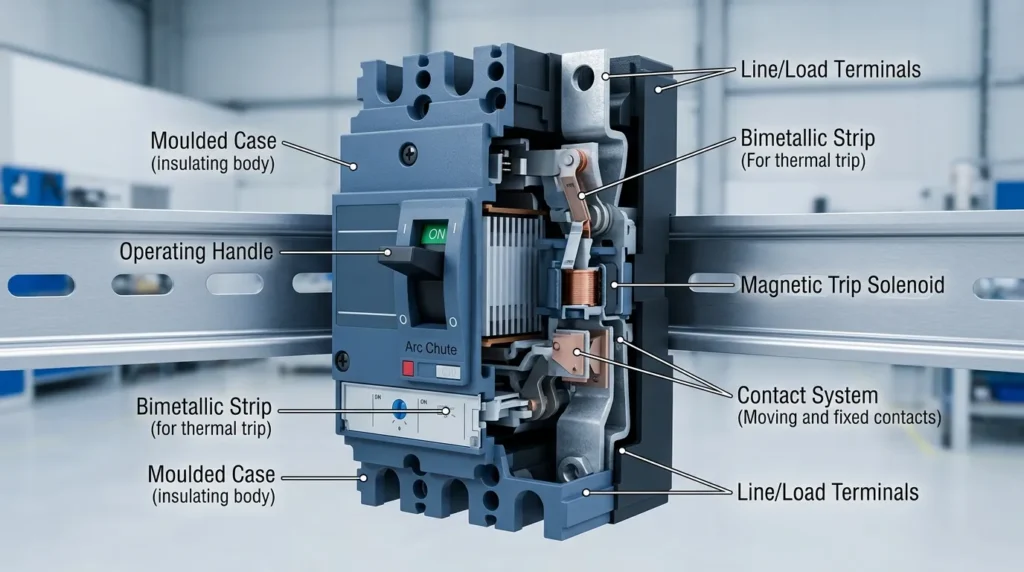
An MCCB consists of several important components that work together to provide reliable circuit protection. Understanding these parts helps students and technicians troubleshoot problems and select the right breaker for different applications.
Molded Case
The molded case is the strong outer body of the MCCB. It is made from high-quality insulating material that protects the internal components from dust, moisture, heat, and accidental contact.
It also provides mechanical strength, allowing the breaker to withstand harsh industrial environments.
Operating Handle
The operating handle is used to manually switch the MCCB ON or OFF.
It also indicates the status of the breaker. When a fault occurs, the handle moves to the trip position, making it easy to identify that the breaker has disconnected the circuit.
Fixed and Moving Contacts
The contacts are responsible for carrying electrical current during normal operation.
When the breaker trips, the moving contact separates from the fixed contact, interrupting the flow of electricity and protecting the circuit.
The contacts are manufactured from durable conductive materials to withstand repeated switching operations.
Arc Chute
Whenever the contacts open under load, an electric arc is produced.
The arc chute safely divides, cools, and extinguishes this arc before it can damage the contacts or other internal components.
Without an arc chute, interrupting high fault currents would be extremely dangerous.
Thermal Trip Unit
The thermal trip unit protects the circuit against overload conditions.
It contains a bimetallic strip that bends when heated by excessive current. If the overload continues for a certain period, the strip activates the trip mechanism and disconnects the circuit.
This delayed operation prevents unnecessary tripping during temporary current increases.
Magnetic Trip Unit
The magnetic trip unit provides instant protection against short circuits.
A sudden increase in current creates a powerful magnetic field that immediately releases the trip mechanism.
This rapid response helps prevent severe damage to electrical equipment.
Electronic Trip Unit
Many modern MCCBs use an electronic trip unit instead of only thermal and magnetic protection.
Electronic trip units use sensors and microprocessors to monitor current accurately. They allow adjustable protection settings and provide better coordination in complex electrical systems.
These trip units are commonly found in industrial plants, data centers, and commercial power distribution systems.
Terminals
The terminals provide secure electrical connections between the MCCB and the incoming and outgoing cables.
Proper tightening of the terminals is important because loose connections can generate heat and reduce the life of the breaker.
Advantages of MCCB
MCCBs offer several benefits that make them one of the most reliable protection devices for electrical systems.
- Protects circuits against overload and short-circuit faults.
- Handles much higher current ratings than standard MCBs.
- Available with adjustable trip settings for better system coordination.
- Provides fast and reliable fault isolation.
- Reduces the risk of electrical fires and equipment damage.
- Suitable for industrial, commercial, and large residential installations.
- Long service life with minimal maintenance.
- Easy to reset after a fault has been corrected.
- Available in different pole configurations for various systems.
- Can be used with electronic monitoring and automation systems.
Real-World Benefits
In a manufacturing plant, a single motor failure can stop an entire production line. An MCCB quickly isolates the faulty circuit, allowing the remaining equipment to continue operating safely. This reduces downtime, lowers maintenance costs, and improves workplace safety.
Disadvantages of MCCB
Although MCCBs are highly reliable, they also have some limitations.
- Higher initial cost than Miniature Circuit Breakers (MCBs).
- Larger physical size requires more panel space.
- Installation should be performed by qualified personnel.
- Adjustable settings require proper knowledge to avoid incorrect protection.
- Electronic trip models are more expensive than thermal-magnetic models.
- Oversized MCCBs may not provide adequate protection for smaller circuits.
Despite these limitations, the advantages usually outweigh the disadvantages in medium and high-power electrical systems.
MCCB Applications
Because of their high current capacity and reliable protection, MCCBs are used in many electrical installations.
Industrial Plants
Factories use MCCBs to protect motors, production equipment, conveyors, compressors, pumps, and heavy machinery from overloads and short circuits.
Commercial Buildings
Shopping malls, office buildings, hotels, airports, and hospitals use MCCBs in their main electrical distribution panels to ensure safe and reliable power distribution.
Power Distribution Panels
MCCBs are commonly installed in low-voltage distribution boards where they protect outgoing feeders and major electrical loads.
Motor Protection
Large electric motors draw high starting currents that cannot always be handled by standard MCBs.
MCCBs provide dependable protection while allowing temporary starting currents without unnecessary tripping.
Generator Protection
Generators require protection against overloads and fault currents.
An MCCB helps isolate generator faults quickly, reducing the risk of equipment damage.
Transformer Protection
Transformers represent a significant investment in any electrical system.
MCCBs protect transformer circuits from excessive current, helping extend transformer life and improve system reliability.
Solar Power Systems
Modern solar installations use MCCBs to protect inverters, distribution panels, and battery storage systems from electrical faults.
Data Centers
Reliable electrical protection is essential in data centers because even a brief interruption can affect servers and communication equipment.
Electronic MCCBs provide accurate protection and better coordination in these critical environments.
Difference Between MCCB and MCB
Although both devices protect electrical circuits, they are designed for different applications.
| Feature | MCCB | MCB |
|---|---|---|
| Full Form | Molded Case Circuit Breaker | Miniature Circuit Breaker |
| Current Rating | Up to 2500 A or more | Usually up to 125 A |
| Breaking Capacity | High | Lower |
| Trip Settings | Adjustable (many models) | Fixed |
| Applications | Industrial and commercial systems | Residential and light commercial circuits |
| Physical Size | Larger | Smaller |
| Cost | Higher | Lower |
| Motor Protection | Excellent | Limited |
| Maintenance | Low | Very low |
| Best For | Heavy electrical loads | Small household circuits |
Which One Should You Choose?
Choose an MCB for homes and small electrical loads where current requirements are relatively low.
Choose an MCCB for industrial machines, large commercial buildings, generators, transformers, and high-current electrical systems where adjustable protection and higher interrupting capacity are required.
MCCB Selection Guide
Selecting the correct MCCB is important for ensuring both electrical safety and reliable system performance.
Current Rating
Choose an MCCB with a current rating that matches the expected load current. Avoid selecting a breaker that is significantly larger or smaller than the actual requirement.
Breaking Capacity
The breaking capacity should always be greater than the maximum fault current that may occur in the system.
A breaker with insufficient breaking capacity may fail to interrupt a severe short circuit safely.
Voltage Rating
Ensure the voltage rating of the MCCB matches the system voltage.
Using an incorrect voltage rating can reduce protection performance and create safety risks.
Number of Poles
Select the appropriate pole configuration based on the electrical system:
- Single Pole (SP)
- Double Pole (DP)
- Triple Pole (TP)
- Four Pole (4P)
Three-pole and four-pole MCCBs are commonly used in three-phase industrial power systems.
Trip Unit Type
Choose the trip unit according to the application:
- Thermal Magnetic MCCB for general industrial and commercial protection.
- Electronic Trip MCCB for precise protection, adjustable settings, and critical installations.
Environmental Conditions
Consider the installation environment.
High temperatures, dust, humidity, vibration, and corrosive conditions may require an MCCB with a higher protection rating or a suitable enclosure.
Compliance with Standards
Always select an MCCB that complies with recognized international standards such as IEC or relevant national electrical standards. Certified products generally offer better reliability and safety.
Tips for Beginners
- Calculate the total connected load before selecting the breaker.
- Never oversize an MCCB simply to prevent nuisance tripping.
- Verify the short-circuit level of the electrical system.
- Select the correct number of poles for the application.
- Purchase MCCBs from reputable manufacturers with certified products.
- Follow local electrical codes and installation guidelines.
Below is Part 3, which continues directly after the MCCB Selection Guide section and completes the article.
Common MCCB Problems and Solutions
Like any electrical protection device, an MCCB can experience problems if it is incorrectly selected, improperly installed, or operated under abnormal conditions. Understanding these common issues helps technicians identify faults quickly and maintain a safe electrical system.
Why Does an MCCB Trip Frequently?
Frequent tripping is one of the most common issues with MCCBs.
Possible Causes
- Circuit overload
- Short circuit
- Ground fault
- Loose electrical connections
- Incorrect MCCB rating
- Faulty electrical equipment
Solutions
- Check whether the connected load exceeds the MCCB rating.
- Inspect the circuit for damaged cables or short circuits.
- Tighten all electrical terminals.
- Test connected equipment for faults.
- Replace the MCCB if it is damaged or has reached the end of its service life.
Why Does the MCCB Feel Hot?
It is normal for an MCCB to become slightly warm during operation. However, excessive heat usually indicates a problem.
Possible Causes
- Loose cable connections
- Overloaded circuit
- Poor ventilation inside the panel
- Undersized MCCB
- High ambient temperature
Solutions
- Tighten all terminal connections.
- Reduce the connected electrical load if necessary.
- Improve airflow inside the electrical panel.
- Install an MCCB with the correct current rating.
- Keep the panel clean and free from dust buildup.
MCCB Will Not Reset
Sometimes the operating handle cannot be moved back to the ON position after a trip.
Possible Causes
- The electrical fault still exists.
- Internal damage to the breaker.
- Mechanical locking mechanism has not fully reset.
Solutions
- Identify and remove the fault before resetting.
- Move the handle completely to the OFF position first.
- Inspect the breaker for visible damage.
- Replace the MCCB if it fails to reset properly.
MCCB Trips Immediately After Switching ON
If the breaker trips as soon as power is restored, a serious fault may still be present.
Possible Causes
- Short circuit
- Ground fault
- Incorrect wiring
- Damaged electrical equipment
Solutions
- Disconnect the load and test each circuit individually.
- Inspect wiring for damaged insulation.
- Check motors, transformers, and other equipment.
- Use insulation resistance testing if necessary.
Unusual Noise Inside the MCCB
Buzzing or clicking sounds should not be ignored.
Possible Causes
- Loose terminals
- Damaged contacts
- Internal mechanical wear
- Electrical arcing
Solutions
- Switch off the power safely.
- Tighten electrical connections.
- Inspect the breaker for wear or burning.
- Replace damaged MCCBs immediately.
Can an MCCB Be Repaired?
Minor maintenance such as cleaning terminals and tightening connections is possible.
However, if the internal trip mechanism, contacts, or molded case is damaged, replacing the MCCB is usually safer and more reliable than attempting repairs.
Future Trends in MCCB Technology
Electrical protection technology continues to improve as industries adopt smarter and more energy-efficient systems. Modern MCCBs are becoming more intelligent, reliable, and easier to monitor.
Smart MCCBs
Many manufacturers now offer smart MCCBs with built-in communication features.
These breakers can send real-time operating data to building management systems or industrial control systems, allowing engineers to monitor electrical performance remotely.
Digital Monitoring
Modern MCCBs can provide information such as:
- Load current
- Voltage
- Power consumption
- Fault history
- Trip events
- System status
This data helps maintenance teams detect problems before they become serious.
IoT Integration
Internet of Things (IoT) technology allows MCCBs to connect with cloud-based monitoring platforms.
Engineers can receive instant alerts on computers or mobile devices whenever abnormal electrical conditions occur.
Improved Safety Features
New-generation MCCBs include enhanced protection functions such as:
- Better arc fault protection
- Improved ground fault detection
- Higher breaking capacities
- Faster trip response
- Increased operational reliability
These features reduce equipment damage and improve workplace safety.
Energy Management
Modern industries are placing greater emphasis on energy efficiency.
Advanced MCCBs help monitor electrical loads, identify energy waste, and improve power distribution, making them valuable tools for energy management systems.
Compact Designs
Manufacturers continue to develop smaller MCCBs with higher performance.
Compact designs save valuable panel space while maintaining excellent protection capabilities.
Frequently Asked Questions (FAQs)
What is the full form of MCCB?
MCCB stands for Molded Case Circuit Breaker.
What is the main purpose of an MCCB?
Its main purpose is to protect electrical circuits from overloads, short circuits, and other fault conditions by automatically disconnecting the power supply.
What is the difference between MCCB and MCB?
An MCCB handles higher current ratings, offers adjustable trip settings, and is mainly used in industrial and commercial systems. An MCB is designed for lower current applications, such as residential electrical circuits.
Can an MCCB be used in a house?
Yes, but it is generally used only in large residential buildings or where higher electrical loads require greater protection. Standard homes typically use MCBs.
How long does an MCCB last?
A high-quality MCCB can last many years when correctly selected, properly installed, and regularly maintained. Its lifespan depends on operating conditions, switching frequency, and maintenance practices.
Can an MCCB be reset after tripping?
Yes. After identifying and correcting the fault, the MCCB can usually be reset manually by moving the handle to the OFF position and then back to the ON position.
Conclusion
An MCCB (Molded Case Circuit Breaker) is one of the most important electrical protection devices used in industrial, commercial, and large power distribution systems. It protects equipment from overloads, short circuits, and other electrical faults while ensuring safe and reliable operation.
Understanding the MCCB working principle, types, main components, applications, and advantages and disadvantages helps students, engineers, and technicians choose the correct breaker for different electrical installations. Selecting the proper current rating, breaking capacity, voltage rating, and trip characteristics is essential for achieving maximum protection and long-term reliability.
As electrical systems become smarter and more connected, modern MCCBs continue to evolve with digital monitoring, electronic trip units, and remote communication features. By learning how MCCBs operate and applying proper installation and maintenance practices, you can improve electrical safety, reduce equipment downtime, and extend the life of valuable electrical assets.