
Imagine you plug a capacitor into an AC circuit and notice that the current does not behave like it does with a simple resistor. Sometimes it flows easily, and sometimes it seems restricted. This behavior is due to capacitive reactance, a key concept in AC electrical systems.
The Capacitive Reactance Formula helps engineers and technicians understand how capacitors oppose alternating current. It is extremely important in designing filters, power systems, and electronic circuits. Without understanding this concept, it becomes difficult to work with AC circuits effectively.
In this article, you will learn:
- What capacitive reactance is
- The capacitive reactance formula working principle
- Types and classification
- Practical applications in real systems
- Advantages and disadvantages
- Troubleshooting and future trends
This guide is written in simple, clear English so beginners and professionals can easily understand and apply the concept.
2. What is Capacitive Reactance Formula?
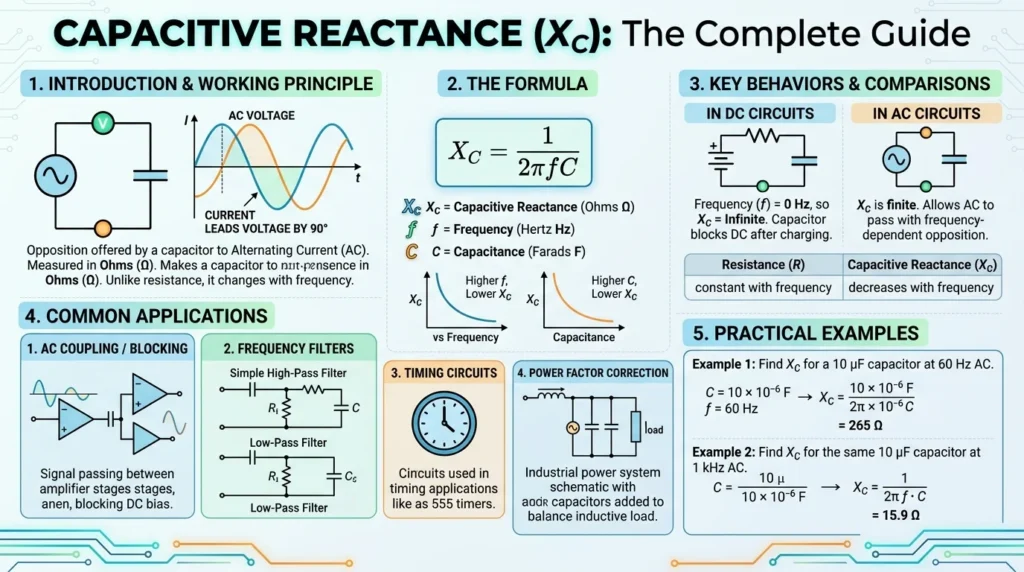
Capacitive reactance is the opposition that a capacitor offers to alternating current (AC).
The Capacitive Reactance Formula is:
X_c = \frac{1}{2\pi f C}
Where:
- (X_c) = Capacitive Reactance (Ohms)
- (f) = Frequency (Hertz)
- (C) = Capacitance (Farads)
Simple Explanation
- Higher frequency → lower reactance
- Higher capacitance → lower reactance
Practical Example
If:
- Frequency = 50 Hz
- Capacitance = 10 µF
Then reactance will be low, allowing more current to pass.
3. Working Principle
The capacitive reactance formula working principle is based on how capacitors store and release energy.
Step-by-Step Explanation
- AC voltage is applied to a capacitor
- The capacitor charges and discharges continuously
- This creates opposition to current flow
- The opposition is called capacitive reactance
Easy Analogy
Think of a capacitor like a flexible membrane:
- It allows movement (AC)
- But resists sudden changes
Key Points
- Reactance decreases with higher frequency
- Reactance decreases with higher capacitance
- Capacitors allow AC but block DC
4. Types / Classification
Low Frequency Reactance
- High opposition to current
- Used in filtering applications
High Frequency Reactance
- Low opposition
- Allows signals to pass easily
Variable Reactance
- Changes based on frequency and capacitance
- Used in tuning circuits
5. Main Components
Capacitor
- Stores electrical energy
- Main component responsible for reactance
AC Source
- Provides alternating voltage
Frequency
- Determines how fast current changes
Circuit Path
- Allows current flow
6. Advantages
Capacitive Reactance Formula Advantages and Disadvantages (Advantages)
- Easy to calculate
- Useful in AC circuit design
- Helps control current flow
- Essential for filters and tuning circuits
- Improves power factor in systems
- Supports efficient energy usage
7. Disadvantages / Limitations
- Only works in AC circuits
- Depends heavily on frequency
- Not useful for DC systems
- Can cause phase shift issues
- Requires accurate measurement
8. Applications
Capacitive Reactance Applications
Home Applications
- Fan regulators
- Power supply circuits
Industrial Applications
- Power factor correction
- Motor control systems
Modern Technology
- Signal processing
- Communication systems
- Electronic filters
9. Comparison Section
Difference Between Capacitive Reactance and Inductive Reactance
| Feature | Capacitive Reactance | Inductive Reactance |
|---|---|---|
| Formula | 1 / (2πfC) | 2πfL |
| Behavior | Decreases with frequency | Increases with frequency |
| Component | Capacitor | Inductor |
| Current | Leads voltage | Lags voltage |
10. Selection Guide
How to Use Capacitive Reactance Formula
- Identify frequency value
- Check capacitor rating
- Use correct units
- Apply formula carefully
Tips for Beginners
- Start with simple calculations
- Practice with real examples
- Use calculators for accuracy
11. Common Problems & Solutions
Q1: Why is reactance too high?
Solution: Increase capacitance or frequency.
Q2: Why is current not flowing?
Solution: Check if frequency is too low.
Q3: Why is circuit unstable?
Solution: Verify capacitor value.
Q4: How to measure reactance?
Solution: Use formula or AC measurement tools.
12. Future Trends
- Smart capacitors
- Advanced power electronics
- Renewable energy systems
- AI-based circuit design
Capacitive reactance will remain important in modern electrical engineering.
13. Conclusion
The Capacitive Reactance Formula is a fundamental concept in AC circuit analysis. It explains how capacitors resist current and how frequency affects circuit behavior.
By understanding the capacitive reactance working principle, types, and applications, you can design better electrical systems and troubleshoot problems efficiently. This knowledge is essential for students, engineers, and technicians.
Keep practicing and applying these concepts in real circuits. With time, you will gain confidence and expertise in handling AC systems.