
Imagine an electrician installing a new air conditioner in a home or an engineer testing a large industrial motor in a factory. In both situations, measuring electrical power accurately is essential to ensure the equipment operates efficiently and safely. This is where single-phase and three-phase wattmeters play an important role. These instruments help measure the real power consumed by electrical loads, making them indispensable in electrical testing, maintenance, and energy management.
Understanding single-phase and three-phase wattmeters is important for electrical students, engineers, technicians, and beginners because power measurement is a fundamental part of electrical engineering. Whether working with household appliances or large industrial machines, choosing the correct wattmeter ensures accurate power readings and reliable system performance.
In this guide, you will learn what single-phase and three-phase wattmeters are, their working principle, different types, components, advantages, disadvantages, applications, comparison, selection tips, troubleshooting methods, and future developments. By the end of this article, you will have a clear understanding of how these wattmeters work and where they are used in modern electrical systems.
What are Single-Phase and Three-Phase Wattmeters?
A single-phase and three-phase wattmeter is an electrical measuring instrument used to determine the real (active) power consumed by electrical circuits. The type of wattmeter used depends on whether the electrical system is a single-phase or a three-phase power supply.
A single-phase wattmeter measures power in single-phase electrical circuits commonly found in homes, offices, and small commercial buildings. A three-phase wattmeter measures power in three-phase systems used in industries, factories, power plants, and large commercial facilities.
Unlike voltmeters or ammeters, which measure only voltage or current, wattmeters calculate the actual electrical power by combining both voltage and current measurements while considering their phase relationship.
Simple Explanation
In simple words, a wattmeter tells you how much electrical power a device is actually using. It measures the energy being converted into useful work, such as running a motor, lighting a lamp, or operating an electrical machine.
Think of electricity like water flowing through a pipe:
- Voltage is the water pressure.
- Current is the amount of water flowing.
- Power is the useful work done by the flowing water.
A wattmeter measures this useful electrical work.
Practical Example
Here are some everyday examples of wattmeter use:
- Measuring the power consumed by an electric heater in a house.
- Testing the power input of an air conditioner.
- Checking the efficiency of an industrial induction motor.
- Measuring generator output during commissioning.
- Monitoring electrical equipment in power distribution panels.
Whether the circuit is small or large, a wattmeter provides valuable information about electrical power consumption.
Single-Phase and Three-Phase Wattmeters Working Principle
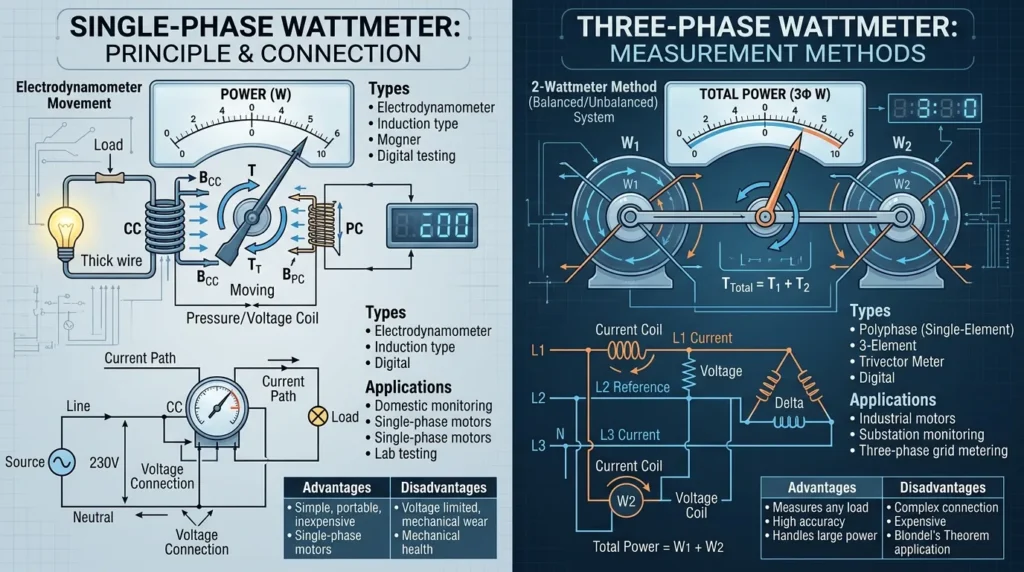
The single-phase and three-phase wattmeters working principle is based on measuring both voltage and current simultaneously and determining the real electrical power consumed by the connected load.
A wattmeter contains two important coils:
- Current Coil (CC)
- Potential (Voltage) Coil (PC)
The current coil carries the load current, while the potential coil is connected across the supply voltage. The interaction of the magnetic fields produced by these two coils creates a force that is proportional to the actual power consumed by the load.
The greater the electrical power, the greater the deflecting force, resulting in a higher reading on the scale or digital display.
Step-by-Step Working Process
Step 1: Connect the Current Coil
The current coil is connected in series with the electrical load.
Its function is to carry the same current flowing through the circuit.
Step 2: Connect the Potential Coil
The voltage coil is connected in parallel across the power supply.
It continuously measures the supply voltage applied to the load.
Step 3: Magnetic Fields Are Produced
When electricity flows:
- The current coil creates one magnetic field.
- The voltage coil creates another magnetic field.
These two magnetic fields interact inside the wattmeter.
Step 4: Electromagnetic Force is Produced
The interaction between the two magnetic fields generates a mechanical force.
This force is directly proportional to:
- Supply voltage
- Load current
- Power factor
Therefore, the wattmeter measures real electrical power, not just voltage or current.
Step 5: Display the Power Reading
The moving system rotates according to the generated force.
The pointer (analog wattmeter) or electronic display (digital wattmeter) indicates the power consumed by the electrical load.
The reading is usually displayed in:
- Watts (W)
- Kilowatts (kW)
- Megawatts (MW)
depending on the application.
Working Principle of a Single-Phase Wattmeter
A single-phase wattmeter measures power in circuits supplied by a single alternating current (AC) source.
The instrument calculates power using:
- Voltage across the load
- Current through the load
- Phase angle between voltage and current
It is commonly used for:
- Residential wiring
- Household appliances
- Small workshops
- Educational laboratories
- Office electrical systems
Working Principle of a Three-Phase Wattmeter
A three-phase wattmeter measures power in three-phase electrical systems.
Since three-phase systems have three conductors carrying power, the wattmeter measures the combined power supplied to all phases.
Depending on the system configuration, different measurement methods are used, such as:
- One-wattmeter method
- Two-wattmeter method
- Three-wattmeter method
These methods provide accurate power measurement for balanced and unbalanced three-phase loads.
Three-phase wattmeters are commonly used in:
- Manufacturing industries
- Power generation stations
- Distribution substations
- Motor testing laboratories
- Large commercial buildings
Simple Analogy
Imagine pushing a heavy shopping cart.
- Voltage is like your pushing force.
- Current is how fast the cart moves.
- Power is the actual work done in moving the cart.
A wattmeter measures the useful work being performed, not just the pushing force or movement alone.
Key Principles
The operation of both single-phase and three-phase wattmeters depends on several important principles:
- Measure voltage and current simultaneously.
- Calculate real (active) power.
- Consider the power factor during measurement.
- Use current and potential coils for accurate operation.
- Display power directly in watts or kilowatts.
- Provide reliable readings for electrical testing and energy monitoring.
Understanding the single-phase and three-phase wattmeters working principle helps electrical students, engineers, and technicians accurately measure electrical power, evaluate equipment performance, improve energy efficiency, and troubleshoot electrical systems safely.
Types of Single-Phase and Three-Phase Wattmeters
Single-phase and three-phase wattmeters are available in different designs to suit various electrical systems and measurement requirements. The choice of wattmeter depends on factors such as the type of power supply, measurement accuracy, load capacity, and application. Understanding the different types helps engineers and technicians select the most suitable instrument for accurate power measurement.
1. Single-Phase Wattmeter
A single-phase wattmeter is designed to measure the real power consumed in a single-phase AC circuit. It contains one current coil and one potential (voltage) coil, which work together to measure electrical power accurately.
Single-phase wattmeters are commonly used in residential, educational, and small commercial electrical systems where only one phase supplies power. They are easy to connect, simple to operate, and provide reliable measurements for low- and medium-power applications.
Features
- Measures real power in single-phase circuits
- Simple construction
- Easy installation and operation
- High measurement accuracy
- Available in analog and digital models
Common Applications
- Household appliances
- Residential electrical wiring
- Office equipment
- Educational laboratories
- Small electrical workshops
- UPS and inverter testing
2. Three-Phase Wattmeter
A three-phase wattmeter is designed to measure the total real power consumed in a three-phase electrical system. It is widely used in industrial and commercial installations where heavy electrical loads operate on three-phase power.
Depending on the type of load and wiring configuration, three-phase power can be measured using one, two, or three wattmeters.
Features
- Measures total power in three-phase systems
- Suitable for balanced and unbalanced loads
- High accuracy for industrial applications
- Supports high-voltage and high-current measurements
- Available in analog and digital versions
Common Applications
- Industrial motors
- Manufacturing plants
- Power stations
- Electrical substations
- Commercial buildings
- Heavy machinery testing
3. Analog Wattmeter
An analog wattmeter uses a moving pointer and calibrated scale to indicate the measured power. It operates on the electrodynamic principle and has been used for many years in electrical laboratories and industrial testing.
Although digital wattmeters are becoming more popular, analog models are still used in educational institutions and certain industrial applications.
Features
- Pointer-type display
- No external power supply required (for many models)
- Rugged construction
- Simple operation
- Suitable for laboratory demonstrations
Advantages
- Easy to understand
- Durable construction
- Reliable for basic measurements
- Cost-effective
4. Digital Wattmeter
A digital wattmeter uses electronic circuits and a microprocessor to calculate and display electrical power. It provides higher accuracy and additional measurement functions compared to analog wattmeters.
Digital wattmeters often measure multiple electrical parameters simultaneously, making them ideal for modern electrical systems.
Features
- LCD or LED digital display
- High measurement accuracy
- Automatic calculations
- Fast response time
- Data storage and communication options (advanced models)
Advantages
- Highly accurate readings
- Easy-to-read display
- Automatic range selection
- Reduced reading errors
- Suitable for advanced electrical testing
5. Electrodynamic Wattmeter
The electrodynamic wattmeter is one of the most common traditional wattmeters. It operates using the interaction between the magnetic fields produced by the current coil and the voltage coil.
It is widely used for measuring both AC and DC power because of its good accuracy and stable performance.
Features
- Measures AC and DC power
- Uses moving coil mechanism
- Good measurement precision
- Suitable for laboratory applications
Common Applications
- Calibration laboratories
- Educational institutions
- Electrical testing laboratories
- Instrument calibration
6. Induction Wattmeter
An induction wattmeter operates on the principle of electromagnetic induction. It is designed specifically for AC power measurement and cannot be used with DC circuits.
It is mainly found in older electrical installations and specialized industrial applications.
Features
- AC power measurement only
- Electromagnetic induction operation
- Smooth pointer movement
- Good reliability
Applications
- AC power systems
- Older industrial equipment
- Electrical testing laboratories
7. Portable Wattmeter
A portable wattmeter is lightweight and designed for field measurements. It is commonly used by maintenance engineers, electricians, and service technicians who need to perform on-site electrical inspections.
Features
- Compact size
- Battery-operated (digital models)
- Easy transportation
- Quick measurements
- Rugged protective housing
Applications
- Field maintenance
- Electrical inspections
- Troubleshooting
- Equipment servicing
- Preventive maintenance
Main Components of Single-Phase and Three-Phase Wattmeters
A wattmeter consists of several important components that work together to measure electrical power accurately. Each component has a specific function that contributes to the overall performance, accuracy, and safety of the instrument.
1. Current Coil (Series Coil)
The current coil is connected in series with the electrical load so that the entire load current flows through it. It is made from thick copper wire with very low resistance to minimize power loss.
Functions
- Carries the load current
- Produces a magnetic field
- Works with the voltage coil
- Helps determine real power
2. Potential Coil (Voltage Coil)
The potential coil is connected in parallel across the supply voltage. It is wound with fine wire and has high resistance to draw only a small amount of current.
Functions
- Measures supply voltage
- Produces a magnetic field
- Interacts with the current coil
- Contributes to power calculation
3. Moving System
The moving system responds to the interaction between the magnetic fields of the current and voltage coils. In analog wattmeters, it carries the pointer across the calibrated scale.
Functions
- Converts electromagnetic force into mechanical movement
- Moves the pointer smoothly
- Indicates measured power
4. Pointer and Scale (Analog Wattmeter)
The pointer moves over a calibrated scale to indicate the measured electrical power.
Functions
- Displays power reading
- Allows direct measurement in watts or kilowatts
- Provides visual indication of power consumption
5. Digital Display (Digital Wattmeter)
Digital wattmeters replace the pointer with an LCD or LED display.
Functions
- Shows accurate numerical readings
- Displays measurement units
- Reduces reading errors
- Improves visibility
6. Control Springs
Control springs provide the restoring force needed to return the moving system to its zero position when no current flows.
Functions
- Maintains pointer balance
- Ensures accurate measurement
- Returns the pointer to zero
7. Damping System
The damping system prevents excessive pointer oscillation and helps the pointer settle quickly.
Functions
- Reduces vibration
- Stabilizes the pointer
- Improves reading accuracy
8. Protective Housing
The outer casing protects the internal components from dust, moisture, accidental impacts, and environmental damage.
Functions
- Protects internal parts
- Improves durability
- Enhances user safety
- Extends instrument life
9. Input Terminals
Input terminals provide secure electrical connections for voltage and current circuits.
Functions
- Connect measurement leads
- Ensure safe electrical contact
- Provide reliable signal transmission
Each of these components plays a crucial role in ensuring that single-phase and three-phase wattmeters deliver accurate, reliable, and safe power measurements in residential, commercial, industrial, and laboratory applications.
Advantages of Single-Phase and Three-Phase Wattmeters
Understanding the single-phase and three-phase wattmeters advantages and disadvantages helps users select the right instrument for accurate electrical power measurement. These wattmeters are essential tools for monitoring energy consumption, testing electrical equipment, and improving system efficiency in residential, commercial, and industrial applications.
Advantages
Single-phase and three-phase wattmeters offer numerous benefits that make them indispensable in modern electrical engineering.
1. Accurate Power Measurement
The primary advantage of a wattmeter is its ability to measure real (active) power accurately. Unlike voltmeters and ammeters, which measure only voltage or current, a wattmeter combines both measurements to calculate actual power consumption.
Benefits
- High measurement accuracy
- Reliable power monitoring
- Better energy analysis
- Reduced calculation errors
2. Suitable for Different Electrical Systems
Single-phase wattmeters are ideal for residential applications, while three-phase wattmeters are designed for industrial and commercial electrical systems.
Benefits
- Supports both single-phase and three-phase circuits
- Wide range of applications
- Flexible power measurement
- Suitable for various electrical loads
3. Improves Energy Efficiency
Accurate power measurement helps identify equipment that consumes excessive electricity. This enables users to improve efficiency and reduce unnecessary energy costs.
Benefits
- Lower electricity bills
- Better energy management
- Reduced power wastage
- Improved system performance
4. Helps in Electrical Troubleshooting
Technicians use wattmeters to diagnose abnormal power consumption, overloaded equipment, and inefficient electrical systems.
Benefits
- Faster fault identification
- Easier maintenance
- Reduced equipment downtime
- Improved troubleshooting accuracy
5. Supports Preventive Maintenance
Regular power measurements allow maintenance teams to detect performance changes before equipment failure occurs.
Benefits
- Early fault detection
- Longer equipment lifespan
- Reduced maintenance costs
- Increased system reliability
6. Easy to Operate
Modern digital wattmeters feature user-friendly interfaces, automatic ranging, and clear displays, making them suitable even for beginners.
Benefits
- Simple operation
- Easy reading of measurements
- Faster testing
- Reduced operator errors
7. Wide Measurement Range
Wattmeters are available in different voltage and current ratings, allowing them to measure power in small household appliances as well as large industrial machines.
Benefits
- Suitable for low and high power systems
- Flexible measurement capability
- Industrial-grade performance
8. Available in Analog and Digital Models
Users can choose between traditional analog wattmeters and advanced digital wattmeters depending on their application and budget.
Benefits
- Multiple design options
- Cost-effective solutions
- High-precision digital measurements
- Rugged analog construction
9. Essential for Electrical Education
Electrical students use wattmeters to understand electrical power concepts through practical experiments.
Benefits
- Improves practical learning
- Supports laboratory experiments
- Builds troubleshooting skills
- Enhances technical knowledge
10. Reliable for Industrial Monitoring
Three-phase wattmeters continuously monitor power consumption in factories, helping industries improve operational efficiency.
Benefits
- Continuous power monitoring
- Improved production efficiency
- Better equipment management
- Supports energy audits
Disadvantages / Limitations of Single-Phase and Three-Phase Wattmeters
Although wattmeters are highly useful measuring instruments, they also have some practical limitations. Understanding these disadvantages helps users operate them correctly and avoid measurement errors.
1. Higher Cost for Advanced Models
Digital and industrial-grade wattmeters are more expensive than basic electrical measuring instruments.
Limitation
- Higher initial investment
- Increased maintenance cost for advanced models
2. Incorrect Connections Can Cause Errors
Improper connection of the current coil or potential coil can produce incorrect readings or damage the instrument.
Limitation
- Requires correct wiring
- Needs trained operators
- Risk of inaccurate measurements
3. Analog Models Have Reading Errors
Analog wattmeters may suffer from parallax errors because the pointer must be viewed from the correct angle.
Limitation
- Lower reading precision
- Human observation errors
- Less suitable for high-accuracy measurements
4. Sensitive to Environmental Conditions
Extreme temperatures, dust, moisture, and vibration can affect measurement accuracy.
Limitation
- Requires proper installation
- Needs periodic maintenance
- Environmental protection may be necessary
5. Calibration Is Required
To maintain accuracy, wattmeters should be calibrated at regular intervals.
Limitation
- Additional maintenance
- Calibration costs
- Requires standard testing equipment
6. Limited Application of Single-Phase Wattmeters
Single-phase wattmeters cannot accurately measure power in three-phase electrical systems.
Limitation
- Restricted to single-phase circuits
- Not suitable for industrial power systems
7. Three-Phase Wattmeters Are More Complex
Three-phase power measurement often requires multiple connections and proper understanding of electrical systems.
Limitation
- More complicated installation
- Requires technical knowledge
- Longer setup time
8. Mechanical Wear in Analog Models
Moving parts inside analog wattmeters can wear over time, affecting long-term accuracy.
Limitation
- Mechanical maintenance required
- Reduced lifespan under harsh conditions
Applications of Single-Phase and Three-Phase Wattmeters
The single-phase and three-phase wattmeters applications cover residential, commercial, industrial, educational, and renewable energy sectors. They are used wherever accurate electrical power measurement is required.
Home Applications
Single-phase wattmeters are commonly used in homes to monitor electrical power consumption and troubleshoot household appliances.
Common Home Applications
- Measuring power consumed by air conditioners
- Testing refrigerators
- Monitoring electric heaters
- Checking washing machines
- Measuring microwave oven power
- Testing home inverters
- UPS performance testing
These applications help homeowners improve energy efficiency and reduce electricity costs.
Commercial Applications
Commercial buildings use wattmeters to monitor electrical loads and improve power management.
Common Commercial Applications
- Office buildings
- Shopping malls
- Hotels
- Hospitals
- Schools
- Data centers
- Commercial kitchens
Industrial Applications
Three-phase wattmeters are widely used in industries because most industrial equipment operates on three-phase power.
Common Industrial Applications
- Electric motor testing
- Generator performance monitoring
- Transformer testing
- Manufacturing plants
- Power distribution panels
- Industrial automation systems
- Production line monitoring
- Electrical maintenance departments
Power Generation and Distribution Applications
Power utilities use wattmeters to monitor power generation, transmission, and distribution.
Applications
- Power plants
- Electrical substations
- Grid stations
- Renewable energy plants
- Load testing
- Energy management systems
Renewable Energy Applications
Modern renewable energy systems require continuous power monitoring for maximum efficiency.
Applications
- Solar power systems
- Wind turbines
- Hybrid power plants
- Battery energy storage systems
- Solar inverter testing
Educational and Laboratory Applications
Electrical engineering laboratories use wattmeters for practical training and research.
Applications
- Engineering colleges
- Technical institutes
- Research laboratories
- Instrument calibration centers
- Student practical experiments
Modern Technology Applications
Advanced digital wattmeters are now integrated into smart electrical systems.
Applications
- Smart grids
- Building automation
- IoT-based energy monitoring
- Electric vehicle charging stations
- Smart factories
- Data logging systems
Comparison: Single-Phase vs Three-Phase Wattmeters
| Feature | Single-Phase Wattmeter | Three-Phase Wattmeter |
|---|---|---|
| Power System | Single-phase AC | Three-phase AC |
| Number of Phases Measured | One | Three |
| Main Application | Homes and small businesses | Industries and power systems |
| Circuit Complexity | Simple | More complex |
| Installation | Easy | Moderate to complex |
| Measurement Accuracy | High | High for industrial loads |
| Equipment Tested | Household appliances | Motors, generators, transformers |
| Cost | Lower | Higher |
| Maintenance | Simple | Requires skilled maintenance |
| Typical Users | Students, electricians, homeowners | Engineers, industrial technicians, utilities |
This comparison highlights the difference between single-phase and three-phase wattmeters, helping users choose the appropriate instrument based on their electrical system and application.
Selection Guide: How to Choose the Right Single-Phase and Three-Phase Wattmeter
Selecting the right wattmeter is essential for obtaining accurate power measurements, ensuring electrical safety, and improving system efficiency. The ideal wattmeter depends on the type of electrical system, measurement accuracy, operating environment, and intended application. Whether you are an electrical student, technician, engineer, or maintenance professional, choosing the correct wattmeter will help you perform reliable power measurements.
1. Identify the Electrical System
The first step is to determine whether you are working with a single-phase or three-phase electrical supply.
Single-Phase Systems
A single-phase wattmeter is suitable for:
- Residential wiring
- Household appliances
- Small offices
- Educational laboratories
- Small commercial equipment
Three-Phase Systems
A three-phase wattmeter is recommended for:
- Industrial motors
- Manufacturing plants
- Power substations
- Generator testing
- Commercial buildings
- Heavy electrical machinery
Always match the wattmeter to the electrical system for accurate results.
2. Check the Voltage and Current Ratings
Choose a wattmeter that can safely measure the maximum voltage and current of your electrical circuit.
Consider:
- Rated AC voltage
- Rated current
- Maximum overload capacity
- Frequency compatibility
Using an underrated wattmeter may damage the instrument and create safety hazards.
3. Select the Required Accuracy
Different applications require different levels of measurement accuracy.
Basic Applications
Suitable for:
- Home maintenance
- Educational purposes
- Routine inspections
Professional Applications
Recommended for:
- Industrial maintenance
- Laboratory testing
- Energy audits
- Equipment commissioning
- Calibration work
Higher accuracy reduces measurement errors and improves decision-making.
4. Choose Between Analog and Digital Wattmeters
Both analog and digital wattmeters have their own advantages.
Analog Wattmeter
Best for:
- Educational laboratories
- Basic electrical measurements
- Rugged industrial environments
Digital Wattmeter
Best for:
- High-accuracy measurements
- Industrial monitoring
- Energy management
- Smart electrical systems
- Data recording
Digital wattmeters generally provide faster readings and additional measurement features.
5. Consider Additional Features
Modern digital wattmeters include advanced functions that improve performance and convenience.
Useful features include:
- Auto-ranging
- Backlit LCD display
- Data Hold function
- True power measurement
- USB or communication interface
- Data logging
- Power factor measurement
- Voltage and current display
- Frequency measurement
- Energy monitoring
Choose features that match your application without paying for functions you do not need.
6. Evaluate Build Quality
For industrial environments, select a wattmeter with a durable construction.
Look for:
- Strong protective housing
- Dust-resistant design
- Shock-resistant casing
- Heat-resistant materials
- High-quality input terminals
A robust wattmeter provides reliable performance even in demanding working conditions.
7. Consider Safety Features
Electrical safety should always be a priority.
Look for:
- Proper insulation
- Overload protection
- Fused input terminals
- High-quality test leads
- Certified safety standards
These features help protect both the user and the instrument.
8. Budget Considerations
Choose a wattmeter that offers the best balance between performance, accuracy, and cost.
General Recommendations
- Students: Basic analog or digital wattmeter
- Electricians: Standard digital wattmeter
- Industrial technicians: Professional digital wattmeter
- Engineers: High-precision industrial wattmeter with advanced features
Avoid choosing the cheapest model if it compromises safety or accuracy.
Tips for Beginners
- Select the correct wattmeter for the electrical system.
- Verify voltage and current ratings before connecting.
- Read the user manual carefully.
- Ensure all electrical connections are secure.
- Never exceed the instrument’s rated capacity.
- Disconnect power before changing wiring connections.
- Calibrate the wattmeter periodically.
- Use appropriate personal protective equipment (PPE) when working on live circuits.
Following these guidelines ensures accurate measurements and safe operation.
Common Problems & Solutions
Like any measuring instrument, wattmeters may experience operational issues due to incorrect connections, faulty components, or environmental conditions. Understanding these common problems helps users troubleshoot quickly and maintain accurate power measurements.
Q1: Why is the wattmeter showing no reading?
Possible Causes
- No power supply
- Loose wiring
- Incorrect connections
- Blown fuse
- Internal component failure
Solution
- Check the power supply.
- Tighten all electrical connections.
- Verify the current and voltage coil wiring.
- Replace the fuse if necessary.
- Inspect the instrument for internal faults.
Q2: Why is the reading unstable?
Possible Causes
- Loose terminals
- Electrical noise
- Fluctuating supply voltage
- Vibrations
Solution
- Tighten all terminals.
- Ensure stable power supply.
- Reduce electrical interference.
- Install the wattmeter securely.
Q3: Why is the wattmeter giving incorrect readings?
Possible Causes
- Wrong wiring
- Incorrect range selection
- Calibration error
- Damaged current or voltage coil
Solution
- Recheck wiring connections.
- Select the correct measurement range.
- Calibrate the instrument.
- Replace damaged components if required.
Q4: Why does the pointer not return to zero? (Analog Wattmeter)
Possible Causes
- Mechanical friction
- Damaged control spring
- Dirt inside the mechanism
Solution
- Clean the instrument.
- Adjust the zero setting.
- Replace damaged mechanical parts if necessary.
Q5: Why does the digital display remain blank?
Possible Causes
- No supply voltage
- Internal circuit fault
- Display failure
- Power supply problem
Solution
- Verify the power source.
- Check the display connections.
- Replace faulty electronic components if required.
Q6: Can a single-phase wattmeter measure three-phase power?
Answer
No. A single-phase wattmeter is designed only for single-phase circuits. Three-phase power measurement requires a dedicated three-phase wattmeter or approved one-, two-, or three-wattmeter measurement methods.
Q7: How often should a wattmeter be calibrated?
For the best accuracy, wattmeters should be calibrated once every 12 months or according to the manufacturer’s recommendations. Instruments used in critical industrial applications may require more frequent calibration.
Future Trends in Single-Phase and Three-Phase Wattmeters
Power measurement technology continues to evolve with the growth of smart grids, renewable energy systems, and industrial automation. Modern wattmeters are becoming more intelligent, accurate, and connected than ever before.
Smart Digital Wattmeters
New-generation wattmeters feature:
- High-speed processors
- Touchscreen displays
- Automatic calculations
- Remote monitoring
- Improved measurement accuracy
IoT-Enabled Power Monitoring
Modern wattmeters can connect to Internet of Things (IoT) platforms, enabling real-time monitoring of electrical systems from anywhere.
Benefits
- Remote diagnostics
- Live power monitoring
- Predictive maintenance
- Centralized energy management
Wireless Communication
Advanced wattmeters support:
- Bluetooth
- Wi-Fi
- Ethernet
- RS-485
- Modbus communication
These technologies simplify data collection and system integration.
Cloud-Based Energy Management
Power measurement data can now be stored securely in cloud platforms for long-term analysis.
Advantages
- Historical performance tracking
- Remote access
- Automatic report generation
- Improved energy optimization
Integration with Smart Grids
Future wattmeters will play a vital role in smart electrical grids by providing accurate, real-time power measurements that improve grid reliability and energy distribution.
Renewable Energy Monitoring
As solar and wind energy installations continue to grow, wattmeters are increasingly used to monitor:
- Solar photovoltaic systems
- Wind turbines
- Battery energy storage systems
- Hybrid renewable energy plants
Artificial Intelligence and Predictive Analytics
Future wattmeters may include AI-powered features that can:
- Detect abnormal power consumption
- Predict equipment failures
- Recommend maintenance schedules
- Improve energy efficiency
Conclusion
Single-phase and three-phase wattmeters are essential instruments for measuring real electrical power accurately in residential, commercial, industrial, and utility applications. While single-phase wattmeters are ideal for homes and small electrical systems, three-phase wattmeters are designed for heavy industrial equipment, power plants, and distribution networks. Understanding the single-phase and three-phase wattmeters working principle, types, components, applications, and advantages and disadvantages enables electrical students, engineers, and technicians to choose the right instrument for every task. By selecting a suitable wattmeter, following proper installation procedures, and maintaining regular calibration, users can ensure accurate power measurements, improve energy efficiency, and enhance the reliability of electrical systems. As technology advances, smart and connected wattmeters will continue to play an increasingly important role in modern power monitoring and energy management.