
Imagine you are using a washing machine at home when an internal wire becomes damaged and starts leaking electricity to its metal body. At the same time, the appliance also draws excessive current because of the fault. If the electrical supply is not disconnected immediately, it could damage the appliance, trip other circuits, or even cause a serious electric shock.
This is where an RCBO (Residual Current Breaker with Overcurrent Protection) plays an important role. Unlike standard circuit breakers that protect only against overloads and short circuits, an RCBO also detects earth leakage currents. It combines the functions of an MCB and an RCCB into one compact device, providing complete protection for both people and electrical equipment.
Today, RCBOs are widely used in homes, offices, hospitals, commercial buildings, and industrial facilities because they improve electrical safety and reduce the risk of electrical accidents.
In this guide, you will learn what an RCBO is, the RCBO working principle, different types, main components, applications, advantages and disadvantages, and how to choose the right RCBO. Whether you are an electrical student, engineer, technician, or beginner, this article will help you understand RCBOs in a simple and practical way.
Quick Answer
An RCBO (Residual Current Breaker with Overcurrent Protection) is an electrical protection device that combines the functions of an MCB (Miniature Circuit Breaker) and an RCCB (Residual Current Circuit Breaker). It protects electrical circuits from overloads, short circuits, and earth leakage currents in a single device.
What Is RCBO?
An RCBO is an automatic circuit protection device designed to disconnect the electrical supply whenever it detects an unsafe condition.
Unlike an MCB, which protects only against overloads and short circuits, an RCBO also protects people from electric shock by detecting leakage current flowing to earth.
This makes the RCBO one of the safest circuit protection devices available for modern electrical installations.
Simple Definition
An RCBO is a combined protection device that offers:
- Overload protection
- Short-circuit protection
- Earth leakage protection
Because it performs all three functions, it eliminates the need to install separate MCB and RCCB devices in many electrical systems.
Practical Example
Suppose a damaged electric iron develops insulation failure and electricity begins leaking through its metal body.
If someone touches the iron, a dangerous electric shock could occur.
An RCBO detects this leakage current within milliseconds and disconnects the electrical supply before serious injury can happen.
At the same time, if the iron develops a short circuit or overload, the same RCBO will also disconnect the circuit.
This dual protection makes RCBOs extremely valuable in modern electrical installations.
RCBO Working Principle
The RCBO working principle is based on continuously monitoring both the electrical current flowing through the circuit and any leakage current flowing to earth.
Whenever it detects an unsafe condition, it automatically trips and disconnects the power supply.
The RCBO combines two different protection mechanisms into one device.
- Overcurrent protection
- Residual current (earth leakage) protection
Step 1: Normal Operation
During normal operation, electricity flows through the live and neutral conductors.
The amount of current leaving through the live wire is exactly equal to the amount returning through the neutral wire.
The RCBO continuously monitors this balance.
Step 2: Detecting Overload
If too many electrical appliances are connected to one circuit, the current gradually increases.
The thermal trip unit inside the RCBO heats up.
After reaching its preset limit, it activates the trip mechanism and disconnects the circuit.
This prevents overheating of cables and electrical equipment.
Step 3: Detecting a Short Circuit
A short circuit causes an extremely high current to flow almost instantly.
The magnetic trip unit reacts immediately.
Within milliseconds, the RCBO opens its contacts and interrupts the fault current before major damage occurs.
Step 4: Detecting Earth Leakage
Earth leakage protection is the main feature that makes an RCBO different from an MCB.
The RCBO constantly compares the current flowing through the live conductor with the current returning through the neutral conductor.
Under normal conditions, both values are equal.
If some current leaks to earth because of damaged insulation or accidental human contact, the RCBO detects the imbalance.
When the leakage current reaches its rated sensitivity (for example 30 mA), the breaker trips immediately.
Step 5: Arc Extinguishing
As the electrical contacts separate, an electric arc forms between them.
The internal arc chute safely cools and extinguishes the arc, preventing damage to the breaker.
Step 6: Manual Reset
After the electrical fault has been identified and corrected, the RCBO can be reset manually.
The operating handle is moved back to the ON position to restore the electrical supply.
RCBO Working Process Summary
- Electricity flows normally through the circuit.
- The RCBO continuously monitors current.
- Thermal protection detects overloads.
- Magnetic protection detects short circuits.
- Residual current protection detects earth leakage.
- The breaker trips automatically when a fault occurs.
- The circuit can be safely reset after removing the fault.
Types of RCBO
Different electrical installations require different types of RCBOs. Manufacturers produce several types to suit residential, commercial, and industrial applications.
Type AC RCBO
Type AC RCBO is designed to detect alternating sinusoidal residual currents.
It is commonly used in traditional electrical installations with simple resistive loads such as lighting circuits and electric heaters.
Although still available, it is becoming less common because many modern appliances produce different leakage current waveforms.
Type A RCBO
Type A RCBO detects both alternating current (AC) and pulsating direct current (DC) leakage.
It is suitable for modern household appliances including washing machines, induction cookers, microwave ovens, computers, LED lighting, and power supplies.
Because of its wider protection capability, Type A RCBO is now recommended for many residential and commercial installations.
Type F RCBO
Type F RCBO is designed for equipment containing variable-speed drives and inverter technology.
It provides reliable protection for appliances such as air conditioners, heat pumps, and modern washing machines.
These devices generate more complex leakage currents that cannot always be detected by Type AC RCBOs.
Type B RCBO
Type B RCBO provides the highest level of protection.
It can detect AC, pulsating DC, and smooth DC leakage currents.
This type is commonly used in:
- Solar photovoltaic systems
- Electric vehicle charging stations
- Industrial automation
- Medical equipment
- Variable frequency drives (VFDs)
- Battery energy storage systems
Although more expensive, Type B RCBOs provide excellent protection for advanced electrical systems.
Main Components of RCBO
An RCBO consists of several important components that work together to provide complete circuit protection. Each component performs a specific function to ensure the breaker operates safely and reliably.
Molded Insulating Case
The molded case is the strong outer body of the RCBO.
It is made from durable insulating material that protects the internal parts from dust, moisture, heat, and accidental contact. It also provides mechanical strength and electrical insulation.
Operating Handle
The operating handle allows users to manually switch the RCBO ON or OFF.
When a fault occurs, the handle automatically moves to the trip position, making it easy to identify that the breaker has disconnected the circuit.
Fixed and Moving Contacts
The contacts carry electrical current during normal operation.
When the RCBO detects a fault, the moving contact separates from the fixed contact, interrupting the current flow and protecting the circuit.
These contacts are designed to withstand thousands of switching operations.
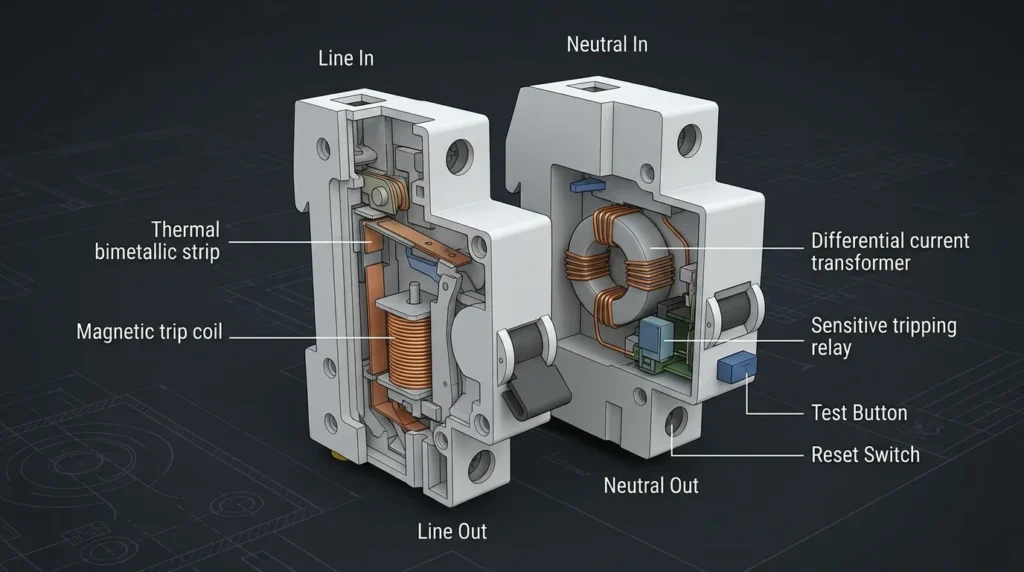
Thermal Trip Unit
The thermal trip unit protects the circuit from overload conditions.
It contains a bimetallic strip that bends when excessive current flows for an extended period. Once it reaches a preset temperature, it activates the trip mechanism.
This delayed response prevents unnecessary tripping during temporary current increases, such as motor starting.
Magnetic Trip Unit
The magnetic trip unit provides instant protection against short circuits.
A sudden surge of current creates a strong magnetic field that immediately releases the trip mechanism, disconnecting the circuit within milliseconds.
Residual Current Transformer
This is one of the most important parts of an RCBO.
The residual current transformer continuously compares the current flowing through the live and neutral conductors.
If the outgoing and returning currents become unequal due to earth leakage, the transformer detects the imbalance and sends a signal to trip the breaker.
Electronic or Mechanical Trip Mechanism
The trip mechanism receives signals from the thermal, magnetic, or residual current sensing system.
When a dangerous condition is detected, it instantly opens the electrical contacts and disconnects the power supply.
Test Button
Most RCBOs include a built-in TEST button.
Pressing this button creates a small simulated leakage current to verify that the RCBO is operating correctly.
Manufacturers recommend testing the RCBO periodically to ensure reliable protection.
Arc Chute
When the contacts separate, an electrical arc is produced.
The arc chute safely divides, cools, and extinguishes the arc, preventing damage to the contacts and improving the service life of the breaker.
Terminals
The terminals provide secure connections between the RCBO and electrical cables.
Proper tightening is essential because loose terminals can cause overheating and unreliable operation.
Advantages of RCBO
An RCBO offers several important benefits that make it one of the safest electrical protection devices available today.
- Provides overload, short-circuit, and earth leakage protection in one device.
- Protects people from electric shock.
- Reduces the risk of electrical fires.
- Saves space inside electrical distribution boards.
- Eliminates the need for separate MCB and RCCB devices.
- Quickly disconnects faulty circuits.
- Improves overall electrical safety.
- Easy to install and reset.
- Suitable for residential, commercial, and industrial applications.
- Available in different current ratings and sensitivity levels.
- Requires minimal maintenance.
- Improves system reliability by isolating only the faulty circuit.
Real-World Benefits
In a home, if a faulty washing machine develops an earth leakage fault, only the RCBO protecting that circuit will trip.
The remaining lighting and appliances continue operating normally, reducing inconvenience and making fault finding much easier.
Disadvantages of RCBO
Although RCBOs provide excellent protection, they also have some limitations.
- More expensive than a standard MCB.
- Slightly larger than an MCB.
- Sensitive models may trip because of leakage from certain electronic equipment.
- Installation requires correct wiring for reliable operation.
- Troubleshooting may require electrical testing equipment.
- Electronic RCBOs generally cost more than mechanical models.
Despite these limitations, the additional safety provided by an RCBO makes it a preferred choice for modern electrical installations.
RCBO Applications
Because an RCBO combines three protection functions in one device, it is used in many different electrical systems.
Residential Buildings
RCBOs protect lighting circuits, socket outlets, kitchens, bathrooms, air conditioners, and home appliances.
Many modern homes now use RCBOs for each individual circuit to improve safety and reduce unnecessary power interruptions.
Commercial Buildings
Office buildings, hotels, schools, shopping centers, and restaurants use RCBOs to protect electrical distribution circuits.
They provide reliable protection while minimizing disruption during electrical faults.
Industrial Facilities
Factories use RCBOs to protect machinery, motor circuits, production equipment, and control panels.
They help reduce equipment damage and improve workplace safety.
Hospitals
Hospitals require highly reliable electrical protection.
RCBOs protect sensitive medical equipment while reducing the risk of electric shock to patients and healthcare staff.
Data Centers
Servers and communication equipment require continuous electrical protection.
RCBOs help isolate faults quickly while maintaining reliable power to other circuits.
Solar Power Systems
Modern solar installations often use suitable RCBOs to protect inverter output circuits and distribution systems.
Electric Vehicle Charging Stations
Many EV charging systems require RCBO protection because they combine high electrical loads with increased safety requirements.
Educational Laboratories
Schools, colleges, and training centers use RCBOs to protect electrical laboratory equipment and provide additional safety for students.
Difference Between RCBO, RCCB, and MCB
Although these devices look similar, they provide different types of electrical protection.
| Feature | RCBO | RCCB | MCB |
|---|---|---|---|
| Full Form | Residual Current Breaker with Overcurrent Protection | Residual Current Circuit Breaker | Miniature Circuit Breaker |
| Overload Protection | ✔ Yes | ✘ No | ✔ Yes |
| Short Circuit Protection | ✔ Yes | ✘ No | ✔ Yes |
| Earth Leakage Protection | ✔ Yes | ✔ Yes | ✘ No |
| Combined Protection | ✔ Yes | ✘ No | ✘ No |
| Installation Space | Compact | Requires MCB for complete protection | Compact |
| Cost | Higher | Medium | Lower |
| Residential Use | Excellent | Common | Very Common |
| Industrial Use | Excellent | Used with MCB | Common |
| Best Choice | Complete circuit protection | Earth leakage protection only | Overcurrent protection only |
Which One Should You Choose?
- Choose an MCB if you only need overload and short-circuit protection.
- Choose an RCCB if your system already has an MCB and you only require earth leakage protection.
- Choose an RCBO if you want complete protection from overloads, short circuits, and earth leakage using a single device.
RCBO Selection Guide
Selecting the correct RCBO is essential for safe and reliable electrical protection.
Current Rating
Choose an RCBO with a current rating suitable for the connected electrical load.
Common ratings include:
- 6 A
- 10 A
- 16 A
- 20 A
- 32 A
- 40 A
- 63 A
Always calculate the expected load before selecting the breaker.
Residual Current Sensitivity
Choose the correct leakage current sensitivity based on the application.
- 30 mA – Personal protection (most homes and offices)
- 100 mA – Equipment protection
- 300 mA – Fire protection and industrial applications
Breaking Capacity
Ensure the RCBO has a breaking capacity greater than the maximum prospective fault current in the installation.
Voltage Rating
Verify that the RCBO matches the system voltage.
Using the correct voltage rating ensures reliable operation and safety.
Number of Poles
Choose the appropriate configuration:
- Single Pole + Neutral (SPN)
- Double Pole (DP)
- Three Pole (TP)
- Four Pole (4P)
Three-phase systems usually require three-pole or four-pole RCBOs.
RCBO Type
Select the appropriate type according to the connected equipment:
- Type AC – Simple AC loads
- Type A – Modern household appliances
- Type F – Variable-speed motors and inverters
- Type B – Solar systems, EV chargers, and industrial drives
Installation Environment
Consider temperature, humidity, dust, vibration, and other environmental conditions.
Harsh environments may require additional protective enclosures.
Tips for Beginners
- Calculate the circuit load before purchasing.
- Select the correct leakage sensitivity.
- Never replace an RCBO with a higher current rating simply to stop nuisance tripping.
- Use certified products that comply with recognized electrical standards.
- Test the RCBO regularly using the TEST button.
- If unsure, consult a qualified electrician or electrical engineer.
Common RCBO Problems and Solutions
Although RCBOs are highly reliable, they may occasionally trip or fail because of electrical faults, incorrect installation, or aging components. Understanding these common problems helps electricians and technicians diagnose faults quickly and restore the electrical system safely.
Why Does an RCBO Trip Frequently?
Frequent tripping is one of the most common RCBO problems.
Possible Causes
- Circuit overload
- Earth leakage current
- Short circuit
- Damaged appliance
- Moisture entering electrical equipment
- Loose wiring connections
Solutions
- Disconnect all electrical appliances and reconnect them one by one.
- Inspect the circuit for damaged insulation.
- Tighten loose electrical terminals.
- Check for moisture in sockets, switches, and outdoor equipment.
- Replace faulty appliances causing leakage current.
Why Does the RCBO Trip Immediately After Resetting?
If the RCBO trips immediately after being switched ON, a fault is usually still present in the circuit.
Possible Causes
- Permanent short circuit
- Severe earth leakage
- Incorrect wiring
- Faulty electrical equipment
Solutions
- Turn OFF all connected loads.
- Inspect wiring for damage.
- Test insulation resistance if possible.
- Connect appliances individually until the faulty one is identified.
RCBO Will Not Reset
Sometimes the operating handle refuses to stay in the ON position.
Possible Causes
- Internal mechanical failure
- Ongoing earth fault
- Damaged RCBO
- Incorrect neutral wiring
Solutions
- Ensure the fault has been removed.
- Verify that live and neutral connections are correct.
- Inspect the breaker for physical damage.
- Replace the RCBO if necessary.
RCBO Becomes Hot
A slightly warm RCBO is normal during operation, especially under heavy load.
Excessive heat, however, indicates a problem.
Possible Causes
- Loose terminal connections
- Overloaded circuit
- Poor panel ventilation
- Undersized RCBO
Solutions
- Tighten all cable connections.
- Reduce the connected load.
- Improve airflow inside the distribution board.
- Select an RCBO with the correct current rating.
RCBO Trips During Rain
Outdoor circuits often trip during wet weather.
Possible Causes
- Water entering outdoor sockets
- Moisture inside junction boxes
- Damaged cable insulation
Solutions
- Inspect outdoor electrical equipment.
- Replace damaged weatherproof covers.
- Repair or replace faulty cables.
- Ensure outdoor electrical accessories have the correct IP rating.
TEST Button Does Not Work
Every RCBO includes a TEST button that checks whether the device operates correctly.
If pressing the TEST button does not trip the RCBO, the breaker may no longer provide reliable protection.
Solution
Replace the RCBO immediately and have the electrical installation inspected by a qualified electrician.
Future Trends in RCBO Technology
Electrical protection systems continue to improve as buildings become smarter and more energy efficient. Modern RCBOs are evolving beyond simple protection devices into intelligent monitoring solutions.
Smart RCBOs
Smart RCBOs can communicate with building management systems and industrial automation platforms.
They provide real-time information about circuit status and electrical faults.
Remote Monitoring
Modern RCBOs allow engineers to monitor electrical systems remotely using computers or mobile devices.
This helps maintenance teams respond quickly to electrical faults.
IoT Integration
Many manufacturers are developing RCBOs that integrate with the Internet of Things (IoT).
These devices can send automatic notifications whenever abnormal current or earth leakage is detected.
Better Energy Management
Future RCBOs will not only protect electrical circuits but also help monitor energy consumption.
This information allows businesses to improve energy efficiency and reduce operating costs.
Higher Safety Standards
New RCBO designs offer:
- Faster tripping speed
- Improved earth leakage detection
- Better arc suppression
- Higher breaking capacity
- Increased reliability
- Longer service life
These improvements make electrical systems safer for both people and equipment.
Compact Designs
Manufacturers continue to produce smaller RCBOs with higher performance.
Compact devices save valuable space inside modern distribution boards without compromising protection.
Frequently Asked Questions (FAQs)
What is the full form of RCBO?
RCBO stands for Residual Current Breaker with Overcurrent Protection.
What is the main purpose of an RCBO?
An RCBO protects electrical circuits against overloads, short circuits, and earth leakage currents, helping protect both people and electrical equipment.
What is the difference between RCBO and RCCB?
An RCBO provides overload, short-circuit, and earth leakage protection in one device, while an RCCB protects only against earth leakage and must be used with an MCB for complete circuit protection.
Can an RCBO replace an MCB?
Yes. An RCBO performs all the functions of an MCB and also provides additional earth leakage protection, making it a complete circuit protection device.
Where are RCBOs commonly used?
RCBOs are widely used in homes, offices, hospitals, commercial buildings, industrial facilities, solar power systems, and electric vehicle charging stations.
How often should an RCBO be tested?
Most manufacturers recommend pressing the TEST button approximately once every month to confirm that the RCBO is operating correctly.
Is an RCBO better than an MCB?
For most modern electrical installations, yes. An RCBO offers more comprehensive protection because it combines overcurrent and residual current protection in a single device.
Conclusion
An RCBO (Residual Current Breaker with Overcurrent Protection) is one of the most advanced circuit protection devices used in modern electrical installations. It combines the functions of an MCB and an RCCB, providing protection against overloads, short circuits, and earth leakage currents in a single unit.
Understanding the RCBO working principle, types, main components, applications, and advantages and disadvantages helps electrical students, engineers, technicians, and homeowners choose the right protection device for their systems. Proper selection based on current rating, leakage sensitivity, and installation requirements improves electrical safety and reduces the risk of equipment damage and electric shock.
As smart buildings and renewable energy systems continue to grow, RCBO technology is becoming more intelligent, efficient, and reliable. Learning how RCBOs work is an important step toward building safer and more dependable electrical installations.