
Imagine a large power station supplying electricity to thousands of homes, hospitals, factories, and offices. The generator inside the power plant must produce a stable voltage every second, even when electricity demand changes throughout the day. But how does the generator maintain a strong and controlled magnetic field to generate electrical power efficiently? The answer lies in an important device called the exciter.
An exciter is a key part of synchronous generators and alternators. It supplies the direct current (DC) needed to energize the generator’s rotor field winding, allowing the generator to produce the correct output voltage. Without an exciter, a generator cannot build the magnetic field required for electricity generation.
Whether you are an electrical engineering student, technician, engineer, or beginner, understanding the exciter working principle is essential for learning how modern power generation systems operate. In this complete guide, you’ll learn what an exciter is, how it works, its types, components, exciter applications, advantages, disadvantages, selection tips, troubleshooting methods, and the difference between exciter and AVR.
What Is an Exciter?
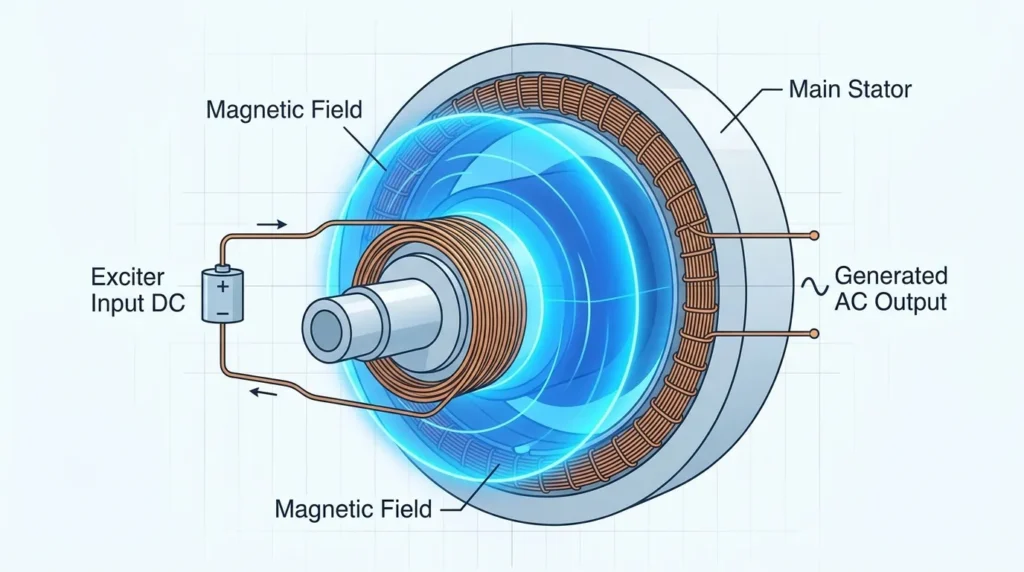
An exciter is an electrical device that supplies Direct Current (DC) to the field winding (rotor) of a synchronous generator or alternator. This DC current creates the magnetic field required for the generator to produce Alternating Current (AC) electricity.
Without an exciter, the generator cannot establish the magnetic field needed for electromagnetic induction, meaning it cannot generate electrical power. For this reason, the exciter is considered one of the most important components of a synchronous generator.
The exciter also controls the strength of the magnetic field. By increasing or decreasing the field current, it regulates the generator’s output voltage and helps maintain a stable power supply under changing load conditions.
In modern power plants, the exciter works together with an Automatic Voltage Regulator (AVR). The AVR continuously monitors the generator output voltage and automatically adjusts the excitation current to keep the voltage constant, even when the electrical load changes.
Whether in hydroelectric stations, thermal power plants, wind farms, or diesel generator systems, the exciter plays a vital role in ensuring reliable, efficient, and stable electricity generation.
Why Is an Exciter Important?
An exciter performs several essential functions in a generator system:
- Supplies DC current to the generator field winding.
- Creates the magnetic field required for power generation.
- Regulates generator output voltage.
- Maintains voltage stability under varying loads.
- Improves generator efficiency and performance.
- Supports synchronization with the electrical power grid.
- Protects the generator from voltage fluctuations.
Without proper excitation, the generator cannot produce the required voltage or operate safely.
Simple Explanation
Think of a flashlight.
The battery supplies electrical energy to the bulb, allowing it to produce light.
Similarly, the exciter acts like the battery for a generator. It supplies DC current to the rotor winding, creating the magnetic field needed for the generator to produce AC electricity.
If the battery is removed from the flashlight, the bulb cannot light up. Likewise, without an exciter, a synchronous generator cannot generate electrical power.
Practical Example
Consider a hydroelectric power plant.
Water flowing through a dam rotates a turbine. The turbine drives the rotor of a synchronous generator.
Before electricity can be generated, the exciter supplies DC current to the rotor field winding. This current creates a strong magnetic field around the rotor.
As the rotor spins inside the stator, the rotating magnetic field cuts the stator windings and induces AC voltage through electromagnetic induction.
The generated electricity is then stepped up by transformers and transmitted through power lines to homes, industries, and commercial buildings.
Exciter Working Principle
The Exciter Working Principle is based on supplying a controlled amount of Direct Current (DC) to the field winding of a synchronous generator. This DC current produces a magnetic field around the rotor. As the rotor rotates inside the stator, the magnetic field cuts the stator conductors and induces Alternating Current (AC) according to Faraday’s Law of Electromagnetic Induction.
The strength of the magnetic field depends on the amount of excitation current supplied by the exciter. By increasing or decreasing this field current, the exciter controls the generator’s output voltage.
Modern excitation systems use an Automatic Voltage Regulator (AVR) to continuously monitor the generator output voltage and automatically adjust the excitation current. This ensures that the generator delivers a stable voltage even when the electrical load changes suddenly.
The exciter therefore acts as the “voltage controller” of the generator, maintaining reliable and efficient operation.
Step-by-Step Working Process of an Exciter
The complete working process of an exciter can be understood through the following steps.
Step 1: Prime Mover Starts the Generator
The process begins when a prime mover rotates the generator rotor.
Depending on the application, the prime mover may be:
- Steam turbine
- Water turbine
- Gas turbine
- Diesel engine
- Wind turbine
Mechanical energy is converted into rotational motion.
Step 2: Exciter Supplies DC Current
The exciter delivers a controlled DC current to the rotor field winding.
This field current energizes the rotor and prepares it for electricity generation.
Step 3: Rotor Magnetic Field Is Created
As DC flows through the rotor winding, it creates a powerful magnetic field around the rotor poles.
The strength of this magnetic field depends on the amount of excitation current.
- Higher excitation current → Stronger magnetic field
- Lower excitation current → Weaker magnetic field
Step 4: Rotor Rotates Inside the Stator
The prime mover continues rotating the energized rotor at synchronous speed.
The rotating magnetic field moves continuously around the stationary stator windings.
Step 5: Magnetic Field Cuts the Stator Windings
As the rotor spins, its magnetic field passes across the stator conductors.
This changing magnetic flux cuts the stator windings.
Step 6: AC Voltage Is Induced
According to Faraday’s Law of Electromagnetic Induction, the changing magnetic field induces an Alternating Current (AC) voltage in the stator windings.
This generated AC voltage becomes the electrical output of the generator.
Step 7: AVR Monitors Generator Voltage
An Automatic Voltage Regulator (AVR) continuously measures the generator output voltage.
It compares the actual voltage with the desired reference voltage.
Step 8: Excitation Current Is Automatically Adjusted
If the generator voltage changes because of varying electrical loads, the AVR automatically controls the exciter.
- If the voltage drops, the AVR increases the excitation current.
- If the voltage rises, the AVR reduces the excitation current.
This automatic adjustment keeps the generator voltage stable.
Step 9: Stable Voltage Is Maintained
The continuous cooperation between the exciter and the AVR ensures:
- Constant output voltage
- Stable generator operation
- Improved efficiency
- Reliable power generation
- Safe operation under changing load conditions
This automatic control is essential in modern power plants and industrial generators.
Easy Analogy
Imagine you are watering a garden with a hose.
- The water tap controls how much water flows.
- If the plants need more water, you open the tap wider.
- If they need less water, you partially close the tap.
The exciter works in exactly the same way.
- The generator is like the garden.
- The excitation current is like the water flowing through the hose.
- The AVR acts like your hand controlling the tap.
When more electrical load is connected, the AVR increases the field current—just like opening the tap to provide more water. When the load decreases, it reduces the field current—just like closing the tap slightly.
This continuous adjustment keeps the generator voltage stable and ensures a reliable supply of electricity.
Types of Exciters
Different generators require different excitation systems depending on their size, operating conditions, efficiency requirements, and maintenance needs. Over the years, excitation technology has evolved from simple DC exciters to advanced static excitation systems that use modern power electronics.
Each type of exciter has its own working method, advantages, limitations, and applications. Understanding these types helps students and engineers choose the most suitable excitation system for a particular generator.
1. DC Exciter
A DC Exciter is one of the oldest and simplest excitation systems used in synchronous generators. It consists of a small DC generator mounted on the same shaft as the main generator.
The DC generator supplies direct current to the rotor field winding through brushes and slip rings. As the main generator rotates, the DC exciter also rotates and continuously provides the field current required for electricity generation.
Although DC exciters have largely been replaced by modern systems, they are still important for understanding the fundamentals of generator excitation.
Working Principle
- A small DC generator rotates with the main generator.
- The DC generator produces direct current.
- Brushes and slip rings transfer the DC current to the rotor field winding.
- The energized rotor creates the magnetic field required for power generation.
Features
- Simple construction
- Easy to understand and operate
- Uses brushes, commutator, and slip rings
- Low initial cost
- Suitable for small generating systems
Advantages
- Simple maintenance
- Low manufacturing cost
- Easy fault diagnosis
- Suitable for educational purposes
Limitations
- Brushes and commutator wear over time
- Requires regular maintenance
- Sparking may occur at the brushes
- Lower efficiency compared to modern systems
Applications
- Older power stations
- Educational laboratories
- Small synchronous generators
- Training equipment
- Experimental electrical machines
2. AC Exciter
An AC Exciter is a more advanced excitation system that generates Alternating Current (AC) instead of DC. The generated AC is then converted into DC using rectifiers before being supplied to the generator rotor.
Because AC exciters eliminate many of the problems associated with DC commutators, they are more reliable and require less maintenance.
Working Principle
- The AC exciter rotates with the generator.
- It produces alternating current.
- A rectifier converts the AC output into DC.
- The DC current energizes the generator field winding.
Features
- Higher reliability
- Better efficiency
- Reduced maintenance
- Longer operating life
- Suitable for medium and large generators
Advantages
- Lower maintenance than DC exciters
- Improved voltage regulation
- More reliable operation
- Higher efficiency
- Better performance under varying loads
Limitations
- More complex construction
- Requires rectifier circuits
- Higher installation cost
Applications
- Industrial generators
- Diesel power plants
- Marine generators
- Medium-size power stations
- Commercial power systems
3. Brushless Exciter
A Brushless Exciter is one of the most widely used excitation systems in modern synchronous generators. As the name suggests, it operates without brushes, slip rings, or commutators.
Instead, it uses a small AC exciter and a set of rotating rectifiers mounted directly on the generator shaft. These rotating rectifiers convert AC into DC and supply it directly to the rotor field winding.
Since there are no brushes making physical contact, maintenance requirements are greatly reduced.
Working Principle
- The brushless AC exciter produces alternating current.
- Rotating rectifier assemblies convert AC into DC.
- The DC current flows directly into the rotor field winding.
- The rotor generates the magnetic field required for power generation.
Features
- No brushes or slip rings
- No sparking
- High reliability
- Low maintenance
- Long service life
Advantages
- Minimal maintenance
- Excellent operational reliability
- Reduced mechanical wear
- Improved safety
- Longer equipment life
- Suitable for continuous operation
Limitations
- More expensive than DC exciters
- Rotating rectifier replacement can be more difficult
- More complex design
Applications
- Large alternators
- Hydroelectric power plants
- Thermal power stations
- Nuclear power plants
- Wind power generators
- Industrial synchronous generators
4. Static Exciter
A Static Exciter is the most advanced excitation system used in modern power plants. Unlike rotating exciters, it contains no rotating electrical machine. Instead, it uses power electronic devices such as thyristors, IGBTs, or controlled rectifiers to supply DC current directly to the generator field winding.
Because electronic control is extremely fast, static exciters provide excellent voltage regulation and rapid response to sudden load changes.
Working Principle
- AC power is taken directly from the generator terminals or station supply.
- Power electronic converters convert AC into controlled DC.
- The controlled DC is supplied directly to the generator rotor through slip rings.
- The Automatic Voltage Regulator continuously adjusts the excitation current.
Features
- Fast voltage response
- Excellent voltage regulation
- High efficiency
- Compact design
- Advanced electronic control
Advantages
- Very fast response to load changes
- High excitation accuracy
- Improved system stability
- Better fault recovery
- Suitable for large interconnected power systems
Limitations
- Higher installation cost
- Requires sophisticated electronic equipment
- Sensitive to power electronic failures
- Requires skilled maintenance personnel
Applications
- Modern thermal power plants
- Hydroelectric generating stations
- Gas turbine power plants
- Grid-connected synchronous generators
- Industrial power systems
- Renewable energy power plants
Comparison of Different Types of Exciters
| Type of Exciter | Working Method | Main Advantages | Main Limitations | Common Applications |
|---|---|---|---|---|
| DC Exciter | Small DC generator supplies field current through brushes and slip rings | Simple design, low cost, easy to understand | High maintenance, brush wear, sparking | Older power stations, educational laboratories, small generators |
| AC Exciter | AC generator with rectifier supplies DC field current | Better efficiency, improved reliability, reduced maintenance | More complex than DC exciter | Industrial generators, marine generators, medium power plants |
| Brushless Exciter | AC exciter with rotating rectifiers supplies DC without brushes | No brushes, low maintenance, high reliability | Higher cost, complex rectifier assembly | Large alternators, hydroelectric plants, thermal stations, wind farms |
| Static Exciter | Power electronic converters provide controlled DC excitation | Fast response, excellent voltage regulation, high efficiency | Expensive, requires advanced electronics | Modern power plants, grid-connected generators, industrial synchronous generators |
Choosing the Right Exciter
The selection of an excitation system depends on several factors, including:
- Generator size
- Required voltage regulation
- Maintenance requirements
- Reliability
- Installation cost
- Operating environment
- Response speed
- Power system stability
For small generators, a DC exciter may still be sufficient.
For industrial generators, an AC exciter provides better efficiency and reliability.
For large power plants, brushless exciters are preferred because of their low maintenance and long service life.
For modern utility-scale generating stations, static exciters are the most popular choice due to their rapid response, precise voltage control, and compatibility with advanced Automatic Voltage Regulator (AVR) systems.
Main Components of an Exciter
An excitation system is made up of several important components that work together to supply and regulate the DC current required by a synchronous generator. Each component performs a specific function to ensure stable voltage, reliable operation, and efficient power generation.
Understanding these components helps students, technicians, and engineers learn how an exciter maintains generator performance under different operating conditions.
1. Exciter Generator
The Exciter Generator is the primary source of excitation power. Its main job is to produce the electrical energy required to energize the generator’s field winding.
Depending on the type of excitation system, the exciter generator may produce either AC or DC power. In modern systems, the generated AC is often converted into DC before being supplied to the rotor.
Functions
- Generates excitation power for the generator.
- Supplies electrical energy to the field circuit.
- Helps establish the rotor’s magnetic field.
- Supports stable generator operation.
- Works together with the AVR to regulate output voltage.
Importance
Without the exciter generator, the rotor cannot produce the magnetic field necessary for electricity generation.
2. Automatic Voltage Regulator (AVR)
The Automatic Voltage Regulator (AVR) is one of the most important parts of an excitation system. It continuously monitors the generator output voltage and automatically adjusts the excitation current to keep the voltage constant.
Whenever the electrical load changes, the AVR responds within milliseconds by increasing or decreasing the field current.
Functions
- Maintains constant generator voltage.
- Automatically adjusts excitation current.
- Compensates for load variations.
- Improves voltage regulation.
- Protects the generator from overvoltage and undervoltage.
- Enhances overall system stability.
Importance
The AVR ensures that the generator supplies a stable voltage even when electrical demand changes rapidly.
3. Rectifier Assembly
The Rectifier Assembly converts Alternating Current (AC) produced by the exciter into Direct Current (DC) required by the rotor field winding.
Modern excitation systems use high-efficiency semiconductor rectifiers, such as diodes or thyristors, to perform this conversion with minimal power loss.
Functions
- Converts AC excitation into DC.
- Supplies steady DC current to the field winding.
- Improves excitation efficiency.
- Provides smooth and reliable field current.
- Supports stable generator performance.
Importance
Since the generator field winding requires DC power, the rectifier assembly is essential in AC and brushless excitation systems.
4. Field Winding (Rotor Field)
The Field Winding is a coil of insulated copper wire wound around the rotor poles. When DC current flows through this winding, it produces the magnetic field required for electromagnetic induction.
The strength of this magnetic field determines the generator’s output voltage.
Functions
- Produces the generator’s magnetic field.
- Controls the strength of magnetic flux.
- Determines output voltage.
- Enables electromagnetic induction.
- Supports efficient electricity generation.
Importance
The field winding is the heart of the excitation system because it creates the magnetic field needed to generate electrical power.
5. Rotating Diodes (Brushless Exciter)
Rotating Diodes are used in brushless excitation systems to convert AC produced by the exciter into DC while rotating with the generator shaft.
Because the rectification takes place on the rotating assembly, brushes and slip rings are no longer required.
Functions
- Convert AC excitation into DC.
- Supply DC directly to the rotor field winding.
- Eliminate the need for brushes and slip rings.
- Reduce mechanical wear.
- Improve system reliability.
Importance
Rotating diodes make brushless excitation systems highly reliable and significantly reduce maintenance requirements.
6. Control System
The Control System consists of electronic controllers, sensors, protection circuits, and monitoring equipment that supervise the entire excitation process.
It continuously communicates with the AVR and other protection devices to ensure safe and efficient generator operation.
Functions
- Monitors generator voltage.
- Controls excitation current.
- Detects abnormal operating conditions.
- Provides fault protection.
- Coordinates with protective relays.
- Records system operating data.
- Improves overall generator reliability.
Importance
The control system acts as the “brain” of the excitation system, ensuring that all components work together safely and efficiently.
Summary of Exciter Components
| Component | Main Function | Importance |
|---|---|---|
| Exciter Generator | Produces excitation power | Creates the electrical energy required for field excitation |
| Automatic Voltage Regulator (AVR) | Regulates excitation current | Maintains constant generator output voltage |
| Rectifier Assembly | Converts AC into DC | Supplies stable DC current to the field winding |
| Field Winding | Produces the magnetic field | Enables electromagnetic induction and power generation |
| Rotating Diodes | Rectify AC while rotating | Eliminate brushes and reduce maintenance in brushless systems |
| Control System | Monitors and controls excitation | Ensures safe, reliable, and efficient generator operation |
Together, these components form a complete excitation system that allows synchronous generators to produce stable, efficient, and reliable electrical power in power plants, industrial facilities, and commercial applications.
Advantages of Exciter
Understanding the exciter advantages and disadvantages helps engineers select the right excitation system.
Advantages
- Maintains stable generator voltage.
- Improves power system reliability.
- Supports efficient power generation.
- Provides automatic voltage control.
- Improves generator stability.
- Responds quickly to load changes.
- Enhances power quality.
- Reduces voltage fluctuations.
- Increases generator efficiency.
- Essential for synchronous generators.
Disadvantages of Exciter
Although highly effective, excitation systems also have some limitations.
- Increases system complexity.
- Higher installation cost.
- Requires regular maintenance in brushed systems.
- Electronic components may fail.
- Static exciters require reliable power supplies.
- Brush wear occurs in conventional systems.
- Cooling may be necessary for large systems.
- Troubleshooting requires skilled personnel.
- Initial setup can be complex.
- Component replacement may be expensive.
Exciter Applications
The exciter applications cover almost every sector using synchronous generators.
Power Generation
- Thermal power plants
- Hydroelectric stations
- Nuclear power plants
- Gas turbine generators
Renewable Energy
- Wind turbines
- Large hydroelectric generators
- Biomass power plants
Industrial Applications
- Manufacturing plants
- Steel mills
- Cement factories
- Chemical industries
Marine Industry
- Ship generators
- Offshore platforms
- Marine propulsion systems
Commercial Buildings
- Backup generators
- Emergency power systems
- Data centers
Modern Technology
- Smart grid systems
- Renewable energy integration
- Utility-scale generators
- High-voltage substations
Difference Between Exciter and AVR
Although they work together, the exciter and AVR perform different functions.
| Feature | Exciter | AVR (Automatic Voltage Regulator) |
|---|---|---|
| Purpose | Supplies field current | Controls excitation level |
| Output | DC current | Control signals |
| Main Function | Produces magnetic field | Maintains generator voltage |
| Location | Generator excitation system | Generator control system |
| Operation | Supplies excitation power | Monitors output voltage |
| Power Handling | High | Low |
| Dependency | Works under AVR control | Controls exciter |
| Importance | Creates field magnetism | Maintains voltage stability |
Understanding the difference between exciter and AVR helps beginners understand modern generator control systems.
Selection Guide: How to Choose the Right Exciter
Selecting the right exciter is essential for achieving reliable generator operation, stable voltage regulation, and efficient power generation. The ideal excitation system depends on several factors, including the generator’s size, application, operating environment, and maintenance requirements.
Whether you are selecting an exciter for a small standby generator or a large power plant, understanding these factors will help you make the right choice.
1. Consider the Generator Capacity
The first step is to determine the generator’s power rating.
Different generator sizes require different excitation systems.
- Small generators generally use simple DC or AC exciters.
- Medium-sized industrial generators commonly use AC or brushless exciters.
- Large power plant generators typically use brushless or static excitation systems because they offer higher reliability and better voltage control.
Choosing an exciter that matches the generator capacity ensures efficient and stable operation.
2. Evaluate Voltage Regulation Performance
One of the primary functions of an exciter is to maintain constant generator voltage.
Select an excitation system that can:
- Respond quickly to load changes.
- Maintain stable output voltage.
- Minimize voltage fluctuations.
- Support grid stability.
Good voltage regulation improves power quality and protects connected electrical equipment.
3. Consider Maintenance Requirements
Maintenance costs vary significantly between different excitation systems.
- DC exciters require regular inspection of brushes and commutators.
- AC exciters require less maintenance than DC systems.
- Brushless exciters eliminate brushes and slip rings, reducing maintenance requirements.
- Static exciters have very few moving parts but require periodic inspection of electronic components.
If minimizing maintenance is a priority, brushless or static excitation systems are usually the best choice.
4. Check the Required Response Speed
Some generators operate under rapidly changing electrical loads.
Applications such as:
- Power plants
- Industrial manufacturing
- Data centers
- Renewable energy systems
require excitation systems with a very fast response.
Static exciters provide the fastest voltage response and excellent dynamic performance.
5. Ensure High Reliability
Generators used in critical applications must operate continuously without unexpected failures.
High-reliability excitation systems should include:
- Redundant protection
- Reliable control electronics
- Fault monitoring
- Automatic diagnostics
- Emergency backup features
Reliable excitation improves the overall availability of the generator.
6. Evaluate Environmental Conditions
The installation environment greatly affects exciter performance and lifespan.
Consider operating conditions such as:
- High temperatures
- Dust and dirt
- Moisture and humidity
- Mechanical vibration
- Continuous operation
- Corrosive environments
Choose an excitation system designed to withstand the environmental conditions of the installation site.
7. Consider Installation and Operating Costs
Cost is another important factor when selecting an exciter.
Instead of choosing the cheapest option, consider the total lifecycle cost, including:
- Initial purchase price
- Installation cost
- Maintenance expenses
- Energy efficiency
- Expected service life
- Replacement parts availability
A slightly higher initial investment often results in lower operating costs over time.
Practical Tips for Beginners
If you are selecting an exciter for the first time, follow these simple guidelines:
- Match the exciter to the generator size.
- Choose an excitation system with reliable voltage regulation.
- Consider future maintenance requirements.
- Select equipment from reputable manufacturers.
- Verify compatibility with the Automatic Voltage Regulator (AVR).
- Ensure the system meets applicable electrical standards.
- Consider future expansion and system upgrades.
Common Problems and Solutions
Like any electrical equipment, excitation systems can develop faults over time. Understanding common problems helps technicians diagnose issues quickly and minimize generator downtime.
Problem 1: Low Generator Voltage
If the generator produces a lower voltage than expected, the excitation system may not be supplying sufficient field current.
Possible Causes
- Low excitation current
- Faulty Automatic Voltage Regulator (AVR)
- Damaged field winding
- Poor electrical connections
- Defective rectifier assembly
Solution
- Inspect the AVR operation.
- Measure the field current.
- Check the field winding resistance.
- Tighten loose electrical connections.
- Replace faulty excitation components if necessary.
Problem 2: Exciter Overheating
Excessive temperature reduces equipment life and may damage excitation components.
Possible Causes
- Generator overloading
- Poor ventilation
- Cooling fan failure
- Blocked air passages
- High ambient temperature
Solution
- Reduce excessive electrical load.
- Improve ventilation around the equipment.
- Clean cooling passages regularly.
- Repair or replace faulty cooling fans.
- Monitor operating temperature during operation.
Problem 3: Generator Voltage Fluctuation
Unstable generator voltage can affect connected equipment and reduce power quality.
Possible Causes
- Faulty AVR
- Loose electrical connections
- Damaged voltage sensors
- Incorrect AVR settings
- Unstable excitation current
Solution
- Inspect the AVR carefully.
- Tighten all electrical terminals.
- Test voltage sensing circuits.
- Verify AVR calibration.
- Replace defective control components.
Problem 4: Brushless Exciter Failure
Although brushless exciters require little maintenance, failures can still occur.
Possible Causes
- Damaged rotating diodes
- Rectifier failure
- Bearing wear
- Mechanical vibration
- Overheating
Solution
- Test rotating diodes.
- Inspect the rectifier assembly.
- Replace worn bearings.
- Perform vibration analysis.
- Follow preventive maintenance schedules.
Problem 5: Reduced Exciter Life
Poor maintenance can significantly shorten the life of an excitation system.
Common Causes
- Dust accumulation
- Loose connections
- Poor cooling
- Excessive vibration
- Lack of routine inspections
Solution
- Perform regular preventive maintenance.
- Keep cooling passages clean.
- Test the AVR periodically.
- Inspect all electrical connections.
- Replace worn components before failure occurs.
- Maintain proper operating conditions.
Troubleshooting Tips
When diagnosing excitation system problems:
- Check the generator output voltage first.
- Measure the excitation current.
- Inspect the AVR operation.
- Test field winding resistance.
- Examine rectifiers and rotating diodes.
- Verify all electrical connections.
- Review alarm and fault indications.
- Follow the manufacturer’s maintenance procedures.
A systematic troubleshooting approach improves safety and reduces repair time.
Future Trends in Excitation Technology
Excitation systems continue to evolve with advances in digital electronics, automation, and intelligent monitoring. Modern technologies are making generators more efficient, reliable, and easier to maintain.
1. Digital Excitation Control Systems
Traditional analog controllers are being replaced by advanced digital control systems that provide faster response, greater accuracy, and improved voltage regulation.
2. Smart Automatic Voltage Regulators (AVRs)
Modern AVRs include intelligent control algorithms that automatically optimize excitation under varying operating conditions.
Benefits include:
- Faster voltage correction
- Improved stability
- Better fault detection
- Enhanced generator protection
3. AI-Based Predictive Maintenance
Artificial Intelligence is transforming generator maintenance by continuously monitoring excitation system performance.
AI can:
- Predict equipment failures.
- Detect abnormal operating conditions.
- Schedule maintenance before breakdowns occur.
- Reduce maintenance costs and downtime.
4. Advanced Power Electronics
Modern semiconductor devices such as IGBTs and Silicon Carbide (SiC) components are improving excitation efficiency, reducing losses, and providing faster control of field current.
5. Improved Brushless Excitation Systems
Future brushless exciters will offer:
- Higher efficiency
- Longer service life
- Better cooling systems
- Reduced maintenance
- Improved reliability for large generators
6. IoT-Based Remote Monitoring
Internet of Things (IoT) technology enables engineers to monitor generator excitation systems remotely in real time.
Remote monitoring provides:
- Live performance data
- Automatic fault alerts
- Predictive diagnostics
- Centralized maintenance management
7. Enhanced Cybersecurity
As excitation systems become more connected, protecting them from cyber threats is increasingly important.
Modern systems include:
- Secure communication protocols
- Access control
- Data encryption
- Network security features
8. Energy-Efficient Excitation Methods
Future excitation technologies will focus on reducing power losses while improving voltage regulation and generator efficiency.
These improvements help lower operating costs and reduce environmental impact.
9. Self-Diagnostic Generator Controls
Next-generation excitation systems will continuously perform self-checks, identify developing faults, and recommend corrective actions before failures occur.
10. Integration with Renewable Energy Systems
Modern excitation systems are being designed to work seamlessly with:
- Solar power plants
- Wind farms
- Hydroelectric stations
- Hybrid energy systems
- Smart electrical grids
Improved excitation control will play a key role in maintaining voltage stability as renewable energy becomes a larger part of the global power system.
Industry Outlook
The future of excitation technology lies in digital automation, intelligent monitoring, fast electronic control, and seamless integration with renewable energy systems. These innovations will improve generator efficiency, reduce maintenance costs, enhance voltage stability, and ensure reliable electricity generation for modern power networks.
Conclusion
The exciter is an essential component of every synchronous generator because it supplies the field current needed to create the magnetic field for electricity generation. Understanding the exciter working principle, types, components, exciter applications, and exciter advantages and disadvantages gives students and engineers a strong foundation in power generation technology. Whether used in hydroelectric stations, thermal power plants, industrial facilities, or renewable energy systems, excitation systems ensure stable voltage, reliable operation, and efficient performance. As modern power systems continue to adopt digital controls, brushless technology, and intelligent monitoring, exciters are becoming more reliable, efficient, and easier to maintain. Mastering this topic is an important step toward understanding synchronous generators and modern electrical power systems.