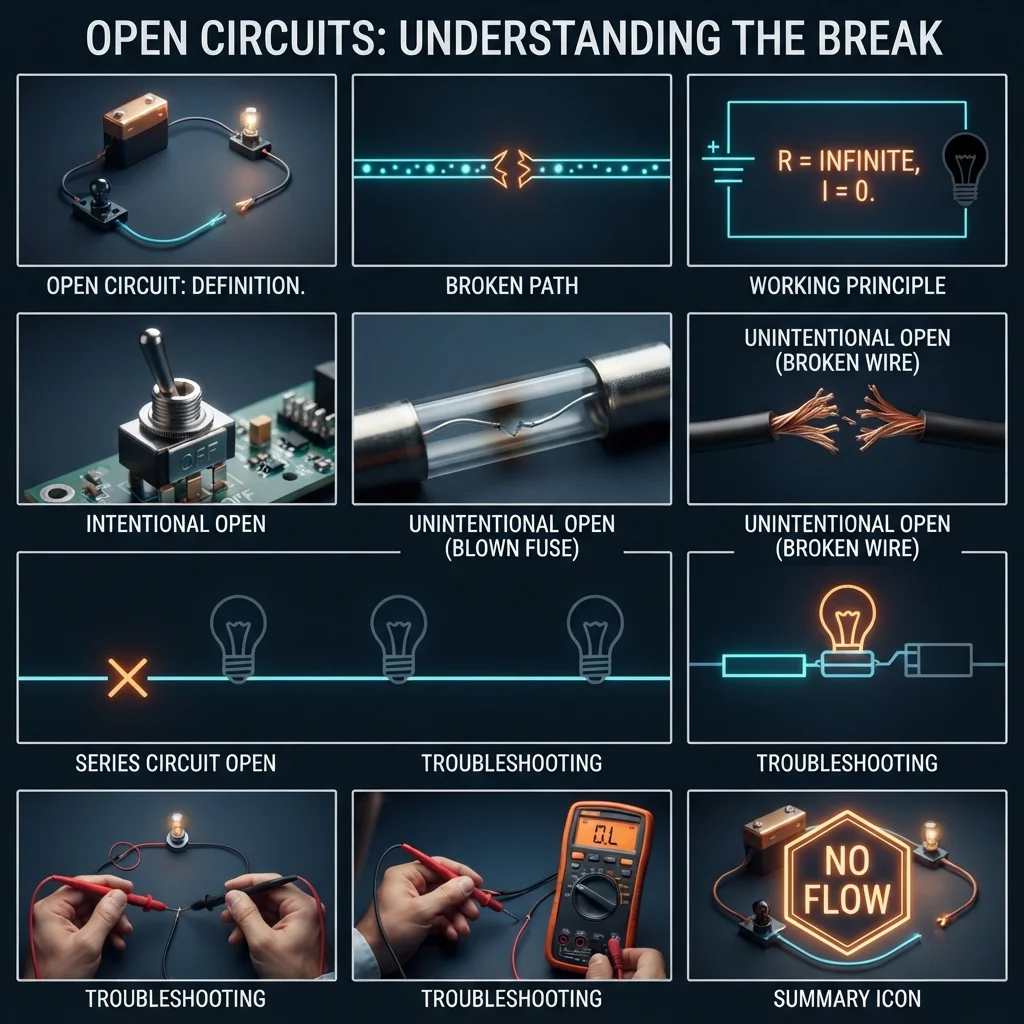

Imagine turning on a wall switch and finding that the light does not turn on. The bulb may be perfectly good, and the power source may be working, but the electrical path has been interrupted. In this situation, the circuit is open. This simple example helps explain the Open Circuit Meaning in electrical engineering.
An open circuit occurs when the normal path for electric current is broken or disconnected. Because the path is incomplete, current cannot flow through the open section under normal circuit conditions. However, voltage may still be present across the open point.
Understanding an open circuit is important for electricians, technicians, engineering students, and anyone working with electrical equipment. It is one of the first concepts used when learning circuit analysis and troubleshooting.
In this guide, you will learn what an open circuit is, how an open circuit works, its common types, major components, advantages and disadvantages, applications, troubleshooting methods, and the difference between an open circuit and a closed circuit. The goal is to make this basic electrical concept easy to understand and apply in real-world situations.
What Is an Open Circuit?
An open circuit is an electrical circuit in which the conducting path is interrupted, preventing normal current flow.
In simple words, an open circuit is like a road with a broken bridge. Vehicles cannot travel across the missing section. Similarly, electric current cannot complete its path when a circuit has an open point.
An open circuit can be created intentionally or accidentally.
For example, when you turn off a light switch, the switch opens the circuit. The electrical path is interrupted, so current stops flowing through the lamp.
An accidental open circuit can occur because of:
- A broken wire
- A loose terminal
- A damaged switch
- A blown fuse
- A disconnected connector
- A damaged circuit-board track
- A faulty component
Simple Electrical Example
Consider a basic circuit containing:
Battery → Switch → Lamp → Battery
When the switch is closed, the path is complete and current can flow.
When the switch is opened, the path is broken.
Therefore:
Open circuit = incomplete path = normally no current flow
An important point is that zero current does not necessarily mean zero voltage. If a circuit is open, a voltage can exist across the open section.
Open Circuit Working Principle
The open circuit working principle is based on the interruption of the current path.
Electric current requires a continuous conducting path between the source and load. When that path is broken, normal current cannot flow through the break.
Step-by-Step Working
- An electrical source provides voltage.
- Conductors create a path between the source and load.
- The load requires a complete path for current.
- An open point interrupts the conducting path.
- Current through the open section becomes essentially zero under ideal conditions.
- Voltage can remain across the open point.
- The load normally stops operating.
Water Pipe Analogy
Think about an electrical circuit as a water pipe system.
Imagine a pump pushing water through a pipe. If the pipe is continuous, water can flow.
Now imagine cutting the pipe and separating the two ends.
The pump may still create pressure, but water cannot cross the gap.
Electrical circuits behave similarly:
- Voltage is similar to pressure.
- Current is similar to water flow.
- Wire is similar to a pipe.
- An open circuit is similar to a broken pipe.
This analogy is useful for beginners because it separates voltage from current.
What Happens to Resistance?
An ideal open circuit has extremely high resistance, theoretically approaching infinity.
Using Ohm’s law:
I = V / R
When resistance becomes extremely large, current approaches zero.
For a practical open circuit:
I ≈ 0 A
while voltage may still be measurable.
Types / Classification of Open Circuits
Open circuits can be classified according to how and why the electrical path is interrupted.
1. Intentional Open Circuit
An intentional open circuit is created by a person or control device.
The most common example is a switch.
When a switch is turned OFF, it opens the circuit and stops current flow.
Examples include:
- Light switches
- Emergency stop buttons
- Circuit control switches
- Disconnect switches
- Selector switches
This type of open circuit is part of normal system operation.
2. Accidental Open Circuit
An accidental open circuit occurs when a connection fails unexpectedly.
Common causes include:
- Broken conductors
- Loose terminals
- Damaged connectors
- Corrosion
- Mechanical damage
- Poor installation
This type usually causes equipment malfunction.
3. Open Wire Circuit
An open wire circuit occurs when a conductor is physically broken.
For example, a damaged cable may have an internal conductor break even though its outer insulation looks normal.
This can be difficult to locate without proper testing equipment.
4. Open Switch Circuit
A switch creates an open circuit when its contacts separate.
For example:
Switch OFF → contacts open → current stops
When the switch is turned ON:
Switch ON → contacts close → current can flow
5. Open Fuse Circuit
A fuse is designed to open when excessive current causes its fusible element to melt.
This protects the circuit from excessive current.
After a fuse operates, the circuit becomes open and the load stops receiving current.
6. Open Circuit in a Motor
An open circuit can occur in a motor because of:
- Broken winding connection
- Open coil
- Loose terminal
- Damaged cable
- Faulty contactor
The motor may fail to start because the required electrical path is incomplete.
7. Open Circuit in Electronic Systems
Printed circuit boards can develop open circuits because of:
- Broken PCB traces
- Cracked solder joints
- Damaged connectors
- Component failures
These faults can interrupt signals or power.
Main Components Related to an Open Circuit
An open circuit is a condition rather than a specific electrical component. However, several components are commonly involved when an open circuit occurs.
Power Source
The source provides electrical voltage.
Examples include:
- Batteries
- Generators
- Utility supplies
- DC power supplies
Even when the circuit is open, the source can still maintain voltage.
Conductors
Conductors provide the normal path for current.
Examples include:
- Copper wires
- Aluminum conductors
- PCB tracks
- Flexible cables
A broken conductor can create an open circuit.
Switch
A switch intentionally opens or closes an electrical path.
It is one of the simplest examples used to demonstrate an open circuit.
Load
The load consumes electrical energy.
Examples include:
- Lamps
- Motors
- Heaters
- Relays
- Electronic circuits
An open circuit normally prevents the load from receiving its required current.
Fuse
A fuse protects electrical circuits against excessive current.
When it operates, its internal element opens the circuit.
Circuit Breaker
A circuit breaker can disconnect a circuit automatically during certain fault conditions.
When its contacts open, current flow through the protected circuit stops.
Connectors and Terminals
Connectors provide removable electrical connections.
A loose, corroded, or damaged connector can create an unwanted open circuit.
Advantages of an Open Circuit
An open circuit may sound like a fault, but intentional open circuits are extremely useful.
Improved Safety
Opening a circuit can disconnect power from equipment during maintenance or emergencies.
Control of Electrical Equipment
Switches use open and closed states to control lights, motors, machines, and other equipment.
Fault Protection
Fuses and circuit breakers intentionally create an open circuit when protective operation occurs.
Easier Maintenance
Disconnecting a circuit provides a way to isolate equipment before servicing.
Emergency Shutdown
Emergency-stop systems can open control circuits to stop machinery quickly.
Energy Control
Opening a circuit can prevent a load from consuming electrical energy when operation is not required.
Disadvantages / Limitations of an Open Circuit
Unwanted open circuits can create serious operational problems.
Equipment Stops Working
A broken electrical path can prevent a machine or appliance from operating.
Difficult Fault Location
An open conductor may be hidden inside a cable, conduit, connector, or piece of equipment.
Intermittent Operation
A loose connection may make and break contact due to vibration or movement.
This can cause equipment to operate intermittently.
Production Downtime
In industrial facilities, an open circuit can stop motors, control systems, or production equipment.
Safety Concerns
An open circuit does not necessarily mean the circuit is electrically safe.
Voltage can remain present at the open point, creating a shock hazard.
Troubleshooting Time
Locating an open conductor can take time, especially in complex control systems.
Open Circuit Applications
The open circuit applications are found in homes, industrial systems, electronic equipment, and modern technology.
Home Applications
Open circuits are commonly used in:
- Light switches
- Wall outlets with switches
- Appliance controls
- Door switches
- Thermostats
- Circuit breakers
For example, a light switch creates an open circuit when turned OFF.
Industrial Applications
Industrial control systems use open and closed circuits extensively.
Examples include:
- Motor starters
- Emergency-stop circuits
- Limit switches
- Safety interlocks
- Control panels
- Contactors
- Machine protection systems
A safety interlock may open a control circuit when a machine guard is removed.
Automotive Applications
Vehicles use many switches and sensors that control electrical circuits.
Examples include:
- Brake switches
- Door switches
- Ignition circuits
- Hood switches
- Safety sensors
Electronic Applications
Open-circuit conditions can occur in:
- Printed circuit boards
- Communication equipment
- Power supplies
- Control electronics
- Sensors
- Computer hardware
Modern Technology
Modern automation systems use electrical signals to determine whether a circuit is open or closed.
Industrial controllers can monitor switches, sensors, and safety devices and respond accordingly.
Difference Between Open Circuit and Closed Circuit
One of the most important concepts for beginners is the difference between open circuit and closed circuit.
| Feature | Open Circuit | Closed Circuit |
|---|---|---|
| Electrical path | Broken/incomplete | Complete |
| Current flow | Normally zero | Current can flow |
| Resistance | Very high/ideally infinite | Finite |
| Voltage | Can be present | Present according to circuit conditions |
| Load operation | Normally stops | Can operate |
| Example | OFF switch | ON switch |
| Troubleshooting meaning | Possible fault or intentional isolation | Normal conducting condition |
Simple Example
Think of a light bulb.
Switch OFF:
Battery/source → open switch → lamp → source
The path is broken, so the lamp remains OFF.
Switch ON:
Battery/source → closed switch → lamp → source
The path is complete, so current flows and the lamp can turn ON.
Open Circuit vs Short Circuit
Another common confusion is the difference between an open circuit and a short circuit.
| Feature | Open Circuit | Short Circuit |
|---|---|---|
| Path | Broken | Unintentionally very low resistance |
| Current | Normally very low or zero | Can become very high |
| Resistance | Very high | Very low |
| Typical result | Load stops | Excessive current |
| Common protection | Not necessarily required | Fuse/breaker may operate |
| Example | Broken wire | Phase conductor contacting another conductor |
An open circuit and short circuit are almost opposite conditions from a resistance perspective.
Selection Guide
There is normally no “open circuit component” to select. Instead, engineers select devices that can intentionally create or detect an open condition.
Choose the Correct Switch
Consider:
- Voltage rating
- Current rating
- AC or DC operation
- Number of poles
- Number of positions
- Environmental conditions
Choose Proper Protection
Fuses and circuit breakers should be selected based on:
- Load current
- System voltage
- Available fault current
- Conductor ratings
- Equipment requirements
- Applicable electrical codes
Choose Suitable Safety Devices
Industrial systems may require emergency stops, interlocks, limit switches, and safety-rated control equipment.
Beginner Tip
When troubleshooting an open circuit, do not immediately replace the component.
First determine:
- Where voltage is available.
- Where voltage disappears.
- Whether the conductor is continuous.
- Whether terminals are secure.
- Whether a protective device has operated.
This approach is usually faster and safer than replacing parts randomly.
Common Problems & Solutions
What is the most common cause of an open circuit?
Common causes include broken wires, loose terminals, damaged connectors, blown fuses, failed switches, and broken PCB traces.
How do you find an open circuit?
A technician can use appropriate test equipment such as a multimeter.
For a de-energized circuit, continuity testing can help identify a broken conducting path.
For an energized circuit, voltage measurements can help identify where voltage is lost.
Can an open circuit have voltage?
Yes.
Voltage can exist across the open section even though current through that section is essentially zero.
This is an important electrical safety concept.
Why does a light not turn on when the switch is working?
Possible causes include:
- Open wire
- Loose terminal
- Failed lamp
- Open fuse
- Circuit breaker issue
- Faulty neutral connection
- Supply problem
Troubleshooting should begin with safe measurements rather than assumptions.
Can a blown fuse create an open circuit?
Yes.
A fuse that has operated normally creates an open circuit to interrupt current and protect the wiring.
How do you test a wire for an open circuit?
After proper isolation and verification that the circuit is de-energized, a continuity or resistance test can be performed with suitable equipment.
A healthy conductor should show low resistance relative to an open path.
What is an intermittent open circuit?
It is a connection that opens and closes unpredictably.
Vibration, temperature changes, corrosion, or mechanical movement can cause this problem.
Is an open circuit dangerous?
It can be.
An open circuit may still have voltage present at one or both sides of the interruption.
Always isolate and verify electrical circuits before working on them.
Future Trends in Open Circuit Detection
Modern electrical systems are becoming more intelligent, making fault detection faster and more accurate.
Smart Monitoring
Modern control systems can monitor electrical circuits continuously.
A controller can detect when a switch, sensor, or safety circuit changes state.
Industrial Automation
Programmable logic controllers and advanced control systems can identify open inputs and generate alarms.
This reduces troubleshooting time.
Predictive Maintenance
Sensors can monitor:
- Current
- Voltage
- Temperature
- Vibration
- Connection condition
Changes in these values can provide early warnings of developing faults.
Smart Buildings
Building automation systems can monitor switches, safety devices, lighting circuits, and equipment status.
This allows technicians to identify problems without checking every circuit manually.
Advanced Test Equipment
Modern digital multimeters, insulation testers, circuit tracers, and specialized diagnostic equipment can help technicians locate difficult open circuits more efficiently.
The future direction is toward faster fault identification, remote monitoring, and predictive maintenance.
Conclusion
Understanding Open Circuit Meaning is essential for anyone learning or working in electrical engineering. An open circuit occurs when the normal conducting path is interrupted, causing current to stop or become essentially zero through the open section. However, voltage can still be present, so an open circuit should never automatically be considered safe.
Open circuits can be intentional, such as a switch in the OFF position, or accidental, such as a broken wire, loose terminal, failed fuse, or damaged connection. They are used in homes, industrial controls, vehicles, electronics, automation, and safety systems.
The most important lesson is to understand the relationship between voltage, current, and circuit continuity. Once this basic concept is clear, troubleshooting electrical circuits becomes much easier. Always isolate equipment and use proper test procedures before working on electrical systems.