
Every electrical device you own — from a phone charger to a factory motor — is one fault away from damage. A loose wire, a failed component, or a sudden surge can send far more current through a circuit than it was designed to carry. That is exactly the problem the humble electrical fuse was invented to solve. It is one of the oldest, simplest, and still most widely used protection devices in electrical engineering.
In this guide, you will learn what an electrical fuse is, how it works, the main types you will encounter, how to read fuse ratings, and how a fuse compares with its modern rival, the MCB.
How an Electrical Fuse Actually Works
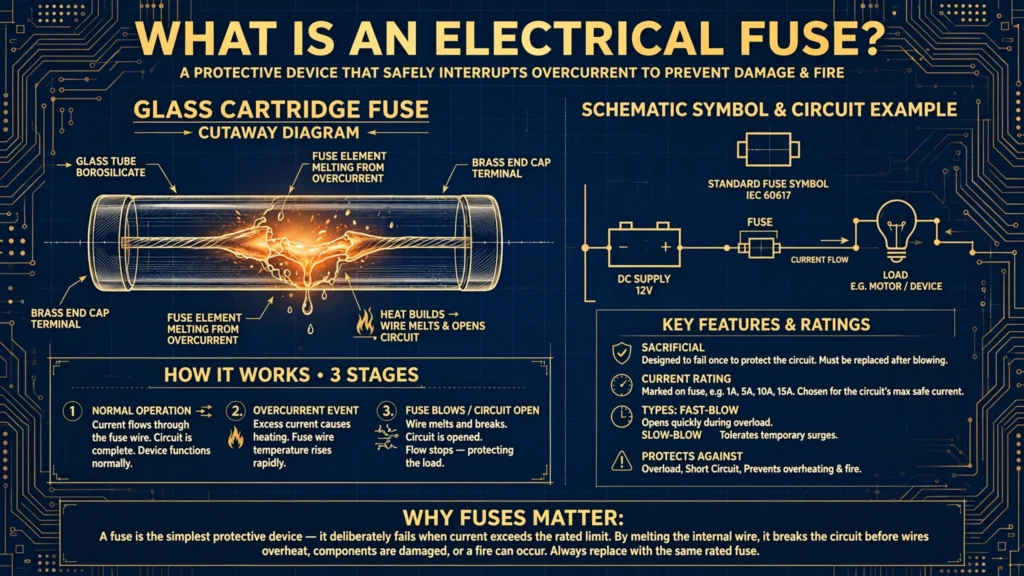
An electrical fuse is a sacrificial protection device wired in series with the circuit it guards. Inside the fuse is a thin metal wire or strip — the fuse element — made from a material with a carefully chosen melting point, such as copper, silver, zinc, or an alloy.
Under normal conditions, the rated current flows through the fuse element without any trouble. But when the current rises beyond the safe limit — because of an overload or a short circuit — the element heats up. This heating follows a simple physical rule: the heat produced is proportional to the square of the current multiplied by the resistance of the wire (a direct consequence of Ohm’s law relationships, P = I²R). Once the heat crosses the melting point of the element, the wire melts, breaks the circuit, and stops the current in a fraction of a second.
This is why a fuse is called “sacrificial”: it destroys itself to save everything downstream — the wiring, the appliances, and in many cases, the building itself from fire.
Main Parts of a Fuse
Although fuses come in many shapes, most share the same basic construction:
- Fuse element — the thin wire or strip that melts during a fault. Its thickness and material decide the current rating.
- Fuse body — the enclosure (glass, ceramic, or plastic) that holds the element and contains the arc produced when the element melts.
- Terminals / end caps — metal contacts at each end that connect the fuse into the circuit.
- Filler material — in high-capacity fuses, quartz sand or similar material surrounds the element to absorb heat and quench the arc quickly.
When you look at a blown glass fuse, you can often see the broken, blackened wire inside — a clear visual sign that it did its job.
Types of Electrical Fuses
Fuses are broadly grouped by where they are used and how much fault current they can interrupt.
Cartridge Fuses
Cylindrical fuses with metal end caps, common in industrial panels, appliances, and older home fuse boxes. They are cheap, compact, and available in a wide range of ratings.
Blade Fuses
The flat, colored plastic fuses found in cars and automotive panels. The color codes the current rating (for example, red for 10 A, blue for 15 A), making identification quick.
Glass Tube Fuses
Small transparent fuses used in electronics, power supplies, and test equipment. You can see the element inside, so a blown fuse is easy to spot.
HRC (High Rupturing Capacity) Fuses
Heavy-duty fuses with a ceramic body filled with quartz sand. They can safely interrupt very large fault currents without exploding, which is why they are standard in industrial switchgear.
Rewirable (Kit-Kat) Fuses
The old-style porcelain fuse holders once common in homes, where a blown fuse wire could be replaced by hand. They are now largely obsolete because the replacement wire rating depends on the person doing the repair — a safety risk.
Thermal Fuses
These respond to temperature rather than current alone. You will find them inside hair dryers, coffee makers, and transformers, where they cut power if the device overheats.
Fuse Ratings: What the Numbers Mean
Every fuse carries markings that tell you exactly what it can handle. The three most important are:
- Current rating (A) — the maximum current the fuse can carry continuously without blowing. A 10 A fuse should never be replaced with a 20 A one “to stop it blowing” — that defeats the protection.
- Voltage rating (V) — the maximum circuit voltage the fuse can safely interrupt. A fuse rated for 250 V must not be used on a 440 V line, even if the current rating matches.
- Breaking capacity (kA) — the maximum fault current the fuse can interrupt without rupturing dangerously. HRC fuses are chosen specifically for their high breaking capacity.
There is also the time-current characteristic: fuses do not all blow at the same speed. Fast-acting fuses protect sensitive electronics, while slow-blow (time-delay) fuses tolerate the brief inrush current of motors and transformers without nuisance tripping.
Fuse vs MCB: Key Differences
The MCB (miniature circuit breaker) has replaced fuses in most modern homes, but fuses are far from dead. Here is how they compare:
| Feature | Fuse | MCB |
|---|---|---|
| Operation | Melts and must be replaced | Trips and can be reset |
| Speed | Very fast (especially for short circuits) | Slightly slower |
| Cost | Very cheap | More expensive |
| Reuse | Single use | Reusable |
| Indication | Often visible (glass type) | Trip indicator/flag |
| Maintenance | Needs spare fuses | Almost none |
Fuses still win on cost and speed, which is why they remain standard in cars, electronics, and high-current industrial applications. MCBs win on convenience — you just flip the switch back on. If you want to understand the modern alternative in depth, read about the different types of circuit breakers and how MCBs are wired in a home distribution board.
Where Fuses Are Still Used
Despite the rise of breakers, fuses protect:
- Automobiles — every car has a fuse box guarding lights, fans, and ECUs.
- Electronics — power supplies, TVs, and chargers use small glass or SMD fuses.
- Industrial plants — HRC fuses guard motors, transformers, and capacitor banks against massive fault currents.
- Appliances — many devices hide a thermal fuse as a last line of defense against overheating.
In short, wherever cost matters, fault currents are extreme, or the device must fail safely without human intervention, the fuse remains the go-to choice. Both fuses and breakers exist to fight the same enemies: overloads and short circuits.
Frequently Asked Questions
What is an electrical fuse in simple words?
An electrical fuse is a safety device with a thin wire inside that melts and breaks the circuit when too much current flows. It sacrifices itself to protect wires and appliances from damage or fire.
Can I replace a blown fuse with a higher-rated one?
No. The rating is matched to the wiring and load. A higher-rated fuse will allow dangerous current to flow before blowing, which can overheat wires and start a fire. Always replace with the same rating.
Why do fuses blow for no apparent reason?
There is always a reason: an overload (too many devices on one circuit), a short circuit (damaged insulation or faulty appliance), or a worn-out fuse. If a replacement blows immediately, do not keep replacing it — find and fix the fault first.
Is a fuse better than an MCB?
Neither is universally better. Fuses are cheaper and faster but single-use; MCBs are resettable and more convenient but cost more. Homes today mostly use MCBs, while cars, electronics, and industry still rely heavily on fuses.
What is the difference between a fast-acting and a slow-blow fuse?
A fast-acting fuse blows almost instantly on overcurrent and protects sensitive electronics. A slow-blow (time-delay) fuse tolerates brief current surges, such as motor starting current, and is used where inrush currents are normal.
How do I know if a fuse is blown?
In a glass fuse, look for a broken or blackened wire inside. In opaque fuses, use a multimeter on the continuity setting — no beep means the fuse is open (blown).
Final Thoughts
The electrical fuse is proof that the best engineering is often the simplest: a calibrated weak link that fails exactly when it should. Understanding fuse types, ratings, and the fuse-versus-MCB trade-off gives you a solid foundation in circuit protection — a topic every electrical student and DIY enthusiast should master before touching a live panel. For a deeper dive into the science behind these devices, the fuse on Wikipedia article covers standards and history in detail.