
Two miniature circuit breakers can look identical, carry the same “C32” style marking, and yet behave completely differently when a motor starts or a short circuit occurs. One trips instantly on your air conditioner’s startup surge; the other rides through it without a blink. The difference is not the brand or the price — it is the tripping curve.
The tripping curve is the single most misunderstood MCB specification, and selecting the wrong one is behind countless nuisance-tripping complaints and, worse, dangerously slow fault clearance. In this guide, you will learn exactly what MCB tripping curves are, what the B, C, D, K and Z designations mean, and how to select the right curve for residential, commercial and industrial loads.
What Is an MCB Tripping Curve?
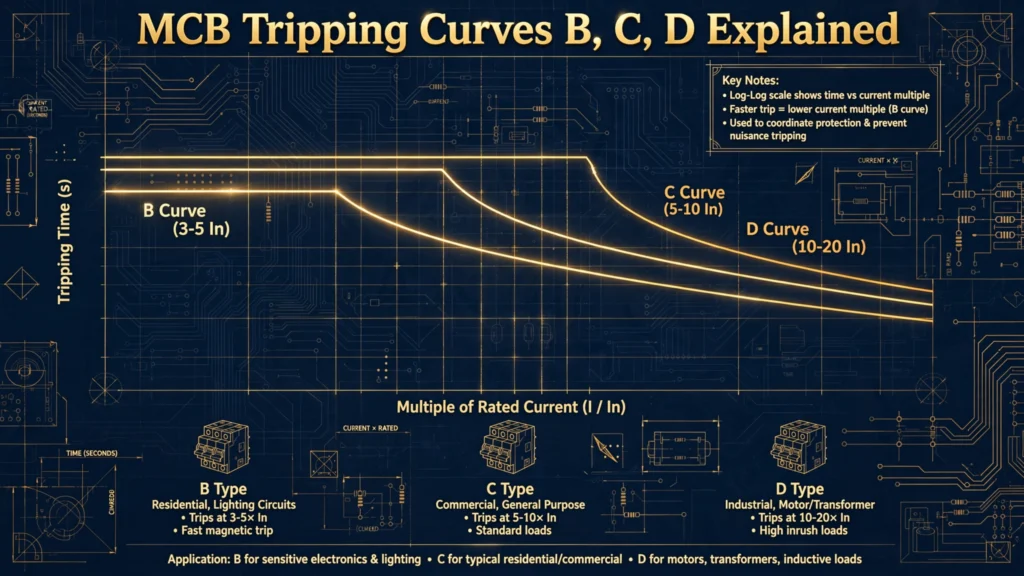
An MCB tripping curve — also called the time-current characteristic — is a graph that shows how long an MCB takes to trip at different levels of overcurrent. The horizontal axis plots current as a multiple of the breaker’s rated current (In), and the vertical axis plots tripping time in seconds.
Every curve has a characteristic shape: a long, sloping section on the left and a sharp vertical drop on the right. The sloping part represents overload protection — small sustained overloads take minutes to trip the breaker. The vertical drop represents short-circuit protection — large fault currents trip the breaker in milliseconds. The exact position of that vertical drop is what separates a B curve from a C or D curve.
Manufacturers publish these curves as a band rather than a single line, because manufacturing tolerances mean two breakers of the same type trip within a small range rather than at one exact point. When you understand how to read this graph, the letter printed on every MCB suddenly makes perfect sense.
How an MCB Trips: Thermal and Magnetic Protection
To understand tripping curves, you need to know that every MCB contains two separate tripping mechanisms working together:
1. Thermal tripping (overload protection). A bimetallic strip heats up as current flows through it. Under a moderate overload — say 1.5 times the rated current — the strip bends slowly and eventually trips the mechanism after tens of seconds or minutes. This is an inverse-time characteristic: the bigger the overload, the faster the trip. All MCB curves share roughly the same thermal region, which is why the left side of every curve looks similar.
2. Magnetic tripping (short-circuit protection). An electromagnetic coil (solenoid) generates a magnetic field proportional to current. When current exceeds a set threshold, the magnetic force pulls the trip mechanism instantly — typically in under 0.1 seconds. This threshold is the magnetic trip setting, and it is exactly what the B, C, D, K and Z letters define.
So when someone asks what a tripping curve means, the practical answer is: it tells you at what multiple of rated current the magnetic (instantaneous) trip kicks in. That is the whole game.
MCB Tripping Curve Types: B, C, D, K and Z
Here is the complete picture in one table:
| Curve | Magnetic trip range (× In) | Standard | Typical applications |
|---|---|---|---|
| Z | 2–3 × In | IEC 60947-2 | Sensitive electronics, control circuits, semiconductor protection |
| B | 3–5 × In | IEC 60898-1 | Residential lighting, resistive loads, no inrush current |
| C | 5–10 × In | IEC 60898-1 | General purpose: sockets, small motors, commercial buildings |
| K | 8–12 × In | IEC 60947-2 | Motors and transformers, tighter overload protection than D |
| D | 10–20 × In | IEC 60898-1 | High inrush loads: large motors, welding machines, X-ray equipment |
Let us look at each curve in detail.
B Curve (3–5 × In)
The B curve is the most sensitive standard curve. Its magnetic trip operates between 3 and 5 times the rated current, so a 16 A B-curve MCB trips magnetically somewhere between 48 A and 80 A. It is designed for circuits with no significant inrush current — lighting circuits, resistive heaters and general domestic loads. Because it reacts to relatively small fault currents, it offers excellent protection, but it will nuisance-trip if connected to anything with a startup surge.
C Curve (5–10 × In)
The C curve is the workhorse of the MCB world and the default choice for most installations. A 20 A C-curve MCB tolerates magnetic inrush up to 100–200 A, which comfortably covers small motors, air conditioners, refrigerators and mixed commercial loads. If you are ever unsure which curve to pick for a general-purpose circuit, C is the safe answer — which is why it dominates residential distribution boards worldwide.
D Curve (10–20 × In)
The D curve tolerates very large inrush currents — a 25 A D-curve MCB will not trip magnetically below 250 A. This makes it the right choice for large motors, transformers, welding sets and discharge lighting, all of which draw massive starting currents. The trade-off is reduced sensitivity: on a D curve, a moderate short circuit takes longer to clear, so it should never be used where fast fault clearance is needed for shock protection.
K Curve (8–12 × In)
The K curve sits between C and D in magnetic sensitivity (8–12 × In) but has a more sensitive thermal characteristic than D, making it popular for motor protection in industrial panels built to IEC 60947-2. You will encounter K-curve breakers mainly in motor control centres and industrial motor control and protection assemblies rather than homes.
Z Curve (2–3 × In)
The Z curve is the most sensitive of all, tripping magnetically at just 2–3 times rated current. It exists to protect sensitive electronic equipment and control circuits where even a brief overcurrent could destroy components. You will find Z-curve MCBs in PLC panels, instrumentation circuits and laboratory equipment — places where the load itself has virtually no inrush tolerance.
How to Select the Right MCB Tripping Curve
Follow this practical selection process:
Step 1: Identify the load type. Is it resistive (heaters, lighting), inductive with moderate inrush (small motors, ACs), or high-inrush (large motors, transformers, welders)? Resistive and lighting loads suit B; mixed general loads suit C; high-inrush loads need D (or K in industrial settings).
Step 2: Check the inrush current. Look at the equipment nameplate or datasheet for starting current. A motor with 6× starting current on a 10 A rated circuit produces 60 A at startup — a B16 (trips at 48–80 A) might nuisance-trip, while a C16 (80–160 A) rides through comfortably.
Step 3: Match the curve, then size the current rating. Select the curve first, then choose the rated current (In) to suit the cable and the load’s full-load current. Remember: the MCB protects the cable as well as the load, so In must not exceed the cable’s current-carrying capacity. Our guide on wiring an MCB in a home distribution board walks through practical sizing.
Quick reference examples:
- Home lighting circuit → B10 or B16
- Home socket outlets → C16 or C20
- 1.5-ton air conditioner → C20
- 5 HP three-phase motor → D25 or D32
- PLC control circuit → Z4 or Z6
For loads above roughly 100 A, you move beyond MCBs into MCCB territory, where adjustable trip settings replace fixed curves.
Common Mistakes to Avoid
Using C curve for everything. It works most of the time, which is why people do it — until a large motor’s DOL start keeps tripping a C-curve breaker, or a sensitive instrument gets damaged because a C curve was too slow.
Putting a D curve in a home. A D-curve MCB on a domestic socket circuit delays fault clearance significantly. In a home wired to IEC 60898, stick with B and C.
Ignoring discrimination. In a distribution board, the upstream breaker should be slower (or higher rated) than downstream ones, so only the faulty circuit trips. Mixing curves randomly across main and sub-circuits defeats this selectivity.
Forgetting the cable. The curve selects when the breaker trips; the current rating must still coordinate with cable size. A perfectly chosen D curve on an undersized cable is still a fire risk. If you are new to protective devices, start with our overview of different types of circuit breakers and how circuit breakers interrupt fault current before sizing anything.
Frequently Asked Questions
Which MCB tripping curve is best for home use?
For homes, use B curve for lighting circuits and C curve for socket outlets and appliances. C is the best all-rounder for residential distribution boards because it tolerates the small inrush currents of refrigerators, washing machines and air conditioners without nuisance tripping.
What is the difference between B curve and C curve MCB?
The difference is the magnetic (instantaneous) trip threshold. A B-curve MCB trips magnetically at 3–5 times its rated current, while a C-curve MCB trips at 5–10 times. The thermal (overload) protection is essentially the same for both — only the short-circuit sensitivity differs.
Can I use a D curve MCB in my house?
It is not recommended. A D-curve MCB allows up to 10–20 times rated current before magnetic tripping, which means short circuits on domestic wiring take longer to clear. This increases fire and electric-shock risk. Homes should use B and C curves as per IEC 60898.
Do tripping curves affect overload protection?
No. The tripping curve letter (B, C, D, K, Z) only changes the magnetic trip threshold for short circuits. The thermal bimetal element that handles sustained overloads behaves nearly identically across all curves of the same current rating.
What happens if I select the wrong tripping curve?
Two failure modes: a curve that is too sensitive (e.g. B on a motor circuit) causes nuisance tripping every time the load starts; a curve that is too slow (e.g. D on a lighting circuit) lets fault current flow longer than necessary, raising the risk of cable damage or fire.
Is a K curve better than a D curve for motors?
Neither is universally better — they serve different standards. K curve (8–12 × In, IEC 60947-2) pairs motor-suitable magnetic tolerance with tighter thermal protection and is common in industrial motor control panels. D curve (10–20 × In, IEC 60898-1) tolerates even larger inrush and is used for heavy starting duty. Check which standard your panel is built to.
Final Thoughts
MCB tripping curves look intimidating on a datasheet, but the idea is simple: the letter tells you how much sudden current the breaker tolerates before tripping instantly. B is sensitive, C is the all-rounder, D handles heavy inrush, K protects motors in industrial panels, and Z guards delicate electronics. Match the curve to your load’s inrush characteristics, size the current rating to the cable, and you will get protection that trips when it should — and never when it should not.