
Introduction
Imagine plugging in too many heaters on a cold evening: the wires inside your walls heat up, and without protection, melting insulation could start a fire. A small device called the MCB prevents exactly this danger every day.
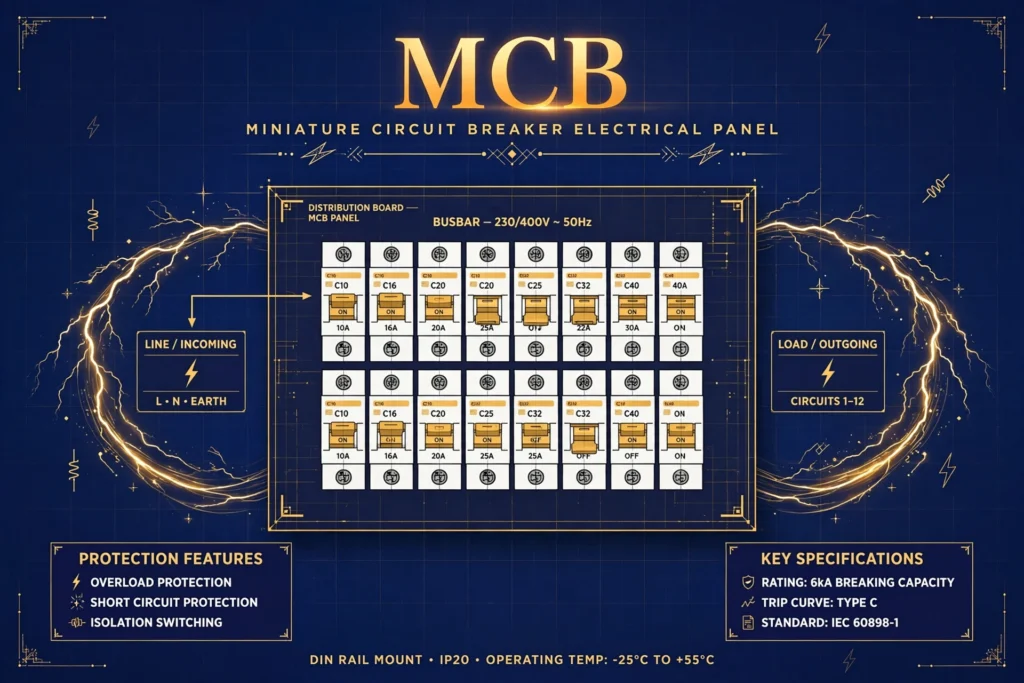
MCB stands for Miniature Circuit Breaker. It is the small switch you see inside your home’s distribution board — the row of little toggles that trip when something goes wrong. When current exceeds a safe limit, the MCB switches off the circuit automatically, protecting your wires and appliances.
Before MCBs, homes used fuses: thin wires that melted during a fault and had to be replaced each time. MCBs do the same job but can be switched back on after the fault is fixed. They are faster, safer, and reusable.
In this article, we explain what a miniature circuit breaker is, how it works, its types, components, advantages, disadvantages, and applications. You will also learn how it compares with fuses and MCCBs, and how to choose the right MCB for your needs.
What Is an MCB?
An MCB (Miniature Circuit Breaker) is an automatic electrical switch that protects a circuit from damage caused by overload or short circuit. “Overload” means too much current flowing for too long, like running many appliances on one circuit. “Short circuit” means a sudden, very large current caused by a fault, such as live and neutral wires touching.
An MCB sits in the distribution board and watches the current in its circuit continuously. Under normal conditions, it stays on and lets current flow. When the current crosses a dangerous level, it trips — meaning it opens its contacts and stops the flow within milliseconds. After you fix the cause, you simply flip the switch back on.
For example, a 16-amp kitchen MCB trips when a microwave, kettle, and toaster together draw 22 amps. You unplug one appliance, reset the MCB, and power returns — no wire replaced, no damage done.
MCBs are rated for low-voltage circuits, typically up to 100 amps and 240/415 volts. They are the standard protection device in homes, offices, and small commercial buildings worldwide.
Working Principle
An MCB detects two kinds of faults using two different tripping mechanisms inside one small body. Here is how each works, step by step.
Thermal tripping (for overload):
- Inside the MCB, current flows through a bimetallic strip — two metals bonded together that expand at different rates when heated.
- During a small, sustained overload, the strip slowly heats up and bends.
- When it bends far enough, it pushes the trip mechanism and opens the contacts.
- This delay is intentional: brief surges like motor starting will not trip it, but a lasting overload will.
Magnetic tripping (for short circuit):
- Current also flows through an electromagnetic coil (solenoid) inside the MCB.
- A short circuit creates a huge current spike, producing a strong magnetic field instantly.
- The magnetic force pulls a plunger that trips the mechanism in milliseconds.
- This instant action limits the damage from the massive fault current.
Think of it like a security guard with two reflexes: the thermal strip is the patient guard who acts when a crowd slowly grows too large, while the magnetic coil reacts instantly when someone crashes through the door. Together they give the MCB its “thermal-magnetic” protection.
When contacts open under fault current, a small arc forms. The arc chute — a stack of metal splitter plates — divides, cools, and extinguishes it safely.
Types of MCB
Type B MCB
Type B trips magnetically at 3 to 5 times its rated current. It is the most sensitive type, designed for circuits with no large inrush currents. Typical uses: lighting circuits, residential sockets, and general home wiring.
Type C MCB
Type C trips magnetically at 5 to 10 times its rated current. It tolerates moderate inrush currents from small motors and transformers. Typical uses: small motors, air conditioners, and commercial lighting. It is the most common type in commercial installations.
Type D MCB
Type D trips magnetically at 10 to 20 times its rated current. It handles very large inrush currents without nuisance tripping. Typical uses: large motors, welding equipment, and X-ray machines. It offers the least sensitive short-circuit protection, so it must be matched carefully to the circuit.
Single Pole, Double Pole, Triple Pole, and Four Pole MCBs
MCBs are also classified by the number of poles — the conductors they switch. A single pole (1P) MCB protects one phase wire in single phase circuits. A double pole (2P) MCB switches phase and neutral together, common as a main switch in homes. A triple pole (3P) MCB protects three phase circuits, and a four pole (4P) MCB switches all three phases plus neutral as the main incomer in three phase boards.
Main Components
An MCB packs several precision parts into a compact case:
- Operating knob/lever: the toggle you flip to switch the MCB on or off manually and to reset it after a trip.
- Contacts (fixed and moving): metal contacts that carry the normal current and separate to break the circuit during a fault.
- Bimetallic strip: bends when heated by sustained overload current and triggers the thermal trip.
- Electromagnetic coil (solenoid): creates an instant magnetic pull during short circuit and triggers the magnetic trip.
- Trip mechanism (latch): the mechanical linkage that releases the moving contact when either the strip or the coil acts.
- Arc chute: a stack of metal splitter plates that divides and cools the arc formed when contacts open, extinguishing it quickly.
- Terminals: screw clamps where the incoming and outgoing wires connect securely.
- Housing: a flame-retardant insulated case that contains the arc and protects the user from live parts.
Advantages
- Reusable: unlike a fuse, an MCB is simply reset after tripping — no replacement part needed.
- Fast protection: trips in milliseconds during a short circuit, limiting damage to wires and equipment.
- Precise ratings: available in standard ratings (6 A, 10 A, 16 A, 20 A, 32 A, 40 A, 63 A and more), so each circuit gets exactly the protection it needs.
- Easy fault identification: the tripped lever shows which circuit has the problem, making fault finding quick.
- Safe to operate: the insulated knob lets anyone reset it without touching live parts.
- Compact and modular: MCBs clip onto a standard DIN rail, so boards stay neat and extra ways can be added easily.
- Low maintenance: no parts to replace under normal use; periodic testing is simple.
Disadvantages and Limitations
- Higher cost than fuses: an MCB costs more upfront than a simple fuse wire or cartridge.
- Cannot be repaired: if the internal mechanism fails, the whole MCB must be replaced.
- Limited breaking capacity: standard MCBs handle fault currents up to about 6 kA or 10 kA; larger faults need MCCBs or fuses with higher ratings.
- Not for very high currents: MCBs top out around 100–125 A; bigger loads need MCCBs or air circuit breakers.
- Thermal tripping is slow: by design, overload tripping takes seconds to minutes.
- Needs correct selection: the wrong type (B, C, or D) causes either nuisance tripping or weak protection.
Applications
Homes: every modern home distribution board uses MCBs — lighting circuits (usually 6 A or 10 A Type B), socket circuits (16 A or 20 A), and dedicated circuits for air conditioners, geysers, and kitchen appliances. The main switch is often a double pole MCB or isolator.
Commercial buildings: offices, shops, schools, and hospitals use MCBs for lighting, computer circuits, HVAC controls, and small machinery. Type C is common here because of moderate inrush currents.
Industry: factories use MCBs for control panels, lighting, and small motor circuits, while larger machines get MCCBs. Type D MCBs protect circuits feeding motors and welding sets with heavy starting currents.
Modern uses: solar inverter AC output circuits, EV charger sub-circuits, and data-center rack power distribution all rely on MCBs for branch protection. Smart MCBs with energy monitoring and remote tripping are now appearing in home automation systems.
MCB Comparison
| Feature | MCB | Fuse | MCCB |
|---|---|---|---|
| Full form | Miniature Circuit Breaker | — | Moulded Case Circuit Breaker |
| Operation | Automatic trip, manual reset | Melts and must be replaced | Automatic trip, manual reset |
| Reusable | Yes | No | Yes |
| Current range | Up to ~100 A | Wide range | Up to ~2500 A |
| Breaking capacity | Up to ~10 kA | Can be very high | Up to ~100 kA |
| Tripping speed (short circuit) | Milliseconds | Very fast | Milliseconds (adjustable) |
| Overload protection | Yes (thermal) | Yes | Yes (adjustable) |
| Cost | Moderate | Low | High |
| Typical use | Homes, offices, small industry | Simple/legacy circuits, backup protection | Large industry, main feeders |
| Fault indication | Visible tripped lever | Must inspect/replace to find fault | Trip indicator, some show cause |
How to Choose the Right MCB
- Match the current rating to the circuit: the MCB rating must suit the wire size and expected load. Common home choices: 6 A for lighting, 16 A for sockets, 20–32 A for air conditioners and geysers. The breaker protects the wiring, so never fit a rating higher than the cable can carry.
- Pick the right type (B, C, or D): use Type B for lighting and general home circuits, Type C for small motors and commercial loads, and Type D only for equipment with very heavy starting currents.
- Choose the correct number of poles: single pole for normal single phase circuits, double pole for the main switch, and three or four pole for three phase boards.
- Check the breaking capacity: 6 kA is standard for homes; use 10 kA where the supply authority requires it or fault levels are higher.
- Buy certified products: look for recognized safety marks (such as IEC 60898 compliance) and buy from reputable sources. Counterfeit breakers may not trip when needed.
- Leave spare ways: choose a distribution board with a few empty slots so future circuits can be added without replacing the board.
Common Problems and Solutions
Q1: Why does my MCB keep tripping?
The most common cause is overload — too many appliances on one circuit. Unplug some loads and reset. If it trips with almost nothing connected, there may be a short circuit or a faulty appliance; unplug everything, reset, then reconnect items one by one to find the culprit.
Q2: My MCB trips instantly and will not stay on. What is wrong?
This points to a short circuit or a serious fault in the wiring or an appliance. Do not force it to stay on. Switch off all appliances on that circuit, then try resetting. If it still trips immediately, call an electrician — the wiring needs inspection.
Q3: Can I replace a fuse with an MCB?
Yes, in most cases this is a genuine upgrade, provided the MCB rating matches the circuit and an electrician confirms the wiring is suitable. Very old fuse boxes may need replacing too, since MCBs need a proper DIN-rail board.
Q4: Is it safe to reset a tripped MCB myself?
Yes — the insulated knob makes resetting safe, and MCBs are designed for it. But always remove the cause first, and if it trips repeatedly, get the fault checked.
Q5: Why does my air conditioner trip a Type B MCB but works on Type C?
Compressor motors draw a large inrush current at startup. A Type B breaker sees this as a fault and trips, while Type C tolerates the brief surge. Air conditioner circuits should use Type C MCBs of the correct rating.
Q6: How long does an MCB last?
A good quality MCB lasts 15–20 years or more in normal service. Replace it if the knob feels loose, it trips at loads it used to handle, or it shows burn marks. After a severe short circuit, consider replacing it even if it looks fine.
Future Trends
MCBs are getting smarter. Manufacturers now offer MCBs with built-in energy monitoring that report current, voltage, and power use to a phone app. Smart breakers can be tripped or reset remotely, scheduled by time, and linked with home automation systems.
Safety is improving too. Devices that combine MCB overcurrent protection with earth leakage protection (RCBOs) and arc fault detection are becoming standard in new installations in many countries. These combination devices protect against overload, short circuit, earth leakage, and dangerous arcing in one compact unit.
On the sustainability side, manufacturers are designing MCBs with recyclable housings and longer mechanical life. As homes add solar panels, battery storage, and EV chargers, demand is growing for DC-rated miniature breakers. The humble MCB is evolving from a simple switch into an intelligent guardian of the modern electrical system.
Conclusion
The MCB is one of the most important safety devices in any electrical installation. Its thermal-magnetic mechanism guards against both slow overloads and sudden short circuits, and it resets with a simple flick after the fault is cleared. Whether it protects a bedroom lighting circuit or a factory control panel, it stands guard around the clock without needing attention.
Choosing the right type, rating, and pole count — and buying certified products — is what turns a small plastic switch into reliable protection for your home or business. Understand what your MCB does, respect its trips instead of ignoring them, and call a professional when faults repeat. That small device on your distribution board is working quietly to keep you safe every single day.