
Imagine switching on a ceiling fan. The fan starts rotating because electrical energy reaches its motor. But what actually moves through the wires and allows the fan to operate? The answer is electric current.
Electric current is one of the most important concepts in electrical engineering. Every electrical device, from a small LED to a large industrial motor, depends on current to operate. Understanding current helps students, technicians, and engineers understand how electrical circuits work and how electrical equipment should be designed, operated, and protected.
In simple terms, electric current is the flow of electric charge through a conductive path. It is measured in amperes (A) and is commonly represented by the letter I.
This article explains what is current, how it works, its types, important circuit elements, advantages and limitations, applications, and common problems. You will also learn the difference between AC and DC current, how current is measured, and why controlling current is essential for electrical safety.
2. What Is Current?
Definition of Electric Current
Electric current is the rate at which electric charge flows through a conductor or electrical circuit.
The standard unit of current is the ampere (A).
The basic formula is:
I = Q / t
Where:
- I = Current in amperes (A)
- Q = Electric charge in coulombs (C)
- t = Time in seconds (s)
One ampere means that one coulomb of electric charge passes through a point in a circuit every second.
Simple Explanation
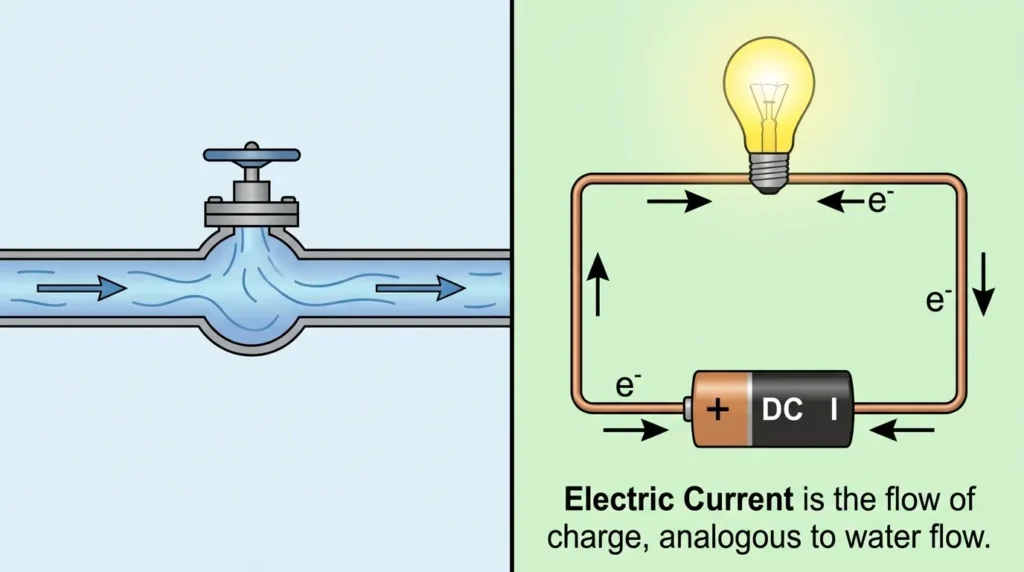
Think of an electrical wire like a water pipe.
- Water flowing through the pipe is similar to electric current.
- The pipe provides a path, similar to an electrical conductor.
- Water pressure is similar to voltage.
- A valve can be compared with a device that controls flow.
If there is no pressure, water may not flow. Similarly, a suitable voltage is normally required to drive current through a circuit.
This analogy is useful for beginners, although electricity and water do not behave exactly the same way.
Practical Example
Suppose a small lamp is connected to a battery.
When the switch is closed:
- The circuit becomes complete.
- The battery creates an electrical potential difference.
- Charge begins moving through the circuit.
- Current flows through the lamp.
- The lamp converts electrical energy into light and heat.
This simple circuit demonstrates the basic relationship between voltage, current, resistance, and electrical power.
3. Current Working Principle
Understanding the current working principle becomes easier when we look at what happens inside a complete electrical circuit.
Step 1: A Voltage Source Provides Potential Difference
A battery, generator, or power supply provides voltage.
Voltage creates the electrical force that causes charge carriers to move through a suitable circuit.
Step 2: The Circuit Provides a Path
Current needs a conductive path.
Copper and aluminum are commonly used conductors because they allow electric charge to move relatively easily.
Step 3: The Circuit Is Completed
When a switch is closed, a continuous electrical path is created.
If the circuit is open, current normally cannot flow through the open section.
Step 4: Charge Moves Through the Circuit
In metallic conductors, electrons are the primary charge carriers.
Electrons move from the negative side toward the positive side of a source. However, conventional current direction is defined as flowing from positive to negative through the external circuit.
This distinction is important in electrical engineering.
Step 5: The Load Uses Electrical Energy
The current passes through electrical loads such as:
- Lamps
- Motors
- Heaters
- Transformers
- Electronic circuits
The load converts electrical energy into another useful form.
A Simple Analogy
Imagine people moving through a hallway.
- The hallway is the conductor.
- People represent charge carriers.
- The number of people passing a doorway each second represents current.
- A narrow hallway restricts movement, similar to resistance restricting current.
This gives beginners a simple way to understand why current depends on the conditions of a circuit.
4. Types of Current
Electric current can mainly be classified into direct current (DC) and alternating current (AC).
Direct Current (DC)
Direct current flows in one direction.
Its voltage polarity remains fixed or changes very little over time in a basic DC system.
Common DC sources include:
- Batteries
- Solar panels
- DC power supplies
- Fuel cells
- Electronic circuits
DC Example
A flashlight powered by a battery uses DC electricity.
The battery provides a voltage that causes current to flow through the circuit in a consistent direction.
Alternating Current (AC)
Alternating current periodically changes direction and magnitude.
AC is widely used in electrical power systems because it can be generated, transmitted, and distributed efficiently.
Common AC sources include:
- Power generators
- Utility grids
- Household electrical outlets
- Industrial power systems
AC vs DC Current
| Feature | AC Current | DC Current |
|---|---|---|
| Direction | Changes periodically | Mainly one direction |
| Common source | Alternator/grid | Battery |
| Frequency | Usually has a defined frequency | Normally 0 Hz for steady DC |
| Common use | Homes and industries | Electronics and battery systems |
| Transmission | Widely used in power grids | Increasingly used in modern HVDC systems |
| Example | Household supply | Battery-powered device |
Other Ways to Classify Current
Current can also be discussed based on the circuit or waveform.
Constant Current
A constant current maintains approximately the same value with time.
Variable Current
Variable current changes with time.
Sinusoidal Current
This is a common AC waveform that follows a sine-wave pattern.
Pulsating Current
Pulsating current flows mainly in one direction but its magnitude varies with time. It can occur after rectification.
5. Main Components That Control Current in a Circuit
Current itself does not have physical components. However, several electrical components determine how current flows through a circuit.
Voltage Source
A voltage source provides the electrical potential difference needed to drive current.
Examples include batteries, generators, and power supplies.
Conductor
A conductor provides the path for current.
Copper and aluminum are widely used because they have good electrical conductivity.
Resistance
Resistance opposes current flow.
According to Ohm’s law:
I = V / R
Therefore, when voltage remains constant, increasing resistance generally reduces current.
Load
A load consumes electrical energy.
Examples include:
- Motors
- Lamps
- Heating elements
- Fans
- Electronic equipment
Switch
A switch controls the electrical path.
A closed switch allows current to flow through the intended circuit path, while an open switch interrupts the path.
Protective Devices
Devices such as fuses and circuit breakers help protect circuits from excessive current.
They can disconnect a circuit when current becomes unsafe.
Ammeter
An ammeter measures current.
It is normally connected in series with the circuit branch whose current is being measured.
A modern digital multimeter can also measure current when connected using the correct terminals and settings.
6. Advantages of Electric Current
Electric current provides many benefits in modern life and industry.
Major Advantages
- Powers electrical equipment: Current allows electrical devices to operate.
- Supports industrial production: Motors and machines depend on electrical power.
- Enables lighting: Current allows lamps and LED systems to produce light.
- Supports electronics: Computers, communication equipment, and control systems require controlled electrical current.
- Makes automation possible: Industrial control systems use electrical signals and power.
- Works with renewable energy: Solar, wind, and battery systems depend on controlled electrical current.
- Enables transportation technology: Electric vehicles use electrical current to operate their drive systems.
- Allows precise control: Modern power electronics can control current accurately.
7. Disadvantages and Limitations of Current
Electric current is useful, but uncontrolled or excessive current can create serious problems.
Excessive Heating
When current becomes too high, conductors can heat up.
The heating effect is related to:
P = I²R
This shows why a small increase in current can produce a significant increase in resistive heating.
Electrical Damage
Excessive current can damage:
- Motors
- Cables
- Transformers
- Circuit boards
- Switchgear
Fire Risk
Overcurrent can cause excessive conductor heating and may create a fire hazard if protection is inadequate.
Electric Shock
Current passing through the human body can cause injury or death. The severity depends on several factors, including current magnitude, path through the body, duration, and conditions.
Voltage Drop
Long conductors carrying current can experience voltage drop because conductors have resistance.
Energy Loss
Resistance causes electrical energy to be converted into heat. This can reduce system efficiency.
8. Current Applications
Electric current is used almost everywhere electricity is used.
Home Applications
In homes, current operates:
- Fans
- Refrigerators
- Washing machines
- Air conditioners
- Water pumps
- Televisions
- Computers
- Lighting systems
- Kitchen appliances
The amount of current required depends on the equipment’s voltage, power, efficiency, and operating conditions.
Industrial Applications
Industry uses current for:
- Electric motors
- Pumps
- Compressors
- Conveyors
- Welding machines
- Industrial heaters
- Control systems
- Automation equipment
- Manufacturing machines
Large industrial systems require careful current monitoring because excessive current can indicate overload, faults, or equipment problems.
Modern Technology Applications
Current is also essential in modern technologies such as:
- Electric vehicles
- Battery energy storage
- Solar power systems
- Wind power systems
- Data centers
- Robotics
- Smart grids
- Semiconductor devices
- Telecommunications
- Power electronic converters
Electrical Testing and Maintenance
Technicians regularly measure current during troubleshooting.
Abnormal current can provide useful information about equipment condition.
For example, a motor drawing significantly more current than its rated value may indicate overload, mechanical problems, low voltage, phase imbalance, or another fault.
9. Difference Between AC and DC Current
The difference between AC and DC current is mainly related to direction and behavior over time.
| Parameter | AC | DC |
|---|---|---|
| Direction | Periodically changes | Generally remains in one direction |
| Typical source | Alternator | Battery |
| Frequency | Greater than 0 Hz in normal AC systems | 0 Hz for steady DC |
| Common application | Power distribution | Electronics and battery systems |
| Voltage polarity | Alternates | Normally fixed |
| Example | Utility electricity | Battery output |
Both AC and DC are important. Neither is universally better.
The appropriate type depends on the application.
10. How to Measure Current
Current is measured using instruments designed for electrical testing.
Ammeter
An ammeter measures current directly.
It is connected in series so that the circuit current passes through the measuring instrument.
Digital Multimeter
A digital multimeter can measure current when the correct current function and terminals are selected.
Before measuring:
- Check the expected current range.
- Select the appropriate measurement function.
- Place the test leads in the correct terminals.
- Connect the meter correctly.
- Start with a higher range when uncertain.
- Never connect a current input directly across a voltage source.
Clamp Meter
A clamp meter measures current by clamping around a conductor.
It is especially useful for maintenance because the conductor usually does not need to be disconnected.
Clamp meters are widely used for:
- Motor testing
- Panel inspection
- Load measurements
- HVAC maintenance
- Industrial troubleshooting
11. Selection Guide: Choosing the Right Current Measurement Method
The correct measurement method depends on the application.
For Small Electronic Circuits
A digital multimeter is often suitable.
Always check its current rating before making the connection.
For Household Circuits
A properly rated multimeter or clamp meter can be useful, depending on the measurement task.
Safety category and voltage rating are important.
For Industrial Motors
A clamp meter is often convenient because it allows technicians to measure operating current without disconnecting the conductor.
For High-Current Systems
Use properly rated current transformers, clamp meters, or other suitable instruments designed for the system.
Beginner Tips
- Never guess the current range.
- Check the instrument rating.
- Use proper personal protective equipment where required.
- Follow electrical safety procedures.
- Understand the circuit before connecting a meter.
- Never place an ammeter directly across a voltage source.
- Disconnect power before changing wiring connections unless the equipment and procedure specifically allow energized testing.
12. Common Problems and Solutions
Why Is Current Too High?
High current can result from:
- Excessive load
- Short circuit
- Low system voltage in some motor applications
- Motor mechanical overload
- Damaged equipment
- Incorrect wiring
Solution: Check the load, wiring, protective devices, and equipment condition. Do not simply replace a fuse or breaker without identifying the cause.
Why Is Current Too Low?
Low current may result from:
- Light loading
- An open circuit
- Poor connection
- Incorrect supply conditions
- Equipment not operating correctly
Solution: Check voltage, continuity, connections, and the equipment’s operating condition.
Why Does a Motor Draw High Current?
Possible causes include:
- Mechanical overload
- Low voltage
- Phase imbalance
- Bearing problems
- Incorrect motor connection
- Starting conditions
The correct diagnosis requires checking the motor’s rated current, supply voltage, phase conditions, and mechanical load.
Why Does a Circuit Breaker Trip?
A breaker may trip because of:
- Overload
- Short circuit
- Earth fault
- Equipment fault
- Incorrect protection settings
Repeated tripping should be investigated rather than ignored.
Can Current Flow Without Voltage?
In practical circuit analysis, a current requires an electromotive force or voltage difference and a suitable conductive path. In some specialized systems, induced currents can occur due to changing electromagnetic fields, but this still involves an electrical driving mechanism.
13. Future Trends in Current Measurement and Control
Electrical systems are becoming more intelligent, connected, and efficient. This is changing how current is measured and controlled.
Smart Sensors
Modern current sensors can provide accurate measurements to digital control systems.
These sensors are increasingly used in industrial automation, energy systems, and electric vehicles.
Smart Grids
Smart grids use sensors, communication systems, and automated controls to monitor electrical networks.
Current measurements help identify changes in demand, faults, and system performance.
Electric Vehicles
Electric vehicles require accurate current measurement for:
- Battery management
- Motor control
- Charging
- Protection
- Energy monitoring
Renewable Energy
Solar and wind systems use power electronics to control electrical energy.
Current monitoring helps improve system efficiency and protect equipment.
Advanced Current Sensors
Technologies such as Hall-effect sensors, current transformers, Rogowski coils, and other non-invasive sensing methods are becoming increasingly important.
These technologies allow engineers to monitor current without always making a direct electrical connection to the conductor.
Predictive Maintenance
Modern industrial systems can analyze current patterns to detect unusual equipment behavior.
For example, changes in motor current can sometimes provide early warning of mechanical or electrical problems.
14. Conclusion
Electric current is the flow of electric charge through a suitable electrical path. It is measured in amperes and is one of the fundamental quantities used in electrical engineering.
The two main types are AC and DC current. AC changes direction periodically and is widely used in power systems, while DC generally flows in one direction and is common in batteries, electronics, and energy-storage systems.
Understanding current is essential for safely designing, operating, testing, and maintaining electrical equipment. Voltage drives current, resistance limits it, and electrical loads convert electrical energy into useful forms.
For beginners, the most important concepts to remember are current, voltage, resistance, Ohm’s law, AC, DC, and safe current measurement. As you progress, understanding current will make more advanced topics such as motors, transformers, power systems, protection, and power electronics much easier to learn.