
Weather vs Whether: Meaning, Difference, and How to Use Each Correctly
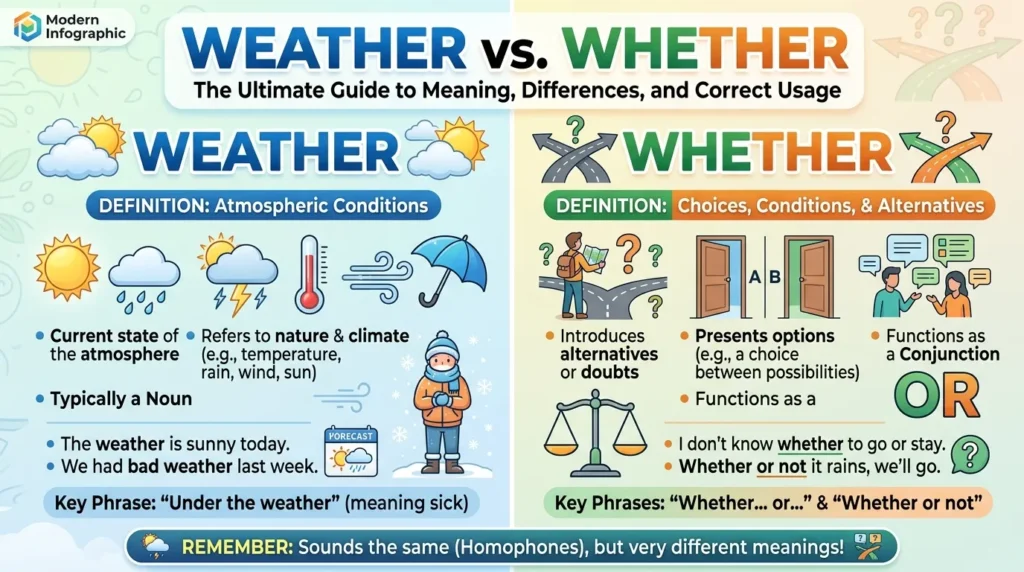
Have you ever wondered whether you should write weather or whether? These two English words sound the same or very similar in many accents, but they have completely different meanings and uses. Weather refers to conditions in the atmosphere, such as rain, wind, sunshine, temperature, and storms. Whether is used to talk about a choice, possibility, or alternative.
For example, you might say, “The weather is cold today,” but “I don’t know whether he will come.” The first sentence describes outdoor conditions, while the second expresses uncertainty about a possibility.
Understanding weather vs whether is especially important for students, English learners, and anyone writing emails, assignments, reports, or online content. A single letter can change the meaning of the sentence completely.
In this guide, you’ll learn the meaning of weather and whether, the key differences, correct usage, common mistakes, examples, word origins, American English usage, and easy memory tricks so you can choose the right word with confidence.
Weather vs Whether – Quick Answer
The easiest way to remember the difference is:
- Weather = conditions outside, such as rain, wind, heat, or snow.
- Whether = a choice, possibility, or alternative.
Weather Examples
- The weather is sunny today.
- We stayed home because of bad weather.
- The cold weather made the road dangerous.
- What will the weather be like tomorrow?
Whether Examples
- I do not know whether she will come.
- Tell me whether you agree.
- We need to decide whether to stay.
- I am not sure whether this is correct.
Easy Memory Trick
Think:
Weather = What happens outside.
Whether = Which choice?
| Word | Meaning | Example |
|---|---|---|
| Weather | Conditions in the atmosphere | The weather is warm. |
| Whether | Choice or possibility | I don’t know whether he is coming. |
The Origin of Weather vs Whether
Although weather and whether have different meanings today, both words have long histories in English.
Origin of Weather
The word weather comes from Old English “weder,” which referred to air, wind, or atmospheric conditions. Over time, its spelling changed into the modern form weather.
Today, weather describes conditions such as:
- Rain
- Snow
- Wind
- Temperature
- Storms
- Sunshine
- Humidity
The word can also be used as a verb. For example:
The old building has weathered many storms.
Origin of Whether
Whether comes from Old English “hwæther,” meaning “which of two” or “which one.”
Its meaning developed around choices and alternatives. This explains why we often use whether when discussing two possible situations.
For example:
I don’t know whether to call him.
The sentence presents a choice: call him or do not call him.
Why Are They Confused?
The main reason is pronunciation. In many forms of modern English, weather and whether sound very similar or identical.
Their meanings, however, are completely different.
Whether vs If
Whether and if can sometimes be used in similar sentences when expressing uncertainty. However, they are not always interchangeable. Whether is especially useful when a sentence involves alternatives, choices, or the phrase “or not.”
When Whether and If Have Similar Meanings
In many sentences, both words can introduce an uncertain situation.
For example:
I don’t know whether she will come.
I don’t know if she will come.
Both sentences mean that the speaker does not know if she will come.
Another example:
Please tell me whether the store is open.
Please tell me if the store is open.
Both can be understood as asking for information about the store.
Use Whether for Choices and Alternatives
Whether is often preferred when there are two or more alternatives.
Examples:
We need to decide whether to stay or leave.
She couldn’t decide whether to buy the blue dress or the red one.
The committee will determine whether the proposal should be accepted or rejected.
In these examples, whether clearly introduces alternatives.
Use Whether With “Or Not”
Whether or not is a common construction.
Examples:
I will go whether or not it rains.
We need to finish the project whether or not they agree.
She plans to attend whether or not her friends come.
The phrase means that the outcome will remain the same regardless of the situation.
Whether or If: Simple Comparison
| Usage | Whether | If |
|---|---|---|
| Express uncertainty | ✅ Yes | ✅ Yes |
| Introduce alternatives | ✅ Yes | Sometimes |
| “Whether or not” | ✅ Yes | ❌ Usually not |
| “Whether to” | ✅ Yes | ❌ No |
| Formal writing | ✅ Common | ✅ Common |
Easy Rule
Use whether when you are thinking about choices, alternatives, or “or not.”
Use if when you are simply expressing a condition or uncertainty and there is no need to emphasize alternatives.
For example:
I don’t know whether to call him.
Here, whether is correct because the sentence involves a choice.
If it rains, we will stay home.
Here, if introduces a condition, so if is correct.
Whether or Not – Meaning and Correct Usage
Whether or not is a common English expression used to show that something will happen or remain true regardless of two possible situations. It often means “regardless of whether” or “no matter if.”
Examples of Whether or Not
- I will go whether or not it rains.
- She will finish the project whether or not you help her.
- We need to make a decision whether or not everyone agrees.
- He plans to attend the meeting whether or not his manager is there.
- The company will continue the project whether or not sales increase.
In each example, the final result does not depend on which possibility occurs.
Whether vs Whether or Not
Whether can introduce a choice or uncertainty:
I don’t know whether she will come.
This means the speaker is uncertain about her attendance.
Whether or not emphasizes that the result will remain the same:
I will attend the meeting whether or not she comes.
This means the speaker will attend in either situation.
Whether or Not at the Beginning of a Sentence
The phrase can also appear at the beginning of a sentence.
For example:
Whether or not you agree, we need to make a decision.
Whether or not it rains, the event will continue.
This structure is grammatically correct and common in both American and British English.
Whether or Not vs If
When expressing a condition, if is often used:
If it rains, we will stay home.
When emphasizing that the result will be the same in either situation, whether or not is often more appropriate:
We will go whether or not it rains.
Easy Rule to Remember
Think of:
Whether = Which possibility?
Whether or not = Either way / Regardless
For example:
I don’t know whether he will come.
I will go whether or not he comes.
Weather vs Whether – Clear Difference
The main difference between weather and whether is their meaning.
Weather is used for conditions in the atmosphere, such as rain, wind, temperature, sunshine, snow, and storms. Whether is used for a choice, possibility, or uncertainty.
Weather
Weather is a noun when it describes atmospheric conditions.
Examples:
- The weather is hot today.
- We stayed home because of the bad weather.
- The weather forecast predicts rain tomorrow.
- The cold weather caused travel delays.
Weather can also be used as a verb meaning to survive, endure, or withstand something difficult.
Example:
The company weathered the financial crisis.
Whether
Whether is a conjunction used to introduce a choice, alternative, or uncertain possibility.
Examples:
- I don’t know whether he will come.
- She asked whether the store was open.
- We must decide whether to accept the offer.
- I’m not sure whether this information is correct.
Weather vs Whether Examples
Compare these sentences:
The weather is getting colder.
This sentence describes atmospheric conditions.
I don’t know whether it will get colder.
This sentence expresses uncertainty about a possibility.
Another example:
The weather prevented us from traveling.
Here, weather refers to outdoor conditions.
We haven’t decided whether to travel.
Here, whether introduces a choice.
Simple Difference
| Word | Meaning | Example |
|---|---|---|
| Weather | Atmospheric conditions | The weather is rainy. |
| Whether | Choice or possibility | I don’t know whether to go. |
Easy Memory Trick
Remember:
Weather → Outside conditions → Rain, wind, sun, snow
Whether → Choice or possibility → This or that?
If you’re talking about what is happening outside, use weather.
If you’re talking about which possibility or choice is involved, use whether.
Whether as a Conjunction – Grammar and Sentence Patterns
Whether is mainly used as a conjunction to connect a statement with a choice, possibility, or uncertainty. It commonly appears before a clause or before an infinitive such as “whether to.”
Learning these common sentence patterns makes it easier to use whether correctly in everyday and professional English.
1. Whether + Clause
Use whether before a clause when you are uncertain about something.
Pattern:
whether + subject + verb
Examples:
- I don’t know whether he is coming.
- She asked whether the store was open.
- We need to determine whether the information is accurate.
- I’m not sure whether they will accept the offer.
2. Whether + To + Verb
Use whether to when someone is deciding what action to take.
Pattern:
whether + to + verb
Examples:
- I don’t know whether to stay.
- She is deciding whether to apply for the job.
- We need to determine whether to continue the project.
- He hasn’t decided whether to buy the car.
This structure is especially useful when the sentence describes a direct choice between actions.
3. Whether + Or
Use whether … or … when presenting two or more alternatives.
Examples:
- I don’t know whether to call or email him.
- We must decide whether to stay or leave.
- She hasn’t decided whether she wants tea or coffee.
- The company will determine whether the equipment should be repaired or replaced.
4. Whether + Or Not
Use whether or not when you want to emphasize two possible situations or show that something applies regardless of the outcome.
Examples:
- I will attend whether or not you come.
- We will continue whether or not the weather improves.
- Please complete the application whether or not you plan to attend the event.
5. Whether After Certain Verbs
Whether commonly follows verbs related to knowledge, decisions, questions, and uncertainty.
Examples:
- I wonder whether he is available.
- We discussed whether the plan would work.
- She asked whether I needed help.
- They decided whether to continue.
- He doesn’t know whether the information is correct.
Quick Grammar Rule
Remember these common patterns:
- Whether + clause → whether he will come
- Whether + to + verb → whether to go
- Whether + or → whether to stay or leave
- Whether or not → whether or not it happens
Using these patterns will help you recognize and use whether correctly in American English and other standard forms of English.
Whether Meaning – Quick Answer
Whether is a conjunction used to talk about a choice, possibility, uncertainty, or alternatives. It is commonly used when there are two or more possible situations or outcomes.
In simple English, whether often means “if” when talking about uncertainty or a choice.
Examples of Whether
- I don’t know whether he will come.
- She asked whether the store was open.
- We need to decide whether to stay or leave.
- I’m not sure whether this answer is correct.
- Tell me whether you agree with the plan.
Whether Meaning in Simple Words
Think of whether as a word that introduces a question or choice that has more than one possible answer.
For example:
I don’t know whether to buy it.
This means the person is uncertain about the choice: buy it or not buy it.
Another example:
We need to decide whether to take the bus or train.
Here, whether introduces two alternatives: take the bus or take the train.
Whether vs If
Whether and if can sometimes have similar meanings, especially when expressing uncertainty.
Compare:
I don’t know whether she is coming.
I don’t know if she is coming.
Both sentences can express uncertainty. However, whether is especially useful when discussing alternatives or when followed by “or not.”
Example:
I don’t know whether or not she will come.
Easy Rule to Remember
Whether = choice, possibility, or uncertainty.
If the sentence is about which possibility is true or which option to choose, whether is often the correct word.
British English vs American English Spelling
The spelling of weather and whether is the same in British English and American English.
Unlike words such as colour/color or centre/center, there is no standard British-American spelling difference for these two words.
| Meaning | British English | American English | Example |
|---|---|---|---|
| Atmospheric conditions | weather | weather | The weather is cold. |
| Choice or possibility | whether | whether | I don’t know whether to go. |
| Past form of withstand | weathered | weathered | The house weathered the storm. |
British English Examples
- The weather is lovely today.
- I wonder whether they will arrive.
- We stayed inside because of the bad weather.
American English Examples
- The weather is beautiful today.
- I don’t know whether they will arrive.
- The storm caused dangerous weather conditions.
The important point is simple: both British and American English use weather and whether with the same spelling and meaning.
Which Spelling Should You Use?
Your choice depends on what you mean, not where your audience lives.
Use Weather for Atmospheric Conditions
Use weather when discussing outdoor or atmospheric conditions.
Correct:
The weather is getting colder.
Incorrect:
The whether is getting colder.
Use Whether for Choices
Use whether when discussing alternatives, choices, or uncertainty.
Correct:
I don’t know whether he will attend.
Incorrect:
I don’t know weather he will attend.
For US Readers
American readers use weather and whether in the same way as British readers.
For UK and Commonwealth Readers
The same spelling rules apply. You should also use weather for atmospheric conditions and whether for alternatives.
For Global English
If you write for an international audience, the same rule applies. Focus on meaning rather than regional spelling.
Common Mistakes With Whether
Because whether sounds similar to weather, it is often misspelled or used incorrectly. The following are some of the most common mistakes to avoid.
Mistake 1: Using Weather Instead of Whether
❌ I don’t know weather he will come.
✅ I don’t know whether he will come.
Here, whether is correct because the sentence expresses uncertainty about a possibility.
Mistake 2: Using Whether When You Mean Weather
❌ The whether is cold today.
✅ The weather is cold today.
Use weather when talking about conditions such as temperature, rain, wind, snow, or sunshine.
Mistake 3: Using If With “To”
When talking about a choice followed by an infinitive, whether is normally used.
❌ I don’t know if to stay.
✅ I don’t know whether to stay.
More examples:
- She hasn’t decided whether to apply for the job.
- We need to determine whether to continue.
- He is considering whether to buy a new car.
Mistake 4: Forgetting the Subject After Whether
Whether usually introduces a complete clause that includes a subject and verb.
❌ I don’t know whether is he ready.
✅ I don’t know whether he is ready.
❌ She asked whether was the store open.
✅ She asked whether the store was open.
The correct structure is generally:
whether + subject + verb
Mistake 5: Using “If or Not” Instead of “Whether or Not”
When you mean that something will happen regardless of the outcome, whether or not is the standard expression.
❌ We will go if or not it rains.
✅ We will go whether or not it rains.
More examples:
- I will support you whether or not you agree.
- The meeting will continue whether or not everyone attends.
- She will finish the work whether or not she receives help.
Mistake 6: Forgetting “Or” When Presenting Alternatives
When clearly presenting two alternatives, whether … or … is often the clearest structure.
❌ We need to decide whether to stay leave.
✅ We need to decide whether to stay or leave.
More examples:
- I don’t know whether to call or email him.
- She must decide whether to accept or reject the offer.
- They are discussing whether to repair or replace the equipment.
Mistake 7: Confusing Whether With a Conditional If
Whether and if can sometimes express uncertainty, but if is also commonly used for conditions.
Compare:
- I don’t know whether he will come. → I am uncertain.
- If he comes, we will start the meeting. → This describes a condition.
A useful rule is:
Whether → choice, alternatives, or uncertainty
If → condition or uncertainty, depending on the sentence
Quick Correction Guide
| Incorrect | Correct |
|---|---|
| I don’t know weather he is coming. | I don’t know whether he is coming. |
| The whether is rainy. | The weather is rainy. |
| I don’t know if to go. | I don’t know whether to go. |
| I don’t know whether is he ready. | I don’t know whether he is ready. |
| We will go if or not it rains. | We will go whether or not it rains. |
| Decide whether to stay leave. | Decide whether to stay or leave. |
Easy Way to Avoid Mistakes
Before using whether, ask yourself what the sentence means.
- Talking about rain, temperature, wind, or outdoor conditions? Use weather.
- Talking about a choice or possibility? Use whether.
- Talking about a condition? If may be the better choice.
- Talking about two alternatives? Use whether … or ….
- Meaning “regardless of the outcome”? Use whether or not.
Understanding these patterns makes it much easier to use whether correctly in everyday American English.
Common Mistakes with Weather vs Whether
Mistake 1: Using Weather for a Choice
Incorrect:
I don’t know weather I should apply.
Correct:
I don’t know whether I should apply.
Here, the sentence describes a choice, so whether is correct.
Mistake 2: Using Whether for Outdoor Conditions
Incorrect:
The whether is terrible today.
Correct:
The weather is terrible today.
The sentence talks about atmospheric conditions, so weather is correct.
Mistake 3: Confusing “Whether or Not”
The phrase whether or not is common.
Correct:
I will go whether or not it rains.
It means the result will be the same in either situation.
Mistake 4: Confusing “Weather” as a Verb
Weather can also be a verb.
For example:
The company weathered the financial crisis.
Here, weathered means survived or endured something difficult.
Mistake 5: Assuming the Words Are Interchangeable
They are not interchangeable.
Compare:
The weather is changing.
This talks about atmospheric conditions.
I am wondering whether it will change.
This talks about uncertainty.
Weather vs Whether in Everyday Examples
Understanding real-world examples makes the difference easier to remember.
In Emails
Weather:
Due to severe weather, today’s meeting will be delayed.
Whether:
Please let me know whether you can attend the meeting.
In News
Weather:
Severe weather is expected across several regions.
Whether:
Officials have not confirmed whether the event will continue.
On Social Media
Weather:
The weather is perfect for a walk today!
Whether:
I can’t decide whether to stay home or go out.
In Formal Writing
Weather:
The aircraft was delayed because of poor weather conditions.
Whether:
The committee must determine whether the proposal should be accepted.
In Everyday Conversation
Weather:
How is the weather today?
Whether:
Do you know whether Sarah is coming?
Weather vs Whether – Comparison Table
| Feature | Weather | Whether |
|---|---|---|
| Main meaning | Atmospheric conditions | Choice or possibility |
| Part of speech | Noun / verb | Conjunction |
| Related to rain or sunshine? | Yes | No |
| Used for alternatives? | No | Yes |
| Example | The weather is hot. | I don’t know whether he is coming. |
| British spelling | weather | whether |
| American spelling | weather | whether |
| Common phrase | bad weather | whether or not |
Weather vs Whether – Google Trends & Usage Data
Search interest for weather is naturally high because people regularly check weather conditions before traveling, working outdoors, commuting, or planning activities.
The word weather also appears frequently in news reports, weather applications, websites, and everyday conversations.
Whether is different. It is a common grammatical word, but people are more likely to search for it when they are learning English or checking the difference between similar words.
Search interest can also vary by country and season. Weather-related searches often increase during periods of storms, extreme temperatures, hurricanes, snowfall, or other major weather events.
For SEO writers, teachers, and English learners, weather vs whether is a useful keyword because it addresses a clear spelling and grammar problem. However, exact Google Trends numbers can change over time, so current figures should be checked directly in Google Trends before publishing data-based claims.
How to Remember Weather vs Whether
Use a simple mental test.
Ask: Is it about the sky?
If yes, use weather.
The weather is rainy.
Ask: Is it about a choice?
If yes, use whether.
I don’t know whether to go.
Another useful trick is:
Weather → umbrella
Whether → choice
When you see weather, think about rain, wind, clouds, or sunshine.
When you see whether, think about two possible choices.
Whether in a Sentence – 20+ Examples
Seeing whether in real sentences makes its meaning and usage easier to understand. In most cases, whether introduces a choice, possibility, uncertainty, or two alternatives.
Whether for Uncertainty
- I don’t know whether he will come.
- She isn’t sure whether the store is open.
- We need to find out whether the information is accurate.
- I’m not sure whether they will accept the offer.
- He wondered whether she knew the answer.
- Can you tell me whether this is correct?
In these examples, whether introduces something that is uncertain or not yet known.
Whether for Choices
- We need to decide whether to stay or leave.
- She is deciding whether to buy a new laptop.
- He hasn’t decided whether to accept the job.
- They discussed whether to continue the project.
- I can’t decide whether to call or email her.
- The manager will determine whether to repair or replace the equipment.
Here, whether introduces a decision between different possibilities.
Whether With “Or”
- I don’t know whether to take the bus or train.
- She couldn’t decide whether to study at home or go to the library.
- We must determine whether the problem is caused by the motor or the control system.
- He is considering whether he should stay or leave.
- The company must decide whether to expand or remain in its current location.
The structure whether … or … is useful when two alternatives are being considered.
Whether or Not Examples
- I will go whether or not it rains.
- She will finish the project whether or not you help her.
- We will continue whether or not everyone agrees.
- He plans to attend whether or not his friends come.
- The event will take place whether or not the weather improves.
Whether or not means that the result will remain the same regardless of which possibility occurs.
Whether Meaning in Everyday English
Consider these simple examples:
- Do you know whether he is home? → Do you know if he is home?
- I wonder whether she needs help. → I am uncertain if she needs help.
- Tell me whether you agree. → Tell me if you agree.
- We need to decide whether to go. → We need to choose if we should go.
- I’ll help whether or not you ask. → I’ll help either way.
Whether vs Weather in Sentences
Remember that weather and whether have different meanings even though they sound similar.
Weather:
- The weather is beautiful today.
- The cold weather caused travel delays.
- We stayed home because the weather was bad.
Whether:
- I don’t know whether he is coming.
- She asked whether I needed help.
- We must decide whether to stay.
Quick Rule
Use whether when you are talking about a choice, possibility, uncertainty, or alternatives.
Whether + clause:
I don’t know whether he is coming.
Whether + to + verb:
She hasn’t decided whether to go.
Whether … or …:
We need to decide whether to stay or leave.
Whether or not:
I will go whether or not you come.
FAQs About Weather vs Whether
1. What is the difference between weather and whether?
Weather refers to atmospheric conditions. Whether is used to introduce a choice, alternative, or possibility.
2. Is “weather” used for rain?
Yes. Weather can describe rain, snow, wind, sunshine, temperature, storms, and other atmospheric conditions.
3. How do you use whether in a sentence?
Use whether when discussing alternatives or uncertainty.
Example:
I don’t know whether he will come.
4. Are weather and whether pronounced the same?
In many English accents, they are pronounced the same or very similarly. This is one reason people often confuse them.
5. Is weather spelled differently in British and American English?
No. Weather has the same spelling in both British and American English.
6. Is whether spelled differently in British English?
No. Whether has the same standard spelling in British and American English.
7. What is an easy way to remember weather vs whether?
Remember: weather = outside conditions, while whether = a choice or possibility.
Conclusion
The difference between weather vs whether is simple once you connect each word with its meaning. Weather describes conditions in the atmosphere, including rain, wind, sunshine, snow, temperature, and storms. Whether is used when discussing a choice, alternative, or uncertain situation.
For example, “The weather is cold” talks about outdoor conditions, while “I don’t know whether he will come” talks about uncertainty. The words sound similar in many English accents, which explains why they are often confused.
There is no British-American spelling difference between these words. Both varieties of English use weather and whether in the same way. The key is to focus on meaning rather than pronunciation.
If you are writing an email, article, school assignment, social media post, or professional document, remember this simple rule: weather is about the outside world; whether is about a choice or possibility. Once this distinction becomes familiar, you will be much less likely to confuse these two common English words.