
Imagine you are sitting in a room on a hot day, and you switch on a ceiling fan. Within seconds, you feel a cool breeze flowing directly toward you. That simple yet powerful airflow is created by an axial fan. From home ceiling fans to large industrial ventilation systems, axial fans are widely used to move air efficiently.
Axial fans are important because they provide ventilation, cooling, and air circulation in many environments. Without proper airflow, machines can overheat, indoor air can become unhealthy, and industrial processes may fail. For electrical students, engineers, and technicians, understanding axial fans is essential because they are commonly used in electrical and mechanical systems.
In this article, you will learn everything about the axial fan, including its definition, axial fan working principle, types, components, axial fan applications, advantages and disadvantages, and how to select the right fan. This guide is written in simple and clear language, just like a senior engineer explaining to a beginner.
What is Axial Fan?
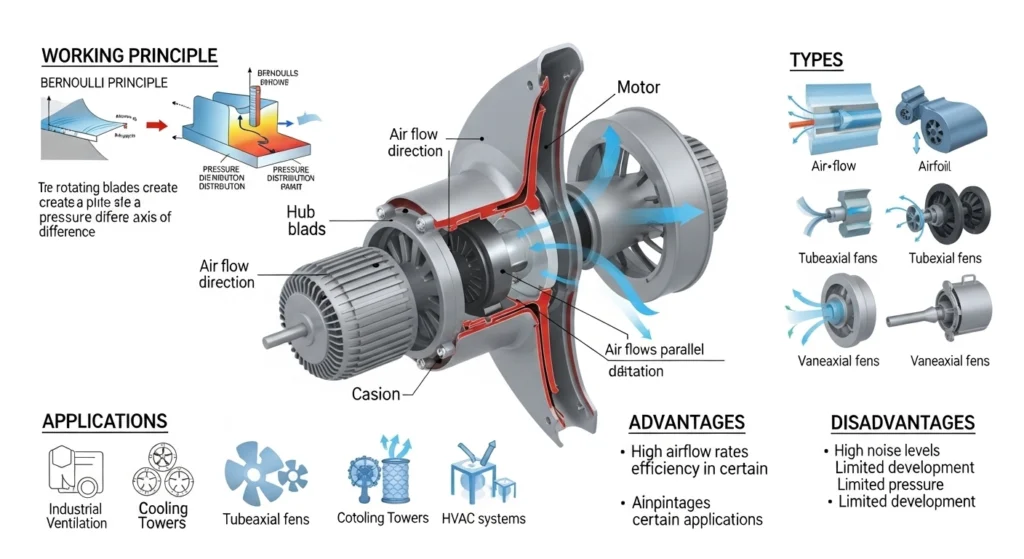
An axial fan is a type of fan that moves air parallel (in the same direction) to the axis of the rotating blades.An axial fan is a type of fan designed to move air parallel to the axis of rotation. In simple words, the air flows in the same direction as the fan blades spin. This makes axial fans one of the most commonly used fans in homes, industries, and electronic systems. You can easily recognize an axial fan in everyday devices such as ceiling fans, table fans, exhaust fans, and computer cooling fans.
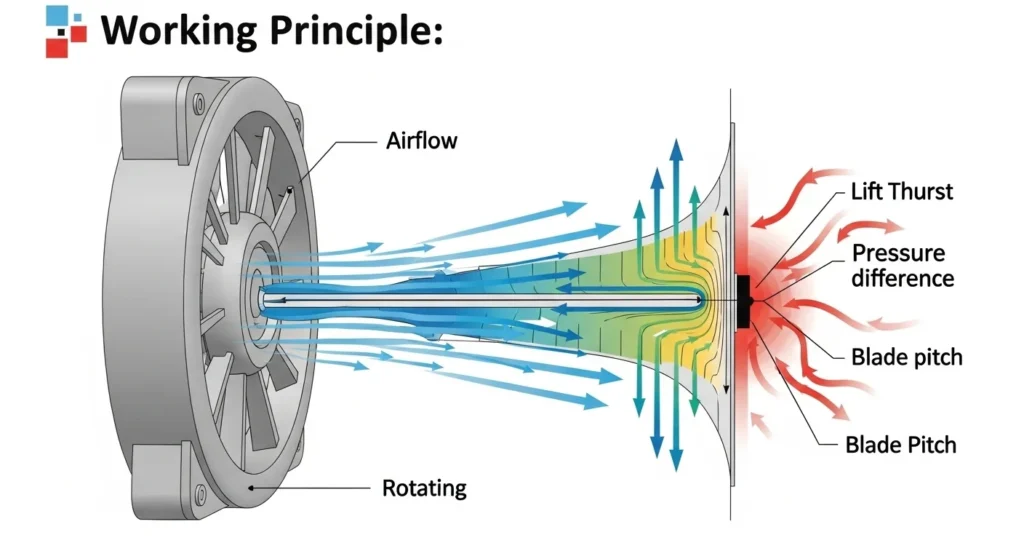
The working principle of an axial fan is simple and efficient. When the motor rotates the blades, they create a pressure difference that pulls air from one side and pushes it to the other side along a straight path. The blades are shaped like airplane wings, which helps them move large volumes of air with relatively low energy consumption. Because of this design, axial fans are best suited for applications where a high flow rate of air is required with low resistance.
Axial fans are widely used due to their simple construction and cost-effectiveness. They typically consist of a motor, fan blades, a housing or frame, and sometimes a protective grille. The motor provides the rotational force, while the blades push the air forward. Depending on the design, axial fans can be used for ventilation, cooling, and air circulation.
These fans are commonly used in residential spaces for cooling and ventilation, in industries for removing hot air and fumes, and in electronic devices to prevent overheating. For example, computers use small axial fans to cool internal components, while large industrial axial fans are used in factories and warehouses.
One major advantage of axial fans is their ability to move a large volume of air efficiently. They are lightweight, easy to install, and require less maintenance. However, they are not suitable for high-pressure applications, as they cannot overcome strong airflow resistance.
Overall, axial fans are a practical and reliable solution for general ventilation and cooling needs, making them an essential part of modern electrical and mechanical systems.
Simple Explanation
In simple words:
- Air enters and exits in a straight line
- The fan pushes air forward
- The airflow is parallel to the shaft
Practical Example
A common example is a ceiling fan:
- It rotates
- Pushes air downward
- Air flows along the same axis
Axial Fan Working Principle
The axial fan working principle is based on the rotation of blades that push air in a straight direction.
Step-by-Step Working
- Motor Starts
The electric motor rotates the fan blades. - Blade Movement
Blades are angled to push air forward. - Air Intake
Air enters from the front side. - Air Acceleration
Rotating blades increase air velocity. - Air Discharge
Air exits in the same direction as the axis.
Simple Analogy
Think of a propeller of an airplane:
- It rotates
- Pushes air backward
- Moves the plane forward
Similarly, an axial fan pushes air in one direction.
Types of Axial Fans
Axial fans are classified based on blade design and performance.
Propeller Fan
- Simple design
- Low pressure, high airflow
- Used in homes and ventilation
Tube Axial Fan
- Installed inside a cylindrical tube
- Improves airflow direction
- Used in HVAC systems
Vane Axial Fan
- Includes guide vanes
- Higher efficiency
- Used in industrial applications
Cooling Fan
- Small size
- Used in electronics like computers
Main Components of Axial Fan
Understanding components helps in maintenance and operation.
Electric Motor
- Drives the blades
- Can be AC or DC
Fan Blades
- Move air
- Designed with specific angles
Hub
- Central part holding blades
- Connected to motor shaft
Casing
- Outer body
- Guides airflow
Bearings
- Support rotation
- Reduce friction
Axial Fan Advantages
The axial fan advantages and disadvantages help in understanding its use.
Advantages
- Simple design and low cost
- High airflow rate
- Easy installation
- Lightweight and compact
- Energy efficient for large airflow
- Suitable for ventilation
Disadvantages / Limitations
Disadvantages
- Low pressure compared to centrifugal fans
- Not suitable for long ducts
- Noise at high speed
- Limited control over airflow direction
- Less efficient in high resistance systems
Axial Fan Applications
The axial fan applications are found in many areas.
Home Applications
- Ceiling fans
- Exhaust fans
- Air coolers
Industrial Applications
- Ventilation systems
- Cooling machinery
- Smoke extraction
Modern Technology Uses
- Computer cooling systems
- HVAC systems
- Automotive cooling
Comparison: Axial Fan vs Centrifugal Fan
Understanding the difference between axial fan and centrifugal fan is important.
| Feature | Axial Fan | Centrifugal Fan |
|---|---|---|
| Airflow Direction | Parallel | Perpendicular |
| Pressure | Low | High |
| Airflow Volume | High | Moderate |
| Design | Simple | Complex |
| Applications | Ventilation | Industrial systems |
Selection Guide
Choosing the right axial fan is important for performance.
Key Factors
- Airflow Requirement (CFM)
Higher airflow for larger spaces - Pressure Requirement
Choose based on system resistance - Size and Installation Space
Ensure proper fit - Noise Level
Important for indoor use - Power Consumption
Energy-efficient models preferred
Beginner Tips
- Select based on application
- Avoid oversizing
- Check motor quality
- Ensure proper mounting
Common Problems & Solutions
Q1: Why is the fan not rotating?
Solution:
- Check power supply
- Inspect motor
- Replace faulty capacitor
Q2: Why is there noise?
Solution:
- Tighten screws
- Check bearings
- Clean blades
Q3: Why is airflow weak?
Solution:
- Clean dust from blades
- Check speed settings
Q4: Why is the fan overheating?
Solution:
- Ensure ventilation
- Avoid continuous overload
Future Trends in Axial Fans
Axial fans are improving with technology.
New Developments
- Energy-efficient motors
- Smart control systems
- Noise reduction designs
- Brushless DC fans
Industry Direction
- Automation integration
- Eco-friendly materials
- High-performance designs
Conclusion
An axial fan is a simple yet highly effective device used for moving air in a straight direction. It is widely used in homes, industries, and modern technology due to its high airflow and simple design. Understanding the axial fan working principle, types, and components helps in proper selection and usage.
Although axial fans have some limitations like low pressure and noise, their advantages make them ideal for ventilation and cooling applications. Choosing the right fan based on airflow, size, and efficiency ensures better performance.
For students and beginners, learning about axial fans builds a strong foundation in electrical and mechanical systems, making it easier to understand real-world applications.