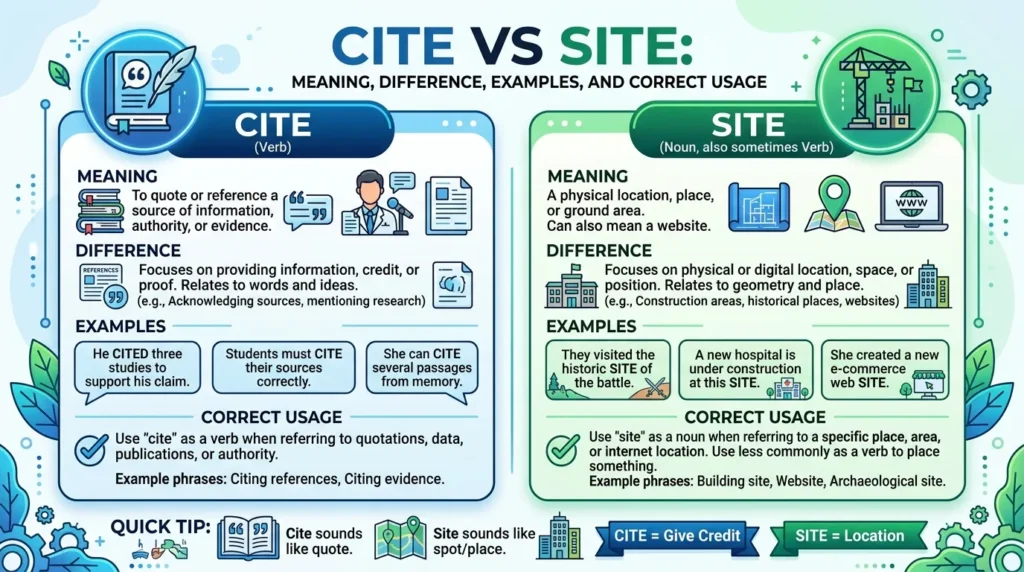

If you have ever wondered whether to write “cite” or “site,” you are not alone. These two words look and sound very similar, but they have very different meanings. One is mainly used when referring to a source, while the other can refer to a place or location. A third word, “sight,” sounds the same but has another meaning.
People often search for “cite vs site” because these words are homophones. This means they can sound alike but have different spellings and meanings. The confusion is common in emails, school assignments, research papers, websites, news articles, and everyday writing.
Understanding the difference is important because using the wrong word can change the meaning of a sentence. For example, “Please cite your source” is correct when asking someone to name a source. “Please visit the site” is correct when referring to a website or location.
This guide explains cite vs site, their origins, spelling, meanings, common mistakes, and practical examples so you can choose the right word with confidence.
Cite vs Site – Quick Answer
Cite means to mention or refer to a source, person, rule, or example as evidence or support.
Site means a place, location, or position. It can also mean a website.
| Word | Meaning | Example |
|---|---|---|
| Cite | Refer to a source or example | Please cite your sources. |
| Site | A place or location | They chose a site for the new building. |
| Site | A website | I visited the company site. |
Easy Memory Trick
Think of cite = citation.
You cite a book in a research paper.
Think of site = location.
A construction site is a place where work happens.
Cite Examples
- The student cited three research papers.
- Please cite the source of this information.
- The lawyer cited an important court case.
- The report cites several studies.
Site Examples
- The factory site is near the highway.
- We visited the building site yesterday.
- Check the company’s site for more information.
- The website site is easy to use.
The Origin of Cite vs Site
Although cite and site sound alike today, they developed from different historical roots.
Origin of Cite
Cite comes from Latin citare, meaning “to call” or “summon.” It entered English through French and developed into a word meaning to call attention to something or refer to an authority or source.
Today, cite is commonly used in academic, legal, and professional writing.
For example:
The researcher cited a study published in 2025.
Here, cited means the researcher referred to the study.
Origin of Site
Site comes from Latin situs, meaning “position” or “place.” It entered English through French and came to mean a particular location.
Today, site can describe a physical place or a digital location.
For example:
The company selected a site for its new office.
The word later became common in terms such as website, which means a location on the internet.
Why Do Cite and Site Sound the Same?
English contains many homophones. These are words that have the same or very similar pronunciation but different meanings and spellings.
Examples include:
- cite / site / sight
- right / write
- sea / see
- pair / pear
- hear / here
The spelling difference exists because the words have different histories and meanings.
British English vs American English Spelling
Unlike some spelling differences between British and American English, cite and site are spelled the same in both varieties of English.
There is no British spelling such as “cited” versus an American spelling such as “cited.” Both use the same spelling.
| Word | British English | American English | Meaning |
|---|---|---|---|
| cite | cite | cite | Refer to a source |
| cited | cited | cited | Referred to a source |
| citing | citing | citing | Referring to a source |
| site | site | site | Place or website |
| sites | sites | sites | Places or websites |
| sited | sited | sited | Located in a place |
Examples
British English:
The student cited several sources.
American English:
The student cited several sources.
The spelling is identical.
Similarly:
British English:
The company chose a new site.
American English:
The company chose a new site.
Again, the spelling does not change.
Important Point
The difference between cite and site is not a British vs American spelling issue. It is a difference in meaning and word usage.
Which Spelling Should You Use?
The correct word depends on what you mean, not where you live.
Use “Cite” for Sources
Use cite when you mean:
- Refer to a source
- Mention evidence
- Quote an authority
- Refer to a law
- Give credit to a source
- Mention an example as support
Example:
You should cite the original research paper.
Use “Site” for a Place
Use site when you mean:
- Location
- Physical place
- Construction area
- Building location
- Archaeological location
- Website
Example:
The engineers inspected the construction site.
Use “Site” for a Website
In modern English, site is also short for website.
Example:
I found the information on their official site.
Advice for US Writers
American writers should use cite for references and site for places or websites.
Advice for UK and Commonwealth Writers
The same rule applies. British and Commonwealth English speakers also use cite for references and site for locations or websites.
Advice for Global Writers
If you write for an international audience, focus on meaning rather than regional spelling. The correct choice remains the same:
Source → cite
Place or website → site
Common Mistakes with Cite vs Site
Because these words sound alike, they are easy to confuse.
Mistake 1: “Please Site Your Sources”
❌ Please site your sources.
✅ Please cite your sources.
Why?
You are asking someone to refer to their sources.
Mistake 2: “Construction Cite”
❌ The workers arrived at the construction cite.
✅ The workers arrived at the construction site.
Why?
A construction site is a physical location.
Mistake 3: “Visit Our Cite”
❌ Visit our cite for more information.
✅ Visit our site for more information.
Why?
A website is called a site.
Mistake 4: “The Author Sited a Study”
❌ The author sited a study.
✅ The author cited a study.
Why?
The author referred to a study as a source.
Mistake 5: Confusing “Sight” with Both Words
There is another homophone: sight.
Sight relates to seeing or something that is seen.
The mountain was a beautiful sight.
So remember:
- Cite = refer to a source
- Site = place or website
- Sight = something you see
Cite vs Site in Everyday Examples
Knowing the rule is useful, but seeing the words in real sentences makes the difference easier to remember.
In Emails
Cite:
Please cite the report you used in your presentation.
Site:
Please visit our company site for the latest information.
In Academic Writing
Cite:
Students must cite all sources used in their research.
Site:
The researchers selected the site for further investigation.
Academic writing often uses cite because writers need to identify their sources.
In News Writing
Cite:
The report cited government data to support its findings.
Site:
Officials inspected the site after the incident.
In Social Media
Cite:
If you share this statistic, please cite the original source.
Site:
You can read the full article on our site.
In Formal Writing
Cite:
The report cites several independent studies.
Site:
The proposed site is suitable for the project.
In Business Writing
Cite:
The manager cited customer feedback as the reason for the change.
Site:
The company plans to open a new site next year.
Cite vs Site – Comparison Table
| Feature | Cite | Site |
|---|---|---|
| Pronunciation | Usually /saɪt/ | Usually /saɪt/ |
| Main meaning | Refer to a source | Place or location |
| Used for sources? | Yes | No |
| Used for websites? | No | Yes |
| Used for physical locations? | No | Yes |
| Common in academic writing | Yes | Sometimes |
| Common in business writing | Yes | Yes |
| Example | Cite the article. | Visit the site. |
| Related word | Citation | Website |
Cite vs Site vs Sight
| Word | Meaning | Example |
|---|---|---|
| Cite | Refer to a source | Cite the research paper. |
| Site | Place or website | Visit the site. |
| Sight | Something seen or ability to see | The view was a beautiful sight. |
Cite vs Site – Google Trends & Usage Data
Searches for “cite vs site” usually come from people who are trying to solve a spelling or word-choice problem. The phrase is especially relevant to students, teachers, writers, editors, researchers, and people writing professional English.
Search interest can vary by country and over time. It can also change based on school terms, academic deadlines, writing assignments, and increased online publishing.
The important point is that cite and site are both common English words, but they appear in different contexts.
Where “Cite” Is Common
The word cite appears frequently in:
- Academic papers
- Research articles
- Legal documents
- Essays
- Reports
- News articles
- Reference lists
Where “Site” Is Common
The word site appears frequently in:
- Websites
- Construction
- Real estate
- Engineering
- Business
- Travel
- Geography
- News reports
Search Context Matters
Someone searching “cite vs site” is usually not asking which spelling is British or American. They are trying to understand which word fits a particular sentence.
For example:
Please ___ your source.
The correct answer is cite.
But:
Please visit our ___.
The correct answer is site.
Because search trends change over time, exact popularity numbers should be checked directly in a current Google Trends report rather than treated as permanent figures.
Cite vs Site – Common Word Variations
| Variation | Correct? | Meaning |
|---|---|---|
| cite | ✅ | Refer to a source |
| cites | ✅ | Refers to a source |
| cited | ✅ | Referred to a source |
| citing | ✅ | Referring to a source |
| site | ✅ | Place or website |
| sites | ✅ | Places or websites |
| sited | ✅ | Located or positioned |
| siting | ✅ | Choosing or positioning a location |
| sight | ✅ | Something seen or visual ability |
| citation | ✅ | A reference to a source |
FAQs About Cite vs Site
1. What is the difference between cite and site?
Cite means to refer to a source, authority, or example. Site means a place, location, or website.
Cite the source.
Visit the site.
2. Is it “cite your sources” or “site your sources”?
The correct phrase is “cite your sources.”
You cite a source because you refer to it or give credit to it.
3. Is a website called a site?
Yes. Site is commonly used as a short form of website.
Visit our site for more information.
4. Are cite and site homophones?
Yes. Cite and site are homophones because they have the same pronunciation but different meanings and spellings.
Sight is another commonly confused homophone.
5. Is cite British or American English?
Cite is used in both British and American English. The spelling does not change between these varieties.
6. Is site British or American English?
Site is also used in both British and American English. There is no British-American spelling difference for this word.
7. How can I remember cite vs site?
Use this simple rule:
Cite = source
Site = place or website
If you are referring to a book, study, article, law, or other source, use cite. If you mean a location or website, use site.
Conclusion
Understanding cite vs site is simple once you connect each word with its meaning. Cite means to refer to a source, authority, example, or piece of evidence. Site means a physical location, position, or website. Both words are pronounced the same in standard English, which is why they are often confused.
The key is to focus on the meaning of the sentence. If you are talking about research or giving credit to a source, use cite. If you are talking about a location or website, use site. Remembering the phrase “cite a source” and “visit a site” can help you avoid most mistakes.
These words are spelled the same in British and American English, so the choice is not based on regional spelling. It is based entirely on meaning. Once you learn this simple distinction, you can use cite and site correctly in emails, academic work, business documents, news writing, websites, and everyday communication.