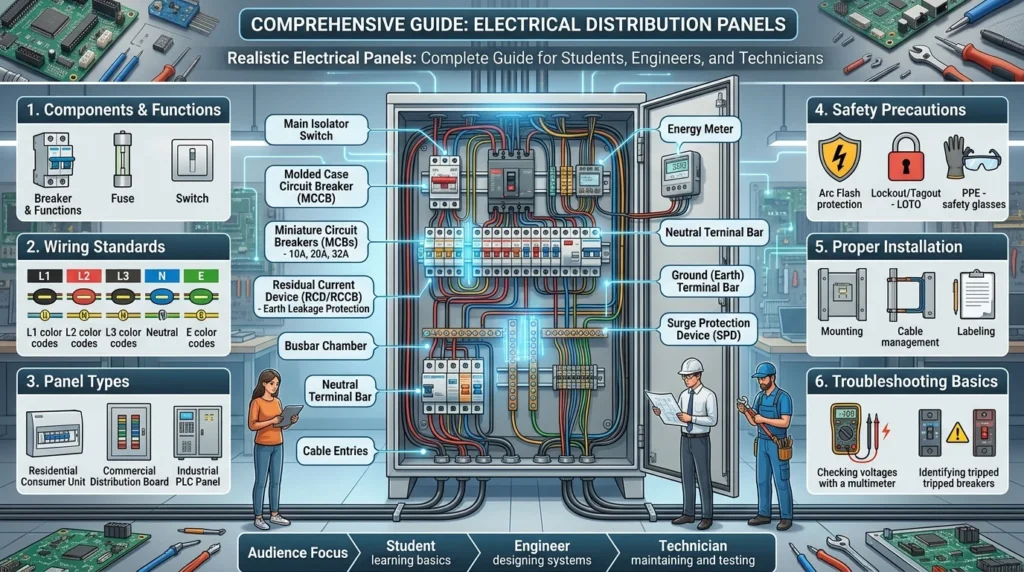

Imagine you enter a factory control room and see a large panel filled with switches, meters, and indicators. With just a few actions, an engineer can start machines, control power, and monitor the entire system. This is the power of realistic electrical panels in action.
Electrical panels are the backbone of any electrical system, whether in homes, offices, or industries. Without them, managing electricity safely and efficiently would be almost impossible. They protect equipment, distribute power, and provide control in a structured way.
Understanding realistic electrical panels is essential for electrical students, technicians, and engineers. In this article, you will learn what realistic electrical panels are, how they work, their types, components, advantages, and practical applications. You will also understand troubleshooting, selection tips, and future trends.
Realistic Electrical Panel Design: Components, Working Principles, and Practical Applications
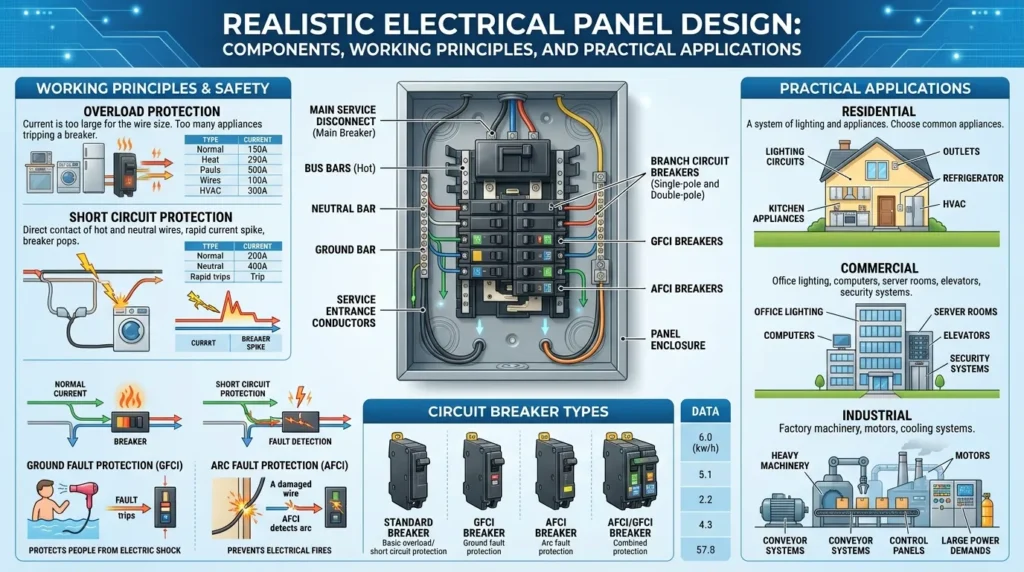
A realistic electrical panel is a carefully designed and assembled system that distributes electrical power safely and efficiently in homes, commercial buildings, and industrial facilities. Unlike basic or simplified setups, a realistic panel reflects actual working conditions, including proper wiring methods, protective devices, labeling, and compliance with safety standards. It acts as the central control point where electricity from the main supply is divided into different circuits to power lights, appliances, machines, and equipment.
In a typical realistic electrical panel, the main components include the main circuit breaker, distribution breakers, busbars, wiring connections, earthing system, and protective devices. The main breaker controls the entire power supply, allowing users to switch off electricity during maintenance or emergencies. From this point, power is distributed through smaller circuit breakers that protect individual circuits from overloads and short circuits. These breakers automatically trip when a fault occurs, preventing damage to equipment and reducing the risk of fire hazards.
One of the key features of a realistic electrical panel is proper wiring management. Wires are neatly arranged, color-coded, and secured using cable ties or ducts. This not only improves safety but also makes troubleshooting easier. In professional panels, technicians follow standard color codes for phase, neutral, and earth wires, ensuring clarity and reducing errors during installation or repair. The use of terminal blocks further enhances organization by providing safe and structured connections.
Another important aspect is the inclusion of safety devices such as Residual Current Devices (RCDs) or Earth Leakage Circuit Breakers (ELCBs). These devices protect users from electric shock by detecting leakage currents and disconnecting the supply instantly. Surge protection devices may also be included to safeguard sensitive equipment from voltage spikes caused by lightning or power fluctuations.
Realistic panels also emphasize proper labeling and documentation. Each circuit breaker is clearly marked to indicate its function, such as lighting, air conditioning, or power outlets. This helps users quickly identify and control specific circuits when needed. In industrial settings, detailed diagrams and schematics are often attached inside the panel door for reference.
Ventilation and enclosure design are also critical in realistic electrical panels. Panels are housed in metal or insulated enclosures that protect internal components from dust, moisture, and accidental contact. Proper ventilation prevents overheating, ensuring long-term reliability and performance.
In summary, a realistic electrical panel is more than just a box of switches—it is a well-organized, safety-focused system designed to handle real-world electrical demands. By incorporating proper components, structured wiring, and advanced protection devices, it ensures efficient power distribution while maintaining high safety standards.
Realistic Electrical Panel: Definition, Components, Working, and Applications
A realistic electrical panel is a practical panel assembly designed to represent or perform the functions of a real electrical distribution, control, or automation system under actual operating conditions. It may be installed in residential buildings, commercial facilities, industrial plants, workshops, and other electrical installations where power needs to be distributed, controlled, monitored, and protected. Unlike a simple demonstration board used only for training, a realistic electrical panel uses properly rated components and follows appropriate electrical safety and installation practices.
A typical panel can contain circuit breakers, fuses, contactors, relays, overload protection devices, busbars, terminal blocks, switches, meters, indicators, and control equipment. More advanced panels may also include PLCs, variable frequency drives (VFDs), programmable relays, energy meters, communication modules, and remote monitoring systems.
The main purpose of a realistic electrical panel is to provide safe power distribution and reliable control. It helps protect electrical circuits and connected equipment from common problems such as overloads, short circuits, phase faults, and excessive current. In industrial applications, panels can also control motors, pumps, fans, compressors, conveyors, and automated production equipment.
What Is a Realistic Electrical Panel?
A realistic electrical panel is an enclosed electrical assembly containing correctly selected and interconnected components that perform practical power distribution, protection, measurement, or control functions.
The exact design depends on the application. A small residential distribution board may contain only a main breaker, busbars, residual-current protection, and several branch circuit breakers. In contrast, an industrial control panel may contain contactors, overload relays, PLCs, VFDs, transformers, control switches, meters, and communication devices.
The word “realistic” generally emphasizes that the panel resembles or functions like an actual field-installed electrical system rather than being only a simplified educational model.
Main Components of a Realistic Electrical Panel
The components used depend on the panel’s purpose, but common components include:
- Main circuit breaker: Disconnects and protects the incoming electrical supply.
- Circuit breakers: Protect individual circuits against overloads and short circuits.
- Busbars: Distribute electrical power to multiple outgoing circuits.
- Contactors: Switch motors and other high-power loads.
- Overload relays: Protect motors from sustained overcurrent conditions.
- Control relays: Operate control circuits and provide switching functions.
- Terminal blocks: Provide organized connections between field wiring and panel components.
- Meters: Measure parameters such as voltage, current, power, frequency, and energy.
- Indicator lights: Show operating conditions such as power available, motor running, or fault status.
- Switches and push buttons: Allow operators to start, stop, select, or control equipment.
- PLC: Provides programmable control for automated industrial processes.
- VFD: Controls the speed and operation of AC motors by adjusting frequency and voltage.
- Surge protection devices: Help protect equipment against transient voltage surges.
- Enclosure: Provides mechanical protection and helps prevent accidental contact with energized components.
How Does a Realistic Electrical Panel Work?
The operation of a realistic electrical panel depends on its design, but the basic process is straightforward. Electrical power first enters the panel through the main incoming connection. The main protective device provides a means of isolation and protection for the panel and downstream circuits.
From the main device, power is distributed through busbars or other distribution arrangements to individual circuit breakers or control devices. Each outgoing circuit supplies a specific load, such as lighting, sockets, motors, pumps, HVAC equipment, or machinery.
In a motor control panel, for example, pressing the start button can energize a contactor. The contactor then connects the motor to the power supply, while the overload relay continuously monitors the motor current. If an excessive current persists, the overload protection can trip the control circuit and stop the motor.
More advanced panels can continuously monitor electrical parameters and communicate operating information to a supervisory control system.
Types of Realistic Electrical Panels
Realistic electrical panels can be classified according to their application and function.
1. Distribution Panel
A distribution panel distributes electrical power from an incoming supply to multiple branch circuits. It is commonly used in homes, offices, commercial buildings, and industrial facilities.
2. Motor Control Panel
A motor control panel is designed to operate and protect electric motors. It may contain contactors, overload relays, motor protection breakers, control switches, and other components.
3. Motor Control Center (MCC)
An MCC combines multiple motor control sections into one organized assembly. It is widely used in industrial plants where several motors need centralized control and protection.
4. Power Control Center (PCC)
A PCC is primarily designed for distributing and controlling electrical power to large loads and downstream distribution systems.
5. Automation Control Panel
Automation panels contain devices such as PLCs, relays, VFDs, HMIs, and communication equipment to control automated industrial processes.
6. Solar Electrical Panel
Solar installations may use electrical panels containing DC protection, AC protection, isolators, monitoring equipment, and other devices required to safely manage solar-generated electricity.
Realistic Electrical Panel vs Training Panel
A training electrical panel is primarily designed for learning and demonstration. It may use simplified circuits, transparent components, switches, indicator lamps, and accessible terminals so students can understand electrical principles safely.
A realistic electrical panel, on the other hand, is designed to reflect practical electrical installations. It uses appropriately rated components, organized wiring, protective devices, grounding arrangements, and an enclosure suitable for its intended environment.
Training panels are useful for education, while realistic panels are intended to represent or perform practical electrical distribution and control functions.
Applications of Realistic Electrical Panels
Realistic electrical panels are used in many areas, including:
- Residential electrical distribution
- Commercial buildings
- Hospitals and educational institutions
- Manufacturing plants
- Water treatment facilities
- HVAC systems
- Pumping stations
- Oil and gas facilities
- Renewable energy installations
- Industrial automation systems
- Warehouses and workshops
- Data centers and critical facilities
Advantages of a Realistic Electrical Panel
A properly designed electrical panel provides several important benefits:
- Improved electrical safety through appropriate protection and isolation.
- Organized wiring that makes inspection and maintenance easier.
- Reliable power distribution to multiple circuits and loads.
- Equipment protection against electrical faults and abnormal conditions.
- Easy monitoring when meters and indicators are installed.
- Better troubleshooting because circuits and components can be clearly identified.
- Scalability when the panel is designed with future expansion in mind.
- Centralized control of motors, machines, lighting, and other electrical equipment.
Safety Considerations
Electrical panels contain potentially hazardous voltages and should be designed, installed, inspected, and maintained by qualified electrical professionals. Proper circuit protection, grounding, conductor sizing, enclosure selection, labeling, isolation, and applicable electrical codes are essential.
Before working inside a panel, the appropriate isolation and verification procedures should be followed. A panel should never be considered safe simply because a switch or breaker appears to be in the OFF position.
A realistic electrical panel is more than a box containing electrical components. It is an organized system that combines power distribution, circuit protection, control, monitoring, and isolation to provide reliable electrical operation. Depending on the application, it can range from a relatively simple distribution board to a sophisticated industrial control panel containing PLCs, VFDs, meters, relays, and communication equipment.
For students and technicians, understanding the structure and operation of realistic electrical panels provides valuable practical knowledge of how electrical systems work in real-world environments.
Working Principle of Realistic Electrical Panels (2026): How They Work Step by Step
A realistic electrical panel works by receiving electrical power from the main power source, protecting the electrical system from overloads and short circuits, controlling electrical equipment, distributing electricity to multiple circuits, and continuously monitoring system performance. Every component inside the panel performs a specific function to ensure a safe, efficient, and reliable power distribution system.
Whether the panel is installed in a residential home, commercial building, industrial plant, manufacturing facility, data center, or power station, the basic electrical panel working principle remains the same. It follows five major stages:
- Receive electrical power
- Protect the electrical system
- Control electrical loads
- Distribute electrical power
- Monitor and maintain system safety
Understanding this process helps electrical students, engineers, and technicians troubleshoot faults, perform maintenance, and design safer electrical installations.
1. Power Input (Receiving Electrical Power)
Every electrical panel begins its operation by receiving electrical energy from the main power source. Depending on the installation, this incoming power may come from:
- Utility Grid (Main Electricity Supply)
- Distribution Transformer
- Diesel Generator
- Solar Power System
- Wind Power System
- Battery Energy Storage System (BESS)
The incoming electrical supply first enters the Main Incoming Circuit Breaker (ACB, MCCB, or Main Isolator). This is the first and one of the most critical protection devices inside the panel.
Its primary job is to:
- Connect the electrical panel to the power source.
- Disconnect power during maintenance.
- Protect the complete electrical system against major faults.
- Prevent dangerous electrical accidents.
Think of the main breaker as the main gate of a building. Every person entering or leaving the building must pass through this gate. Similarly, every unit of electrical energy entering the panel passes through the main breaker first.
Why the Main Incoming Breaker Is Important
The main breaker protects the entire electrical installation from dangerous electrical conditions such as:
- Overcurrent
- Short circuits
- Earth faults
- Equipment failure
- Electrical fires
If a major fault occurs anywhere downstream, the breaker immediately interrupts the power supply, preventing damage to expensive equipment and reducing the risk of fire or electric shock.
Incoming Power Inspection
Before electricity is distributed further, modern electrical panels often monitor the incoming supply using measuring instruments such as:
- Digital Voltmeter
- Ammeter
- Frequency Meter
- Power Factor Meter
- Multifunction Energy Meter
These instruments continuously measure:
- Input Voltage
- Load Current
- Frequency (50 Hz or 60 Hz)
- Active Power (kW)
- Apparent Power (kVA)
- Reactive Power (kVAR)
- Power Factor
- Energy Consumption (kWh)
This real-time monitoring allows operators to detect abnormal electrical conditions before they become serious problems.
Busbar Connection
After passing through the main breaker, electricity reaches the main busbar system.
A busbar is a thick copper or aluminum conductor designed to carry large amounts of electrical current safely throughout the panel.
The busbar acts like a main highway, while the outgoing circuits are smaller roads branching off to supply different electrical loads.
Modern electrical panels use insulated busbars because they provide:
- Better conductivity
- Lower heat generation
- Reduced voltage drop
- Improved electrical safety
- Easier maintenance
- Longer service life
for more information click https: Busbar: Working Principle, Types, Applications, Advantages and Disadvantages
Voltage Stabilization and Power Quality
Before power is distributed, many industrial panels also evaluate the quality of the incoming electrical supply.
Advanced protection relays monitor:
- Under Voltage
- Over Voltage
- Phase Sequence
- Phase Failure
- Voltage Imbalance
- Frequency Variation
- Harmonic Distortion
If the supply falls outside safe operating limits, protective devices automatically disconnect the system to protect motors, transformers, PLCs, VFDs, and other sensitive electrical equipment. for more detilas
Voltage Stabilization and Power Quality
Safety Before Distribution
At the end of the power input stage, the electrical panel has successfully:
- Received electrical power from the main source.
- Passed power through the main circuit breaker.
- Protected the system against incoming electrical faults.
- Measured important electrical parameters.
- Distributed power to the main busbar.
- Prepared the electrical supply for safe distribution to individual circuits.
This first stage forms the foundation of the electrical panel working principle, ensuring that every connected device receives a stable, protected, and properly managed power supply.
By incorporating components such as main circuit breakers, busbars, protective relays, and digital energy meters, modern electrical panels provide safe power distribution, improved energy efficiency, and reliable electrical system protection, making them indispensable in residential, commercial, and industrial applications.
2. Protection Against Electrical Faults
After entering the panel, electricity flows through various protective devices designed to safeguard both the electrical system and connected equipment.
Common protective devices include:
- Circuit breakers
- Fuses
- Overload relays
- Earth leakage protection devices (RCDs/RCCBs)
- Surge protection devices (SPDs)
These components continuously monitor the electrical current. If they detect abnormal conditions such as:
- Overloads
- Short circuits
- Ground faults
- Current leakage
- Voltage surges
they automatically disconnect the faulty circuit within milliseconds. This prevents damage to equipment, minimizes downtime, and significantly reduces the risk of electrical fires and electric shock.
3. Electrical Equipment Control Systems: Complete Guide (2026)
Once the power has been protected, the control section determines when, where, and how electricity is supplied to connected equipment.
Typical control components include:
- Push buttons
- Selector switches
- Contactors
- Control relays
- Timers
- Programmable Logic Controllers (PLCs)
- Variable Frequency Drives (VFDs)
For example, when an operator presses the Start button, a contactor energizes and supplies power to an electric motor. Pressing the Stop button de-energizes the contactor, immediately disconnecting the motor from the power supply.
In modern industrial automation systems, PLCs automatically control machines by sending signals to relays and contactors based on programmed instructions, sensor inputs, or production requirements, eliminating the need for constant manual operation.
4. Power Distribution
After protection and control, the electrical panel distributes power to multiple outgoing circuits.
This distribution is carried out using:
- Busbars
- Terminal blocks
- Distribution blocks
- Electrical wiring and cables
Each outgoing circuit supplies electricity to specific loads such as:
- Lighting systems
- Motors
- Pumps
- Air conditioning units
- Production machinery
- Control systems
- Electrical outlets
Proper power distribution ensures that every device receives the correct voltage and current required for safe and efficient operation while preventing uneven loading across the electrical system.
5. System Monitoring and Indication
Modern realistic electrical panels include monitoring instruments that provide operators with real-time information about system performance.
Common monitoring devices include:
- Voltmeters
- Ammeters
- Power meters
- Energy meters
- Frequency meters
- Indicator lamps
- Human Machine Interface (HMI) displays
- Digital monitoring systems
These devices display important operating parameters such as:
- Voltage
- Current
- Power consumption
- Energy usage
- Frequency
- Equipment operating status
- Fault alarms
Continuous monitoring helps technicians identify abnormal conditions early, improve energy efficiency, reduce maintenance costs, and maintain reliable system operation.
How Does an Electrical Panel Work? Step-by-Step Working Process
An electrical panel is the main distribution and control point of an electrical system. It receives electrical power from a utility supply, transformer, generator, or other source and distributes that power to different circuits and equipment. At the same time, the panel provides protection against electrical faults and, in advanced systems, allows operators to monitor and control electrical equipment.
Although electrical panels vary in design and function, the basic working process remains similar. A residential distribution board may contain a main breaker, RCD, and several branch circuit breakers, while an industrial panel may include MCCBs, contactors, overload relays, PLCs, VFDs, meters, and communication devices.
The electrical power generally follows a controlled path from the incoming supply → main protective device → busbars → branch protection and control devices → outgoing circuits → connected loads. If an abnormal condition occurs, the appropriate protective device disconnects the affected circuit to reduce the risk of equipment damage, fire, and electrical shock.
Step 1: Electrical Power Enters the Panel
The working process begins when electrical power enters the panel from the main source. Depending on the installation, the incoming supply may come from the utility grid, transformer, generator, solar system, or another power source.
The incoming conductors are connected to the panel’s main incoming terminals. In a three-phase system, the incoming supply normally consists of three phase conductors and may also include a neutral and protective earth connection, depending on the system arrangement.
At this point, the panel receives electrical power but does not yet distribute it to all connected circuits until the main switching and protection devices permit it.
Step 2: The Main Breaker Controls and Protects the Supply
The incoming power passes through a main circuit breaker, isolator, or other main switching and protective device. The specific device depends on the size and design of the electrical installation.
Common main protective devices include:
- MCBs for smaller circuits
- MCCBs for higher-current applications
- ACBs for large electrical distribution systems
- Main isolators for safe isolation
- RCD/RCCB devices where residual-current protection is required
The main device provides a central means of controlling or isolating the panel. Circuit breakers can also provide protection against conditions such as excessive current and short circuits when appropriately selected.
When the main breaker is switched ON, power can proceed to the panel’s internal distribution system.
Step 3: Electrical Power Reaches the Busbars
After passing through the main device, electrical power is distributed through busbars or an equivalent internal distribution arrangement.
A busbar is a solid conductor, commonly made from copper or aluminum, designed to carry and distribute electrical current. Instead of connecting every outgoing circuit directly to the incoming terminals with separate large conductors, busbars provide an organized method of distributing power to multiple circuits.
Busbars are commonly used in distribution boards, PCCs, MCCs, and industrial switchboards.
Their major benefits include:
- High current-carrying capacity
- Organized power distribution
- Reduced wiring complexity
- Efficient connection of outgoing circuits
- Easier maintenance and inspection when properly designed
The busbar system must be correctly rated for the expected current, voltage, temperature, and fault conditions.
Step 4: Individual Circuits Pass Through Protective Devices
Power from the busbars is supplied to individual outgoing circuits through their respective protective devices.
Depending on the application, these may include:
- MCBs
- MCCBs
- Fuses
- RCDs or RCCBs
- RCBOs
- Motor protection devices
- Overload relays
- Surge protection devices
Each protective device is selected according to the characteristics of the circuit and the connected load.
For example, an MCB may protect a lighting or socket circuit, while an MCCB may be used for a larger feeder supplying industrial equipment.
The protection system is designed to disconnect a circuit when an unsafe electrical condition exceeds the limits of the equipment or installation.
Step 5: Control Components Manage Connected Equipment
In control and industrial panels, electrical power also passes through control components that determine when and how equipment operates.
Common control components include:
- Contactors
- Control relays
- Push buttons
- Selector switches
- Timers
- Motor starters
- PLCs
- VFDs
- HMIs
For example, when an operator presses a motor START push button, the control circuit can energize a contactor. The contactor then connects the motor to the power supply. A STOP command or detected fault can de-energize the contactor and disconnect the motor.
In automated systems, a PLC may receive signals from sensors and make decisions based on programmed logic before controlling contactors, valves, motors, or other equipment.
Step 6: Electrical Power Reaches the Loads
After passing through the appropriate protective and control devices, electricity reaches the connected loads.
Depending on the type of installation, these loads may include:
- Lighting equipment
- Electrical outlets
- Motors
- Pumps
- Fans
- Compressors
- Air-conditioning systems
- Industrial machinery
- Heating equipment
- Control equipment
Each load receives the voltage and current required for its intended operation.
A well-designed distribution system keeps circuits properly separated so that a problem in one branch circuit does not unnecessarily interrupt the operation of unrelated circuits.
Step 7: Meters and Monitoring Devices Check System Conditions
Many electrical panels include monitoring equipment that allows operators and maintenance personnel to observe system conditions.
Common monitoring devices include:
- Voltmeter
- Ammeter
- Frequency meter
- Power meter
- Energy meter
- Power factor meter
- Digital multifunction meter
- Indicator lamps
- HMI display
These devices can provide information about voltage, current, frequency, power, energy consumption, and other operating parameters.
Modern panels may also communicate this information to a building management system, SCADA system, or industrial control network. This allows electrical conditions to be monitored remotely and can help maintenance teams identify abnormal conditions before they become serious problems.
Step 8: The Protection System Responds to Faults
If an electrical fault occurs, the appropriate protection device responds according to its design and settings.
Possible abnormal conditions include:
- Short circuits
- Overloads
- Earth faults
- Residual current
- Motor overload
- Phase loss
- Phase imbalance
- Excessive voltage
- Voltage below acceptable limits
For example, if a short circuit occurs on an outgoing circuit, the circuit breaker protecting that circuit is designed to interrupt the fault current. In a properly coordinated system, the protection closest to the fault should operate where practical, limiting unnecessary interruption to other circuits.
This protection helps reduce the risk of:
- Equipment damage
- Cable overheating
- Electrical fires
- Extended system downtime
- Unsafe operating conditions
Step 9: The Faulty Circuit Is Isolated
Once the protective device operates, the affected circuit is disconnected from the electrical supply.
The rest of the system may continue operating if its circuits remain healthy and the protection system has been properly designed and coordinated.
For example, if a fault occurs in one lighting circuit, its protective device may trip while other lighting circuits and electrical loads continue operating.
This principle is important in industrial and commercial facilities because it helps minimize unnecessary shutdowns.
Step 10: The Fault Is Investigated and Corrected
A tripped breaker should not simply be reset repeatedly without determining why it operated.
A qualified person should identify the cause of the fault and correct the underlying problem. Depending on the situation, this may involve checking cables, terminals, connected equipment, insulation, motor loads, or other components.
After the fault has been safely cleared, the protective device can be restored according to the manufacturer’s instructions and the applicable electrical safety procedures.
Step 11: The Panel Returns to Normal Operation
Once the fault has been corrected and the circuit is safely restored, the electrical panel resumes normal operation.
Power again flows through the appropriate protection and control devices to the connected load. Monitoring equipment continues to display system conditions, while protective devices remain ready to respond if another abnormal condition occurs.
This creates a continuous operating cycle:
Power Input → Main Protection → Busbar Distribution → Circuit Protection → Control → Load → Monitoring → Fault Protection
Overall Working Principle of an Electrical Panel
The complete operation of an electrical panel can be summarized as a combination of four main functions:
1. Power Distribution: Receives electrical power and distributes it to multiple circuits.
2. Protection: Detects or responds to electrical faults and disconnects affected circuits.
3. Control: Allows electrical equipment and machines to be switched or controlled manually or automatically.
4. Monitoring: Measures important electrical parameters and provides information about system performance.
Therefore, an electrical panel is not simply a box containing breakers. It is a coordinated electrical system that provides distribution, protection, control, isolation, and monitoring for the connected installation.
Easy Analogy: Electrical Panel as a City’s Traffic Control Center
Understanding an electrical panel becomes much easier when you compare it to a city’s traffic control system, where every component has a specific responsibility for keeping traffic flowing safely.
| Electrical Panel Component | City Traffic Analogy | Function |
|---|---|---|
| Main Power Supply | Main highway entering the city | Brings electricity into the panel |
| Main Circuit Breaker | Main entrance gate | Controls whether power can enter the system |
| Busbars | Major highways | Carry electricity to different sections of the panel |
| Circuit Breakers & Fuses | Traffic police | Stop dangerous situations by disconnecting faulty circuits |
| Contactors & Relays | Traffic signals | Direct when and where electricity should flow |
| Switches & Push Buttons | Traffic control operators | Start or stop equipment manually |
| Wires & Cables | City roads | Deliver electricity to different destinations |
| Meters & Indicator Lights | CCTV cameras and monitoring screens | Show the health and status of the electrical system |
| Protective Relays | Emergency response team | Detect faults and trigger protective actions immediately |
Simple Explanation
Imagine a busy city where thousands of vehicles travel every minute. The city works smoothly because highways, traffic lights, police officers, and monitoring systems all work together. If an accident happens on one road, traffic police quickly close only that affected road while allowing traffic to continue on the rest of the city’s network.
An electrical panel works in exactly the same way. Electricity enters through the main supply, travels along the busbars, and is directed to different circuits through protective and control devices. If a fault such as a short circuit or overload occurs, the panel isolates only the affected circuit while keeping the remaining system operating safely. This intelligent operation ensures continuous power distribution, protects expensive electrical equipment, and greatly improves the overall safety and reliability of the electrical installation.
Just as a traffic control center safely manages the movement of vehicles, a realistic electrical panel safely controls, protects, distributes, and monitors electrical power, ensuring that every connected device operates efficiently, reliably, and safely.
Types and Classification of Realistic Electrical Panels (2026)
Understanding the types of electrical panels is essential for anyone learning electrical engineering, industrial automation, or power distribution. Modern electrical panels are designed for different applications, including residential buildings, commercial facilities, manufacturing plants, renewable energy systems, and smart factories.
Each panel has a specific function, but all follow the same goal—safe electrical power distribution, circuit protection, equipment control, and system monitoring. Choosing the right panel depends on the voltage level, load capacity, control requirements, and installation environment.
Below are the most common types of realistic electrical panels used in today’s electrical industry.
1. Realistic Electrical Panel Complete Kit
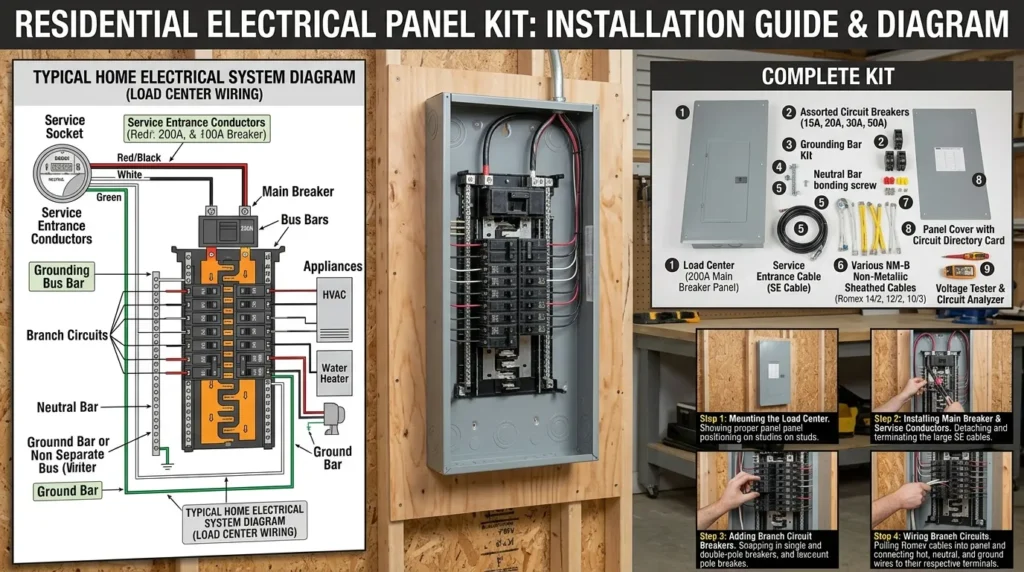
A Realistic Electrical Panel Complete Kit is a fully assembled or semi-assembled training and demonstration panel designed to simulate the operation of real industrial electrical systems. It allows students, technicians, and engineers to gain hands-on experience with electrical panel wiring, power distribution, motor control, circuit protection, and industrial automation without working on live high-voltage equipment.
Unlike theoretical classroom learning, a realistic electrical panel kit provides a practical environment where users can understand how electrical components work together inside an actual control panel. It closely replicates the layout and functionality of panels used in factories, commercial buildings, power plants, and manufacturing industries.
As industries increasingly adopt automation and smart electrical systems, these training kits have become an essential learning tool in engineering colleges, ITI institutes, vocational training centers, and industrial maintenance programs.
What Does a Complete Electrical Panel Kit Include?
A modern electrical panel training kit contains many of the same components found in real industrial control panels, including:
- Main Circuit Breaker (MCB, MCCB, or RCCB)
- Magnetic Contactors
- Thermal Overload Relays
- Control Relays and Timer Relays
- Push Buttons (Start/Stop)
- Selector Switches
- Emergency Stop (E-Stop) Button
- Indicator Lamps (Red, Yellow, Green)
- Copper or Aluminum Busbars
- Terminal Blocks
- DIN Rails
- Industrial Wiring and Cable Ducts
- Digital Voltmeter and Ammeter
- Energy Meter
- Fuses and Fuse Holders
- Motor Protection Circuit Breakers (MPCB)
- PLC (Programmable Logic Controller) in advanced kits
- Variable Frequency Drive (VFD) in automation kits
- Human Machine Interface (HMI) in premium training panels
These components are mounted inside a metal enclosure or insulated panel board to replicate a real electrical control panel used in industrial environments.
Working Principle of a Realistic Electrical Panel Kit
The electrical panel working principle demonstrated by the kit closely matches that of an actual industrial panel.
The operating sequence typically follows these steps:
- Electrical power enters through the main incoming breaker.
- The breaker protects the system against overloads and short circuits.
- Electricity flows to the main busbar, which distributes power throughout the panel.
- Individual circuit breakers supply different loads or control circuits.
- Contactors and relays control motors, lighting systems, or other electrical equipment.
- PLCs or timers automate switching operations in advanced panels.
- Measuring instruments continuously monitor voltage, current, frequency, power factor, and energy consumption.
- Protective devices disconnect faulty circuits automatically, ensuring safe operation.
This practical setup helps learners visualize how industrial electrical panels receive, control, protect, and distribute electrical power.
Types of Realistic Electrical Panel Kits (2026)
Different training requirements call for different panel configurations. The most common types include:
The demand for electrical panel training kits has increased significantly as industries adopt automation, smart manufacturing, and advanced power distribution systems. These realistic electrical panel kits (2026) are designed to provide hands-on experience in electrical wiring, industrial control, PLC programming, motor control, and electrical power distribution. Below are the most widely used types of electrical panel kits for students, engineers, technicians, and industrial training institutes.
1. Basic Electrical Wiring Panel Kit (2026)
The Basic Electrical Wiring Panel Kit (2026) is designed for beginners who want to learn the fundamentals of electrical wiring, circuit protection, and residential electrical installation. It provides a safe and practical environment to understand how electricity flows through a wiring system and how common electrical components are connected.
This kit is widely used in ITI colleges, polytechnic institutes, electrical engineering laboratories, vocational training centers, and electrician training programs.
Key Features
- One-Way Switch Circuit
- Two-Way Switch Wiring
- Intermediate Switching
- Lamp Control Circuits
- Socket Outlet Wiring
- Bell Circuit Wiring
- MCB (Miniature Circuit Breaker) Operation
- Fuse Protection
- Neutral and Earth Connections
- Electrical Wiring Diagram Practice
Applications
- Residential Electrical Wiring Training
- Electrical Safety Practice
- Domestic Installation Learning
- Basic Circuit Troubleshooting
- Electrician Skill Development
This is the ideal electrical wiring training panel for beginners starting their careers in electrical engineering or electrical maintenance.
2. Motor Control Panel Training Kit (2026)
The Motor Control Panel Training Kit (2026) is one of the most popular industrial electrical panel kits used for learning electric motor control systems. It simulates real industrial motor control panels used in factories, manufacturing plants, and process industries.
Students gain practical experience in motor starter wiring, control logic, overload protection, and industrial motor automation.
Common Motor Control Experiments
- Direct-On-Line (DOL) Starter
- Star-Delta Starter
- Forward-Reverse Motor Control
- Automatic Motor Starter
- Sequential Motor Control
- Jogging Control Circuit
- Thermal Overload Relay Protection
- Motor Interlocking
- Push Button Control
- Contactor Wiring
Applications
- Industrial Motor Control Training
- Factory Electrical Maintenance
- Pump Control Systems
- Conveyor Belt Control
- Industrial Machine Automation
This kit is highly recommended for anyone learning motor control panel wiring or preparing for industrial maintenance jobs.
3. PLC Electrical Panel Kit (2026)
The PLC Electrical Panel Kit (2026) is designed to teach Programmable Logic Controller (PLC) programming and industrial automation. Since PLCs are the backbone of modern manufacturing, this kit allows learners to understand how automated systems are designed, programmed, and controlled.
It closely replicates real PLC control panels used in industries such as automotive manufacturing, food processing, pharmaceuticals, oil & gas, and packaging plants.
Key Learning Modules
- PLC Programming (Ladder Logic)
- Digital Input and Output Wiring
- Industrial Sensors
- Solenoid Valve Control
- Conveyor Belt Automation
- Motor Automation
- Automatic Machine Control
- Industrial Process Automation
- Relay Logic Replacement
- Timer and Counter Programming
Applications
- Smart Factory Automation
- Industrial Control Systems
- Manufacturing Plants
- Packaging Industries
- Robotics Training
- Process Automation
The PLC training panel is one of the most valuable electrical training kits for students pursuing careers in industrial automation and control engineering.
4. Industrial Automation Panel Kit (2026)
The Industrial Automation Panel Kit (2026) is an advanced training system that combines multiple automation technologies into a single platform. It is specifically developed to prepare engineers for Industry 4.0, smart manufacturing, and digital industrial control systems.
Unlike basic electrical training kits, this panel focuses on integrated automation, communication, and intelligent machine control.
Major Components
- PLC (Programmable Logic Controller)
- HMI (Human Machine Interface)
- Variable Frequency Drive (VFD)
- Servo Motor Controllers
- Industrial Ethernet Communication
- Smart Sensors
- SCADA Integration
- Industrial Relays
- Safety Interlocks
- Remote Monitoring Systems
Applications
- Smart Manufacturing
- Factory Automation
- Process Industries
- Industrial Robotics
- Automated Production Lines
- Packaging Systems
- Water Treatment Plants
- Material Handling Systems
As industries move toward digital transformation, the industrial automation training panel has become one of the most in-demand learning platforms for electrical and automation engineers.
5. Power Distribution Panel Kit (2026)
The Power Distribution Panel Kit (2026) is designed to demonstrate the complete operation of an electrical power distribution system. It teaches how electrical energy is received, protected, monitored, and distributed safely to multiple loads.
This training panel closely resembles the power distribution panels installed in commercial buildings, industrial facilities, hospitals, shopping malls, and power plants.
Main Components
- Main Incoming Circuit Breaker
- Copper Busbar System
- MCCB (Molded Case Circuit Breaker)
- MCB (Miniature Circuit Breaker)
- RCCB/RCBO Protection
- Surge Protection Device (SPD)
- Digital Energy Meter
- Ammeter and Voltmeter
- Distribution Busbars
- Outgoing Distribution Feeders
Applications
- Electrical Power Distribution Training
- Industrial Electrical Panels
- Commercial Building Power Systems
- Transformer Distribution Systems
- Substation Training
- Electrical Load Management
- Energy Monitoring Systems
The power distribution training panel is essential for understanding electrical distribution systems, circuit protection, load balancing, and energy management, making it one of the most important electrical panel kits for future electrical engineers and technicians.
Advantages of a Realistic Electrical Panel Kit
A high-quality electrical panel training kit offers several practical and educational benefits:
- Provides hands-on learning with real electrical components.
- Improves understanding of electrical panel wiring diagrams.
- Enhances troubleshooting and fault-finding skills.
- Develops practical industrial maintenance experience.
- Increases workplace safety awareness.
- Builds confidence before handling live electrical installations.
- Supports learning of PLCs, VFDs, and industrial automation.
- Reduces training risks compared to live systems.
- Helps prepare students for electrical engineering and maintenance careers.
- Simulates real industrial electrical panel operations.
Limitations
Despite their many benefits, realistic panel kits also have some limitations:
- Advanced automation kits can be expensive.
- Require proper instructor supervision.
- Incorrect wiring may damage components.
- Basic kits cannot fully simulate large industrial power systems.
- Some training panels lack modern smart monitoring features.
However, these limitations are small compared to the practical experience gained during training.
Applications of Realistic Electrical Panel Kits
These kits are widely used across education and industry, including:
- Electrical Engineering Colleges
- ITI and Polytechnic Institutes
- Industrial Automation Training Centers
- Technical Universities
- Industrial Maintenance Workshops
- Manufacturing Plants
- Electrical Contractor Training
- Research and Development Laboratories
- Renewable Energy Training Centers
- Corporate Technical Skill Development Programs
They are also used by panel manufacturers to test new control circuits before deployment in real-world installations.
Why Are Realistic Electrical Panel Kits Important?
Modern industries demand professionals who can do more than understand theory—they need technicians and engineers who can confidently wire, troubleshoot, and maintain real electrical systems.
A realistic electrical panel complete kit bridges the gap between classroom learning and practical fieldwork by providing experience with electrical panel design, control panel wiring, motor control circuits, electrical protection devices, PLC programming, and power distribution systems. This hands-on training improves technical skills, increases safety awareness, and prepares learners for careers in electrical engineering, industrial maintenance, and automation.
By mastering these kits, students gain the confidence to work on real industrial electrical panels with greater accuracy and professionalism. This practical exposure makes them more job-ready and aligns with the growing demand for skilled professionals in modern electrical and automation industries.
4.1 Distribution Panels (2026): Complete Guide to Power Distribution Panels
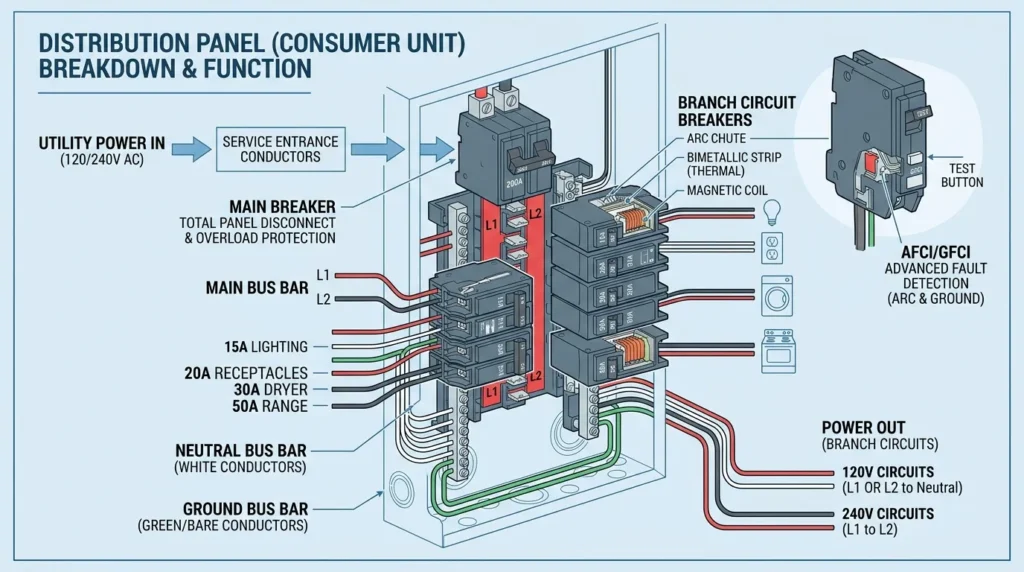
Distribution panels are important electrical devices used to distribute electrical power safely from the main power supply to different circuits within a building, factory, or industrial system. They are also known as distribution boards, panel boards, or breaker panels. A distribution panel acts as the central point of an electrical system where electricity is controlled, protected, and distributed to various electrical loads such as lights, fans, sockets, machines, and appliances.
The main function of a distribution panel is to divide the incoming electrical power into smaller branch circuits while providing protection through circuit breakers or fuses. Each circuit inside the panel is connected to a protective device that automatically disconnects the supply if an overload, short circuit, or fault occurs. This helps prevent electrical fires, equipment damage, and electric shock hazards.
A typical distribution panel consists of important components such as the main switch, circuit breakers, bus bars, neutral bar, earth bar, and protective enclosure. The main switch controls the entire power supply, while circuit breakers protect individual circuits. Bus bars distribute current efficiently inside the panel, and the earth system ensures electrical safety.
Distribution panels are available in different types such as single-phase panels, three-phase panels, main distribution boards (MDB), sub-distribution boards (SDB), and motor control panels. Single-phase panels are commonly used in homes, while three-phase panels are used in industries and commercial buildings where heavy electrical loads are required.
One major advantage of distribution panels is improved safety and organized power management. They make troubleshooting easier and allow safe isolation of faulty circuits. However, poor installation or overloading can cause overheating and electrical hazards, so proper maintenance and correct wiring are very important.
Distribution panels are widely used in residential buildings, offices, factories, hospitals, shopping malls, and power systems. Overall, they are essential parts of modern electrical installations that ensure safe, efficient, and reliable distribution of electrical power.
These panels distribute electrical power to different circuits.
A Distribution Panel (DP), also known as a Distribution Board (DB), Electrical Distribution Panel, or Power Distribution Panel, is one of the most important components of an electrical power distribution system. Its primary function is to receive electrical power from the main supply, safely distribute it to multiple branch circuits, and protect each circuit from overloads, short circuits, and earth faults.
Distribution panels are used in residential homes, commercial buildings, industrial plants, hospitals, shopping malls, data centers, schools, hotels, and manufacturing facilities. They act as the central hub of an electrical installation, ensuring that every connected load receives a stable and protected power supply.
Modern Distribution Panels (2026) are equipped with advanced protection devices such as MCBs (Miniature Circuit Breakers), MCCBs (Molded Case Circuit Breakers), RCCBs (Residual Current Circuit Breakers), RCBOs (Residual Current Breaker with Overcurrent Protection), Surge Protection Devices (SPDs), digital energy meters, busbars, and monitoring systems. These features improve electrical safety, reduce downtime, enhance energy efficiency, and simplify maintenance.
Main Components of a Distribution Panel
A standard electrical distribution panel typically includes:
- Main Incoming Circuit Breaker (MCB, MCCB, or ACB)
- Copper or Aluminum Busbar System
- Miniature Circuit Breakers (MCBs)
- Molded Case Circuit Breakers (MCCBs)
- RCCB or RCBO Protection Devices
- Surge Protection Device (SPD)
- Neutral and Earth Busbars
- Digital Voltmeter and Ammeter
- Energy Meter (kWh Meter)
- Terminal Blocks and Cable Connections
- Panel Enclosure with IP Protection
Applications of Distribution Panels
Distribution panels are widely used for safe and reliable electrical power distribution in:
- Residential Buildings
- Commercial Offices
- Shopping Malls
- Industrial Manufacturing Plants
- Hospitals and Healthcare Facilities
- Educational Institutions
- Hotels and Resorts
- Warehouses
- Data Centers
- Renewable Energy Systems (Solar and Hybrid Installations)
Advantages of Distribution Panels
- Ensures safe electrical power distribution.
- Protects circuits from overloads, short circuits, and earth leakage.
- Simplifies electrical maintenance and fault isolation.
- Improves system reliability and operational safety.
- Supports efficient load balancing across multiple circuits.
- Reduces equipment damage caused by electrical faults.
- Compatible with modern energy monitoring and smart building systems.
- Easily expandable for future electrical loads.
Modern power distribution panels are the backbone of every electrical installation, providing safe power distribution, circuit protection, energy management, and reliable operation across residential, commercial, and industrial environments. As smart buildings and Industry 4.0 continue to grow, advanced distribution panels with digital monitoring and remote control capabilities are becoming an essential part of modern electrical infrastructure.
Control Panels (2026): Complete Guide to Electrical Control Panels
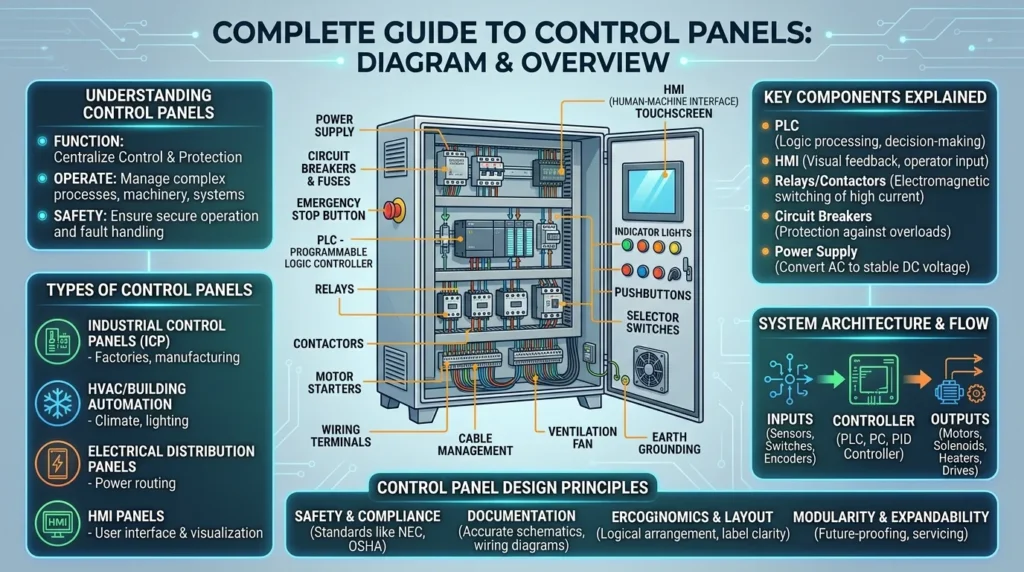
Control panels are electrical systems used to monitor, control, and manage machines, motors, and industrial processes. They act as the central control unit of an electrical or automation system and are widely used in factories, power plants, commercial buildings, and industrial machinery. A control panel contains electrical components arranged inside a protective enclosure to ensure safe and organized operation of equipment.
The main function of a control panel is to control the starting, stopping, protection, and operation of electrical devices. It receives input signals from switches, sensors, or control systems and then sends commands to motors, relays, contactors, and other connected equipment. This helps operators manage industrial processes efficiently and safely.
A typical control panel includes important components such as circuit breakers, contactors, relays, push buttons, timers, indicators, PLCs (Programmable Logic Controllers), fuses, and terminal blocks. Circuit breakers provide protection against overloads and short circuits, while contactors and relays control electrical loads. PLCs are used in modern automation systems for automatic process control.
Control panels are available in different types such as motor control panels, power control panels, automation panels, PLC panels, and distribution control panels. Motor control panels are commonly used for controlling industrial motors, while PLC panels are widely used in automated manufacturing systems.
One major advantage of control panels is improved operational efficiency and safety. They help reduce manual work, simplify machine control, and improve fault detection. However, control panels can be complex and require skilled technicians for proper installation and maintenance.
Control panels are used in industries such as manufacturing, water treatment plants, HVAC systems, elevators, conveyor systems, and power generation plants.
Overall, control panels are essential electrical systems that ensure safe, efficient, and reliable control of industrial and commercial electrical equipment.
Used to control machines and electrical equipment.Control Panels (2026): Complete Guide to Electrical Control Panels
An Electrical Control Panel, also known as an Industrial Control Panel or Control Cabinet, is a centralized enclosure that houses electrical and electronic components used to control, monitor, automate, and protect electrical equipment and industrial machines. Unlike a distribution panel, which mainly distributes electrical power, a control panel manages the operation of motors, pumps, conveyors, compressors, HVAC systems, and automated production lines.
Modern Control Panels (2026) are widely used in manufacturing plants, factories, power plants, water treatment facilities, oil & gas industries, food processing units, commercial buildings, and renewable energy systems. They improve operational efficiency, reduce manual intervention, and ensure safe and reliable equipment operation.
Advanced electrical control panels integrate PLCs (Programmable Logic Controllers), HMIs (Human Machine Interfaces), Variable Frequency Drives (VFDs), relays, contactors, timers, overload relays, sensors, and digital monitoring devices to provide precise machine control and real-time system monitoring.
Main Components of a Control Panel
A standard industrial electrical control panel typically includes:
- Main Circuit Breaker (MCB, MCCB, or ACB)
- Magnetic Contactors
- Thermal Overload Relays
- Control Relays and Timer Relays
- PLC (Programmable Logic Controller)
- HMI (Human Machine Interface)
- Variable Frequency Drive (VFD)
- Push Buttons (Start, Stop, Reset)
- Emergency Stop (E-Stop) Switch
- Selector Switches
- Indicator Lamps (Red, Yellow, Green)
- Control Transformer
- Terminal Blocks
- Power Supply Unit (24V DC)
- Fuses and Surge Protection Devices (SPD)
- Industrial Wiring and Cable Ducts
Applications of Control Panels
Electrical control panels are used in a wide range of industries and applications, including:
- Industrial Automation Systems
- Electric Motor Control
- Conveyor Belt Systems
- Pump and Water Treatment Plants
- HVAC Systems
- Manufacturing and Production Lines
- Packaging Machines
- Food and Beverage Processing
- Oil and Gas Facilities
- Power Generation Plants
- Building Management Systems (BMS)
- Renewable Energy and Solar Power Plants
Advantages of Control Panels
- Automates industrial processes for higher productivity.
- Provides centralized control of electrical equipment.
- Improves electrical and operator safety.
- Protects motors and machines from overloads and faults.
- Reduces manual operation and human error.
- Enables real-time monitoring and fault diagnostics.
- Supports energy-efficient motor control with VFDs.
- Simplifies maintenance and troubleshooting.
- Easily expandable for future automation requirements.
- Compatible with Industry 4.0 and smart factory technologies.
Difference Between a Control Panel and a Distribution Panel
| Feature | Control Panel | Distribution Panel |
|---|---|---|
| Primary Function | Controls and automates electrical equipment | Distributes electrical power to multiple circuits |
| Main Components | PLC, VFD, Contactors, Relays, Timers, HMI | MCBs, MCCBs, RCCBs, Busbars, Energy Meters |
| Main Purpose | Machine control and process automation | Power distribution and circuit protection |
| Common Applications | Factories, automation systems, motor control | Homes, commercial buildings, industrial power distribution |
| Smart Features | PLC programming, remote monitoring, automation | Load monitoring and electrical protection |
Modern Electrical Control Panels (2026) are the heart of industrial automation. By combining electrical control, machine automation, motor protection, and intelligent monitoring, they help industries improve efficiency, minimize downtime, enhance safety, and support the growing demand for smart manufacturing and Industry 4.0 technologies.
4.3 Motor Control Centers (MCC)
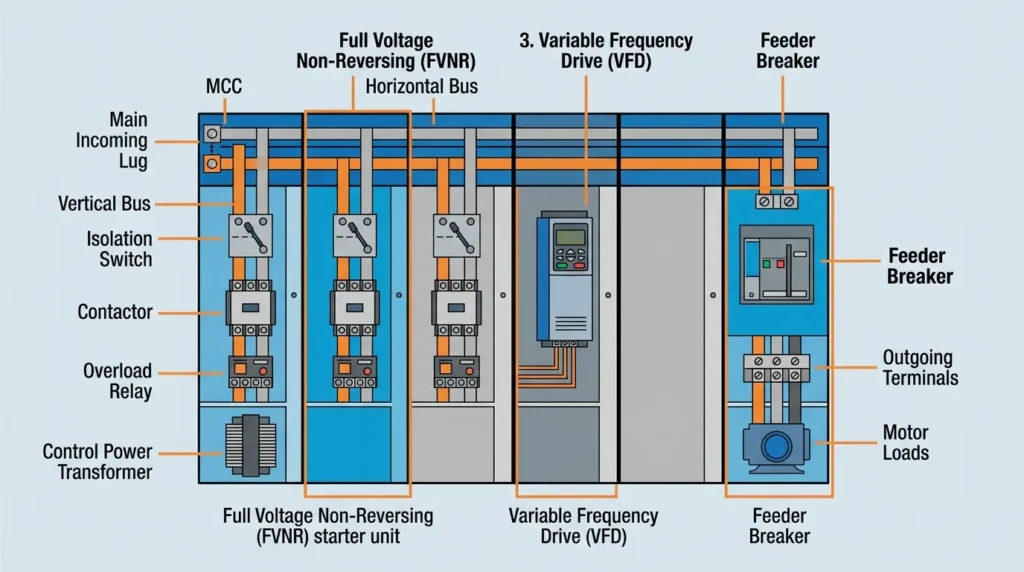
Motor Control Centers (MCC) are centralized electrical control systems used to control, protect, and monitor multiple electric motors from one location. They are widely used in industries, factories, power plants, water treatment systems, and large commercial buildings where many motors operate together. An MCC provides organized motor management, improves safety, and simplifies maintenance in industrial electrical systems.
A Motor Control Center consists of several enclosed sections called compartments or buckets. Each compartment contains components used for controlling a specific motor. These components may include circuit breakers, contactors, overload relays, motor starters, fuses, control transformers, push buttons, and monitoring devices. All these units are mounted inside a strong metal enclosure for protection and safety.
The working principle of an MCC is based on centralized motor operation and protection. Electrical power enters the MCC through a main incoming feeder and is distributed to individual motor control units. Each motor can then be started, stopped, protected, and monitored independently using its dedicated control components. If a fault such as overload or short circuit occurs, the protection devices disconnect the motor automatically to prevent damage.
There are different types of MCCs, including conventional MCCs and intelligent MCCs. Conventional MCCs use standard electrical controls, while intelligent MCCs use digital communication systems, PLCs, and smart monitoring for advanced automation and diagnostics.
One major advantage of MCCs is efficient control of multiple motors from a single system. They improve safety, reduce wiring complexity, save space, and simplify troubleshooting. However, MCCs can be expensive and require skilled technicians for installation and maintenance.
Motor Control Centers are commonly used for pumps, conveyors, compressors, fans, crushers, and industrial machinery where several motors operate continuously.
Overall, MCCs are essential industrial electrical systems that provide safe, reliable, and efficient motor control and protection in modern industrial operations.
Designed to control multiple motors.
- Used in factories
- Centralized motor control
- High efficiency
4.4 Power Control Centers (PCC)
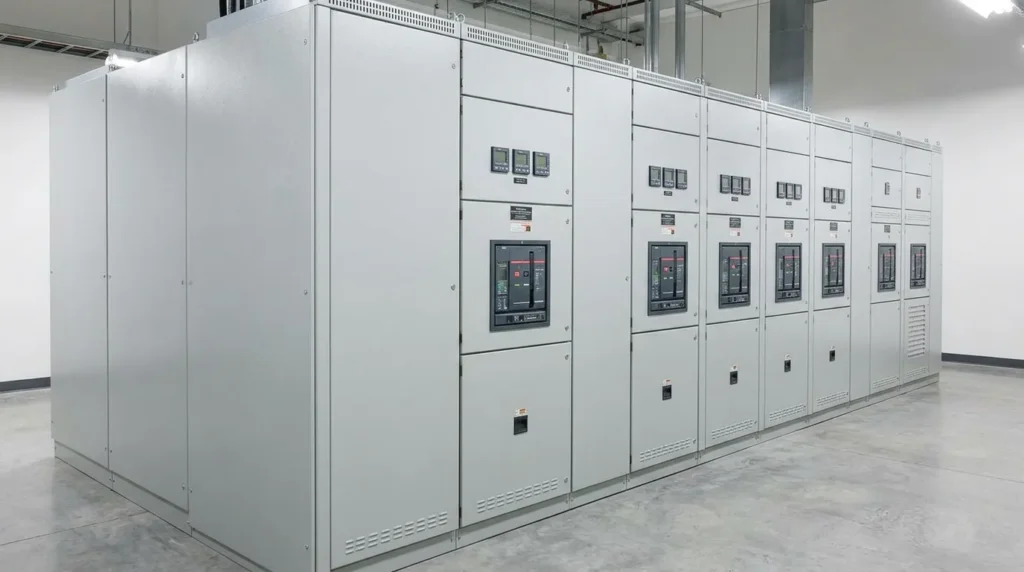
Power Control Centers (PCC) are important electrical systems used to control, distribute, and protect electrical power in industrial and commercial installations. A PCC acts as the main distribution point where electrical power from transformers or generators is received and then supplied to different electrical loads, machines, and distribution panels. These systems are widely used in factories, power plants, commercial buildings, hospitals, and large industrial facilities where reliable power management is necessary.
A Power Control Center contains various electrical components arranged inside a strong metal enclosure for safe operation. The main components include circuit breakers, bus bars, isolators, meters, relays, switches, control devices, and protection systems. Circuit breakers protect the system from overloads and short circuits, while bus bars distribute electrical current efficiently to different outgoing feeders. Meters and indicators help monitor voltage, current, and power conditions continuously.
The working principle of a PCC is based on centralized power distribution and protection. Electrical power enters the PCC from the main source and is then distributed through outgoing feeders to different sections of the plant or building. Protective devices continuously monitor the system and disconnect faulty circuits automatically during abnormal conditions, ensuring safe and stable operation.
Power Control Centers are available in different types such as low-voltage PCCs and medium-voltage PCCs depending on the operating voltage level. Modern PCC systems may also include automation and digital monitoring features for better control and energy management.
The main advantages of PCCs include improved safety, organized power distribution, easy maintenance, and reliable system protection. They also simplify fault detection and reduce downtime in industrial operations. However, PCC systems require proper design, installation, and regular maintenance to ensure safe performance.
Overall, Power Control Centers are essential electrical systems that provide efficient power distribution, centralized control, and protection for modern industrial and commercial electrical networks.
Handle high-power distribution.
- Used in large industries
- Manage heavy loads
- Includes advanced protection systems
4.5 Automation Panels
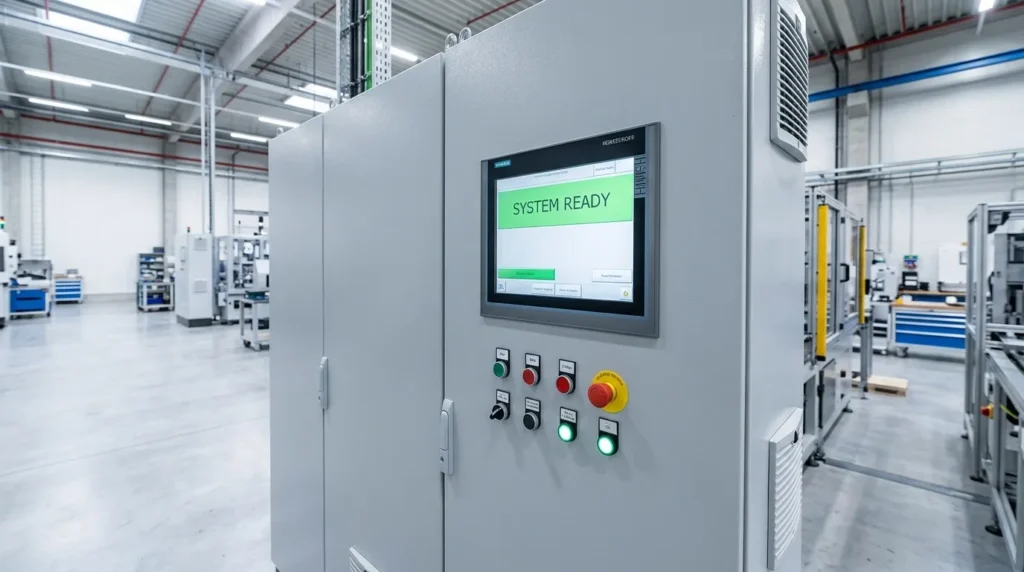
Automation panels are advanced electrical control systems used to automate industrial machines and processes with minimal human involvement. These panels control, monitor, and manage equipment automatically using electrical and electronic components. Automation panels are widely used in factories, manufacturing plants, water treatment systems, food processing industries, and commercial buildings to improve efficiency, accuracy, and productivity.
An automation panel contains important components such as PLCs (Programmable Logic Controllers), relays, contactors, circuit breakers, sensors, timers, push buttons, Human Machine Interfaces (HMI), and communication modules. The PLC acts as the brain of the system and processes input signals from sensors and switches. Based on the programmed instructions, it sends output commands to motors, valves, pumps, and other devices.
The working principle of an automation panel is based on automatic control logic. Sensors detect conditions such as temperature, pressure, speed, or liquid level and send signals to the PLC. The PLC analyzes the information and controls connected equipment automatically according to the programmed sequence. This allows industrial operations to run accurately and continuously without constant manual control.
Automation panels are available in different types such as PLC panels, VFD panels, SCADA panels, motor automation panels, and process control panels. VFD panels are used for motor speed control, while SCADA panels allow remote monitoring and control of industrial systems.
One major advantage of automation panels is increased efficiency and reduced human error. They improve production speed, save energy, enhance safety, and simplify machine operation. However, automation systems can be expensive and require skilled technicians for programming and maintenance.
Automation panels are widely used in conveyor systems, packaging machines, HVAC systems, bottling plants, and smart manufacturing industries.
Overall, automation panels are essential modern control systems that provide intelligent operation, improved reliability, and efficient process management in industrial and commercial applications.
Used in modern smart systems.
- Include PLCs (Programmable Logic Controllers)
- Used in robotics and automation
- High precision control
Main Components of Realistic Electrical Panels (2026)
Understanding components helps you work confidently with panels.
5.1 Circuit Breakers
- Protect circuits from overload and short circuits
- Automatically disconnect power
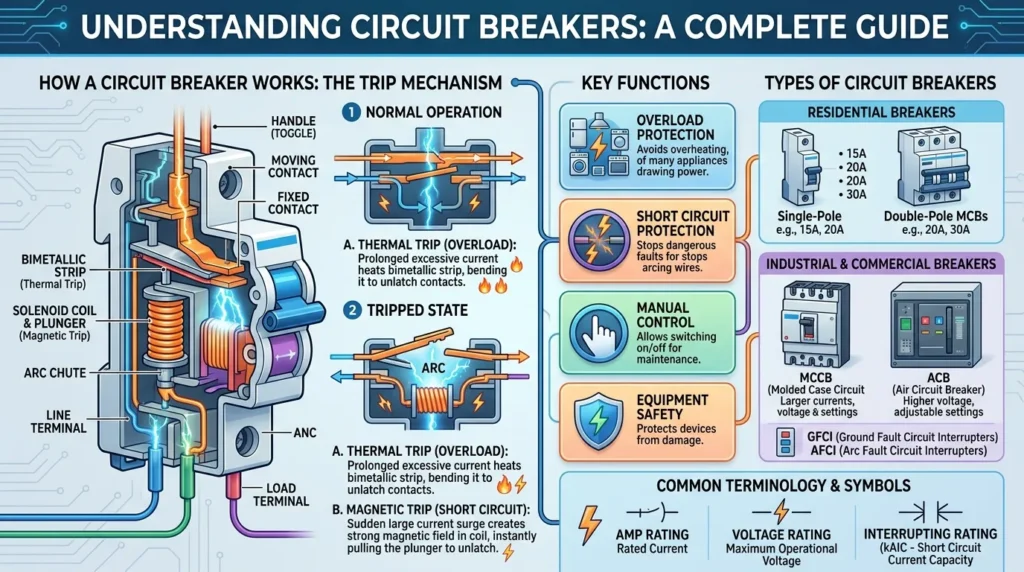
A circuit breaker is an important electrical safety device used in homes, industries, and power systems to protect electrical circuits from damage caused by overload, short circuits, or faults. It automatically interrupts the flow of electricity when it detects an abnormal condition, preventing hazards like fire, equipment damage, or electric shock. Unlike a fuse, which needs to be replaced after it blows, a circuit breaker can be reset and used again, making it more reliable and convenient.
The main function of a circuit breaker is to stop excessive current flow. When too many appliances are connected to a circuit or a fault occurs, the current increases beyond safe limits. The circuit breaker senses this abnormal rise and quickly trips, breaking the circuit. This stops electricity flow and protects wires and devices from overheating or burning.
There are different types of circuit breakers used in electrical systems. Miniature Circuit Breakers (MCBs) are commonly used in homes for low-voltage protection. Molded Case Circuit Breakers (MCCBs) are used in industrial settings for higher loads. Air Circuit Breakers (ACBs) and Vacuum Circuit Breakers (VCBs) are used in large power distribution systems and substations for high-voltage protection.
Circuit breakers work using two main mechanisms: thermal and magnetic. The thermal mechanism responds to slow overloads by bending a bimetallic strip, while the magnetic mechanism responds instantly to short circuits using an electromagnetic coil. Both systems ensure fast and accurate protection.
One of the biggest advantages of circuit breakers is safety and reliability. They can be easily reset after tripping, which saves time and maintenance cost. They also provide better control over electrical systems and reduce the risk of electrical fires.
Overall, circuit breakers are essential components of modern electrical systems. They ensure safe electricity distribution, protect equipment, and help maintain stable power supply in residential, commercial, and industrial applications.
5.2 Busbars
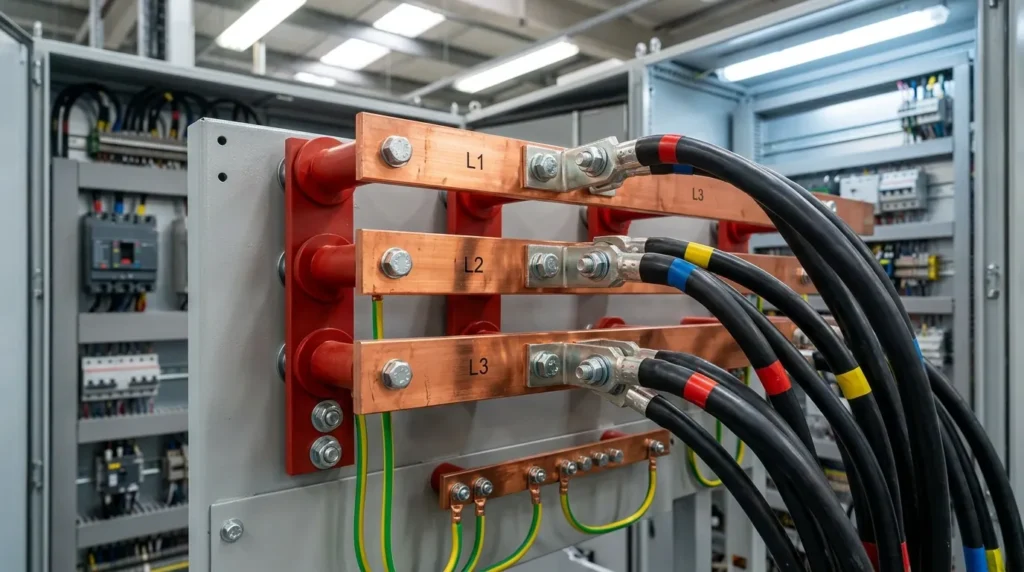
- Conduct electricity within the panel
- Distribute power efficiently
Busbars are an important component used in electrical power distribution systems to carry large amounts of current from one place to another. They are usually made of highly conductive materials like copper or aluminum because these materials allow electricity to flow easily with minimum energy loss. Busbars are commonly used in substations, switchboards, distribution panels, and industrial power systems.
The main purpose of a busbar is to collect electrical power from incoming feeders and distribute it to outgoing circuits. Instead of using many separate wires, a busbar provides a single, strong conducting path that can handle high current safely and efficiently. This improves system organization, reduces wiring complexity, and increases reliability.
Busbars are designed in different shapes such as rectangular, round, or hollow bars depending on the application and current capacity. They are usually mounted inside metal enclosures for safety and protection. Proper insulation is also used to prevent accidental contact and electrical faults.
One of the key advantages of busbars is their ability to carry very high current with low power loss. They also make maintenance easier because connections are organized and clearly arranged. In addition, busbars improve safety and reduce the chances of overheating compared to multiple wire connections.
Overall, busbars are essential in modern electrical systems because they provide a safe, efficient, and reliable way to distribute electrical power in industrial and commercial applications.
5.3 Contactors
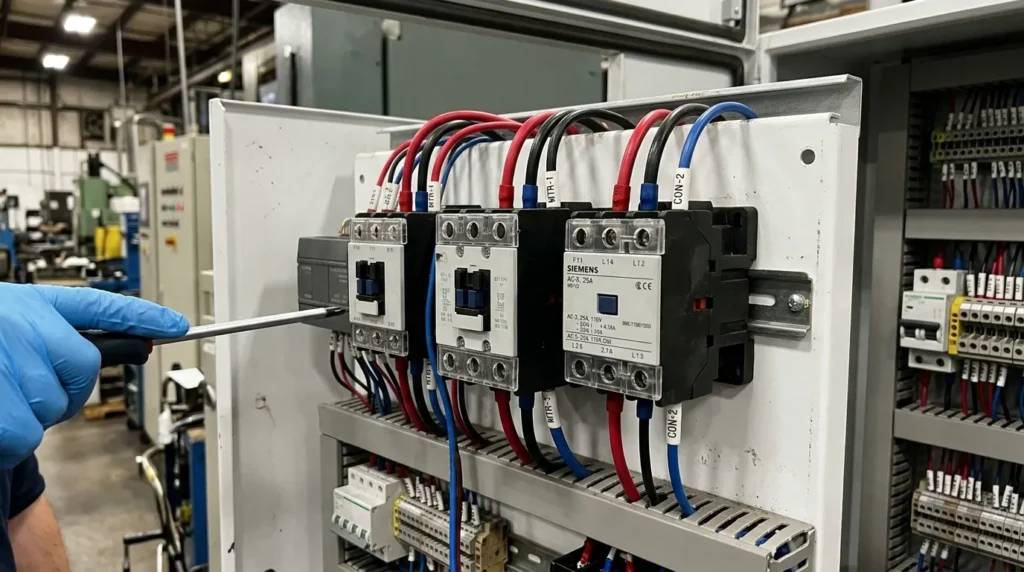
- Electrically controlled switches
- Used for high-power applications
A contactor is an electrically controlled switching device used to turn electrical circuits ON and OFF, especially in high-power systems. It is widely used in industrial machines, motors, HVAC systems, and power control panels. A contactor works like a heavy-duty switch that can handle large electrical loads safely and efficiently.
The main function of a contactor is to control the flow of electricity in a circuit without manual switching. It operates using an electromagnetic coil. When the coil is energized with a small control voltage, it creates a magnetic field that pulls the contacts together, allowing current to flow through the main circuit. When the coil is de-energized, the magnetic field disappears, and a spring mechanism opens the contacts, stopping the current flow.
Contactors are designed to handle high current loads and are more durable than normal switches. They are often used in motor control applications where machines need frequent switching ON and OFF. For example, in water pumps, air conditioners, elevators, and conveyor systems, contactors play a key role in automation and control.
There are different types of contactors, including AC contactors and DC contactors, depending on the type of current they handle. Some advanced contactors also include overload protection features to prevent damage to electrical equipment.
One of the major advantages of contactors is safe remote operation. They allow electrical systems to be controlled from a distance using low-power signals, reducing the risk of electric shock. They are also reliable, fast-acting, and suitable for repeated operations.
Overall, contactors are essential components in modern electrical systems, providing safe, efficient, and automated control of high-power electrical loads in industrial and commercial applications.
5.4 Relays
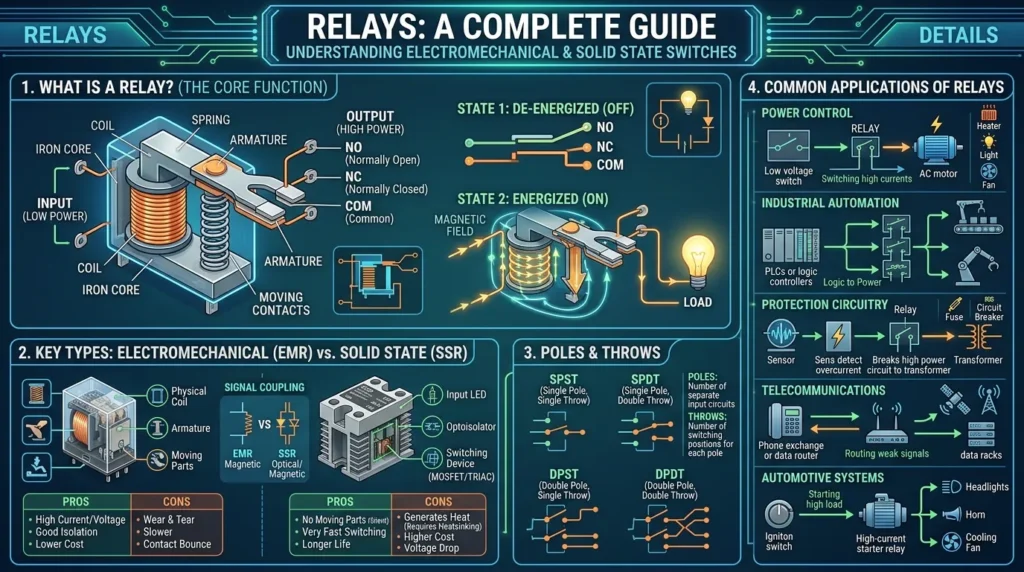
- Control circuits using low power
- Provide protection and automation
A relay is an electrical switching device used to control a high-power circuit using a low-power signal. It acts like an automatic switch that opens or closes a circuit when it receives an electrical signal. Relays are widely used in protection systems, automation, control panels, automobiles, and electronic devices.
The main working principle of a relay is based on electromagnetism. When a small current flows through the coil of the relay, it creates a magnetic field. This magnetic field attracts a metal arm (armature), which then changes the position of the contacts. As a result, the circuit either opens or closes depending on the design. When the current is removed, the spring returns the armature to its original position.
Relays are very useful because they allow low-voltage circuits to control high-voltage or high-current devices safely. For example, a small switch or sensor can activate a relay, which then turns on a large motor, light system, or industrial machine without direct manual control.
There are different types of relays, such as electromagnetic relays, solid-state relays, thermal relays, and time-delay relays. Each type is designed for specific applications, such as protection, timing control, or automation.
One of the major advantages of relays is safety and isolation. They protect control circuits from high voltage and reduce the risk of damage or electric shock. They are also simple, reliable, and cost-effective devices used in many electrical systems.
Overall, relays are essential components in modern electrical and electronic systems because they provide safe control, automation, and efficient switching between low-power and high-power circuits.
5.5 Switches and Push Buttons
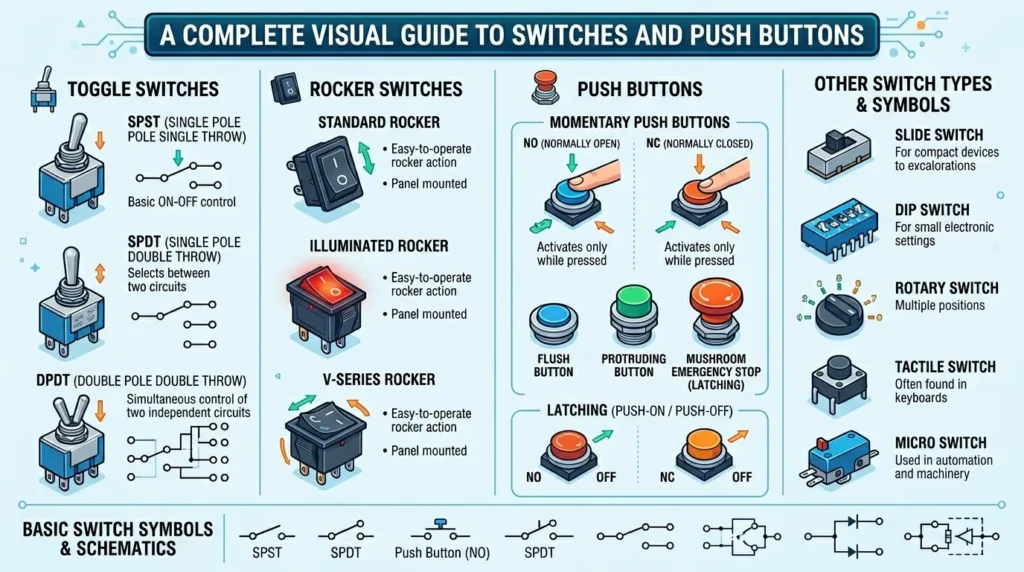
- Manual control of circuits
- Start/stop operations
Switches and push buttons are basic but very important electrical control devices used to turn electrical circuits ON and OFF. They are widely used in homes, offices, machines, control panels, and industrial systems for controlling the flow of electricity safely and easily.
A switch is a simple device that maintains its position until it is changed manually. When a switch is turned ON, it completes the electrical circuit and allows current to flow. When it is turned OFF, it breaks the circuit and stops the current. Switches are commonly used for lights, fans, and electrical appliances in homes.
A push button, on the other hand, is a momentary control device. It works only when it is pressed. When the button is pressed, the circuit is completed, and when it is released, the circuit automatically returns to its original state. Push buttons are commonly used in doorbells, elevators, machines, and industrial control systems.
Switches and push buttons are designed in different types depending on their use. These include single-pole switches, double-pole switches, toggle switches, and illuminated push buttons. In industrial systems, push buttons are often used to start or stop machines safely.
One of the main advantages of switches and push buttons is their simplicity and reliability. They are easy to use, cost-effective, and require very little maintenance. They also provide direct control over electrical circuits, making them essential for everyday electrical operations.
Overall, switches and push buttons are fundamental components in electrical systems that provide safe and easy control of power in residential, commercial, and industrial applications.
5.6 Meters (Voltmeters & Ammeters)
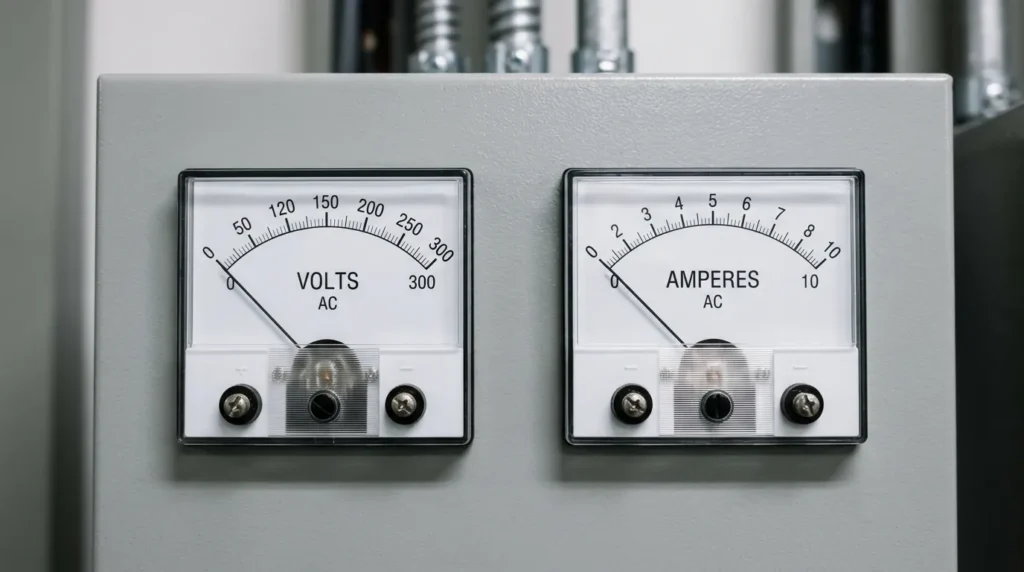
- Measure voltage and current
- Help monitor system performance
Meters such as voltmeters and ammeters are important electrical measuring instruments used to measure voltage, current, and overall performance of electrical circuits. They are widely used in homes, laboratories, industries, and power systems to ensure safe and correct operation of electrical equipment.
A voltmeter is used to measure electrical potential difference (voltage) between two points in a circuit. It is always connected in parallel with the load so that it can measure the correct voltage without affecting the circuit. Voltmeters help in checking whether the supply voltage is stable and suitable for devices.
An ammeter is used to measure electric current flowing through a circuit. It is connected in series so that the full current passes through it. Ammeters help in monitoring how much current is being used by electrical appliances or machines, which is important for safety and performance control.
Both voltmeters and ammeters come in different types such as analog and digital meters. Analog meters use a pointer and scale, while digital meters show readings on a display screen. Digital meters are more accurate and easier to read, so they are widely used in modern systems.
These measuring instruments are very important for detecting faults, preventing overloads, and maintaining electrical systems properly. They help electricians and engineers understand circuit behavior and ensure safe operation.
Overall, voltmeters and ammeters are essential tools in electrical engineering that provide accurate measurement of voltage and current, helping to maintain safety, efficiency, and reliability in electrical systems.
5.7 Indicators (LED Lights)
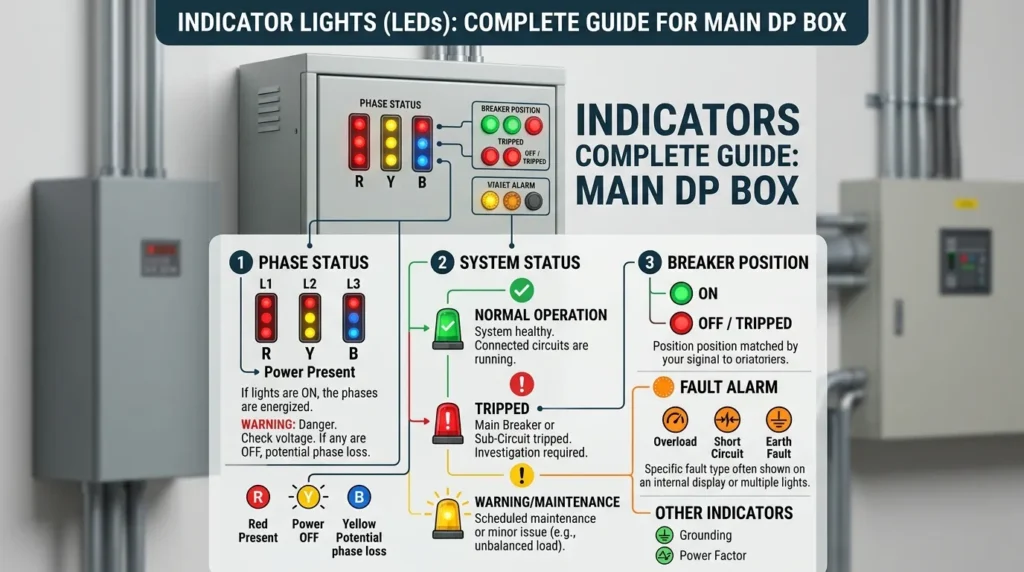
- Show system status
- Provide visual alerts
LED indicators are small light-emitting devices used in electrical and electronic systems to show the status of a circuit or equipment. LED stands for Light Emitting Diode. These indicators are commonly used in control panels, machines, home appliances, and industrial systems to show whether a device is ON, OFF, or in a fault condition.
The main function of LED indicators is to provide a quick visual signal. For example, a green LED may show that the system is working normally, a red LED may indicate a fault or danger, and a yellow LED may show standby or warning status. This helps users and technicians understand the condition of equipment without needing complex instruments.
LEDs work by allowing electric current to pass through a semiconductor material, which then emits light. They require very low power compared to traditional bulbs, making them energy-efficient and cost-effective. They also have a long lifespan and can operate for thousands of hours without failure.
One of the biggest advantages of LED indicators is their reliability and clarity. They respond quickly and clearly show system status even in low-light conditions. They are also small in size, durable, and resistant to shock and vibration, making them suitable for industrial environments.
Overall, LED indicators are essential components in modern electrical systems because they provide simple, fast, and energy-efficient visual communication about system performance and safety conditions.
6. Advantages of Realistic Electrical Panels
Here are the key realistic electrical panels advantages and disadvantages (starting with advantages):
Realistic electrical panels play a very important role in modern electrical systems because they improve safety, efficiency, and reliability. These panels are designed to closely represent actual working conditions, which makes them highly useful for both learning and practical applications. One of the main advantages of realistic electrical panels is enhanced safety. Since they are built with proper circuit protection devices like circuit breakers, fuses, and earthing systems, they help prevent electrical hazards such as short circuits, overloads, and electric shocks. This makes them ideal for training environments as well as real-world installations. Another major benefit is better understanding and training. Students, technicians, and engineers can learn how electrical systems work in a practical way instead of just theoretical knowledge. By using realistic panels, they can practice wiring, fault finding, and maintenance safely, which improves their skills and confidence. Realistic panels also offer accurate simulation of real systems, allowing users to experience how electricity flows, how components interact, and how faults occur in actual conditions. This is especially useful for troubleshooting and diagnosing problems quickly and effectively.
In addition, these panels provide improved efficiency and organization. All components such as switches, relays, meters, and wiring are arranged in a structured manner, making it easier to monitor and control the system. This organized layout reduces errors and saves time during installation and maintenance. Another important advantage is durability and reliability. Realistic electrical panels are usually built with high-quality materials, which ensures long-lasting performance even in demanding conditions. They can handle voltage fluctuations and continuous usage without frequent breakdowns. Furthermore, they support easy maintenance and upgrades. Since the design is clear and accessible, technicians can quickly identify issues, replace faulty parts, and upgrade the system when needed. Lastly, realistic electrical panels contribute to energy efficiency by allowing better control of electrical loads and reducing wastage of electricity. Overall, these panels are essential for safe operation, practical learning, and efficient management of electrical systems in homes, industries, and training institutes.
- Safe distribution of electricity
- Protection against faults and overloads
- Easy control of electrical systems
- Improves efficiency of operations
- Reduces risk of electrical accidents
- Supports automation and smart systems
- Organized wiring and maintenance
7. Disadvantages / Limitations
Despite their benefits, there are some limitations:
Realistic electrical panels, despite their many advantages, also have several disadvantages and limitations that users should understand before using them. One of the main drawbacks is high initial cost. These panels are designed with high-quality components such as circuit breakers, relays, meters, and proper wiring systems, which makes them more expensive compared to simple or basic panels. For small businesses, students, or training institutes with limited budgets, this cost can be a challenge.
Another limitation is complexity in design and operation. Realistic electrical panels closely represent real-world systems, which means they can be complicated for beginners to understand. Without proper guidance or training, users may find it difficult to operate or troubleshoot these panels effectively. This complexity can also increase the chances of errors during installation or maintenance.
Maintenance requirements are also higher. Since these panels contain multiple components, regular inspection and servicing are necessary to ensure proper functioning. If maintenance is ignored, faults can occur, leading to system failure or safety risks. Additionally, repairing or replacing parts can sometimes be costly and time-consuming.
Another disadvantage is space requirement. Realistic panels often need more space due to their structured layout and multiple components. This can be a problem in small work areas or compact installations where space is limited.
There is also a risk of electrical hazards if the panel is not handled properly. Even though they are designed for safety, improper use, incorrect wiring, or lack of protective measures can still lead to shocks, short circuits, or equipment damage.
Lastly, dependency on skilled professionals is a limitation. Installation, operation, and maintenance usually require trained electricians or technicians. This increases overall costs and makes it less accessible for beginners without technical knowledge.
- High initial installation cost
- Requires skilled personnel for operation
- Regular maintenance needed
- Risk of failure if poorly designed
- Space requirements for large panels
Applications of Realistic Electrical Panels (2026)
Realistic electrical panels are used in almost every sector where electrical power needs to be controlled, protected, monitored, and distributed efficiently. These panels are designed to meet the specific requirements of different environments, ensuring safe operation and reliable performance. From homes and commercial buildings to large industrial facilities and advanced automation systems, electrical panels play a critical role in modern life.
8.1 Residential Use
In residential settings, realistic electrical panels are commonly used as distribution boards or consumer units. These panels receive electricity from the utility supply and distribute it to different circuits within the house, such as lighting, air conditioners, kitchen appliances, water heaters, and power outlets.
They also provide essential safety features through circuit breakers and residual current devices (RCDs), which protect residents from electrical shocks, overloads, and short circuits. If an electrical fault occurs in one part of the house, the affected circuit can be isolated without interrupting power to the entire home. Modern residential panels may also include surge protection devices to safeguard sensitive electronic equipment from voltage spikes.
8.2 Commercial Buildings
Commercial buildings such as offices, shopping malls, hotels, schools, and hospitals rely heavily on electrical panels for centralized power management. These panels distribute electricity to lighting systems, elevators, heating and cooling equipment, emergency systems, security devices, and office equipment.
In hospitals, electrical panels are especially important because critical equipment such as life-support machines and operating room devices require an uninterrupted and stable power supply. Backup power integration, load balancing, and monitoring capabilities help ensure continuous operation. In large commercial complexes, multiple panels work together to manage electrical loads efficiently while reducing energy waste and simplifying maintenance.
8.3 Industrial Use
Industrial facilities represent one of the most significant applications of realistic electrical panels. Factories, manufacturing plants, processing units, and production lines use these panels to control heavy machinery and industrial equipment.
Industrial control panels contain components such as motor starters, contactors, relays, overload protection devices, variable frequency drives (VFDs), and programmable logic controllers (PLCs). These components allow operators to start, stop, monitor, and regulate motors, pumps, conveyors, compressors, and automated production systems.
Because industrial environments often involve high power demands and harsh operating conditions, electrical panels are built to withstand dust, heat, vibration, and moisture. Their reliable operation improves productivity, minimizes downtime, and enhances workplace safety.
8.4 Renewable Energy Systems
As the world moves toward cleaner energy sources, realistic electrical panels have become essential components of renewable energy systems. In solar power installations, control panels manage the flow of electricity generated by photovoltaic panels. They coordinate the operation of inverters, batteries, charge controllers, and protective devices to ensure efficient energy conversion and distribution.
Similarly, wind energy systems use specialized panels to monitor turbine performance, regulate power output, and protect the equipment from electrical faults. These panels help integrate renewable energy into the electrical grid while maintaining system stability and safety.
Advanced monitoring functions also allow operators to track energy production, identify faults quickly, and optimize system performance for maximum efficiency.
8.5 Automation Systems
Automation is transforming both homes and industries, and realistic electrical panels are at the center of this technological advancement. In smart homes, electrical panels can interact with automated lighting, climate control systems, security cameras, smart appliances, and energy management systems. Homeowners can monitor and control these devices remotely using mobile applications or voice assistants.
In industrial automation, electrical panels support robotics, artificial intelligence (AI), sensors, and automated machinery. PLCs and intelligent controllers process data from various devices and execute commands without constant human intervention. This improves accuracy, increases production speed, reduces operational costs, and minimizes the possibility of human error.
As industries continue to adopt Industry 4.0 technologies, modern electrical panels are becoming smarter, offering remote diagnostics, predictive maintenance capabilities, and real-time performance analysis.
Summary
The applications of realistic electrical panels are broad and vital to modern society. They provide safe power distribution in homes, efficient energy management in commercial buildings, reliable machine control in industries, effective operation of renewable energy systems, and intelligent support for automation technologies. Their ability to protect, control, monitor, and distribute electrical power makes them indispensable in today’s electrically driven world.
9. Comparison Section
Difference Between Control Panels and Distribution Panels
| Feature | Control Panel | Distribution Panel |
|---|---|---|
| Purpose | Control equipment | Distribute power |
| Complexity | High | Low to Medium |
| Components | Relays, PLCs, contactors | MCBs, fuses |
| Usage | Industrial systems | Homes and buildings |
| Automation Level | High | Low |
This explains the difference between control panels and distribution panels clearly.
Selection Guide for Realistic Electrical Panels (2026)
Choosing the right electrical panel is one of the most important steps in any electrical installation. A properly selected panel ensures safe operation, efficient power distribution, reliable performance, and long service life. On the other hand, selecting an unsuitable panel can lead to frequent breakdowns, equipment damage, increased maintenance costs, safety hazards, and even fire risks. Whether the panel is intended for a home, commercial building, or industrial facility, several factors should be carefully considered before making a final decision.
Identify Your Load Requirement
The first step in selecting an electrical panel is to determine the total electrical load it will handle. Load requirement refers to the amount of power consumed by all connected equipment and devices. For residential installations, this may include lighting circuits, air conditioners, refrigerators, water heaters, and household appliances. In commercial and industrial applications, motors, pumps, HVAC systems, production machinery, and specialized equipment must also be considered.
Calculating the expected load helps determine the panel’s current-carrying capacity and prevents overloading. It is also advisable to include a safety margin to accommodate occasional peak demands.
Choose the Correct Voltage Rating
Electrical panels are designed to operate at specific voltage levels. Therefore, selecting a panel with the correct voltage rating is essential for safety and efficiency. Residential systems commonly operate at lower voltages, while industrial facilities often require higher voltage ratings to power heavy machinery and large equipment.
Using a panel with an incorrect voltage rating can damage connected devices, reduce system efficiency, and create dangerous operating conditions. Always verify the voltage requirements of the installation before purchasing a panel.
Select Proper Protection Devices
Protection devices are among the most critical components of an electrical panel. These devices protect both people and equipment from electrical faults. Depending on the application, the panel should include suitable protective equipment such as:
- Circuit breakers for overload and short-circuit protection.
- Fuses for fast fault interruption.
- Overload relays to protect motors.
- Residual Current Devices (RCDs) or Earth Leakage Circuit Breakers (ELCBs) to prevent electric shock.
- Surge protection devices to guard against voltage spikes and lightning-related disturbances.
Choosing the correct protective devices improves reliability and minimizes the risk of accidents.
Consider Future Expansion
Many people select a panel based only on their current needs and overlook future growth. However, electrical demands often increase over time. Additional appliances, machinery, office equipment, production lines, or automation systems may require extra circuits.
Selecting a panel with spare capacity allows future expansion without replacing the entire system. Extra breaker spaces, additional busbar capacity, and sufficient enclosure size can save significant costs and effort later.
Ensure Quality Materials
The quality of materials used in an electrical panel directly affects its durability and performance. High-quality enclosures resist corrosion, moisture, dust, and physical damage. Reliable conductors, insulated wiring, and well-manufactured components reduce the likelihood of failures.
Panels made from poor-quality materials may deteriorate quickly, resulting in overheating, loose connections, and costly repairs. Investing in quality components provides long-term reliability and peace of mind.
Check Safety Standards and Certifications
Electrical panels should comply with recognized national and international safety standards. Compliance indicates that the panel has been designed and tested to meet established requirements for performance and protection.
Before selecting a panel, verify that it meets the applicable standards and certifications required in your region. Panels that satisfy these standards provide greater assurance of safety, quality, and dependable operation.
Choose Trusted Manufacturers
The reputation of the manufacturer is another important consideration. Established manufacturers typically offer better product quality, technical support, warranties, and availability of spare parts. Their products often undergo extensive testing and quality control procedures.
Research the manufacturer’s history, customer reviews, certifications, and after-sales service before making a decision. Choosing a trusted brand can reduce maintenance problems and improve overall system reliability.
Practical Advice
Although basic electrical panels may appear simple, selecting and installing the right panel requires technical knowledge and careful planning. Industrial panels, in particular, involve complex calculations, protection coordination, load analysis, and compliance with safety regulations.
For this reason, it is always advisable to consult qualified and experienced electrical engineers before purchasing or installing an industrial electrical panel. Professional guidance helps ensure that the selected panel meets operational requirements, safety standards, and future expansion needs.
A wrong selection can result in overloaded circuits, equipment failure, unexpected downtime, increased operating costs, serious safety hazards, and costly modifications. Taking the time to evaluate requirements properly and seeking expert advice will help you choose an electrical panel that delivers safe, efficient, and reliable performance for many years.
Common Problems and Solutions in Electrical Panels (2026)
Even well-designed electrical panels can develop problems over time due to continuous operation, environmental conditions, aging components, or poor maintenance practices. Identifying these issues early and applying the correct solution can prevent equipment damage, reduce downtime, and improve the overall safety and reliability of the electrical system. The following are some of the most common problems encountered in electrical panels and their practical solutions.
Q1: Why Does the Panel Trip Frequently?
Frequent tripping is one of the most common problems in electrical panels. Circuit breakers are designed to trip automatically when they detect abnormal conditions that may damage the system. If the panel trips repeatedly, it indicates that there is an underlying issue that requires attention.
Possible Causes
- Overloading: Too many devices or machines connected to the same circuit may draw more current than the circuit is designed to handle.
- Faulty Wiring: Damaged insulation, loose conductors, or short circuits can cause protective devices to operate.
- Defective Circuit Breakers: Old or damaged breakers may become sensitive and trip even under normal conditions.
- Ground Faults: Leakage of current to earth can activate protective devices.
Solutions
- Check whether the connected load exceeds the circuit capacity and redistribute the load if necessary.
- Inspect all wiring for signs of wear, burning, or loose connections.
- Replace damaged or faulty circuit breakers with correctly rated replacements.
- Test the circuit for earth leakage and repair any insulation faults.
- Consult a qualified electrician if the cause cannot be identified easily.
Timely action can prevent repeated interruptions and reduce the risk of electrical fires.
Q2: Why Is There Overheating in the Panel?
Excessive heat inside an electrical panel should never be ignored. Overheating can damage components, reduce their lifespan, and increase the risk of system failure.
Possible Causes
- Loose Connections: Loose terminals create resistance, which generates heat.
- Overloading: Continuous operation above the rated current causes components to overheat.
- Poor Ventilation: Inadequate airflow prevents heat from escaping.
- Dust Accumulation: Dust can trap heat and affect cooling.
- Undersized Components: Components not designed for the actual load may overheat.
Solutions
- Tighten all electrical connections according to manufacturer specifications.
- Reduce the load or upgrade the panel capacity if overloading is identified.
- Improve ventilation by installing cooling fans, ventilation openings, or air-conditioning where necessary.
- Clean the panel regularly to remove dust and debris.
- Replace undersized cables and components with properly rated equipment.
Regular thermal inspections can help detect overheating before it becomes dangerous.
Q3: Why Are the Indicators Not Working?
Indicator lamps and LEDs provide valuable information about system status. When they fail, operators may lose visibility of the panel’s operating condition.
Possible Causes
- Loss of Power Supply: The indicator may not be receiving voltage.
- Faulty LED or Lamp: The indicator itself may have failed.
- Damaged Wiring: Broken or loose wires interrupt the circuit.
- Control Circuit Failure: Problems in relays or auxiliary contacts can prevent operation.
Solutions
- Verify that the control power supply is present.
- Replace defective LEDs, bulbs, or indicator modules.
- Inspect and tighten all wiring connections associated with the indicator circuit.
- Check auxiliary contacts, relays, and control components for proper operation.
- Use a multimeter to trace the circuit and identify the fault.
Restoring indicator functionality improves monitoring and operational awareness.
Q4: Why Is the Motor Not Starting from the Panel?
Motor starting problems are common in industrial and commercial installations. Since motors are often essential to production processes, quick troubleshooting is important.
Possible Causes
- Faulty Contactor: The contactor may fail to energize or its contacts may be damaged.
- Incorrect Relay Settings: Overload relays may trip due to improper adjustment.
- Control Circuit Failure: Broken push buttons, wiring faults, or control transformer issues can interrupt the start sequence.
- Power Supply Problems: Voltage may be absent or insufficient.
- Motor Faults: Internal motor defects may prevent operation.
Solutions
- Inspect the contactor coil and contacts for signs of damage or wear.
- Check and adjust overload relay settings according to the motor’s rated current.
- Verify that start and stop push buttons are functioning correctly.
- Inspect the control wiring and ensure that the control voltage is present.
- Confirm that the incoming power supply is stable.
- Test the motor insulation and winding condition if necessary.
Systematic troubleshooting minimizes downtime and restores normal operation quickly.
Q5: How to Maintain an Electrical Panel?
Preventive maintenance is essential for ensuring the safe and reliable operation of electrical panels. Regular maintenance reduces unexpected failures and extends equipment life.
Recommended Maintenance Practices
- Regular Cleaning: Remove dust, dirt, and moisture from the panel interior and exterior.
- Tighten Connections: Check terminals and busbar connections periodically to prevent overheating.
- Test Protection Devices: Verify the operation of circuit breakers, overload relays, and earth leakage devices.
- Inspect Components: Look for signs of discoloration, corrosion, cracks, or burning.
- Check Ventilation Systems: Ensure cooling fans and air vents are functioning properly.
- Monitor Temperature: Use thermal imaging or temperature checks to identify hot spots.
- Maintain Records: Keep detailed maintenance logs for inspections, repairs, and testing activities.
- Schedule Periodic Inspections: Establish a preventive maintenance program based on the operating environment and manufacturer recommendations.
Proper maintenance not only improves system reliability but also enhances safety and reduces long-term operating costs.
Electrical panels are the backbone of power distribution and control systems, but they require proper care and timely troubleshooting to perform efficiently. Problems such as frequent tripping, overheating, non-functional indicators, and motor starting failures often have identifiable causes and practical solutions. Through regular inspections, preventive maintenance, and prompt corrective actions, most issues can be resolved before they lead to serious damage or costly downtime. A well-maintained electrical panel ensures continuous operation, protects valuable equipment, and provides a safer working environment for everyone involved.
Future Trends in Electrical Panels (2026)
The electrical industry is undergoing a major transformation driven by digital technology, automation, and the growing demand for energy efficiency. Traditional electrical panels were primarily designed for power distribution and protection. However, modern electrical panels are becoming smarter, more connected, and capable of performing advanced functions beyond basic switching and control.
The future of electrical panels focuses on improving efficiency, enhancing safety, reducing maintenance costs, and supporting intelligent decision-making. The following trends are shaping the next generation of electrical panels.
12.1 Smart Electrical Panels (2026): IoT, AI, and Intelligent Power Management
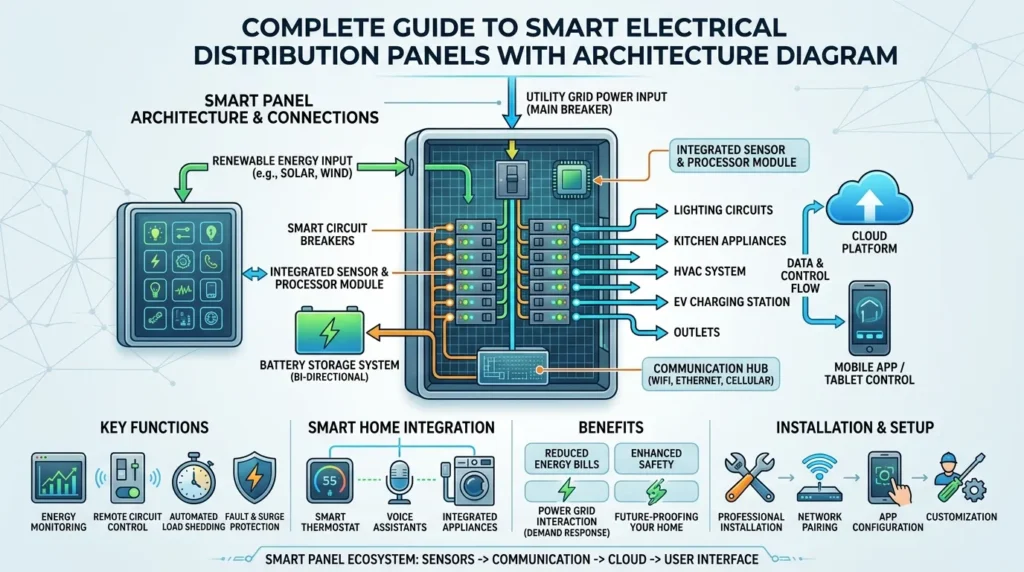
One of the most important advancements in modern electrical systems is the development of Smart Electrical Panels. Unlike traditional distribution panels that only supply and protect electrical circuits, smart panels combine electrical protection with digital monitoring, automation, and intelligent energy management. These advanced panels are becoming increasingly popular in residential buildings, commercial facilities, industrial plants, and smart cities because they improve safety, efficiency, and operational control.
Smart electrical panels use technologies such as the Internet of Things (IoT), artificial intelligence (AI), cloud computing, and smart sensors to continuously monitor the health and performance of an electrical system. They collect real-time information about voltage, current, frequency, power consumption, power quality, temperature, and equipment status. This data is then transmitted to computers, smartphones, tablets, or cloud-based dashboards, allowing users to monitor and control their electrical systems from virtually anywhere.
Unlike conventional panels that require manual inspection, smart panels automatically detect abnormal operating conditions such as overloads, voltage fluctuations, earth faults, overheating, or equipment failures. When a problem occurs, the system immediately sends alerts to maintenance personnel, helping prevent costly downtime and reducing the risk of equipment damage or electrical accidents.
How Smart Electrical Panels Work
Smart panels combine traditional protection devices with intelligent monitoring equipment. Various sensors installed inside the panel continuously collect electrical data and send it to an embedded controller or energy management system.
The controller processes this information and can:
- Display real-time electrical parameters.
- Detect abnormal operating conditions.
- Generate maintenance alerts.
- Automatically disconnect faulty circuits.
- Store historical performance data.
- Share reports through cloud-based software.
Many modern smart panels also support remote firmware updates, ensuring the latest security features and operational improvements without replacing hardware.
Key Features of Smart Electrical Panels
Modern smart panels offer numerous advanced features, including:
- IoT-based real-time monitoring and diagnostics.
- AI-powered predictive maintenance.
- Remote monitoring and control using smartphones or computers.
- Automatic fault detection and event recording.
- Digital energy metering and consumption analysis.
- Power quality monitoring.
- Remote switching of electrical circuits.
- Load balancing and intelligent power distribution.
- Integration with Building Management Systems (BMS).
- Cloud-based data storage and reporting.
- Automatic notifications through mobile apps or email.
- Improved electrical safety through continuous monitoring.
Benefits of Smart Electrical Panels
The growing adoption of smart panels provides significant advantages for both homeowners and industrial facilities.
Some major benefits include:
- Improved electrical system reliability.
- Faster fault identification and troubleshooting.
- Reduced maintenance costs.
- Lower energy consumption through better monitoring.
- Increased equipment lifespan.
- Better protection against overloads and electrical faults.
- Improved operational efficiency.
- Remote access from any location.
- Reduced downtime during electrical failures.
- Support for renewable energy integration.
Real-World Example
Consider a modern manufacturing plant operating hundreds of electrical machines. Instead of sending technicians to inspect every distribution panel manually, the facility uses smart electrical panels connected to a centralized monitoring system.
If a circuit breaker trips due to an overload or a motor begins drawing excessive current, the smart panel immediately detects the abnormal condition and sends a notification to the maintenance team through a mobile application or cloud dashboard. Engineers can identify the exact location of the fault, analyze system data, and take corrective action before the problem causes major production delays.
This combination of automation, IoT connectivity, artificial intelligence, and predictive maintenance is transforming traditional electrical panels into intelligent power management systems that improve safety, reduce operating costs, and increase the overall efficiency of modern electrical installations.
12.2 Digital Monitoring Systems (2026): Real-Time Electrical Monitoring and Energy Management
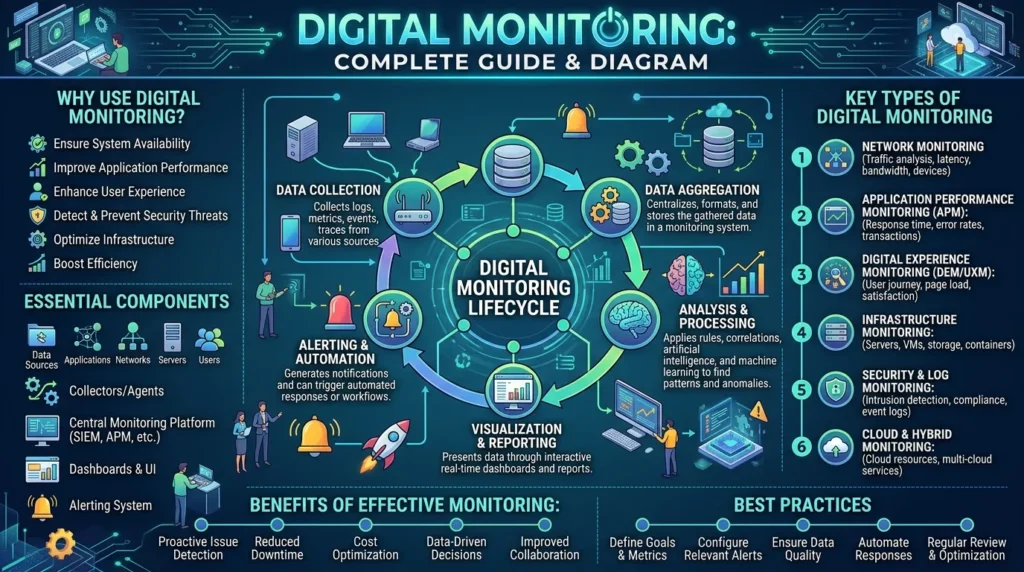
Digital monitoring systems have become an essential part of modern electrical panels and power distribution networks. Traditional analog meters, indicator lamps, and manual inspections are gradually being replaced by digital monitoring technologies that provide accurate, real-time information about the performance and health of electrical systems.
Modern digital monitoring systems use intelligent electronic devices (IEDs), digital meters, sensors, programmable logic controllers (PLCs), and communication networks to continuously collect, process, and display electrical data. This information is presented through digital displays, touchscreen Human Machine Interfaces (HMIs), computer software, and cloud-based dashboards, enabling engineers and facility managers to monitor the entire electrical installation from a single location.
Unlike conventional monitoring methods that require manual readings, digital systems automatically record electrical parameters, detect abnormal operating conditions, generate reports, and send instant alerts whenever faults occur. This helps reduce downtime, improve maintenance planning, and increase the overall reliability of electrical equipment.
How Digital Monitoring Systems Work
Digital monitoring systems continuously collect data from electrical equipment using sensors and intelligent measuring devices installed inside electrical panels.
The collected information is transmitted to monitoring software, where it is analyzed and displayed in an easy-to-understand format. If any parameter exceeds its safe operating limit, the system immediately generates an alarm or notification so that maintenance personnel can take corrective action before equipment is damaged.
These systems can monitor a single electrical panel or an entire industrial power distribution network from one centralized control room.
Key Features of Digital Monitoring Systems
Modern digital monitoring solutions provide a wide range of intelligent features, including:
- Real-time monitoring of voltage, current, frequency, and power.
- Continuous power quality analysis.
- Energy consumption measurement and reporting.
- Automatic fault detection and event logging.
- Historical data recording and trend analysis.
- Remote monitoring through computers, tablets, and smartphones.
- Cloud-based reporting and data storage.
- Automatic alarm notifications via email or mobile applications.
- Predictive maintenance support.
- Integration with SCADA, PLC, and Building Management Systems (BMS).
These features allow engineers to identify electrical problems quickly and make informed maintenance decisions.
Benefits of Digital Monitoring Systems
Implementing digital monitoring technology offers numerous operational and financial advantages.
Some of the major benefits include:
- Real-time visibility of electrical system performance.
- Faster detection of electrical faults and abnormalities.
- Improved system reliability and operational safety.
- Reduced equipment downtime.
- Better preventive and predictive maintenance planning.
- Accurate energy usage tracking.
- Lower maintenance and operating costs.
- Improved power quality management.
- Enhanced decision-making through detailed reports.
- Greater efficiency in industrial and commercial facilities.
Digital monitoring helps organizations maintain stable electrical systems while reducing unexpected failures and maintenance expenses.
Energy Management Systems (EMS)
Modern digital monitoring systems are often integrated with Energy Management Systems (EMS) to improve energy efficiency and reduce electricity costs. An EMS collects data from digital meters, sensors, and electrical panels to analyze how energy is being used throughout a facility.
The system identifies areas where electricity is being wasted and recommends strategies to optimize power consumption without affecting productivity. Engineers can monitor peak demand, compare historical energy usage, schedule equipment operation, and improve overall energy efficiency.
Benefits of Energy Management Systems
An effective EMS provides several important advantages, including:
- Continuous monitoring of energy consumption.
- Identification of energy waste and unnecessary loads.
- Peak demand management.
- Improved load balancing.
- Lower electricity operating costs.
- Better utilization of electrical equipment.
- Support for sustainability and energy-saving initiatives.
- Automated energy performance reporting.
- Improved compliance with energy efficiency standards.
- Enhanced long-term operational planning.
Real-World Example
Consider a large commercial office building equipped with digital monitoring systems and an Energy Management System (EMS). Every electrical panel continuously measures voltage, current, power factor, frequency, and energy consumption.
During periods of high electricity demand, the EMS automatically identifies non-essential loads such as decorative lighting or unused HVAC equipment and recommends or performs load adjustments to reduce peak demand. At the same time, facility managers receive real-time notifications if any breaker trips, voltage fluctuates, or equipment begins operating outside safe limits.
By combining digital monitoring, intelligent analytics, and energy management, modern electrical installations achieve higher reliability, improved safety, lower maintenance costs, and significantly greater energy efficiency than traditional monitoring systems.
12.3 Automation Integration in Modern Electrical Panels (2026): Smart Control Systems and Industrial Applications
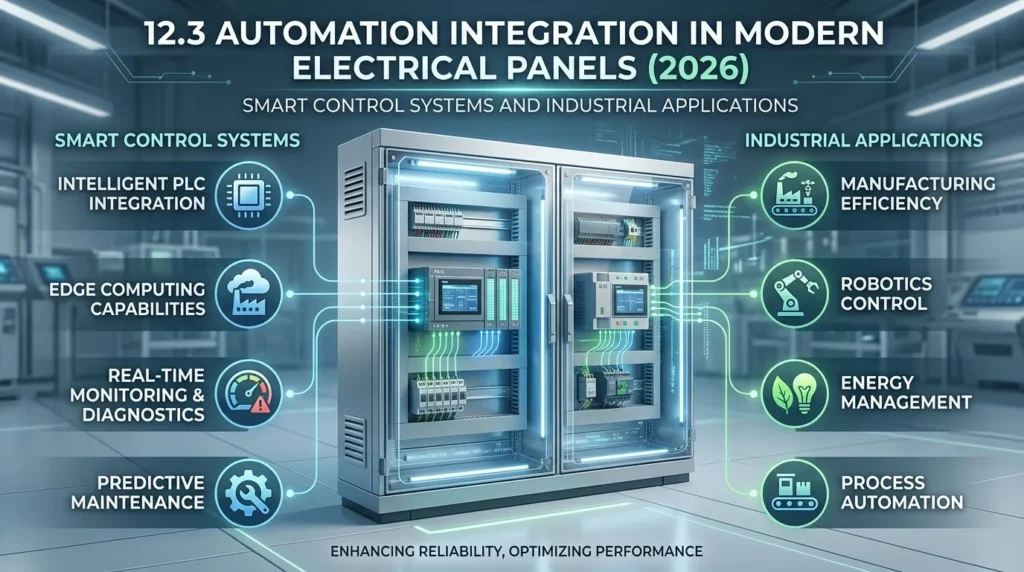
Automation has become one of the most important developments in modern electrical engineering. As industries move toward smart manufacturing and digital transformation, electrical panels are no longer limited to distributing electrical power. They now serve as intelligent control centers that monitor, protect, and automate machines, equipment, and entire production processes.
Modern electrical panels are integrated with advanced technologies such as Programmable Logic Controllers (PLCs), Human Machine Interfaces (HMIs), Supervisory Control and Data Acquisition (SCADA) systems, Industrial Internet of Things (IIoT) devices, and Artificial Intelligence (AI). These technologies enable real-time monitoring, automatic decision-making, predictive maintenance, and remote operation, making industrial systems safer, more efficient, and highly reliable.
Automation integration also helps reduce manual intervention, minimize human error, improve production quality, and lower operating costs. As industries adopt Industry 4.0 standards, intelligent electrical panels are becoming an essential part of modern factories, commercial buildings, and infrastructure projects.
PLC Integration (Programmable Logic Controllers)
Programmable Logic Controllers (PLCs) are among the most important components of industrial automation. Modern electrical panels are designed to house PLCs that automatically control machines and industrial processes based on programmed instructions.
PLCs receive signals from sensors, switches, and measuring devices, process the information, and send commands to motors, valves, relays, pumps, conveyor belts, and other electrical equipment. They operate much faster and more accurately than traditional relay-based control systems.
Advantages of PLC Integration
Modern PLC-based electrical panels provide numerous benefits, including:
- High-speed machine control.
- Reduced human intervention.
- Improved production accuracy.
- Flexible programming and easy modifications.
- Automatic process control.
- Faster fault detection and troubleshooting.
- Improved equipment reliability.
- Reduced wiring complexity.
- Better safety and operational efficiency.
- Easy integration with HMI and SCADA systems.
PLCs are widely used in manufacturing plants, water treatment facilities, power stations, food processing industries, packaging systems, and automated production lines.
Artificial Intelligence (AI) Integration
Artificial Intelligence (AI) is transforming modern electrical panels by enabling them to analyze operational data, recognize patterns, and make intelligent decisions without continuous human supervision.
AI-powered electrical panels continuously monitor electrical parameters such as voltage, current, power consumption, temperature, vibration, and equipment condition. Using advanced algorithms, they can identify abnormal operating conditions before a failure occurs and recommend corrective actions.
Applications of AI in Electrical Panels
AI technology is increasingly being used for:
- Predictive maintenance planning.
- Automatic fault diagnosis.
- Detection of abnormal operating patterns.
- Intelligent energy optimization.
- Load forecasting and management.
- Equipment health monitoring.
- Automatic alarm prioritization.
- Improved electrical safety.
- Reduced maintenance costs.
- Enhanced system reliability.
Instead of waiting for equipment to fail, AI allows maintenance teams to repair components before serious breakdowns occur, significantly reducing downtime and increasing productivity.
Smart Factory Integration (Industry 4.0)
Modern manufacturing facilities are rapidly adopting Industry 4.0, where machines, robots, electrical panels, sensors, and computer systems communicate with each other through high-speed industrial networks.
In these smart factories, electrical panels function as intelligent communication hubs that connect all automation equipment into one integrated control system. They continuously exchange information with PLCs, HMIs, SCADA software, industrial robots, sensors, variable frequency drives (VFDs), and cloud-based monitoring platforms.
This real-time communication allows the entire production process to operate with minimal human intervention while maintaining maximum efficiency and safety.
Benefits of Smart Factory Integration
Smart electrical panels help industries achieve:
- Fully automated production processes.
- Real-time machine monitoring.
- Improved production efficiency.
- Faster fault detection and recovery.
- Better product quality and consistency.
- Reduced production downtime.
- Lower operating and maintenance costs.
- Intelligent energy management.
- Remote monitoring and control.
- Greater flexibility for future expansion.
As Industry 4.0 continues to evolve, automation-integrated electrical panels will play an even greater role in supporting smart factories, intelligent buildings, renewable energy systems, and advanced industrial automation. Their ability to combine power distribution, monitoring, protection, communication, and intelligent control makes them one of the most important technologies shaping the future of electrical engineering.
12.4 Energy Efficiency in Modern Electrical Panels (2026): Smart Power Management, Sustainable Design, and Energy-Saving Technologies
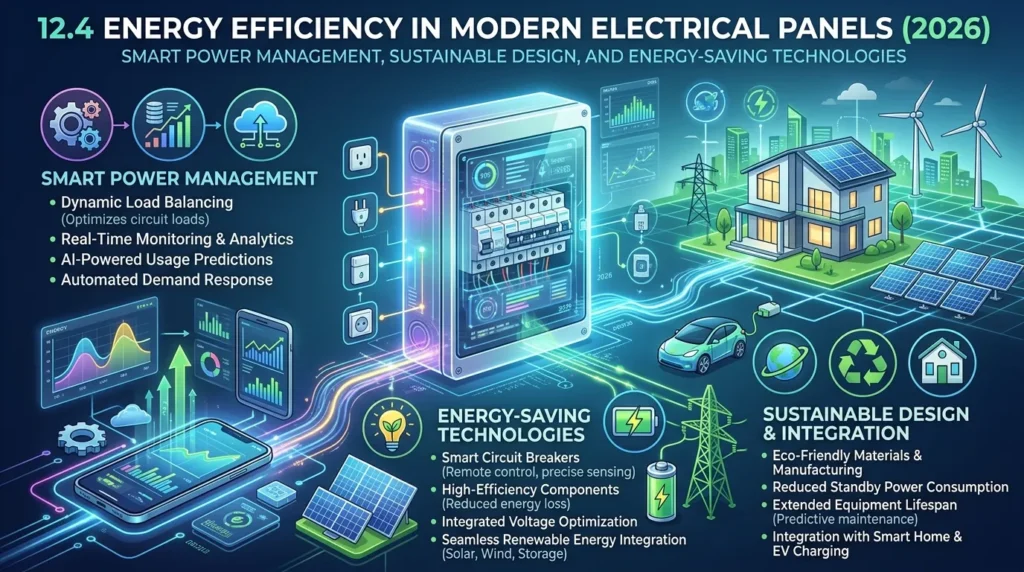
Energy efficiency has become one of the highest priorities in modern electrical engineering. As electricity demand continues to increase across residential, commercial, and industrial sectors, manufacturers are developing energy-efficient electrical panels that reduce power losses, improve system performance, and support sustainable energy management.
Unlike traditional panels that simply distribute electrical power, modern electrical panels are equipped with intelligent monitoring systems, energy management software, high-efficiency components, and advanced protective devices. These technologies continuously monitor energy consumption, identify unnecessary power losses, and optimize the distribution of electricity throughout the electrical system.
Energy-efficient panels also play a major role in reducing electricity costs, minimizing equipment wear, lowering greenhouse gas emissions, and supporting renewable energy integration. With the rapid growth of smart buildings, electric vehicles, solar power systems, and Industry 4.0, energy-efficient electrical panels are becoming an essential part of modern power infrastructure.
Reduced Power Loss Through Advanced Technologies
One of the primary objectives of modern electrical panels is to reduce electrical losses while delivering reliable power to connected equipment. Every electrical system experiences some energy loss due to heat, conductor resistance, poor connections, and inefficient components. Modern engineering focuses on minimizing these losses through improved design and intelligent power management.
Manufacturers now use high-quality materials and advanced electrical components that improve conductivity, reduce heat generation, and increase overall system efficiency. Intelligent monitoring systems also help identify overloaded circuits, voltage imbalances, and inefficient equipment before they affect system performance.
Technologies That Reduce Power Loss
Modern electrical panels improve efficiency by using:
- High-conductivity copper and aluminum busbars.
- High-efficiency circuit breakers and switching devices.
- Intelligent load balancing systems.
- Digital energy monitoring meters.
- Automatic power factor correction equipment.
- Low-loss transformers and protective devices.
- Optimized cable routing and conductor sizing.
- Advanced thermal management and cooling systems.
- Smart energy management software.
- Real-time power quality monitoring.
By reducing electrical losses, these technologies help lower operating costs, improve equipment reliability, and extend the lifespan of electrical components.
Smart Power Management Systems
Modern electrical panels are increasingly equipped with Smart Power Management Systems (SPMS) that continuously monitor and optimize energy consumption. These systems collect real-time data on voltage, current, frequency, power factor, and electrical load, enabling operators to make informed decisions about energy usage.
Using advanced sensors and communication technologies, smart panels can automatically distribute electrical loads, disconnect non-essential equipment during peak demand, and balance power across multiple circuits. This intelligent control reduces energy waste while maintaining stable and reliable electrical operation.
Benefits of Smart Power Management
Smart power management systems provide several advantages, including:
- Continuous monitoring of electrical performance.
- Automatic load balancing.
- Reduced peak electricity demand.
- Improved power quality.
- Lower energy consumption.
- Faster identification of inefficient equipment.
- Better utilization of available electrical capacity.
- Reduced operating and maintenance costs.
- Enhanced electrical safety.
- Improved overall system efficiency.
These features make smart electrical panels an essential component of energy-efficient buildings, manufacturing plants, hospitals, shopping centers, and data centers.
Sustainable Electrical Panel Designs
Environmental protection and sustainability are driving major innovations in electrical panel design. Manufacturers are developing eco-friendly panels that consume less energy, produce fewer emissions, and use environmentally responsible materials throughout the manufacturing process.
Modern sustainable electrical panels are designed to support renewable energy systems such as solar photovoltaic (PV) installations, wind power systems, battery energy storage systems, and electric vehicle charging infrastructure. These panels help reduce dependence on fossil fuels while improving the efficiency of clean energy distribution.
Features of Sustainable Electrical Panels
Modern sustainable panel designs include:
- Use of recyclable and environmentally friendly materials.
- Energy-efficient electrical components.
- Reduced standby power consumption.
- Lower carbon footprint during manufacturing.
- Longer equipment service life.
- Modular construction for easy upgrades.
- High-efficiency insulation materials.
- Support for solar and wind energy integration.
- Compatibility with battery energy storage systems.
- Compliance with modern environmental and energy-efficiency standards.
These improvements contribute to global efforts aimed at reducing energy consumption, conserving natural resources, and promoting environmentally responsible electrical infrastructure.
Future of Energy-Efficient Electrical Panels
The future of electrical panels lies in intelligent energy optimization, digital monitoring, and sustainable power management. Emerging technologies such as Artificial Intelligence (AI), the Internet of Things (IoT), cloud-based analytics, and machine learning will allow electrical panels to automatically predict energy demand, detect inefficiencies, and optimize power distribution with minimal human intervention.
Future energy-efficient panels will not only distribute electricity but also function as intelligent energy management centers capable of improving reliability, reducing operational costs, supporting renewable energy integration, and helping industries achieve their sustainability goals. As smart grids and green technologies continue to expand, energy-efficient electrical panels will remain a cornerstone of modern electrical systems and future power distribution networks.
12.5 Compact Electrical Panel Designs (2026): Space-Saving Solutions, Modular Technology, and Modern Engineering Innovations
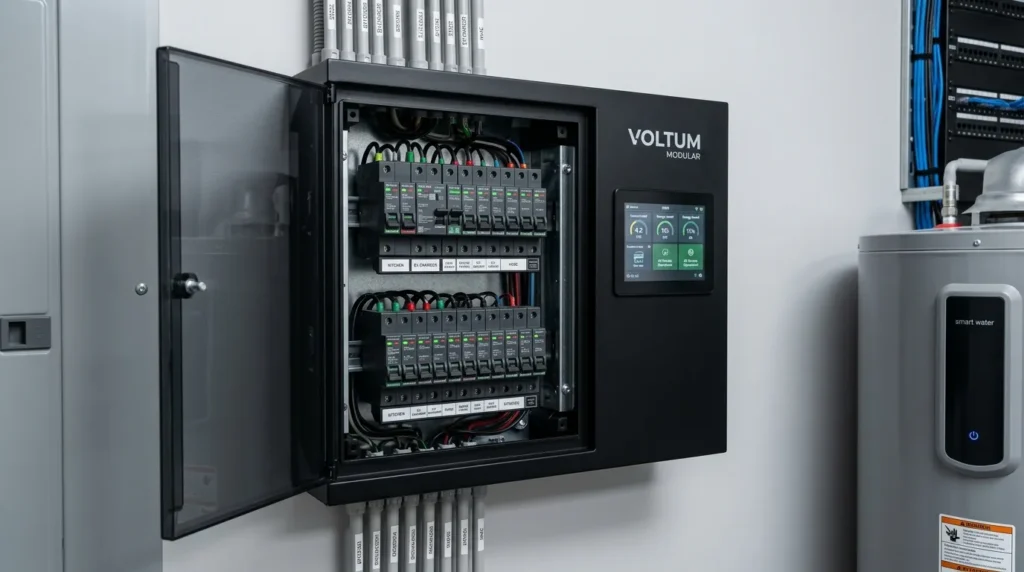
As modern buildings, factories, and commercial facilities continue to become more compact, the demand for space-efficient electrical panels has grown significantly. Traditional electrical panels often require large installation areas, making them less practical for modern infrastructure where every square foot of space matters. To address this challenge, manufacturers are developing compact electrical panel designs that deliver the same level of safety, reliability, and performance while occupying much less space.
Today’s compact electrical panels use advanced engineering techniques, high-density components, improved cooling systems, and modular construction to maximize functionality within a smaller enclosure. These panels are easier to install, transport, maintain, and upgrade, making them an ideal solution for residential buildings, commercial complexes, hospitals, data centers, renewable energy plants, and industrial automation systems.
In addition to saving valuable installation space, compact panel designs help reduce material costs, improve cable management, simplify maintenance, and support future expansion. As smart buildings and Industry 4.0 technologies continue to evolve, compact electrical panels are becoming an essential part of efficient and modern electrical infrastructure.
Space-Saving Electrical Panel Designs
Modern compact electrical panels are carefully engineered to maximize available space without compromising electrical safety or operational performance. Engineers achieve this by using smaller high-performance components, optimized internal layouts, efficient cable routing, and improved heat dissipation techniques.
These innovations allow more electrical equipment to be installed inside a smaller enclosure while maintaining proper ventilation and accessibility for maintenance.
Advantages of Space-Saving Panel Designs
Compact electrical panels offer numerous practical benefits, including:
- Reduced installation space requirements.
- Better utilization of limited floor and wall space.
- Easier transportation and handling.
- Lower construction and infrastructure costs.
- Faster installation and commissioning.
- Improved cable organization and routing.
- Simplified maintenance and servicing.
- Better accessibility to electrical components.
- Reduced enclosure weight.
- Cleaner and more professional installations.
These panels are especially valuable in apartment buildings, office towers, shopping malls, hospitals, telecommunications facilities, and industrial plants where installation space is limited.
Modular Electrical Panel Systems
One of the most important innovations in modern electrical engineering is the development of modular electrical panels. Instead of constructing one large fixed panel, modular systems consist of standardized sections or modules that can be added, removed, or replaced as system requirements change.
This flexible design allows organizations to expand their electrical infrastructure without replacing the entire panel, reducing both installation costs and future upgrade expenses.
Benefits of Modular Electrical Panels
Modular panel systems provide several advantages:
- Quick and simple installation.
- Easy expansion for future electrical loads.
- Reduced maintenance time.
- Faster replacement of damaged modules.
- Lower downtime during repairs and upgrades.
- Greater flexibility for system modifications.
- Simplified inventory management.
- Improved scalability for growing facilities.
- Cost-effective long-term operation.
- Better compatibility with modern automation systems.
For example, if a manufacturing facility installs new production equipment, engineers can simply add additional modules instead of replacing the complete electrical panel, saving both time and money.
Applications of Compact and Modular Panels
Compact and modular electrical panels are now widely used across many industries because of their flexibility, reliability, and efficient use of space.
They are commonly installed in:
- Smart residential buildings.
- Commercial offices and shopping centers.
- Hospitals and healthcare facilities.
- Manufacturing and industrial automation plants.
- Data centers and server rooms.
- Renewable energy installations.
- Water treatment facilities.
- Electric vehicle charging stations.
- Airports and transportation systems.
- Smart city infrastructure.
Their compact size and modular construction make them ideal for modern projects where efficiency, scalability, and easy maintenance are top priorities.
Future Outlook for Compact Electrical Panels
The future of electrical panels is being shaped by rapid advances in digital technology, automation, and sustainable engineering. Modern panels are evolving from simple power distribution units into intelligent systems capable of monitoring, controlling, protecting, and optimizing entire electrical networks.
Future compact electrical panels will increasingly integrate Internet of Things (IoT) connectivity, Artificial Intelligence (AI), cloud-based monitoring, digital protection systems, predictive maintenance, and advanced energy management technologies. These innovations will allow electrical systems to detect faults automatically, optimize energy consumption, improve equipment reliability, and support remote operation from anywhere in the world.
As smart homes, intelligent buildings, renewable energy systems, and Industry 4.0 continue to expand, compact modular electrical panels will play a vital role in delivering safe, efficient, and future-ready power distribution. Engineers, technicians, and facility managers who understand these emerging technologies will be better prepared to design, operate, and maintain the next generation of electrical infrastructure while meeting the growing demands for energy efficiency, automation, and sustainability.
13. Conclusion
Realistic electrical panels are essential for safe and efficient power management in modern systems. From homes to large industries, they play a key role in controlling and protecting electrical circuits.
In this guide, you learned the definition, working principle, types, components, advantages, disadvantages, and applications of realistic electrical panels. You also explored selection tips, troubleshooting methods, and future trends.
For students and engineers, understanding these panels is a fundamental skill. Keep learning, practicing, and exploring real-world systems to gain deeper expertise in electrical engineering.