
Imagine plugging your mobile phone charger into a wall socket. The charger immediately begins supplying power to charge your phone, even though you cannot see electricity flowing. What makes the electric current move from the power outlet to your device? The answer is voltage. Voltage acts as the driving force that pushes electric current through wires and electrical circuits, allowing everything from LED bulbs and ceiling fans to industrial machines to operate efficiently.
Understanding the voltage meaning is essential for anyone studying or working with electricity. Whether you are an electrical student, engineer, technician, or beginner, voltage is one of the first concepts you must master because it forms the foundation of electrical engineering. Without voltage, there would be no electric current and no electrical power.
In this guide, you will learn the voltage meaning, voltage working principle, different types of voltage, major components involved in creating voltage, practical applications, voltage advantages and disadvantages, common problems, and the difference between voltage and current. By the end of this article, you will have a clear understanding of how voltage works in real-world electrical systems.
What Is Voltage Meaning?
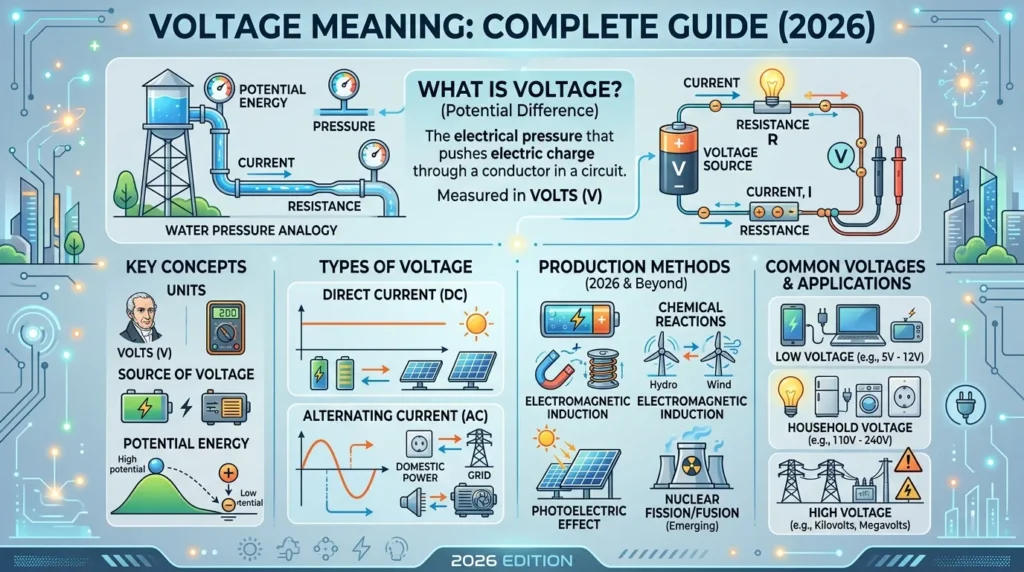
The voltage meaning refers to the electrical potential difference between two points in an electrical circuit. It is the force that pushes electrons through a conductor, creating electric current.
Voltage is measured in volts (V), named after the Italian scientist Alessandro Volta, who invented the first electric battery.
In simple words, voltage is the pressure that moves electricity through wires.
Simple Explanation
Think of electricity like water flowing through a pipe.
- Voltage = Water pressure
- Current = Water flow
- Resistance = Size of the pipe
Higher water pressure pushes more water through a pipe. Similarly, higher voltage pushes electric current through a circuit.
Practical Example
When you switch on a ceiling fan at home, the 230-volt AC supply provides enough electrical pressure to move current through the motor. Without voltage, the motor would not receive the energy needed to rotate the fan blades.
Another example is a 1.5V AA battery, which provides the voltage needed to power a flashlight or TV remote.
Voltage Working Principle
The voltage working principle is based on the movement of electric charges caused by a difference in electrical potential.
Whenever two points have different electrical potentials, electrons naturally move from the higher-energy point toward the lower-energy point through a closed circuit. This movement creates electric current.
Without voltage, electrons remain stationary, and no electrical device can operate.
Step 1: Voltage Source Creates Potential Difference
Every electrical circuit starts with a voltage source.
Common voltage sources include:
- Batteries
- Generators
- Solar panels
- Power stations
- Electrical transformers
These devices create a difference in electrical potential between two terminals.
Step 2: Circuit Is Completed
When a switch closes, the electrical circuit becomes complete.
Electrons now have a continuous path through the conductor.
Step 3: Current Begins to Flow
The voltage pushes electrons through the wire.
This movement is called electric current.
The amount of current depends on:
- Voltage
- Resistance
- Circuit design
This relationship is explained by Ohm’s Law:
Current (I) = Voltage (V) ÷ Resistance (R)
Step 4: Electrical Energy Is Converted
As current flows, electrical devices convert electrical energy into other useful forms.
Examples include:
- Light bulbs → Light energy
- Heaters → Heat energy
- Electric motors → Mechanical energy
- Speakers → Sound energy
Easy Analogy
Imagine a water tank placed on top of a building.
The height of the tank creates water pressure.
When you open the tap, water flows naturally because of this pressure.
Similarly:
- Voltage creates electrical pressure.
- Current flows through wires.
- Electrical devices use the energy.
Without pressure, neither water nor electricity can move.
Types of Voltage
Voltage can be classified into several categories depending on how it behaves and where it is used.
AC Voltage (Alternating Current Voltage)
AC voltage changes its direction continuously.
This is the type of electricity supplied by national power grids.
Common Uses
- Homes
- Offices
- Factories
- Schools
- Hospitals
Advantages
- Easy long-distance transmission
- Efficient power distribution
- Compatible with transformers
DC Voltage (Direct Current Voltage)
DC voltage flows in only one direction.
It is produced by batteries, solar panels, and DC generators.
Common Uses
- Mobile phones
- Laptops
- Electric vehicles
- UPS systems
- Electronic circuits
High Voltage
High voltage refers to electrical systems operating at thousands of volts.
It is mainly used for power transmission.
Applications
- Transmission lines
- Grid stations
- Power plants
- Industrial equipment
Medium Voltage
Medium voltage is commonly used for electricity distribution between substations and consumers.
Applications
- Industrial plants
- Commercial buildings
- Distribution networks
Low Voltage
Low voltage systems are the safest and most common for residential use.
Examples include:
- Household wiring
- LED lighting
- Home appliances
- Consumer electronics
Extra-Low Voltage (ELV)
Extra-low voltage systems improve electrical safety.
They are widely used where human protection is important.
Examples include:
- Doorbells
- CCTV systems
- Fire alarm systems
- Garden lighting
- Communication equipment
Factors That Affect Voltage
Several factors influence voltage in an electrical circuit.
Power Source
Different sources produce different voltage levels.
Examples:
- AA Battery → 1.5V
- Car Battery → 12V
- Household Supply → 120V or 230V
Resistance
Higher resistance causes greater voltage drop.
Long cables often experience noticeable voltage losses.
Current Flow
As current increases, voltage drops become larger across conductors.
Proper cable sizing helps reduce these losses.
Distance
Long transmission lines experience voltage drops due to conductor resistance.
Utilities compensate using transformers and voltage regulation equipment.
Temperature
High temperatures increase conductor resistance, which may slightly affect voltage levels in electrical systems.
Main Components of Voltage Systems
Voltage does not work alone in an electrical circuit. It depends on several key components that generate, carry, control, measure, and use electrical energy. Together, these components ensure that electrical power is delivered safely and efficiently from the source to the load. Understanding these parts helps students and engineers build a solid foundation in electrical engineering.
Voltage Source
A voltage source is the component that creates the electrical potential difference needed to move electrons through a circuit. Without a voltage source, there is no electrical pressure to drive current, and electrical devices cannot operate.
Common voltage sources include:
- Batteries
- AC generators (alternators)
- DC generators (dynamos)
- Solar panels
- Fuel cells
- Electrical power stations
Function of a Voltage Source
- Produces electrical potential difference (voltage).
- Supplies energy to the electrical circuit.
- Maintains a stable voltage for connected loads.
- Powers electrical and electronic devices.
Conductors
Conductors are materials that provide a low-resistance path for electric current to flow. Copper and aluminum are the most widely used conductors because they offer excellent electrical conductivity and long-term reliability.
Conductors connect the voltage source to electrical equipment, allowing energy to travel throughout the circuit.
Functions of Conductors
- Carry electric current safely.
- Minimize energy losses.
- Connect various electrical components.
- Support efficient power transmission and distribution.
Electrical Load
An electrical load is any device or equipment that consumes electrical energy to perform useful work. When voltage is applied across a load, current flows and electrical energy is converted into another form such as light, heat, sound, or mechanical motion.
Examples of electrical loads include:
- Electric motors
- LED lights
- Ceiling fans
- Air conditioners
- Electric heaters
- Refrigerators
- Industrial machines
- Computers and electronic devices
Functions of an Electrical Load
- Uses electrical energy.
- Converts electrical energy into useful output.
- Completes the electrical circuit.
- Determines how much current flows through the system.
Switch
A switch controls the flow of voltage within an electrical circuit. By opening or closing the circuit, it allows users to safely start or stop electrical equipment whenever needed.
Switches are commonly installed in homes, industries, commercial buildings, and control panels.
Functions of a Switch
- Connects or disconnects the electrical circuit.
- Controls electrical equipment safely.
- Prevents unnecessary power consumption.
- Improves maintenance safety.
Transformer
A transformer is an essential component in AC power systems. It changes voltage from one level to another without changing the electrical frequency.
Transformers make electrical transmission more efficient by increasing voltage for long-distance transmission and reducing voltage for safe distribution to consumers.
Functions of a Transformer
- Steps up voltage for transmission lines.
- Steps down voltage for residential and industrial use.
- Improves transmission efficiency.
- Reduces power losses over long distances.
Measuring Instruments
Electrical engineers and technicians use measuring instruments to monitor voltage accurately. These instruments help ensure that electrical systems operate within safe voltage limits and assist in troubleshooting electrical faults.
Common voltage measuring instruments include:
- Voltmeter
- Digital Multimeter (DMM)
- Oscilloscope
- Clamp Meter with voltage measurement
Functions of Measuring Instruments
- Measure voltage accurately.
- Monitor electrical system performance.
- Detect abnormal voltage conditions.
- Assist in electrical maintenance and troubleshooting.
Advantages of Voltage
Voltage is one of the most important concepts in electrical engineering because it makes electrical energy useful in everyday life. Proper voltage levels allow electrical equipment to operate efficiently, safely, and reliably across residential, commercial, and industrial applications.
Some of the major voltage advantages include:
- Provides the electrical force needed to move current through a circuit.
- Powers electrical appliances, machines, and electronic devices.
- Supports efficient long-distance power transmission.
- Works with transformers to reduce transmission losses.
- Enables renewable energy systems such as solar and wind power.
- Makes automation and smart electrical systems possible.
- Improves the performance and efficiency of electrical equipment.
- Supports communication, healthcare, transportation, and manufacturing industries.
- Helps maintain stable operation of electrical networks.
- Essential for modern homes, businesses, and industries.
Disadvantages and Limitations of Voltage
Although voltage is essential for operating electrical systems, improper voltage levels can create safety hazards and damage equipment. Engineers must carefully control and regulate voltage to ensure reliable system performance.
Some common voltage advantages and disadvantages should always be considered before designing or operating electrical systems.
Common Limitations of Voltage
- High voltage can cause severe electric shock.
- Overvoltage may damage sensitive electronic equipment.
- Low voltage reduces the efficiency of motors and electrical appliances.
- Voltage fluctuations can interrupt industrial production.
- Long transmission lines experience voltage drops.
- High-voltage systems require expensive insulation and protective equipment.
- Electrical surges may shorten the lifespan of electronic devices.
- Poor voltage regulation affects equipment performance.
Proper grounding, surge protection, voltage regulators, and circuit breakers help reduce these problems.
Voltage Applications
The voltage applications extend across almost every industry because voltage is required wherever electrical energy is used. From small electronic gadgets to national power grids, voltage plays a vital role in supplying reliable electrical power.
Residential Applications
Homes rely on voltage to operate everyday electrical appliances and lighting systems.
Common residential applications include:
- LED lighting
- Ceiling fans
- Refrigerators
- Washing machines
- Air conditioners
- Electric ovens
- Water heaters
- Television systems
- Mobile phone chargers
Industrial Applications
Industrial facilities require different voltage levels to operate heavy electrical equipment efficiently.
Typical industrial applications include:
- Electric motors
- Manufacturing machinery
- Conveyor systems
- Welding machines
- Industrial automation systems
- Motor control centers (MCCs)
- Production plants
Power Generation Applications
Power plants generate electrical voltage before transmitting electricity across the national grid.
Voltage is essential in:
- Thermal power plants
- Hydroelectric stations
- Nuclear power plants
- Wind farms
- Solar power plants
Power Transmission and Distribution
Electric utilities use high voltage to transmit electricity over long distances with minimum energy loss.
Applications include:
- High-voltage transmission lines
- Grid stations
- Electrical substations
- Distribution transformers
- Utility distribution networks
Electronic Applications
Modern electronic devices require stable and regulated voltage for reliable operation.
Examples include:
- Computers
- Smartphones
- Laptops
- Communication equipment
- CCTV systems
- Medical instruments
- Networking devices
Transportation Applications
Voltage powers many modern transportation systems.
Examples include:
- Electric vehicles (EVs)
- Hybrid vehicles
- Electric buses
- Metro rail systems
- High-speed trains
- Aircraft electrical systems
Renewable Energy Applications
Renewable energy technologies depend on voltage conversion and regulation to deliver clean electricity efficiently.
Common renewable energy applications include:
- Solar photovoltaic (PV) systems
- Wind turbines
- Battery energy storage systems
- Smart electrical grids
- Microgrids
Difference Between Voltage and Current
Many beginners confuse voltage and current because they work together in every electrical circuit. However, they represent different electrical quantities.
| Feature | Voltage | Current |
|---|---|---|
| Definition | Electrical potential difference | Flow of electric charge |
| Symbol | V | I |
| SI Unit | Volt (V) | Ampere (A) |
| Main Function | Pushes electrons through a circuit | Represents the movement of electrons |
| Measuring Instrument | Voltmeter | Ammeter |
| Water Analogy | Water pressure | Water flow |
| Depends On | Electrical source | Voltage and resistance |
| Basic Formula | V = I × R | I = V ÷ R |
Understanding the difference between voltage and current is essential for learning circuit analysis, electrical troubleshooting, and power system design.
Selection Guide: How to Choose the Right Voltage
Selecting the correct voltage is important for ensuring equipment safety, reliability, and efficiency. Using an incorrect voltage can reduce performance, increase energy consumption, or permanently damage electrical equipment.
Check the Equipment Rating
Always verify the voltage rating printed on the equipment nameplate before connecting it to a power source.
Consider the Application
Different applications require different voltage levels.
For example:
- Low voltage for homes and offices.
- Medium voltage for commercial buildings and industries.
- High voltage for power transmission systems.
Choose Between AC and DC Voltage
Select the appropriate voltage type according to the equipment requirements.
- AC Voltage is used for household appliances and industrial machines.
- DC Voltage is used for batteries, electronics, solar systems, and electric vehicles.
Prioritize Electrical Safety
Always choose voltage levels that comply with electrical safety standards and ensure proper insulation, grounding, and protective devices are installed.
Plan for Future Expansion
Electrical systems should be designed with enough voltage capacity to accommodate future equipment or increased electrical demand.
Follow Electrical Standards
Use voltage levels that comply with national electrical codes and international engineering standards to ensure safety, compatibility, and long-term system reliability.
Common Voltage Problems & Solutions
Voltage problems are among the most common issues found in residential, commercial, and industrial electrical systems. Incorrect voltage can reduce equipment performance, shorten the lifespan of electrical devices, and even create serious safety hazards. Understanding these problems and their solutions helps technicians and engineers maintain a reliable electrical system.
Why Is the Voltage Too Low?
Low voltage, also called undervoltage, occurs when the supplied voltage falls below the rated value required by electrical equipment. This can cause motors to overheat, lights to dim, and electronic devices to malfunction.
Common Causes
- Overloaded electrical circuits
- Long cable runs causing voltage drop
- Loose or damaged electrical connections
- Undersized electrical conductors
- Faulty transformer or power supply
Solutions
- Reduce the electrical load on the circuit.
- Use properly sized cables.
- Tighten loose electrical connections.
- Inspect and repair damaged wiring.
- Install a voltage stabilizer if required.
- Check the transformer output voltage.
Why Is the Voltage Too High?
High voltage, also known as overvoltage, can damage electrical appliances and reduce the lifespan of sensitive electronic equipment.
Common Causes
- Incorrect transformer tap settings
- Utility supply fluctuations
- Faulty voltage regulator
- Lightning surges
- Generator voltage setting errors
Solutions
- Install surge protection devices.
- Adjust transformer tap settings.
- Repair or replace faulty voltage regulators.
- Inspect the power supply system.
- Use automatic voltage stabilizers for sensitive equipment.
Why Does Voltage Fluctuate?
Voltage fluctuations occur when the supply voltage continuously rises and falls. These fluctuations may affect both household appliances and industrial machinery.
Common Causes
- Rapid changes in electrical load
- Weak power distribution network
- Faulty wiring
- Large industrial motors starting
- Poor electrical connections
Solutions
- Balance electrical loads properly.
- Inspect all wiring connections.
- Install voltage stabilizers.
- Use power quality monitoring equipment.
- Improve the electrical distribution system.
Why Is There a Voltage Drop?
Voltage drop is the reduction in voltage that occurs as electricity travels through conductors. Excessive voltage drop reduces equipment efficiency and increases power losses.
Common Causes
- Long cable distances
- Small conductor size
- High electrical current
- Loose terminal connections
- Damaged conductors
Solutions
- Increase conductor size.
- Shorten cable length where possible.
- Reduce unnecessary electrical loads.
- Tighten electrical terminals.
- Replace damaged cables.
Why Is There No Voltage in the Circuit?
If no voltage is present, electrical equipment will not operate because there is no electrical potential difference to drive current.
Common Causes
- Blown fuse
- Tripped circuit breaker
- Open switch
- Broken conductor
- Power supply failure
Solutions
- Check the incoming power supply.
- Replace damaged fuses.
- Reset circuit breakers.
- Test wiring continuity.
- Repair or replace faulty switches.
Why Are Electrical Appliances Getting Damaged Frequently?
Repeated equipment failure often indicates unstable voltage conditions.
Common Causes
- Frequent overvoltage
- Voltage spikes
- Poor grounding
- Faulty wiring
- Unstable electrical supply
Solutions
- Install surge protection devices.
- Improve grounding.
- Use voltage regulators.
- Inspect the complete electrical installation.
- Perform regular preventive maintenance.
Future Trends in Voltage Technology (2026)
The future of voltage technology is closely connected with smart power systems, renewable energy, and digital automation. As electricity demand continues to increase worldwide, engineers are developing advanced technologies that improve voltage stability, reduce power losses, and make electrical networks more efficient.
Smart Grids
Modern smart grids automatically monitor and regulate voltage levels across electrical networks. They use digital communication systems to quickly detect faults, improve reliability, and reduce power outages.
Artificial Intelligence (AI) for Voltage Management
Artificial intelligence is increasingly being used to analyze voltage data in real time. AI-powered systems can predict voltage fluctuations, detect abnormal operating conditions, and recommend preventive maintenance before failures occur.
Internet of Things (IoT)-Based Monitoring
IoT technology allows engineers to monitor voltage remotely using smart sensors installed in electrical equipment. These sensors provide real-time information about voltage, current, temperature, and equipment health.
Smart Voltage Regulators
Traditional voltage regulators are being replaced by intelligent digital regulators that automatically adjust voltage according to changing electrical loads, improving both efficiency and equipment protection.
Renewable Energy Integration
As solar and wind power become more common, advanced voltage control systems are helping integrate renewable energy into electrical grids while maintaining stable voltage levels.
Battery Energy Storage Systems
Modern battery storage systems help maintain voltage stability by storing excess electrical energy and supplying power during periods of high demand or power interruptions.
Solid-State Transformers
Solid-state transformers are an emerging technology that offers faster voltage regulation, improved efficiency, smaller size, and better compatibility with smart electrical grids.
Electric Vehicle Charging Infrastructure
The rapid growth of electric vehicles is increasing demand for advanced voltage management systems. Modern EV charging stations require precise voltage control to ensure fast, safe, and efficient battery charging.
Improved Electrical Safety
Future electrical systems will include smarter protection devices capable of detecting abnormal voltage conditions instantly, reducing equipment damage and improving user safety.
Sustainable Power Systems
Future voltage technologies will focus on improving energy efficiency, reducing carbon emissions, and supporting environmentally friendly electrical infrastructure around the world.
Conclusion
Understanding the voltage meaning is one of the first and most important steps in learning electrical engineering. Voltage is the electrical potential difference that drives current through a circuit, making it possible for electrical equipment to operate efficiently. From household appliances and industrial machines to renewable energy systems and national power grids, voltage plays a critical role in every electrical application. Learning the voltage working principle, different voltage types, voltage applications, and the difference between voltage and current helps students and professionals design, operate, and troubleshoot electrical systems with confidence. As smart grids, renewable energy, and digital technologies continue to evolve, voltage management will become even more important for building safer, more efficient, and sustainable electrical systems in the future.