
Have you ever stopped while writing an email and wondered, “Should I write who or whom?” You are not alone. Many native English speakers also find this grammar rule confusing. Since both words refer to people, they often seem interchangeable. However, they have different grammatical jobs.
People search for who vs whom because they want to write correctly in school assignments, business emails, job applications, blogs, and everyday conversations. Using the wrong word may not always change the meaning, but it can make formal writing sound less polished.
The good news is that the difference is much easier than many grammar books suggest. Once you understand one simple rule, choosing the correct word becomes much easier.
In this guide, you’ll learn the quick answer, the history of both words, British and American English usage, common mistakes, practical examples, Google Trends insights, comparison tables, and frequently asked questions. By the end, you’ll know exactly when to use who and whom with confidence.
Who vs Whom – Quick Answer
The simple rule is:
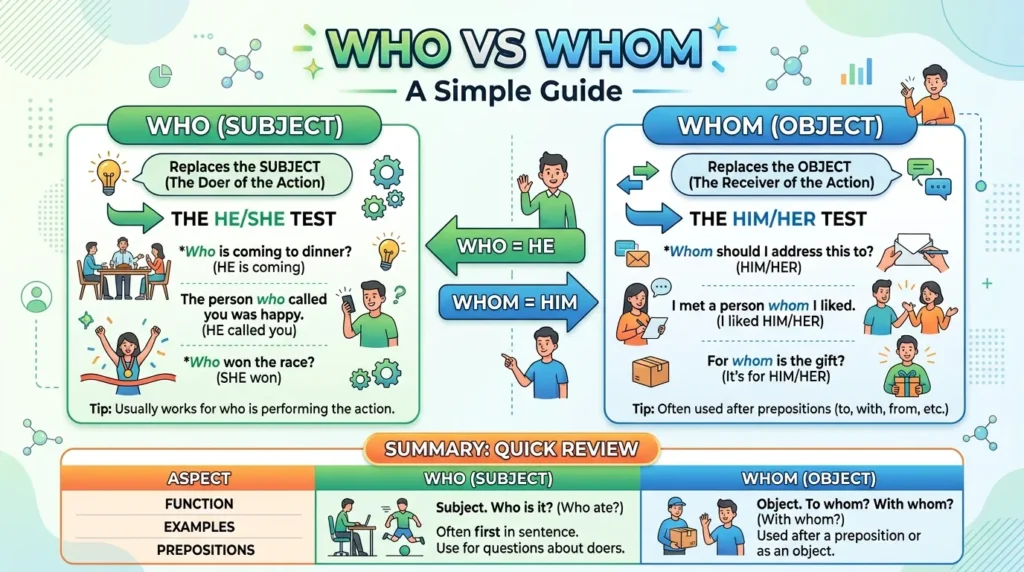
- Who is used as the subject of a sentence.
- Whom is used as the object of a verb or preposition.
Easy Trick
Replace the word with:
- He/She = Who
- Him/Her = Whom
Examples
| Correct Sentence | Why? |
|---|---|
| Who called you? | “He called.” Subject. |
| Whom did you call? | “You called him.” Object. |
| Who is at the door? | Subject of the sentence. |
| To whom should I speak? | Object after a preposition. |
| Who won the game? | Subject performing the action. |
Quick Test
Ask yourself:
Can I replace it with “he”?
- Yes → Who
Can I replace it with “him”?
- Yes → Whom
The Origin of Who vs Whom
The words who and whom come from Old English.
Long ago, English had many grammatical endings, much like modern German. Different forms of a word showed whether it was the subject or object.
Over time, English grammar became simpler. Most noun endings disappeared, but some pronouns kept different forms.
For example:
- I → Me
- He → Him
- She → Her
- Who → Whom
Today, who is far more common in everyday English. Many people rarely use whom outside formal writing.
Although whom still exists in modern grammar, its use continues to decline in casual speech.
British English vs American English Spelling
Unlike many English words, who and whom have exactly the same spelling in both British English and American English.
The difference is not spelling. It is how often people use “whom.”
American English has become more informal over time. Many Americans simply use who in places where traditional grammar recommends whom.
British English still uses whom slightly more often, especially in formal writing, newspapers, legal documents, and official communication.
Examples
American English
- Who did you invite?
- Who are you talking to?
British English (Formal)
- Whom did you invite?
- To whom are you speaking?
Comparison Table
| Feature | British English | American English |
|---|---|---|
| Spelling | Who / Whom | Who / Whom |
| Everyday speech | Mostly “who” | Mostly “who” |
| Formal writing | Uses “whom” more often | Uses “whom” less often |
| Business writing | “Whom” acceptable | Often replaced by “who” |
| Legal writing | Frequently uses “whom” | Frequently uses “whom” |
Which Spelling Should You Use?
Since the spelling never changes, your decision is really about which word fits the grammar.
If Your Audience Is American
Use who in most everyday writing.
Use whom mainly in:
- Formal reports
- Academic papers
- Legal writing
- Professional documents
If Your Audience Is British or Commonwealth
Follow standard grammar.
Use whom whenever it functions as the object.
If Your Audience Is Global
Using who is acceptable in most situations.
Use whom when writing very formal English.
Common Mistakes with Who vs Whom
Here are some of the most common errors.
| Incorrect | Correct |
|---|---|
| Whom is calling? | Who is calling? |
| Who did you meet? (Formal grammar: Whom did you meet?) | Whom did you meet? |
| Who should I send this to? (Formal: To whom should I send this?) | To whom should I send this? |
| Whom won the race? | Who won the race? |
| Give it to who? | Give it to whom? |
Common Error 1
❌ Whom wants coffee?
✅ Who wants coffee?
Common Error 2
❌ Who did you invite? (Acceptable informally, but formal grammar prefers “whom.”)
✅ Whom did you invite?
Common Error 3
❌ Whom is coming tomorrow?
✅ Who is coming tomorrow?
Common Error 4
❌ Who should receive the award? (Formal object use may require “whom” depending on sentence structure.)
✅ Whom should we honor?
Who vs Whom in Everyday Examples
Emails
Formal:
To whom it may concern,
Informal:
Who should I contact?
News
- Who won the election?
- Whom did the president appoint?
Social Media
- Who’s ready for the weekend?
- Who wants pizza?
Most people avoid whom on social media.
Business Writing
- To whom should I address the letter?
- Whom should we notify first?
Academic Writing
- Whom did the researchers interview?
- Who completed the survey?
Who vs Whom – Google Trends & Usage Data
Google search data and general language usage show clear patterns.
- Who is searched much more often than whom because it appears in everyday questions.
- Searches for “who vs whom” remain steady because learners often need grammar help.
- Interest is especially high in countries where English is taught as a second language.
Popular countries include:
- United States
- United Kingdom
- Canada
- Australia
- India
- Pakistan
- Philippines
Usage by context:
| Context | Most Common Choice |
|---|---|
| Everyday conversation | Who |
| Text messages | Who |
| Social media | Who |
| News writing | Mostly Who |
| Academic writing | Who and Whom |
| Legal writing | Whom |
| Official letters | Whom |
Who vs Whom Comparison Table
| Feature | Who | Whom |
|---|---|---|
| Grammar role | Subject | Object |
| Everyday use | Very common | Less common |
| Formal writing | Yes | Yes |
| Informal writing | Very common | Rare |
| After prepositions | Usually not | Yes |
| Easy memory trick | He/She | Him/Her |
| Examples | Who called? | Whom did you call? |
FAQs
Is “whom” still correct?
Yes. It is still grammatically correct and commonly used in formal English.
Is it okay to use “who” instead of “whom”?
Yes. In everyday conversation, many native speakers use who instead of whom.
How can I remember the difference?
Use the he/him test.
- He → Who
- Him → Whom
Is “To whom it may concern” still correct?
Yes. It remains the standard opening for formal letters.
Do schools still teach “whom”?
Yes. Many schools teach it as part of standard English grammar.
Is “whom” disappearing?
Its use has decreased in casual speech, but it remains important in formal and professional writing.
Which is more common today?
Who is much more common in everyday English.
Conclusion
Understanding who vs whom is easier than it first appears. The basic rule is simple: who acts as the subject, while whom acts as the object. If you can replace the word with he or she, choose who. If him or her fits, choose whom. This quick test solves most grammar questions in seconds.
In modern English, especially in everyday conversation and online communication, who is used far more often. Many native speakers rarely use whom unless they are writing formal emails, academic papers, legal documents, or official letters. That means using who in casual situations is perfectly natural, while whom adds a more formal tone when grammar requires it.
Whether you write for school, work, or the web, knowing the difference helps you communicate more clearly and professionally. By practicing the examples in this guide and remembering the simple he/him trick, you’ll be able to choose the correct word confidently every time.