
Have you ever paused while writing and wondered whether to use farther or further? You’re not alone. These two words are among the most commonly confused terms in English because they look similar, sound alike, and are sometimes used interchangeably. Many students, writers, professionals, and English learners search for “farther vs further” to understand the real difference and avoid common grammar mistakes.
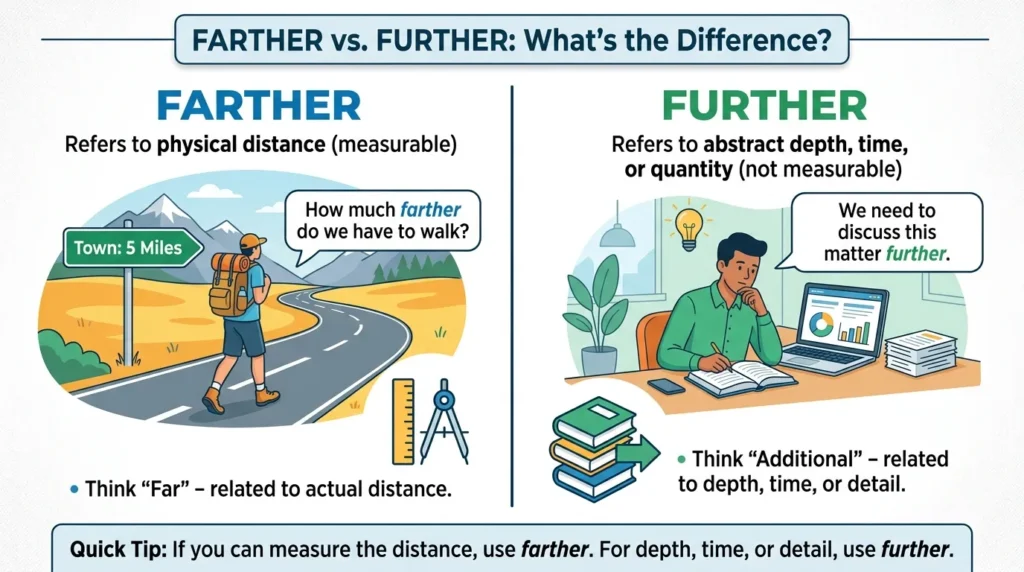
The confusion usually comes from the fact that both words relate to distance or progress. However, there is a simple rule that can help you choose the correct word in most situations. Generally, farther refers to physical distance, while further refers to figurative distance, additional information, or advancement. Although modern dictionaries accept some overlap, following this distinction makes your writing clearer and more professional.
In this guide, you’ll learn the meaning, history, spelling differences, usage rules, examples, common mistakes, and practical tips for choosing the right word every time.
Farther vs Further – Quick Answer
Quick Answer:
- Farther = Physical distance.
- Further = Figurative distance, additional information, or advancement.
Simple Examples
✅ The school is farther than the library.
✅ We need further discussion before making a decision.
✅ Can you walk farther down the road?
✅ Please contact us for further information.
Easy Rule to Remember
- Farther = Far (physical distance)
- Further = Future progress or additional information
The Origin of Farther vs Further
The words farther and further share the same historical roots.
Both developed from the Old English word “furthor,” meaning more forward or at a greater distance. Over time, English evolved and created two common forms.
- Farther became associated with measurable physical distance.
- Further gradually expanded to include ideas such as additional help, progress, continuation, or deeper discussion.
Today, many dictionaries note that the words sometimes overlap, especially in informal speech. However, most grammar guides recommend using farther for physical distance and further for figurative meanings.
British English vs American English Spelling
Unlike words such as color/colour or center/centre, farther and further are not different spellings of the same word.
Instead, they are two separate English words with different meanings.
Both British English and American English use:
- farther
- further
The difference is based on meaning, not spelling.
Comparison Table
| Usage | American English | British English |
|---|---|---|
| Physical distance | Farther | Farther (less common in some contexts) |
| Figurative meaning | Further | Further |
| Additional information | Further | Further |
| More progress | Further | Further |
Examples
American English
- She ran farther than I did.
- We need further investigation.
British English
- The village is farther away.
- Further changes are required.
Many British writers use further more often, even when discussing distance, but farther is still correct for measurable physical distance.
Which Spelling Should You Use?
Since farther and further are different words rather than spelling variations, choose the one that matches your meaning.
For American Audiences
Use:
- Farther for physical distance.
- Further for figurative ideas or additional information.
For British and Commonwealth Audiences
Use the same distinction for clear writing.
Some British publications may prefer further more broadly, but using farther for measurable distance remains widely accepted.
For a Global Audience
Following the traditional grammar rule is the safest choice.
- Physical distance → Farther
- Ideas, progress, or extra information → Further
Common Mistakes with Farther vs Further
Many writers mix these words because they sound similar.
| Incorrect | Correct |
|---|---|
| We walked further than yesterday. (physical distance) | We walked farther than yesterday. |
| For farther information… | For further information… |
| Let’s discuss this farther. | Let’s discuss this further. |
| The store is further down the road. (traditional rule) | The store is farther down the road. |
Tips
✔ Think about whether you’re talking about distance or ideas.
✔ If you can measure it in miles or kilometers, choose farther.
✔ If you cannot measure it physically, choose further.
Farther vs Further in Everyday Examples
In Emails
Please contact us for further assistance.
Our office is farther from downtown than before.
In News Articles
Scientists conducted further research into the issue.
The rescue team traveled farther into the forest.
On Social Media
I can’t walk any farther today!
Stay tuned for further updates.
In Formal Writing
The committee requested further evidence before making its decision.
The hiking trail extends farther into the mountains.
Farther vs Further – Google Trends & Usage Data
Searches for “farther vs further” remain steady because English learners and native speakers frequently confuse these words.
Countries with High Search Interest
| Country | Common Search Intent |
|---|---|
| United States | Grammar rules, writing help |
| United Kingdom | Word usage, style guides |
| Canada | English learning |
| Australia | Grammar explanations |
| India | Competitive exams and education |
Common Contexts
People search for this keyword when writing:
- School assignments
- Business emails
- Blog articles
- Academic papers
- Professional reports
- Competitive exams
The phrase is especially popular among students, teachers, content writers, and anyone who wants to improve English grammar.
Farther vs Further Comparison Table
| Feature | Farther | Further |
|---|---|---|
| Physical distance | ✅ Yes | Sometimes accepted |
| Figurative distance | ❌ No | ✅ Yes |
| Additional information | ❌ No | ✅ Yes |
| Progress or advancement | ❌ No | ✅ Yes |
| Formal writing | Physical distance | Ideas and progress |
| Easy memory trick | Far = Farther | Further = Future |
Frequently Asked Questions (FAQs)
1. What is the difference between farther and further?
Farther usually refers to physical distance, while further refers to additional information, progress, or figurative distance.
2. Can farther and further be used interchangeably?
Sometimes, especially when referring to distance. However, following the traditional distinction makes your writing clearer and more precise.
3. Which word should I use in formal writing?
Use farther for measurable physical distance and further for ideas, discussions, research, or additional details.
4. Is “further information” correct?
Yes. Further information is the correct and standard expression.
5. Is “farther information” correct?
No. The correct phrase is further information.
6. Is farther only used for physical distance?
Generally, yes. Most modern grammar guides recommend using farther only for measurable physical distance.
7. How can I remember the difference?
Remember:
- Farther = Far = Physical distance
- Further = Future = More progress or information
Conclusion
Understanding farther vs further becomes much easier once you know the basic rule. Use farther when talking about measurable physical distance, such as roads, buildings, or travel. Use further when referring to ideas, discussions, research, additional information, or progress. Although modern English sometimes allows these words to overlap, especially when discussing distance, following the traditional distinction helps make your writing clearer and more professional.
Both British and American English recognize farther and further, and the difference is based on meaning rather than spelling. Whether you’re writing an email, school assignment, business report, blog post, or social media update, choosing the correct word shows attention to detail and improves readability. A simple memory trick can help: Farther = Far (physical distance) and Further = Future (additional progress or information). By applying this guideline consistently, you’ll avoid one of the most common grammar mistakes and communicate your ideas with greater confidence and accuracy.