
A transformer is remarkably efficient — typically 98–99.5% — but on a 100 MVA unit, even 1% of loss is 1 MW of heat, enough to warm a small neighborhood. That heat comes from two sources: no-load (core) losses in the iron, which are present whenever the transformer is energized, and load (copper) losses in the windings, which grow with the square of the current. If the heat is not removed, the winding insulation ages faster, and the transformer dies young. The whole subject of transformer cooling is about moving that heat from the windings to the outside air — and the method chosen decides how much power the transformer can deliver, how much it costs, and how long it lasts.
Every liquid-immersed transformer carries a four-letter cooling code on its nameplate — ONAN, ONAF, OFAF, and their relatives — defined by IEC 60076-2 and harmonized with IEEE C57.12.00. This guide decodes those letters, explains how each cooling method works, compares their capacity and cost, and shows how to read a multi-rated nameplate. For the transformer background first, see our guides to power transformers and distribution transformers.
Why Transformers Need Cooling
Heat is the enemy of transformer life because it attacks the cellulose paper that insulates the windings. The governing limit is the hot-spot temperature — the hottest point inside the winding, usually near the top of the coil. IEC 60076-2 limits the average winding temperature rise to 65 °C above ambient and the hot-spot rise to 78 °C. With a 40 °C design ambient, that means the hot spot must stay below about 118 °C in normal service.
The reason the limit matters is the aging rule: per IEEE C57.91, the life of cellulose insulation roughly halves for every 8 °C increase in hot-spot temperature. A transformer run 8 °C hot loses half its expected life; run 16 °C hot and it loses three-quarters. Cooling is therefore not a comfort feature — it is what lets a transformer carry its rated load for its design life of 25–40 years. Upgrading the cooling class does not change the insulation or the aging rule; it changes how much load current the transformer can carry before the hot spot reaches the same design limit.
Decoding the Four-Letter Cooling Code
The IEC 60076-2 code uses four letters, read left to right: the internal cooling medium, how it circulates, the external cooling medium, and how it circulates. The first letter is O for mineral oil (or a synthetic hydrocarbon), K for a high fire-point liquid such as a natural or synthetic ester, or L for a non-flammable synthetic liquid. The second letter is N for natural circulation, F for forced circulation by pump, or D for directed flow forced through the winding ducts. The third letter is A for air or W for water, and the fourth is again N or F for natural or forced movement of that external medium.
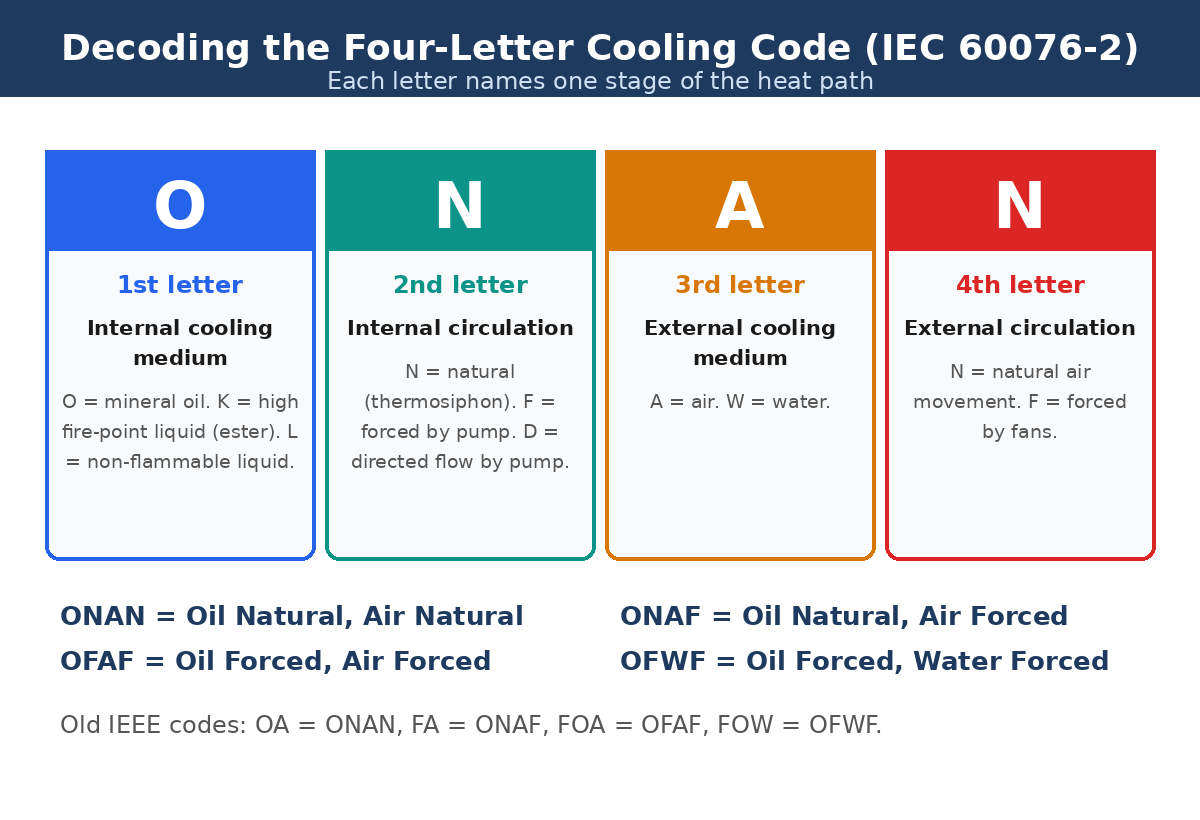
Older US nameplates use the pre-2000 IEEE letter codes, which are still common in the field: OA is ONAN, FA is ONAF, FOA is OFAF, and FOW is OFWF. If you are reading a legacy nameplate on a step-down transformer in a US substation, those are the codes you will see — and they mean exactly the same thing as the modern four-letter versions.
ONAN — Oil Natural, Air Natural
ONAN is the baseline and the most common cooling class in the world. Oil circulates inside the tank by natural thermosiphon action: oil heated by the windings becomes less dense and rises to the top of the tank, flows out through the radiators, cools as it gives up heat to the fins, becomes denser, and sinks back to the bottom of the tank. Air moves across the radiator fins by free convection, with no fans and no pumps. The whole system is driven by nothing but buoyancy and the temperature difference itself.
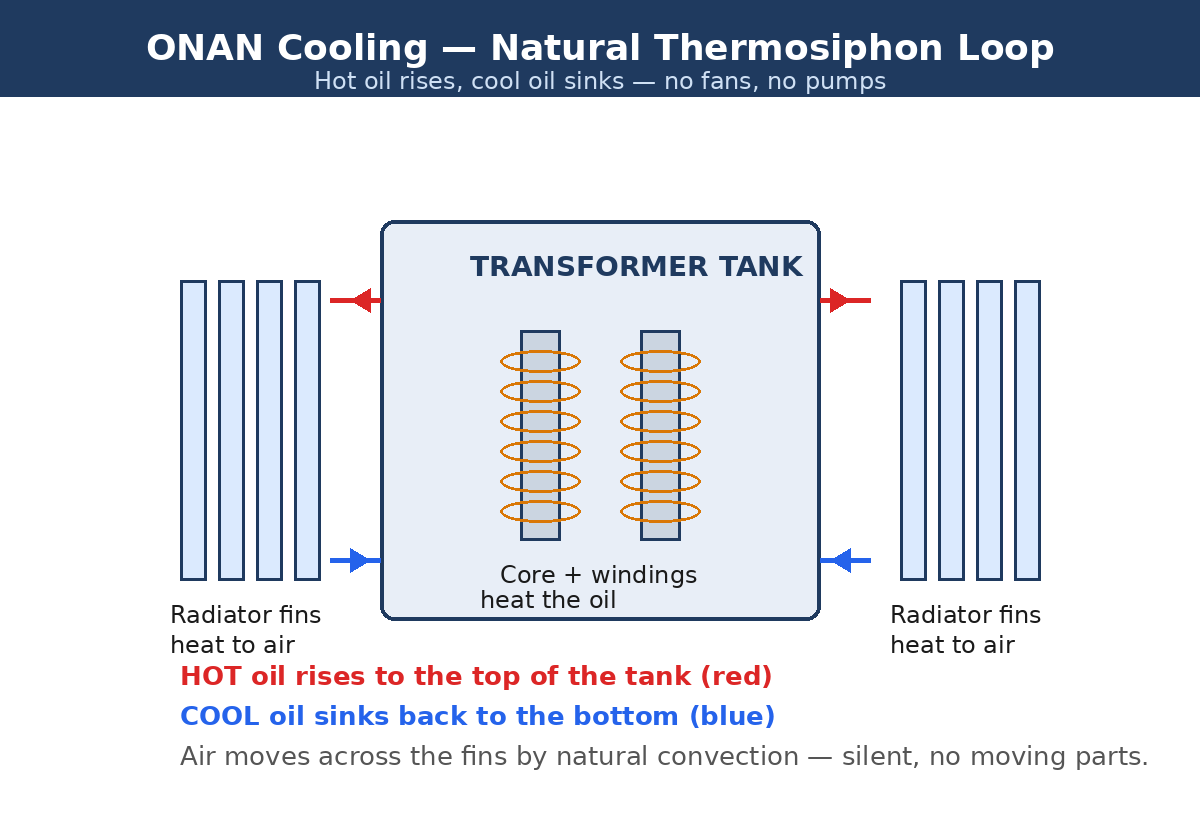
ONAN’s advantages are silence, zero cooling power consumption, and almost no maintenance — there are no fans or pumps to fail, and nothing to power. Its limits are capacity and ambient sensitivity: it is the standard choice for distribution transformers and small power transformers up to roughly 5–10 MVA, and it derates by about 1–1.5% for every 1 °C of ambient temperature above 40 °C. On a hot day in the Gulf or the American Southwest, an ONAN unit simply carries less load.
ONAF — Oil Natural, Air Forced
ONAF keeps the natural oil circulation inside the tank but adds fans that blow air across the radiators. Forcing the air roughly doubles the heat transfer from the fins, which typically buys a 25–33% capacity increase over the same transformer’s ONAN rating. The fans are staged automatically: a winding-temperature or oil-temperature controller switches them on when the load or the oil temperature rises, and off again when it falls.
This staging is what makes ONAN/ONAF dual-rated transformers so common. Under base load the unit runs silently on natural cooling, consuming no fan power; at peak load the fans cut in and the transformer carries a quarter more power without exceeding its temperature limits. The trade-offs are modest: fan power consumption, fan noise, and fan maintenance — bearings, motors, and controls that must be inspected and replaced over the transformer’s life. ONAF is the workhorse class for medium power transformers in the 5–30 MVA range, including most distribution substation units.
OFAF, ODAF and OFWF — Forced Oil and Beyond
OFAF adds oil pumps to the fans: pumps circulate the oil through the radiators at a controlled rate, and fans force air across them. Forcing the oil removes the thermosiphon bottleneck, so the windings stay cooler at high load, and the capacity rises by 50–67% over the ONAN base rating. OFAF is the standard class for large power transformers of 30 MVA and above, including grid substation and industrial units.
ODAF (Oil Directed, Air Forced) goes one step further: the pumps do not just circulate the oil around the tank, they direct it through specific cooling ducts inside the winding assembly, so cool oil reaches the hottest parts of the winding first. ODAF is used on the largest and most heavily loaded transformers, where hot-spot control matters most. OFWF (Oil Forced, Water Forced) replaces air cooling with water-cooled heat exchangers and is used where air cooling is impractical — hydroelectric plants, indoor substations, and space-limited installations. The water side needs its own cooling circuit, so OFWF is the most complex and expensive option, but it gives the highest heat-transfer rate per square meter of plant.
Dry-type transformers, which have no oil at all, use a parallel two-letter system: AN (air natural) and AF (air forced), sometimes written ANAN and ANAF in the four-letter style. They are the choice for indoor installations where oil is not permitted, and they follow the same principle — fans buy capacity — at lower ratings than oil-filled units.
Cooling Class vs Capacity: Reading a Multi-Rated Nameplate
A transformer’s nameplate frequently lists several ratings on one tank, because IEC 60076-2 explicitly allows more than one assigned power rating tied to the cooling mode. A unit marked ONAN/ONAF/OFAF 20/25/33 MVA delivers 20 MVA on natural cooling alone, 25 MVA once the fans stage on, and 33 MVA once the oil pumps also engage — roughly a 25% uplift for the fans and a 65% uplift for fans plus pumps, all from the same tank, core, and windings.
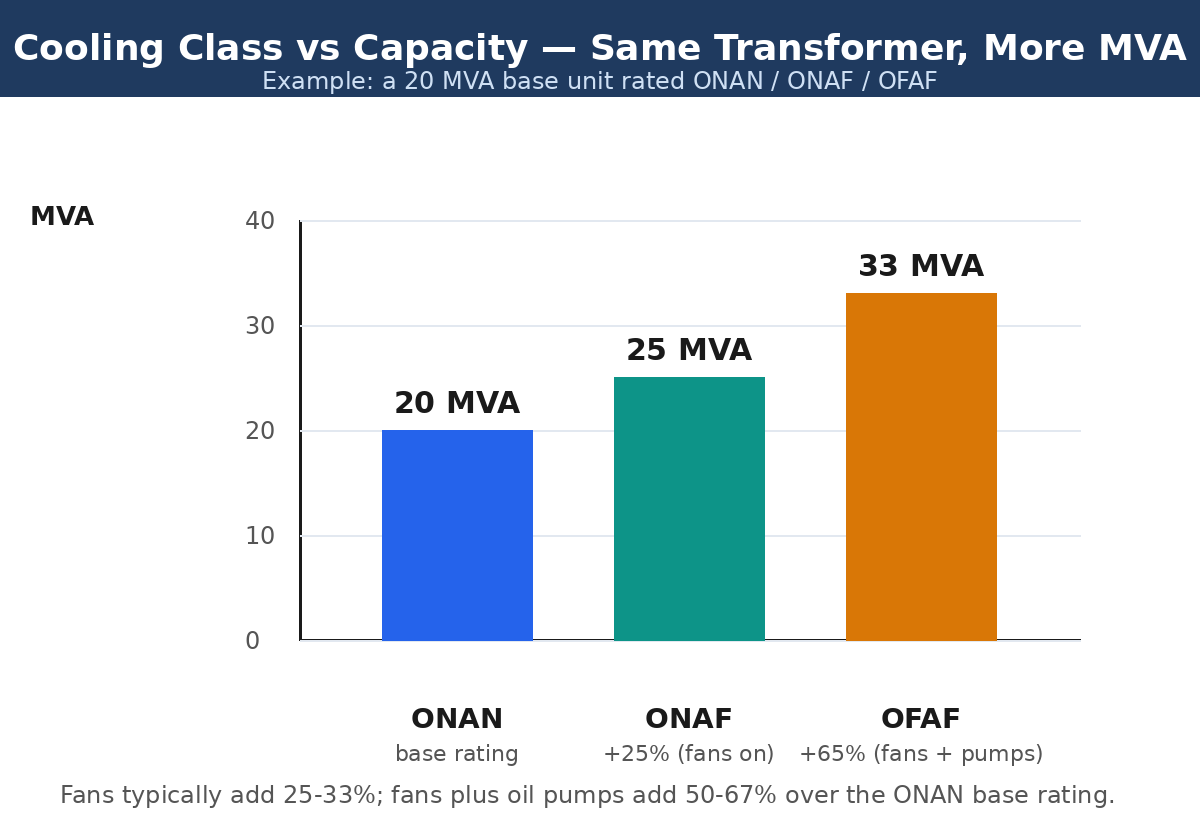
That stacking is the key to specifying cooling correctly. A utility that expects load growth can buy a 20 MVA transformer today with the fans and pumps fitted but rarely used, and grow into 33 MVA without replacing the unit. The kVA rating on the purchase order must therefore state which cooling stage it refers to — a “25 MVA transformer” that only delivers 20 MVA with its fans off is a costly misunderstanding if the fans are out of service on a peak-load day.
ONAN vs ONAF vs OFAF: Comparison
| Feature | ONAN | ONAF | OFAF |
| Oil circulation | Natural (thermosiphon) | Natural (thermosiphon) | Forced (pumps) |
| Air movement | Natural convection | Forced (fans) | Forced (fans) |
| Capacity vs ONAN base | 100% (base) | 125–133% | 150–167% |
| Moving parts | None | Fans | Fans + pumps |
| Cooling power use | Zero | Low (fans only) | Higher (fans + pumps) |
| Noise | Silent | Moderate (fans) | Higher (fans + pumps) |
| Maintenance | Minimal | Fan servicing | Fan + pump servicing |
| Typical size range | Up to ~5–10 MVA | ~5–30 MVA | ~30 MVA and above |
| Typical use | Distribution transformers | Distribution substations | Grid substations, industry |
Choosing a Cooling Method
Cooling selection is a loading, cost, and site decision, in that order. First, the load profile: a transformer that runs near its rating all day needs forced cooling, while one that peaks for a few hours can rely on staged fans. Second, the site: indoor or space-limited installations push toward OFWF or dry-type; quiet residential areas push toward ONAN; hot climates punish ONAN’s ambient derating and favor fans. Third, the economics: fans and pumps add capital cost and auxiliary power consumption, but they buy 25–67% more capacity from the same core and windings — almost always cheaper than buying a larger transformer, and far cheaper than replacing one later.
Two practical details deserve attention. The cooling auxiliaries need their own reliable power supply — a transformer whose fans depend on the same supply it feeds will lose its cooling exactly when it is most loaded, so fan and pump supplies are usually taken from a separate source or a station battery-backed circuit. And the temperature controllers that stage the fans and pumps (winding temperature indicators and oil temperature indicators) must be tested regularly: a failed fan contactor on a peak summer day is one of the most common causes of an avoidable transformer overload.
Frequently Asked Questions
What does ONAN mean on a transformer nameplate?
ONAN means Oil Natural, Air Natural. The transformer is oil-filled, the oil circulates by natural thermosiphon action without pumps, and the air moves across the radiators by natural convection without fans. It is the baseline cooling class, defined in IEC 60076-2.
How much capacity do fans add to a transformer?
Fans typically add 25–33% over the ONAN base rating (ONAF), and fans plus oil pumps add 50–67% (OFAF). A 20 MVA ONAN unit is commonly rated 20/25/33 MVA as ONAN/ONAF/OFAF — the same transformer, three ratings depending on which cooling stages are running.
What is the difference between ONAF and OFAF?
In ONAF the oil still circulates naturally and only the air is forced by fans. In OFAF the oil is also forced by pumps, which removes the thermosiphon bottleneck and cools the windings more effectively at high load. OFAF is used on larger transformers, roughly 30 MVA and above.
What happens if a transformer’s cooling fans fail?
The transformer falls back to its ONAN rating — typically 25–33% less capacity. If the load is not reduced, the winding hot-spot temperature rises and the insulation ages faster, roughly halving its remaining life for every 8 °C of extra hot-spot temperature. That is why fan and pump supplies and temperature controllers are tested regularly.
What is OFWF cooling used for?
OFWF (Oil Forced, Water Forced) uses pumps to circulate the oil through water-cooled heat exchangers instead of air-cooled radiators. It is used where air cooling is impractical — hydroelectric powerhouses, indoor substations, and space-limited plants — and it gives the highest heat-transfer rate of any standard cooling class.
Conclusion
Transformer cooling is a capacity decision disguised as a plumbing decision. ONAN is silent, free to run, and enough for distribution transformers; ONAF adds fans and buys 25–33% more capacity for substations; OFAF adds pumps and buys 50–67% for large power transformers; and OFWF trades air for water where space or location demands it. Read the four-letter code left to right — internal medium, internal circulation, external medium, external circulation — and read the nameplate’s stacked ratings the same way: each rating belongs to a cooling stage, and the transformer only delivers its top rating when every stage is running. For a fuller treatment of the cooling classes, including ester-filled KNAN/KNAF variants and the cost trade-offs at procurement, see the Transformer Cooling Classes guide on Filipino Engineer.