
Have you ever written “stationary” when you meant “stationery”? You are not alone. These two words sound almost the same, but they have completely different meanings. This makes stationary vs stationery a common spelling question for students, writers, office workers, and English learners.
The good news is that the difference is simple once you know what each word means. Stationary describes something that is not moving, while stationery refers to writing materials such as paper, envelopes, pens, and letterheads. The spelling difference is only one letter, but using the wrong word can change the meaning of a sentence.
People often search for stationary vs stationery because both words are pronounced similarly, especially in everyday speech. This article explains their meanings, origins, spelling, common mistakes, and practical uses. You will also learn an easy memory trick to remember which spelling to use.
Stationary vs Stationery – Quick Answer
The quickest way to understand stationary vs stationery is:
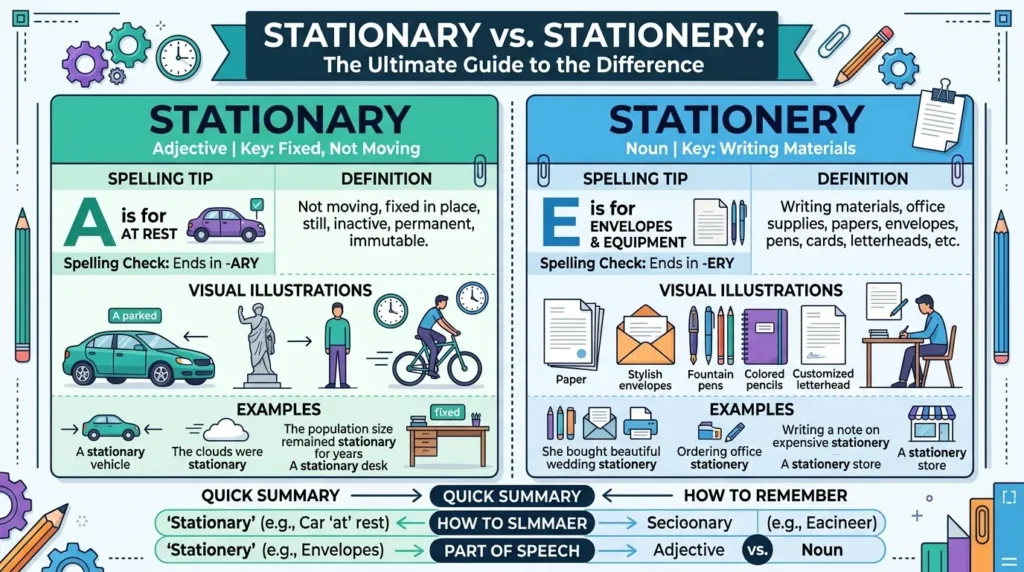
- Stationary = not moving or staying in one place.
- Stationery = writing and office materials.
Examples of Stationary
The car remained stationary at the traffic light.
The workers kept the machine stationary during testing.
The train was stationary for several minutes.
Here, stationary means something is still or not moving.
Examples of Stationery
I bought new stationery for my office.
The company uses branded stationery with its logo.
She wrote the letter on beautiful stationery.
Here, stationery means paper, envelopes, letterheads, and other writing materials.
Easy Memory Trick
Think of the E in stationery as Envelope.
StationEry → Envelope → Writing materials
Think of the A in stationary as At rest.
StationAry → At rest → Not moving
This simple trick can help you remember the difference.
The Origin of Stationary vs Stationery
The words stationary and stationery are closely related historically, which helps explain why they look and sound so similar today.
Origin of Stationary
Stationary comes from the word station, which refers to a place or position where something stands. It developed from Latin statio, meaning a standing place or position.
Over time, stationary came to describe something that remains in one position rather than moving.
For example:
The vehicle remained stationary.
The word therefore has a strong connection with standing, staying, and remaining in place.
Origin of Stationery
Stationery has a different historical development. It comes from the Middle English word stationer, which referred to a person who sold books, paper, writing materials, and other goods.
A stationer was originally a bookseller or seller of writing supplies. The term later became associated with the products sold by such people.
Eventually, stationery came to mean writing materials, including:
- Paper
- Envelopes
- Letterheads
- Notebooks
- Writing cards
This history explains why stationery is connected with writing supplies.
Why Are They So Easy to Confuse?
The words have similar pronunciation and almost identical spelling. They also share the same historical root connected with station.
However, their meanings developed in different directions:
Stationary → staying in one place
Stationery → writing materials
This is why spelling matters when using these words.
British English vs American English Spelling
Unlike some British and American spelling differences, such as colour vs color or centre vs center, there is no major spelling difference between stationary and stationery in British and American English.
Both forms are standard in:
- British English
- American English
- Canadian English
- Australian English
- New Zealand English
The important issue is meaning, not regional spelling.
| Word | British English | American English | Meaning |
|---|---|---|---|
| Stationary | Stationary | Stationary | Not moving |
| Stationery | Stationery | Stationery | Writing materials |
| Station | Station | Station | Place or position |
| Stationer | Stationer | Stationer | Seller of writing materials |
Examples in British English
The bus remained stationary.
She ordered personalized stationery.
Examples in American English
The truck was stationary.
The office ordered new stationery.
The spelling remains the same in both varieties.
Which Spelling Should You Use?
The correct spelling depends on the meaning you want to express, not the country where you write.
For US English
Use stationary when something is not moving.
Use stationery when talking about writing materials.
Example:
The car was stationary.
I need new stationery.
For UK and Commonwealth English
The same rule applies.
Example:
The aircraft remained stationary.
She purchased wedding stationery.
For Global English
If you write for an international audience, use the standard spelling based on meaning:
- Stationary = still
- Stationery = writing materials
This rule works across major English-speaking regions.
Professional Writing Tip
Always check the meaning before choosing the spelling. Do not rely only on pronunciation because the two words can sound almost identical.
Common Mistakes with Stationary vs Stationery
Because these words are homophones or near-homophones in many accents, they are often confused in writing.
Mistake 1: “Office stationary”
Incorrect:
We need new office stationary.
Correct:
We need new office stationery.
Office paper, envelopes, and letterheads are stationery.
Mistake 2: “The car was stationery”
Incorrect:
The car was stationery at the traffic light.
Correct:
The car was stationary at the traffic light.
The car was not moving, so the correct word is stationary.
Mistake 3: “Wedding stationary”
Incorrect:
She ordered wedding stationary.
Correct:
She ordered wedding stationery.
Invitations, cards, envelopes, and related paper products are stationery.
Mistake 4: “Stationary supplies”
Incorrect when referring to paper supplies:
The company ordered stationary supplies.
Correct:
The company ordered stationery supplies.
Mistake 5: “Stationery position”
Incorrect:
The object remained stationery.
Correct:
The object remained stationary.
The object is staying in one position.
Stationary vs Stationery in Everyday Examples
Understanding these words becomes easier when you see them in common situations.
In Emails
Stationery:
Please use the company’s official stationery for client letters.
Stationary:
The vehicle must remain stationary during the inspection.
In Business Writing
Stationery:
The company ordered new stationery with its logo.
Stationary:
The machine must remain stationary while the technician checks it.
In News Writing
Stationary:
The vehicle remained stationary for nearly an hour.
News reports often use stationary when describing cars, trains, aircraft, or other objects that have stopped moving.
On Social Media
Stationery:
My new stationery set has finally arrived!
Stationary:
The car stayed stationary while traffic moved around it.
In Formal Writing
Stationary:
The equipment must remain stationary during the measurement process.
Stationery:
All official documents must be printed on company stationery.
In School Writing
Stationary:
The bicycle remained stationary after the rider stopped.
Stationery:
The student bought new stationery before the school year began.
Stationary vs Stationery – Comparison Table
| Feature | Stationary | Stationery |
|---|---|---|
| Meaning | Not moving | Writing materials |
| Part of speech | Adjective | Noun |
| Common use | Objects, vehicles, machines | Paper, envelopes, cards |
| Example | The bus is stationary. | I bought stationery. |
| Memory clue | A = At rest | E = Envelope |
| US spelling | Stationary | Stationery |
| UK spelling | Stationary | Stationery |
| Pronunciation | Usually similar | Usually similar |
Quick Visual Difference
Stationary = Still
Stationery = Writing supplies
If you can replace the word with “still”, use stationary.
If you can replace it with “writing materials”, use stationery.
Stationary vs Stationery – Google Trends & Usage Data
Search interest in stationary vs stationery is mainly driven by spelling confusion rather than a difference in regional spelling. Both words are used in English-speaking countries, but stationery is especially common in searches related to offices, schools, invitations, paper products, and business supplies.
Stationary appears frequently in contexts involving:
- Vehicles
- Traffic
- Machines
- Objects
- Scientific experiments
- Physics
- Engineering
Stationery appears frequently in contexts involving:
- Office supplies
- School supplies
- Wedding invitations
- Business letterheads
- Personalized paper
- Writing products
Search patterns can change over time and may vary by country, season, and topic. For example, searches for stationery may increase around the start of school terms, while searches for stationary often relate to grammar and spelling questions.
A useful point for writers is that stationary vs stationery is a long-standing English spelling confusion across multiple English-speaking regions. The difference is therefore best understood through meaning and context rather than country-specific spelling rules.
FAQs About Stationary vs Stationery
1. What is the difference between stationary and stationery?
Stationary means something is not moving. Stationery means writing materials such as paper, envelopes, and letterheads.
2. Is office stationery or stationary correct?
Office stationery is correct when referring to paper, envelopes, pens, letterheads, and other office writing supplies.
3. Is a stationary car correct?
Yes. Stationary car is correct because the car is not moving.
4. Is stationery the same as paper?
Not exactly. Paper is one type of stationery. Stationery can also include envelopes, letterheads, cards, notebooks, and other writing materials.
5. Are stationary and stationery pronounced the same?
They are pronounced the same or very similarly in many English accents. This is one reason they are frequently confused.
6. Is stationery British or American?
Stationery is used in both British and American English. The spelling does not change based on the variety of English.
7. How can I remember the difference?
Remember:
StationEry = Envelope = Writing materials
StationAry = At rest = Not moving
This is one of the easiest ways to remember the correct spelling.
Conclusion
Understanding stationary vs stationery is simple once you focus on meaning rather than pronunciation. Stationary is an adjective that describes something that is still or not moving. For example, “The car remained stationary.” Stationery is a noun that refers to writing materials such as paper, envelopes, cards, notebooks, and letterheads. For example, “The company ordered new stationery.”
The spelling is the same in British and American English, so regional English does not change the rule. The main challenge comes from their similar pronunciation and almost identical spelling. A useful memory trick is to remember “E for Envelope” in stationery and “A for At rest” in stationary.
Whether you are writing an email, preparing a business document, creating a school assignment, or posting online, choosing the correct word makes your writing clearer and more professional. When in doubt, ask yourself: Is it still, or is it writing material? If it is still, choose stationary. If it is writing material, choose stationery.