
A single word can connect two ideas and make a sentence much clearer. Words such as and, but, or, because, although, if, and so are called conjunctions. But what is a conjunction? Many students and English learners search this question because conjunctions can be easy to recognize but harder to use correctly.
A conjunction is a word that connects words, phrases, or clauses. For example, in “I like tea and coffee,” the word and connects two words. In “I stayed home because it was raining,” because connects two parts of the sentence and explains the reason.
Understanding conjunctions helps you write smoother sentences, avoid sentence fragments, and connect ideas logically. This guide gives you a simple definition, explains the origin of the word, compares British and American English spelling, covers common mistakes, and provides everyday examples. You will also learn about the main types of conjunctions and how they work in emails, news, social media, and formal writing.
Whether you are a student, English learner, teacher, or professional writer, learning conjunctions can make your English more natural and easier to understand.
What Is a Conjunction? – Quick Answer
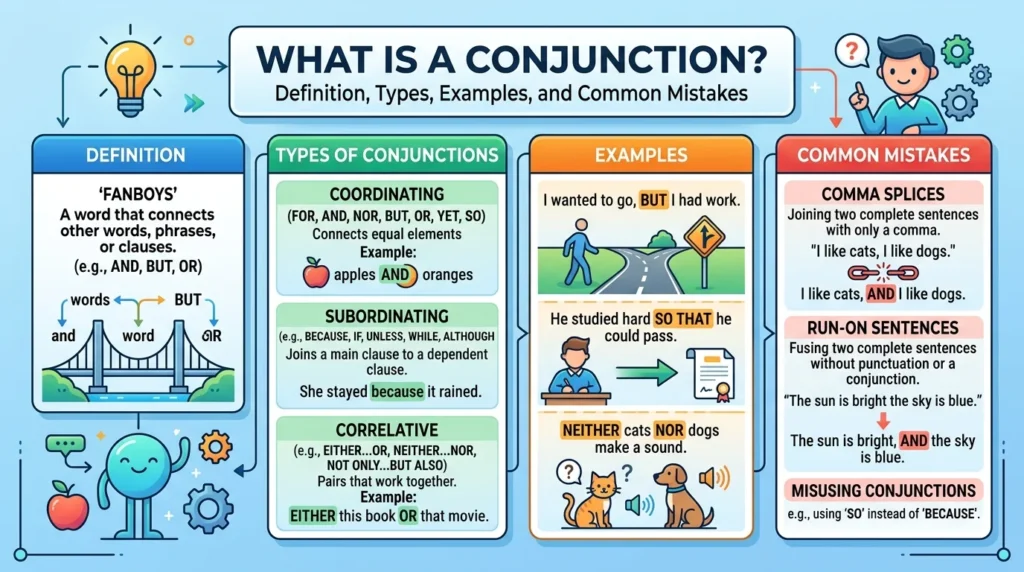
A conjunction is a word that connects words, phrases, or clauses.
Common conjunctions include:
- and
- but
- or
- so
- because
- although
- if
- when
- while
- unless
Examples
I bought apples and oranges.
She was tired, but she continued working.
You can have tea or coffee.
We stayed home because it was raining.
Although he was busy, he helped me.
In the first sentence, and connects two words. In the last two examples, because and although connect clauses.
Three Main Types of Conjunctions
There are three main types:
- Coordinating conjunctions
- Subordinating conjunctions
- Correlative conjunctions
For example, and, but, and or are coordinating conjunctions. Because, although, if, and when are subordinating conjunctions. Pairs such as either…or and neither…nor are correlative conjunctions.
The Origin of What Is a Conjunction?
The word conjunction comes from the Latin word coniunctio, meaning “joining” or “connection.” It comes from the Latin verb coniungere, meaning “to join together.”
The word entered English through Old French and was used as a grammatical term to describe words that join parts of a sentence.
The name fits its function very well. A conjunction literally helps join language elements together.
For example:
Sarah studied hard and she passed the test.
Here, and joins two ideas.
The spelling conjunction is standard in modern English. Unlike some words that have different British and American spellings, conjunction does not have a separate US or UK spelling.
British English vs American English Spelling
The word conjunction is spelled the same way in both British and American English.
| Feature | British English | American English |
|---|---|---|
| Singular | conjunction | conjunction |
| Plural | conjunctions | conjunctions |
| Adjective | conjunctive | conjunctive |
| Example | “And” is a conjunction. | “And” is a conjunction. |
| Spelling difference | None | None |
There is no standard British spelling such as conjunktion and no American alternative spelling.
Conjunction vs Conjunctions
The difference is simply singular and plural:
- Conjunction = one
- Conjunctions = more than one
Examples:
And is a conjunction.
And, but, and or are conjunctions.
Common Conjunction Words
| Conjunction | Common function | Example |
|---|---|---|
| and | Adds information | Tom and Jack came. |
| but | Shows contrast | I tried, but I failed. |
| or | Shows choice | Tea or coffee? |
| so | Shows result | It was late, so we left. |
| because | Gives a reason | I stayed home because I was sick. |
| although | Shows contrast | Although it rained, we went out. |
| if | Shows a condition | If you study, you can pass. |
| when | Shows time | Call me when you arrive. |
Which Spelling Should You Use?
There is no difficult spelling choice with conjunction. Use conjunction in British English, American English, and international English.
For US English
Use:
conjunction
This is the standard American spelling.
For UK and Commonwealth English
Use:
conjunction
The same spelling is standard in British English and commonly used across Commonwealth English.
For Global English
Use:
conjunction
If your website, schoolwork, business documents, or educational material has an international audience, conjunction is the correct spelling.
The bigger issue is not spelling. It is choosing the right conjunction for the relationship between ideas.
For example:
I was tired, but I worked.
But shows contrast.
I was tired, so I went home.
So shows a result.
Common Mistakes with What Is a Conjunction?
Conjunctions are simple words, but they can still cause grammar problems.
Mistake 1: Using “And” When You Need Contrast
Incorrect:
I was tired, and I continued working.
This sentence is possible, but if your main idea is contrast, but is clearer.
Better:
I was tired, but I continued working.
Mistake 2: Confusing “Because” and “So”
Because gives a reason:
I stayed home because I was sick.
So gives a result:
I was sick, so I stayed home.
Do not normally combine them in the same simple structure:
❌ I was sick because so I stayed home.
✅ I was sick, so I stayed home.
Mistake 3: Misusing “Although”
Although already introduces a contrast.
Incorrect:
❌ Although it was raining, but we went outside.
Correct:
✅ Although it was raining, we went outside.
Or:
✅ It was raining, but we went outside.
Using both although and but together in this structure is unnecessary.
Mistake 4: Creating a Sentence Fragment
A subordinating conjunction can introduce a dependent clause.
For example:
❌ Because I was tired.
This is incomplete if it stands alone.
Better:
✅ I went to bed because I was tired.
Or:
✅ Because I was tired, I went to bed.
Mistake 5: Confusing “Either…Or”
Correlative conjunctions usually work in pairs.
Correct:
You can either call me or send an email.
Incorrect:
❌ You can either call me.
The pair is either…or.
Other common pairs include:
- both…and
- neither…nor
- not only…but also
- whether…or
What Is a Conjunction in Everyday Examples?
Conjunctions appear in almost every type of English writing. They help people connect ideas and make sentences flow naturally.
In Emails
I wanted to attend the meeting, but I have another appointment.
Please call me when you arrive.
We can meet on Monday or Tuesday.
I am writing because I need more information.
In News
The company increased sales, but profits remained flat.
The weather improved, so the event continued.
Although the team lost, it performed well.
The project will continue if funding is approved.
In Social Media
I wanted to go, but I was too busy.
Coffee and work today!
Stay home if you are feeling sick.
We went outside because the weather was great.
In Formal Writing
The results were positive, although further research is needed.
The company reduced costs because demand declined.
The proposal can be approved if all requirements are met.
The system is simple and reliable.
Types of Conjunctions
Understanding the types makes conjunctions easier to use.
1. Coordinating Conjunctions
Coordinating conjunctions connect elements that have equal grammatical importance.
The seven common coordinating conjunctions are often remembered with FANBOYS:
- For
- And
- Nor
- But
- Or
- Yet
- So
Examples:
I wanted to go, but I was busy.
She bought bread and milk.
Hurry up, or we will be late.
2. Subordinating Conjunctions
Subordinating conjunctions connect a dependent clause to an independent clause.
Examples include:
- because
- although
- if
- unless
- while
- when
- before
- after
- since
Examples:
I stayed inside because it was cold.
If you work hard, you can succeed.
Call me when you arrive.
3. Correlative Conjunctions
Correlative conjunctions work as pairs.
Examples:
Either study or practice.
Both Ali and Ahmed attended.
Neither the manager nor the assistant was available.
She is not only intelligent but also hardworking.
Conjunction Variations Side by Side
| Keyword variation | Meaning | Example |
|---|---|---|
| conjunction | Singular form | “And” is a conjunction. |
| conjunctions | Plural form | English uses many conjunctions. |
| conjunctive | Related to joining ideas | The word has a conjunctive function. |
| coordinating conjunction | Joins equal elements | I tried, but I failed. |
| subordinating conjunction | Connects dependent and independent clauses | I left because it was late. |
| correlative conjunction | Uses a pair | Either tea or coffee. |
What Is a Conjunction? – Google Trends & Usage Data
The search phrase “what is a conjunction” has clear educational intent. People commonly search for it when they need a quick grammar definition, examples, homework help, or support with English learning.
It is an evergreen grammar keyword, rather than a topic that depends on a current event. Interest can increase during school terms, examination periods, and periods when students are studying English grammar.
Search behavior can differ by country. Countries with large populations of English learners may have strong interest in simple grammar searches. Teachers, students, parents, and ESL learners may all use related searches such as:
- what is a conjunction
- conjunction definition
- conjunction examples
- types of conjunctions
- coordinating conjunctions
- subordinating conjunctions
- conjunction exercises
- conjunctions in English
Google Trends data can change based on country, date range, search type, and comparison keyword. Therefore, it is better not to claim one fixed worldwide search-volume number without defining the exact Google Trends settings.
From an SEO perspective, the topic has strong informational intent. A useful article should answer the definition quickly, then provide examples, types, common mistakes, and practical usage.
FAQs About What Is a Conjunction?
1. What is a conjunction in simple words?
A conjunction is a word that joins words, phrases, or clauses.
Example:
I like tea and coffee.
2. What are the 7 coordinating conjunctions?
The seven coordinating conjunctions are:
for, and, nor, but, or, yet, and so.
They are commonly remembered with the word FANBOYS.
3. What are the three main types of conjunctions?
The three main types are:
- Coordinating conjunctions
- Subordinating conjunctions
- Correlative conjunctions
4. Is “because” a conjunction?
Yes. Because is a subordinating conjunction.
Example:
I stayed home because I was tired.
5. Is “and” a conjunction?
Yes. And is a coordinating conjunction.
Example:
Sarah and John went shopping.
6. Is “or” a conjunction?
Yes. Or is usually a coordinating conjunction used to show a choice or alternative.
Example:
Would you like tea or coffee?
7. Is conjunction spelled differently in British English?
No. Conjunction has the same spelling in British and American English.
Conclusion
So, what is a conjunction? A conjunction is a word that connects words, phrases, or clauses. Common examples include and, but, or, because, although, if, when, and so. These small words help us connect ideas and show relationships such as addition, contrast, choice, reason, time, condition, and result.
The three main types are coordinating, subordinating, and correlative conjunctions. Coordinating conjunctions connect equal elements, subordinating conjunctions connect dependent and independent clauses, and correlative conjunctions work in pairs such as either…or and both…and.
The word conjunction comes from Latin and relates to the idea of joining things together. Its spelling does not change between British and American English, so writers do not need to choose a different spelling for different audiences.
For clear writing, focus on meaning. Choose but for contrast, because for a reason, so for a result, and or for a choice. With regular practice, conjunctions become easy to recognize and use.