
A tiny word can change the whole meaning of a sentence. Words such as in, on, at, by, for, from, with, under, and between may be short, but they play an important role in English grammar. So, what is a preposition? This is a common question for English learners, students, writers, and anyone who wants to improve their grammar.
A preposition is a word that shows the relationship between a noun or pronoun and another part of a sentence. It can show place, time, direction, movement, connection, or method. For example, in “The book is on the table,” the word on tells us where the book is.
People often search for this term because prepositions can be confusing. Some prepositions have several meanings, and choosing the wrong one can make a sentence sound unnatural. This guide explains what a preposition is, where the word came from, how prepositions work, common mistakes, everyday examples, and useful grammar tips.
Preposition
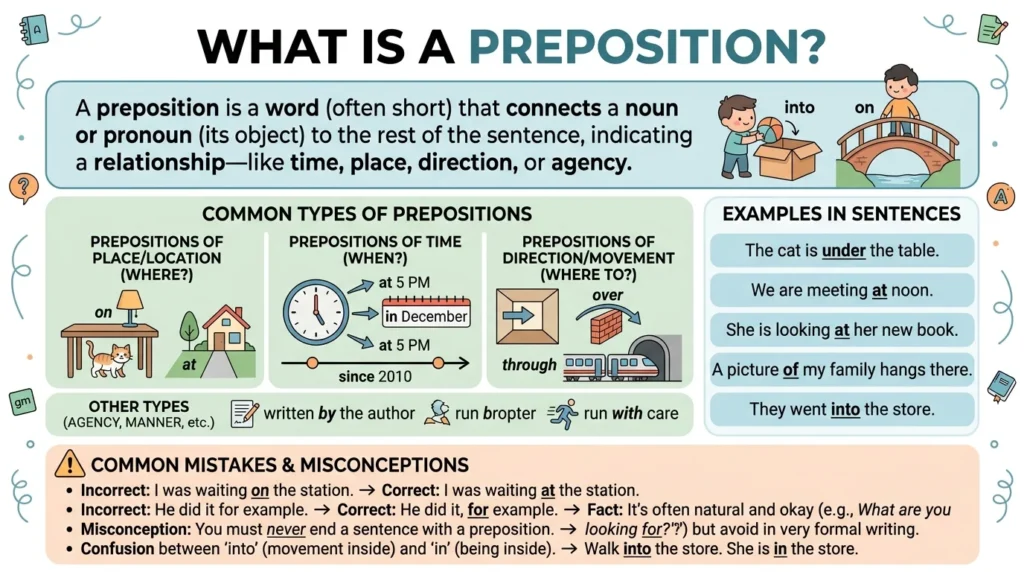
A preposition is a word that shows the relationship between a noun, pronoun, or noun phrase and another word in a sentence. Prepositions are commonly used to show place, time, direction, position, movement, or connection. Common examples include in, on, at, by, for, from, to, with, under, over, between, among, and through. For example, in the sentence “The book is on the table,” the word on is a preposition because it shows the relationship between the book and the table. Similarly, “She lives in London” uses in to show place, while “We will meet at 5 o’clock” uses at to show time.
Prepositions are usually short words, but they play an important role in making sentences clear and meaningful. They help readers and listeners understand where something is, when something happens, where someone is going, or how two things are related. For example, we say “The keys are under the sofa” to show position, “He walked through the door” to show movement, and “This gift is for you” to show a relationship or purpose. Learning prepositions becomes easier when they are studied with simple sentences and real-life examples.
What Is a Preposition? – Quick Answer
A preposition is a word that shows the relationship between a noun, pronoun, or noun phrase and another word or part of a sentence. Prepositions can show place, time, direction, movement, location, position, or other relationships.
Common Prepositions in English
Some common prepositions in English include:
- in
- on
- at
- by
- for
- from
- to
- with
- under
- over
- between
- through
- about
- after
- before
Preposition Examples
Here are 30 simple and clear preposition examples:
- The keys are on the table.
- She lives in London.
- We arrived at noon.
- He walked to school.
- The letter is from John.
- They traveled by train.
- She sat between her friends.
- The cat is under the chair.
- The picture is above the sofa.
- He stood beside his brother.
- The children are playing in the garden.
- We will meet at the station.
- She put the phone on the desk.
- He walked through the park.
- The ball rolled under the bed.
- They went into the classroom.
- The shop is near my house.
- He came from Pakistan.
- She is talking with her teacher.
- We waited for the bus.
- The bird flew over the house.
- He walked across the road.
- The car is parked behind the building.
- She arrived before the meeting.
- We went home after dinner.
- He worked during the night.
- The children ran toward the playground.
- She walked without her umbrella.
- The bank is between the school and the market.
- He placed the books inside the cupboard.
In each sentence, the bold word is the preposition. It shows the relationship between the noun, pronoun, or noun phrase and another part of the sentence. For example, in “The keys are on the table,” the word on is the preposition, while the table is the object of the preposition.
Prepositions can also form prepositional phrases. A prepositional phrase usually begins with a preposition and includes its object and any words that describe or modify the object. For example, “on the table,” “under the bed,” “between the school and the market,” and “during the night” are prepositional phrases.
Examples of Prepositional Phrases
- in the room
- under the bed
- after lunch
- with my brother
- at the station
For example, in “The children are playing in the room,” the words in the room form a prepositional phrase.
The Origin of the Word Preposition
The word preposition has a long history in grammar. It comes from the Latin word praepositio, meaning “a putting before” or “a placing in front.”
The Latin verb praeponere means “to put before.” It is formed from:
- prae = before
- ponere = to put or place
The grammatical term entered English through French and Middle English. Its name reflects the traditional position of a preposition because it is commonly placed before its object.
Example:
The cat is under the table.
Here, under comes before the table, which is its object.
However, a preposition does not always appear directly before its object in modern English. In questions and other constructions, a preposition can occur at the end of a sentence.
Example:
Who are you talking to?
This is normal and widely used English. The traditional rule that a sentence should never end with a preposition was influenced partly by attempts to apply Latin grammatical principles to English. Modern English grammar does not treat sentence-final prepositions as automatically incorrect.
Preposition Meaning
A preposition is a word used to show the relationship between a noun, pronoun, or noun phrase and another part of a sentence. It can tell us about place, time, direction, movement, position, or connection. Prepositions are usually short words, but they are very important because they make the meaning of a sentence clear.
For example, in the sentence “The book is on the table,” the word on shows the position of the book. In “She lives in London,” the word in shows the place. In “He went to school,” the word to shows direction. Other common prepositions include at, by, for, from, with, under, over, between, behind, near, and through. Understanding prepositions helps you build correct sentences and communicate more clearly in English.
British English vs American English Spelling
Unlike spelling differences such as colour/color and centre/center, the word preposition is spelled the same in British English and American English.
| Form | British English | American English |
|---|---|---|
| Singular | preposition | preposition |
| Plural | prepositions | prepositions |
| Adjective | prepositional | prepositional |
| Common abbreviation | prep. | prep. |
| Example | “In” is a preposition. | “In” is a preposition. |
There is no standard British or American spelling variation for the word preposition.
Preposition vs Prepositions
The difference between preposition and prepositions is simply grammatical number:
- preposition = one
- prepositions = more than one
Examples:
In is a preposition.
In, on, and under are prepositions.
The spelling does not change between British and American English.
Comparison of Common Preposition Terms
| Term | Meaning | Example |
|---|---|---|
| Preposition | One grammar word that shows a relationship | “On” is a preposition. |
| Prepositions | More than one preposition | “In” and “at” are prepositions. |
| Prepositional | Related to a preposition | This is a prepositional phrase. |
| Prepositional phrase | A phrase beginning with a preposition and including its object | Under the table |
Which Spelling of Preposition Should You Use?
You should use preposition in both British English and American English. There is no need to change the spelling based on your target audience.
For US English
Use:
preposition
This is the standard spelling in American English.
For UK and Commonwealth English
Use:
preposition
The same spelling is standard in British English and is also widely used across Commonwealth English.
For a Global English Audience
If your article is written for an international audience, simply use:
preposition
The word has the same standard spelling in both major varieties of English.
The main differences between British and American English may appear in other words surrounding the term, but preposition itself does not have a British-American spelling variation.
Common Mistakes with Prepositions
Prepositions are short and common words, but choosing the correct preposition can be difficult for English learners. The following common preposition mistakes show how meaning can change depending on the word used.
Mistake 1: Confusing In and On
The choice between in and on depends on the intended meaning.
❌ The picture is in the wall.
When a picture is attached to the surface of a wall, the natural choice is:
✅ The picture is on the wall.
However, when something is physically inside the wall, in is correct:
The wires are in the wall.
The correct preposition depends on the relationship being described.
Mistake 2: Confusing In and At
In is commonly used for an area, city, country, or enclosed space:
She lives in New York.
At is commonly used for a specific point, place, or location:
She is at the station.
The choice depends on whether you are describing an area or a specific location.
Mistake 3: Confusing At and On for Time
Use at for a specific clock time:
The meeting starts at 9 a.m.
Use on for days and dates:
The meeting is on Monday.
For longer periods such as months and years, in is commonly used:
The course starts in September.
She moved there in 2024.
Mistake 4: Using “To” Incorrectly
To can function as a preposition when it shows movement or direction:
I went to school.
However, to can also function as an infinitive marker before a base-form verb:
I want to learn.
In the second sentence, to is not functioning as a preposition. It introduces the infinitive to learn.
Mistake 5: Thinking a Sentence Cannot End With a Preposition
Some English learners are taught that a sentence should never end with a preposition. In modern English, this is not a general rule.
For example:
Who are you talking to?
This is natural and grammatically acceptable English.
A more formal alternative is:
To whom are you talking?
Both constructions are possible, but the first is generally more natural in everyday conversation.
Mistake 6: Using the Wrong Preposition After a Verb
Some verbs are commonly followed by particular prepositions, so changing the preposition can make a sentence sound unnatural or change its meaning.
Examples:
She is interested in science.
He is waiting for the bus.
They listened to the teacher.
Learning common verb and preposition combinations can help English learners avoid these mistakes.
What Is a Preposition in Everyday Examples?
Prepositions are an essential part of everyday English. You use prepositions in English in conversations, emails, news reports, social media posts, academic writing, and formal documents. Learning preposition examples makes it easier to understand how these words connect different parts of a sentence.
Prepositions in Emails
Prepositions are commonly used in professional and everyday emails.
I am writing about the meeting.
Please send the document to me.
We will meet at 10 a.m.
Thank you for your help.
These examples show how prepositions can express relationships involving topics, direction, time, and purpose.
Prepositions in News
News writing frequently uses prepositions to describe locations, movement, time, and relationships.
The company opened a new office in Dubai.
The team traveled to the city.
The event was held at the stadium.
The agreement was signed between the two companies.
Understanding these prepositions in sentences can help readers understand information more clearly.
Prepositions in Social Media
Prepositions are also common in short social media posts and everyday messages.
I am at the airport.
Photos from our trip are here.
Dinner with friends tonight!
Although these sentences are short, the prepositions help show location, source, and association.
Prepositions in Formal Writing
Formal and academic writing often uses prepositions to connect ideas and provide precise information.
The report was prepared for the management team.
The changes will take effect from January.
The data was collected from several sources.
These examples demonstrate how prepositions in English grammar can provide important details about purpose, starting points, and sources.
Types of Prepositions
Prepositions can be divided into different types based on the relationship they show in a sentence. The most common types include prepositions of place, time, direction, movement, position, and manner. Each type has a specific purpose and helps explain how one word or phrase is connected to another. For example, in, on, under, and behind can show place or position, while at, on, and in are commonly used to talk about time. Prepositions such as to, into, toward, across, and through can show direction or movement. Learning these types with simple examples makes English grammar easier to understand and helps you use prepositions correctly in everyday sentences.
Prepositions of Place
Prepositions of Place show where a person, animal, object, or thing is located. Common examples include in, on, at, under, behind, beside, between, near, and above.
Examples:
- The book is on the table.
- She is in the classroom.
- The car is behind the house.
- The school is near the park.
Prepositions of Time
Prepositions of Time show when something happens or how long an action continues. Common examples include at, on, in, before, after, during, since, and for.
Examples:
- The class starts at 9 a.m.
- We will meet on Monday.
- He was born in 2000.
- She studied for two hours.
Prepositions of Direction
Prepositions of Direction show the direction in which a person, object, or action moves toward a particular place or point. Common examples include to, toward, into, onto, from, and through.
Examples:
- He walked to the office.
- She moved toward the door.
- The boy ran into the room.
- They traveled from Lahore to Islamabad.
Prepositions of Movement
Prepositions of Movement describe movement from one place to another or movement along, across, around, or through a particular area. Common examples include across, through, along, around, over, past, and into.
Examples:
- We walked across the bridge.
- The train passed through the tunnel.
- They walked along the river.
- The children ran around the playground.
Prepositions for Place
Prepositions of place show where a person, object, or thing is located in relation to another thing. Common examples include in, on, under, above, between, behind, and near.
| Preposition | Main Idea | Example |
|---|---|---|
| in | inside | The keys are in the bag. |
| on | on a surface | The phone is on the desk. |
| under | below | The shoes are under the bed. |
| above | higher than | The lamp is above the table. |
| between | in the middle of two | She sat between Tom and Mary. |
| behind | at the back | The car is behind the house. |
| near | close to | The school is near my home. |
Learning these prepositions of place helps you describe the position and location of people and objects accurately.
Prepositions for Time
Prepositions of time explain when an event happens or the period during which something occurs. Common examples include at, on, in, before, after, during, since, and until.
| Preposition | Use | Example |
|---|---|---|
| at | exact time | at 8 o’clock |
| on | day or date | on Monday |
| in | month, year, or period | in July |
| before | earlier than | before lunch |
| after | later than | after work |
| during | within a period | during the meeting |
| since | starting point | since 2020 |
| until | up to a time | until Friday |
These preposition examples show how different words are used to express specific time relationships.
What Is a Preposition? – Google Trends and Usage Data
The search phrase “what is a preposition” has clear educational intent. People commonly search for a preposition definition, examples, rules, and explanations of how prepositions are used in English sentences.
This is an evergreen grammar topic because students, teachers, ESL learners, and people improving their English may need explanations of prepositions throughout the year. Search interest can vary depending on location, season, education schedules, exams, and English-learning activity.
Popular Searches Related to Prepositions
People may search for:
- what is a preposition
- preposition definition
- preposition examples
- types of prepositions
- prepositions in English
- prepositions in English grammar
- preposition exercises
- preposition rules
- prepositions of place
- prepositions of time
- examples of prepositions
- common prepositions
These related searches show different types of search intent. Some users want a simple definition, while others want examples, grammar rules, exercises, or explanations of specific types of prepositions.
Who Searches for Preposition Grammar?
This topic can be useful for several groups, including:
- School students
- English teachers
- ESL learners
- English-language learners
- Parents helping children with homework
- Writers improving grammar
- Readers looking for quick grammar explanations
Because the keyword “what is a preposition” is educational and evergreen, an article that provides a clear definition, useful examples, types, rules, and practical sentence usage can address several related search intents in one resource.
Does Google Trends Show a Fixed Search Volume?
Google Trends does not provide a universal fixed search-volume number for “what is a preposition.” Trends data depends on factors such as the selected country, time period, search type, and comparison keywords.
Therefore, it is more accurate to describe what is a preposition as an evergreen educational grammar topic rather than claim a specific worldwide search volume without a defined Google Trends comparison.
The strongest content approach is to answer the main question directly and then cover related searches such as preposition definition, types of prepositions, preposition examples, preposition rules, prepositions of place, and prepositions of time naturally throughout the article.
Preposition Variations Side by Side
| Keyword or form | Meaning | Example |
|---|---|---|
| preposition | Singular grammar term | “On” is a preposition. |
| prepositions | Plural form | English has many prepositions. |
| prepositional | Related to prepositions | This is a prepositional phrase. |
| prepositional phrase | Preposition + object | In the house |
| preposition of place | Shows location | The book is under the desk. |
| preposition of time | Shows time | We arrived at noon. |
| preposition of direction | Shows movement | She walked toward the door. |
Frequently Asked Questions About What Is a Preposition?
What Is a Preposition in Simple Words?
A preposition is a word that shows the relationship between a noun or pronoun and another part of a sentence. It can show place, time, direction, movement, location, or relationship.
Example:
The cat is under the table.
Here, under is a preposition because it shows the relationship between the cat and the table.
What Are 10 Common Prepositions?
Ten common prepositions in English are:
in, on, at, by, for, from, to, with, under, and between.
These prepositions are commonly used to describe relationships involving time, place, direction, movement, and position.
Is “To” Always a Preposition?
No. To can function as a preposition or as an infinitive marker, depending on how it is used in a sentence.
Preposition:
She went to school.
Here, to shows direction.
Infinitive marker:
She wants to study.
Here, to introduces the verb study and is not functioning as a preposition.
Can a Preposition Come at the End of a Sentence?
Yes. A preposition can come at the end of a sentence in natural English. This is especially common in questions and informal communication.
Example:
Who are you speaking to?
Ending a sentence with a preposition is not automatically grammatically incorrect.
What Is a Prepositional Phrase?
A prepositional phrase usually contains a preposition and its object. It adds information about place, time, direction, or another relationship.
Examples:
- in the room
- under the table
- after lunch
- with my friend
In the phrase under the table, under is the preposition and the table is its object.
What Are the Main Types of Prepositions?
The main types of prepositions are commonly grouped according to the relationship they express. These include prepositions of:
- Place
- Time
- Direction
- Movement
- Location
- Method
- Relationship
For example, in can show location, at can show time or place, and to can show direction.
Is “Preposition” Spelled Differently in British English?
No. Preposition has the same spelling in both British English and American English. There is no British-American spelling difference for the word preposition.
What Is a Preposition Used For?
A preposition is used to show a relationship between words in a sentence. It can explain where something is, when something happens, where something is going, or how two parts of a sentence are connected.
Example:
The book is on the table.
Here, on shows the relationship between the book and the table.
How Can I Identify a Preposition in a Sentence?
To identify a preposition, look for a word that connects a noun or pronoun with another part of the sentence and shows a relationship such as place, time, direction, or movement.
Example:
The children are playing in the garden.
Here, in is the preposition because it shows where the children are playing.
Conclusion
So, what is a preposition? A preposition is a word that helps show the relationship between a noun, pronoun, or noun phrase and another part of a sentence. Common examples include in, on, at, by, for, from, to, with, under, and between.
Prepositions can express place, time, direction, movement, and other relationships. They are small words, but they are essential for clear English. For example, changing in to on can change the meaning of a sentence completely.
The word preposition comes from Latin and means roughly “put before,” reflecting the traditional position of these words. However, English does not require every preposition to appear before its object in every sentence.
There is also no British-versus-American spelling problem here. Preposition is correct in both varieties of English. If you are writing for students, professionals, or a global audience, use the standard spelling and focus on choosing the correct preposition for the meaning you want.
Understanding common patterns is the best way to use prepositions with confidence.