
A sentence is one of the most basic parts of English, yet many learners are unsure what makes a group of words a complete sentence. Is a sentence simply a group of words? Does it need a verb? Can one word be a sentence? These questions make “what is a sentence?” a common search for students, English learners, teachers, and writers.
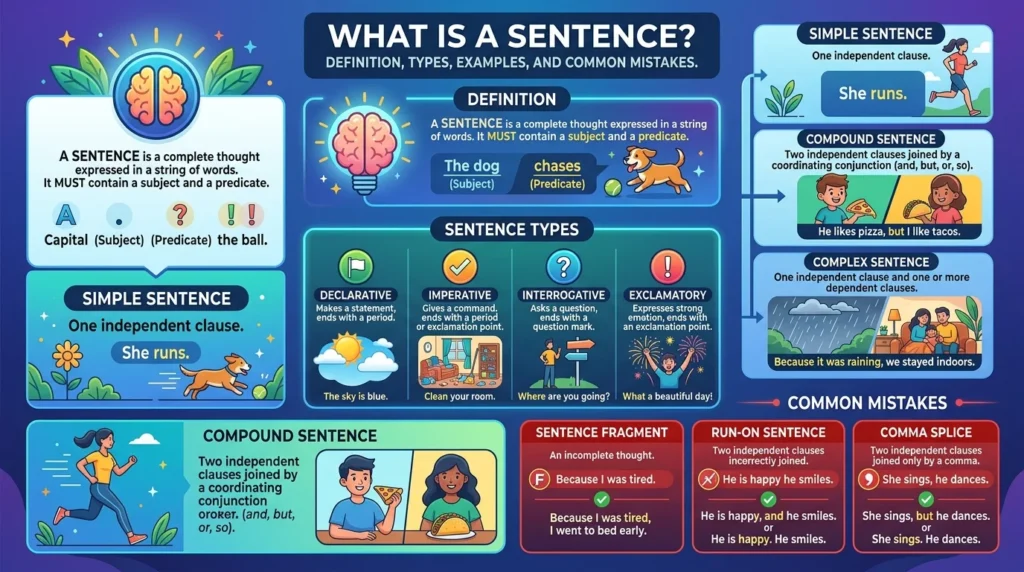
A sentence is more than a random group of words. It normally expresses a complete thought and contains a subject and a predicate, although some sentences can have an understood subject or take other forms. For example, “The boy runs.” is a complete sentence because it communicates a clear idea. “The boy” alone is usually only a phrase, not a complete sentence.
Understanding sentences is important because sentences are the foundation of communication. They help us share facts, ask questions, give commands, and express emotions. This guide explains what a sentence is, where the word comes from, the difference between British and American spelling, common mistakes, sentence types, everyday examples, and useful grammar rules.
What Is a Sentence? – Quick Answer
A sentence is a group of words that communicates a complete thought or performs a complete grammatical function.
Examples:
She works at a hospital.
The children are playing outside.
Are you ready?
Please close the door.
A sentence usually contains two main parts:
- Subject – tells us who or what the sentence is about.
- Predicate – tells us something about the subject and normally contains a verb.
Example:
The dog / is sleeping.
Here:
- The dog = subject
- is sleeping = predicate
Can One Word Be a Sentence?
Yes. Some one-word sentences are complete in context.
Examples:
Stop!
Run!
Yes.
No.
These sentences can communicate a complete message even though they do not contain a traditional subject and predicate.
Sentence vs Phrase
A sentence normally expresses a complete thought.
The cat is sleeping. ✅
A phrase does not normally express a complete thought.
Under the table ❌
A phrase can become part of a sentence:
The cat is sleeping under the table.
The Origin of What Is a Sentence?
The word sentence has a long history. It comes from the Latin word sententia, meaning “thought,” “opinion,” “judgment,” or “meaning.”
The Latin word is related to sentire, meaning “to feel” or “to perceive.”
The word entered English through Old French and developed several meanings. It eventually became strongly connected with a group of words that expresses a complete thought.
Interestingly, sentence also has another important meaning: a judgment or punishment given by a court.
For example:
The judge gave him a five-year sentence.
This is different from the grammatical meaning:
This sentence has ten words.
The spelling sentence is the same in British and American English. There is no standard US or UK spelling variation.
British English vs American English Spelling
The word sentence has the same spelling in British and American English.
| Feature | British English | American English |
|---|---|---|
| Singular | sentence | sentence |
| Plural | sentences | sentences |
| Verb | sentence | sentence |
| Example | Write a complete sentence. | Write a complete sentence. |
| Spelling difference | None | None |
Sentence vs Sentences
The difference between sentence and sentences is grammatical number.
- sentence = one
- sentences = more than one
Examples:
Write one sentence.
Write five sentences.
Common Spelling Mistakes
The correct spelling is:
✅ sentence
Common incorrect forms include:
❌ sentance
❌ sentense
❌ sentance
A useful way to remember the spelling is sen + tence, not sen + tance.
Which Spelling Should You Use?
There is no British-versus-American spelling choice for sentence.
Use:
sentence
in both varieties of English.
For US English
Use sentence in:
- school assignments
- emails
- business documents
- articles
- grammar lessons
- academic writing
For UK and Commonwealth English
Use the same spelling:
sentence
British English does not use a different spelling for this word.
For Global English
Use sentence when writing for an international audience.
The main differences between British and American English often appear in words such as colour/color, centre/center, and organise/organize. Sentence is not one of those words.
Common Mistakes with What Is a Sentence?
Understanding sentence structure can help you avoid several common writing errors.
Mistake 1: Writing a Sentence Fragment
A sentence fragment looks like a sentence but does not express a complete thought.
❌ Because I was tired.
This leaves the reader waiting for more information.
Better:
✅ I went home because I was tired.
Or:
✅ Because I was tired, I went home.
Mistake 2: Using a Phrase as a Sentence
❌ After the meeting.
This is a phrase, not normally a complete sentence.
Better:
✅ We went home after the meeting.
Mistake 3: Creating a Run-On Sentence
A run-on sentence joins two or more independent clauses incorrectly.
❌ I was tired I went to bed.
Better:
✅ I was tired, so I went to bed.
Or:
✅ I was tired. I went to bed.
Mistake 4: Missing a Verb
❌ The boy in the classroom.
The sentence needs a verb.
Better:
✅ The boy is in the classroom.
Mistake 5: Missing a Subject
❌ Went to the store yesterday.
In standard English, the subject is normally needed.
Better:
✅ I went to the store yesterday.
However, commands can have an understood subject:
Open the door.
The subject you is understood.
Mistake 6: Incorrect Capitalization
A standard sentence usually begins with a capital letter.
❌ the weather is nice today.
✅ The weather is nice today.
Mistake 7: Missing End Punctuation
Most sentences need appropriate end punctuation.
Examples:
I like coffee.
Are you ready?
What a beautiful day!
Use:
- . for a statement
- ? for a question
- ! for strong emotion or emphasis
What Is a Sentence in Everyday Examples?
Sentences are everywhere. We use them in emails, news reports, social media, conversations, books, and formal documents.
In Emails
I am writing to ask about the job opening.
Could you please send me the report?
Thank you for your help.
These sentences communicate clear messages.
In News
The company announced a new product on Monday.
The team won the match after a close game.
News sentences usually provide facts in a clear and direct way.
In Social Media
What a great day!
I finally finished my project.
Are you coming tonight?
Social media often uses short sentences because readers want information quickly.
In Formal Writing
The results show a significant increase in demand.
The company will review the policy next month.
Formal writing often uses complete and carefully structured sentences.
Types of Sentences
There are four common types of sentences based on their purpose.
1. Declarative Sentence
A declarative sentence makes a statement or gives information.
Example:
The sun rises in the east.
It normally ends with a period.
2. Interrogative Sentence
An interrogative sentence asks a question.
Examples:
Where do you live?
Are you ready?
It normally ends with a question mark.
3. Imperative Sentence
An imperative sentence gives a command, instruction, request, or advice.
Examples:
Close the door.
Please sit down.
The subject you is often understood.
4. Exclamatory Sentence
An exclamatory sentence expresses strong emotion.
Examples:
What a beautiful view!
That was amazing!
It normally ends with an exclamation mark.
Sentence Structures
Sentences can also be classified by their structure.
Simple Sentence
A simple sentence contains one independent clause.
She works hard.
Compound Sentence
A compound sentence contains two or more independent clauses joined by a conjunction.
I was tired, but I continued working.
Complex Sentence
A complex sentence contains an independent clause and at least one dependent clause.
I stayed home because it was raining.
Compound-Complex Sentence
A compound-complex sentence contains at least two independent clauses and at least one dependent clause.
I stayed home because it was raining, and my brother watched a movie.
Sentence Comparison Table
| Sentence Type | Purpose or Structure | Example |
|---|---|---|
| Declarative | Makes a statement | She likes coffee. |
| Interrogative | Asks a question | Do you like coffee? |
| Imperative | Gives a command or request | Please close the door. |
| Exclamatory | Shows strong emotion | What a great idea! |
| Simple | One independent clause | He works here. |
| Compound | Two independent clauses | He works here, and she studies here. |
| Complex | Independent + dependent clause | He left because he was tired. |
| Compound-complex | Two independent + dependent clause | He left because he was tired, and she stayed. |
What Is a Sentence? Keyword Variations Side by Side
| Keyword Variation | Meaning | Example |
|---|---|---|
| sentence | One complete grammatical unit | This is a sentence. |
| sentences | More than one sentence | Write three sentences. |
| sentence structure | How a sentence is built | Study sentence structure. |
| sentence types | Categories based on purpose | Learn the four sentence types. |
| sentence examples | Sample sentences | Read these sentence examples. |
| complete sentence | A grammatically complete sentence | She finished the work. |
| simple sentence | Sentence with one independent clause | He runs daily. |
| compound sentence | Two independent clauses | I called, and he answered. |
| complex sentence | Independent and dependent clauses | I left because it was late. |
| sentence fragment | Incomplete sentence-like group | Because I was tired. |
What Is a Sentence? – Google Trends & Usage Data
The keyword “what is a sentence” has strong educational intent. Students, teachers, parents, English learners, and beginner writers may search this phrase when learning basic grammar.
It is an evergreen educational topic because sentence structure is a basic part of English. Search interest can rise during school terms, examination periods, homework seasons, and English-learning courses.
People may also search for related terms such as:
- what is a sentence
- sentence definition
- sentence examples
- types of sentences
- sentence structure
- what makes a sentence
- complete sentence
- simple sentence
- compound sentence
- complex sentence
Search behavior can vary by country and language-learning demand. Countries with large populations of English learners may have strong interest in basic grammar searches.
Google Trends does not provide one permanent global search-volume number for “what is a sentence.” Results depend on the selected country, date range, search type, and comparison terms. Therefore, a specific worldwide search volume should not be presented without stating the exact research settings.
From an SEO perspective, the keyword has clear informational intent. A strong article should answer the definition quickly and then cover examples, sentence types, structure, mistakes, and related grammar concepts.
FAQs About What Is a Sentence?
1. What is a sentence in simple words?
A sentence is a group of words that communicates a complete thought or message.
Example:
The dog is sleeping.
2. What are the four main types of sentences?
The four common types are:
- Declarative
- Interrogative
- Imperative
- Exclamatory
3. What are the basic parts of a sentence?
A traditional sentence often contains a subject and a predicate.
Example:
John / plays football.
John is the subject, and plays football is the predicate.
4. Can one word be a sentence?
Yes. A one-word command or response can function as a complete sentence in context.
Examples:
Stop!
Yes.
No.
5. What is a sentence fragment?
A sentence fragment is a group of words that looks like a sentence but does not form a complete thought.
Example:
❌ Because I was tired.
A complete version is:
✅ I went home because I was tired.
6. What is a simple sentence?
A simple sentence contains one independent clause.
Example:
She works at a bank.
It can have more than one subject or verb and still be simple if it has only one independent clause.
7. What is the difference between a sentence and a phrase?
A sentence normally communicates a complete thought, while a phrase is a group of words that does not normally form a complete thought by itself.
Example:
The boy is running. — sentence
The boy in the park — phrase
Conclusion
So, what is a sentence? A sentence is a group of words that communicates a complete thought or performs a complete grammatical function. Most standard sentences contain a subject and a predicate, but some one-word sentences, such as “Stop!” or “Yes,” can also communicate a complete message in context.
Sentences are the foundation of English communication. They allow us to make statements, ask questions, give instructions, and express strong emotions. The four common types are declarative, interrogative, imperative, and exclamatory. Sentences can also be classified by structure as simple, compound, complex, or compound-complex.
A common mistake is to confuse a sentence with a phrase or fragment. Remember that a complete sentence should give the reader enough information to understand the intended idea. Watch for missing subjects, missing verbs, run-on sentences, poor capitalization, and missing punctuation.
There is no British or American spelling difference for sentence. The same spelling works in both varieties of English. Once you understand how sentences are built, you can write more clearly, avoid common grammar errors, and communicate your ideas with confidence.