
Have you ever stopped while writing because you were unsure whether to use principal or principle? You are not alone. These two words sound almost the same, but they have very different meanings. Because of their similar pronunciation and spelling, they are among the most commonly confused words in English.
Many students, professionals, writers, and English learners search for principal vs principle to understand which word is correct in different situations. Using the wrong one can change the meaning of a sentence and make your writing look less professional.
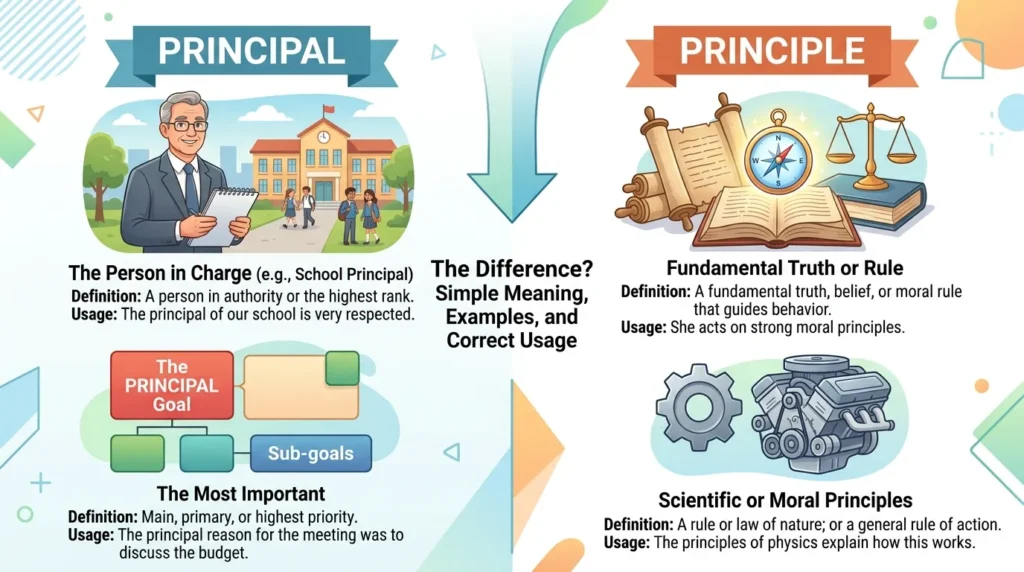
The good news is that the difference is simple once you know it. Principal usually refers to a person, the most important thing, or an amount of money. Principle refers to a rule, belief, law, or moral value.
In this guide, you’ll learn the meaning of both words, their origins, spelling differences, real-life examples, common mistakes, usage tips, FAQs, and practical advice so you can confidently choose the correct word every time.
Principal vs Principle – Quick Answer
The easiest way to remember the difference is:
- Principal = A person, the main thing, or the original amount of money.
- Principle = A rule, belief, law, or moral standard.
Quick Examples
- The principal welcomed the students to school. ✅
- Honesty is an important principle. ✅
- She paid off the principal on her loan. ✅
- He follows strong moral principles. ✅
Quick Comparison
| Word | Meaning | Example |
|---|---|---|
| Principal | Main person, most important, or original amount | The school principal gave a speech. |
| Principle | Rule, belief, law, or moral value | Fairness is an important principle. |
The Origin of Principal vs Principle
Although these words look similar, they developed different meanings over time.
Origin of Principal
The word principal comes from the Latin word principalis, meaning first, chief, or most important.
Over time, English speakers began using it to describe:
- The head of a school
- The main or primary thing
- The original amount of borrowed money
Examples:
- Principal officer
- Principal reason
- Principal balance
Origin of Principle
The word principle comes from the Latin word principium, meaning beginning, foundation, or basic rule.
Today it refers to:
- Moral values
- Scientific laws
- Basic truths
- Rules of behavior
Examples:
- Scientific principles
- Ethical principles
- Legal principles
Why Are They Confusing?
Both words:
- Sound almost identical.
- Come from related Latin roots.
- Begin with “princip-“.
However, they developed different meanings in English, which is why context matters.
British English vs American English Spelling
Unlike many English words, principal and principle are spelled exactly the same in both British English and American English.
The difference is not regional—it is based entirely on meaning.
British English Examples
- The principal addressed the assembly.
- Freedom is an important principle.
American English Examples
- The principal announced the school holiday.
- The company follows ethical principles.
Comparison Table
| Meaning | British English | American English |
|---|---|---|
| School head | Principal | Principal |
| Main or primary | Principal | Principal |
| Rule or belief | Principle | Principle |
| Moral value | Principle | Principle |
Key Point: There is no spelling difference between British and American English.
Which Spelling Should You Use?
Choosing the correct word depends on what you want to say.
For American English
Use:
- Principal for a school leader, main thing, or loan amount.
- Principle for rules, beliefs, or morals.
For British English
The same rule applies.
Use:
- Principal for people or primary importance.
- Principle for values and rules.
For International or Global English
Both spellings remain exactly the same worldwide.
Always choose based on meaning rather than country.
Easy Memory Trick
Remember:
The principal is your “pal.”
A school principal is a person—your “pal.”
A principle is a rule or belief.
Common Mistakes with Principal vs Principle
Many writers mix these words because they sound alike.
Mistake 1
❌ The school principle gave a speech.
✅ The school principal gave a speech.
Mistake 2
❌ Honesty is my strongest principal.
✅ Honesty is my strongest principle.
Mistake 3
❌ The bank reduced the principle amount.
✅ The bank reduced the principal amount.
Mistake 4
❌ She follows good principals.
✅ She follows good principles.
Mistake 5
❌ Our school principle retired.
✅ Our school principal retired.
Principal vs Principle in Everyday Examples
Understanding real-life examples makes the difference much easier.
In Emails
Principal
“Our school principal will attend tomorrow’s meeting.”
Principle
“Our company follows the principle of honesty.”
In News
Principal
“The principal announced new safety rules.”
Principle
“The new law is based on constitutional principles.”
On Social Media
Principal
“Our principal is the best!”
Principle
“Kindness is a principle everyone should follow.”
In Formal Writing
Principal
“The principal objective is to improve education.”
Principle
“The research follows established scientific principles.”
In Finance
Principal
“The borrower repaid the principal before interest.”
Principal vs Principle – Google Trends & Usage Data
Search interest for principal vs principle remains consistently high because these words are frequently confused by English learners and native speakers alike.
Popular Countries
The keyword is commonly searched in:
- United States
- United Kingdom
- Canada
- Australia
- India
- Pakistan
- Philippines
Common Search Intent
People usually search for:
- principal vs principle meaning
- principal meaning
- principle meaning
- principal or principle
- principal examples
- principle examples
- how to remember principal vs principle
Why Is It Popular?
People often confuse these words because:
- They sound the same.
- They have similar spellings.
- Both are common in schools, business, finance, and writing.
- English learners want clear examples before using them.
Principal vs Principle Comparison Table
| Feature | Principal | Principle |
|---|---|---|
| Part of Speech | Noun, Adjective | Noun |
| Main Meaning | Person, main thing, original money | Rule, belief, moral value |
| Used for School | Yes | No |
| Used for Finance | Yes | No |
| Used for Ethics | No | Yes |
| Used for Laws | No | Yes |
| Refers to a Person | Yes | No |
| Refers to an Idea | Sometimes | Yes |
| Example | The principal greeted students. | Respect is an important principle. |
Frequently Asked Questions (FAQs)
1. What is the difference between principal and principle?
Principal refers to a person, main thing, or original amount of money. Principle means a rule, belief, or moral value.
2. Is a school leader called principal or principle?
A school leader is called the principal.
3. Does principle mean a rule?
Yes. A principle is a basic rule, belief, or moral standard.
4. Which word is used in banking?
Principal is used in banking to describe the original amount of money borrowed or invested.
5. Are principal and principle pronounced the same?
Yes. They are pronounced almost exactly the same but have different meanings.
6. Is there a spelling difference in British English?
No. British English and American English use the same spellings: principal and principle.
7. How can I remember the difference?
Think:
- Principal is your pal (a person).
- Principle is a principle or rule (an idea or belief).
Conclusion
The difference between principal vs principle becomes simple once you understand their meanings. Although the words sound almost identical, they are used in completely different situations. Principal refers to a person, something of primary importance, or the original amount of money in finance. Principle, on the other hand, refers to a rule, belief, moral value, or fundamental truth. Remembering this distinction will help you avoid one of the most common English writing mistakes.
There is no spelling difference between British and American English, so your choice depends only on the meaning you want to express. A helpful memory trick is to remember that the principal is your “pal,” while a principle is a rule you live by. Whether you are writing an email, completing schoolwork, preparing business documents, or creating professional content, using the correct word improves clarity and credibility. With regular practice and the examples in this guide, choosing between principal and principle will soon become second nature.