
Have you ever wondered whether to write council or counsel? These two words sound almost the same, but they have different meanings and uses. The confusion is common because both words are used in formal English, especially in government, business, law, and professional writing.
Understanding council vs counsel is important because using the wrong word can change the meaning of your sentence. Council usually refers to a group of people who meet to discuss, advise, manage, or make decisions. For example, a city council may make local rules. Counsel, on the other hand, usually means advice or guidance. It can also refer to a lawyer, especially in legal writing.
People often search for council vs counsel because the words have similar pronunciation and related historical roots. However, their modern meanings are different. This guide explains the difference in simple English, covers their origins, compares British and American usage, highlights common mistakes, and provides practical examples.
By the end, you will know exactly when to use council and when to use counsel.
Council vs Counsel – Quick Answer
The easiest way to understand council vs counsel is:
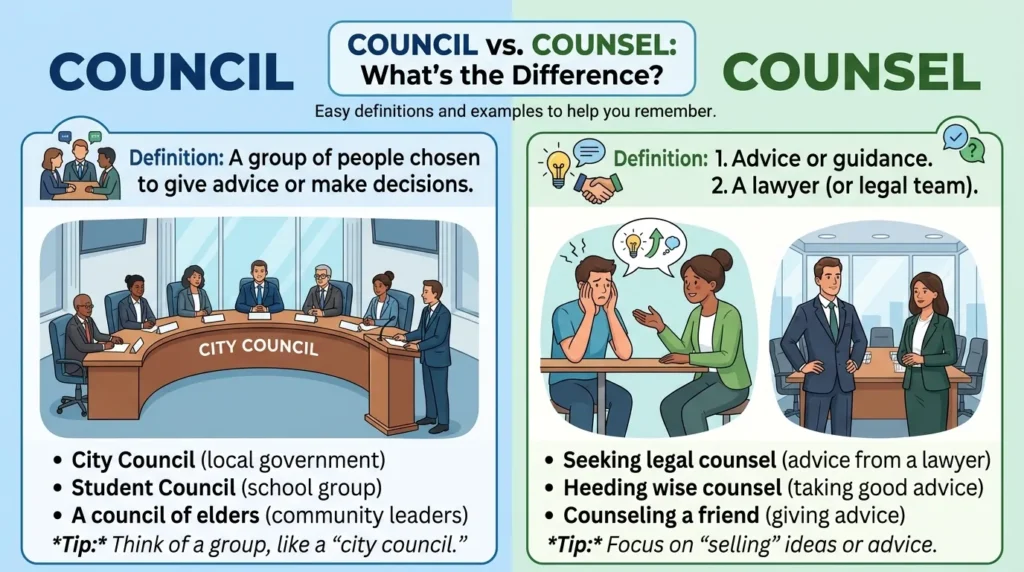
- Council = a group of people who meet to discuss or make decisions.
- Counsel = advice, guidance, or a lawyer.
Council Examples
The city council approved the new park.
The school council organized a fundraising event.
The local council discussed the road project.
In these examples, council means an organized group.
Counsel Examples
She sought legal counsel before signing the contract.
His counsel helped me make the right decision.
The lawyer served as counsel for the defendant.
Here, counsel means advice, guidance, or a lawyer.
Easy Memory Trick
Remember:
Council = Committee
Both words begin with C, and a council is a group or committee.
Counsel = Advice
Think of counselor. A counselor gives advice.
So:
Council → Group
Counsel → Advice or Lawyer
The Origin of Council vs Counsel
The words council and counsel have similar historical roots. This is one reason they look and sound so similar today.
Origin of Council
Council comes from Old French and Latin roots related to a meeting or assembly. The Latin word concilium referred to a gathering, meeting, or assembly.
Over time, the word developed into council, meaning a group of people who meet to discuss matters and make decisions.
Examples include:
- City council
- Town council
- Advisory council
- School council
- Security council
The central idea is a group meeting together.
Origin of Counsel
Counsel also comes from Latin roots connected with advice and deliberation. It developed through Old French and Middle English.
The word came to mean advice, guidance, or a recommendation.
It later developed an important legal meaning. A lawyer representing someone in court may be called counsel.
For example:
The defendant’s counsel presented the evidence.
Why Are Council and Counsel Confused?
The main reason is pronunciation. In many varieties of English, council and counsel are pronounced almost exactly the same.
However, their meanings are different:
Council → a group
Counsel → advice or lawyer
The spelling difference is therefore very important in written English.
British English vs American English Spelling
Unlike words such as colour/color or centre/center, there is no major spelling difference between council and counsel in British and American English.
Both forms are standard in:
- British English
- American English
- Canadian English
- Australian English
- New Zealand English
The difference is based on meaning, not geography.
| Word | British English | American English | Main Meaning |
|---|---|---|---|
| Council | Council | Council | Organized group |
| Counsel | Counsel | Counsel | Advice or lawyer |
| Councillor | Councillor | Councilor | Member of a council |
| Counselor | Counsellor | Counselor | Adviser or counselor |
An Important Spelling Difference
There is a regional spelling difference with councillor/councilor and counsellor/counselor.
British English commonly uses:
- Councillor
- Counsellor
American English commonly uses:
- Councilor
- Counselor
However, council and counsel themselves keep the same spelling in both varieties.
Which Spelling Should You Use?
The correct choice depends on the meaning of your sentence, not your location.
For US English
Use council when referring to an official group.
The city council passed the law.
Use counsel when referring to advice or a lawyer.
The company hired legal counsel.
For UK and Commonwealth English
The same basic rule applies.
The local council approved the plan.
She sought professional counsel.
The main difference appears in related words such as councillor and counsellor.
For Global English
If you write for an international audience, use:
Council = group or governing body
Counsel = advice or lawyer
This distinction is clear and widely understood.
Professional Writing Tip
When writing about government, schools, or organizations, check whether you mean a group or advice.
If you mean a group, use council.
If you mean advice or a lawyer, use counsel.
Common Mistakes with Council vs Counsel
Because these words sound alike, writers often use one in place of the other.
Mistake 1: “City Counsel”
Incorrect:
The city counsel approved the proposal.
Correct:
The city council approved the proposal.
A city council is a governing group.
Mistake 2: “Legal Council”
Incorrect:
He hired legal council.
Correct:
He hired legal counsel.
Here, counsel means a lawyer or legal representation.
Mistake 3: “The Council of the Lawyer”
Incorrect:
I followed my lawyer’s council.
Correct:
I followed my lawyer’s counsel.
The lawyer gave advice, so counsel is correct.
Mistake 4: “School Counsel”
Incorrect:
The school counsel voted on the new policy.
Correct:
The school council voted on the new policy.
A council is a group that discusses and makes decisions.
Mistake 5: “He Gave Me Council”
Incorrect:
My friend gave me council.
Correct:
My friend gave me counsel.
Here, the person provided advice.
Council vs Counsel in Everyday Examples
These words appear in many areas of everyday and professional English.
In Emails
Council:
The city council will meet on Monday.
Counsel:
Please consult legal counsel before signing the agreement.
In News
Council:
The city council voted to approve the new housing project.
Counsel:
The defendant’s counsel asked the court to delay the hearing.
News reports often use both words because government and legal topics frequently appear in the news.
In Social Media
Council:
Our student council is planning a new campus event.
Counsel:
Thanks for your counsel. It really helped me make a decision.
In Business Writing
Council:
The advisory council reviewed the company’s proposal.
Counsel:
The company sought legal counsel before completing the transaction.
In Formal Writing
Council:
The council approved the proposed development plan.
Counsel:
The board accepted the counsel provided by its legal adviser.
In Education
Council:
The student council organized the annual event.
Counsel:
The student received career counsel from an experienced adviser.
Council vs Counsel – Comparison Table
| Feature | Council | Counsel |
|---|---|---|
| Main meaning | Group or governing body | Advice or lawyer |
| Part of speech | Usually noun | Noun; sometimes verb |
| Common context | Government, school, organization | Law, advice, guidance |
| Example | The council met today. | She sought counsel. |
| Legal use | A legal group may have a council, depending on context | Lawyer or legal advice |
| Pronunciation | Usually similar to counsel | Usually similar to council |
| British spelling | Council | Counsel |
| American spelling | Council | Counsel |
| Memory clue | Council = Committee | Counsel = Advice |
Related Words
| Word | Meaning |
|---|---|
| Council | A group that discusses or decides matters |
| Councillor | A member of a council |
| Counsel | Advice or a lawyer |
| Counselor | A person who gives advice |
| Counsellor | British spelling of counselor |
Council vs Counsel – Google Trends & Usage Data
Search interest in council vs counsel usually comes from spelling questions, grammar searches, and professional writing. Both words are used widely in English-speaking countries, but their frequency changes depending on the context.
Council is common in searches related to:
- Local government
- City government
- Schools
- Universities
- Organizations
- Public policy
- Community groups
Counsel is common in searches related to:
- Lawyers
- Courts
- Legal advice
- Business advice
- Professional guidance
- Counseling
The word council is especially common in the UK because local councils play an important role in public administration. In the United States, city council and county council are also common terms, although local government structures vary by state.
Counsel is widely used internationally, especially in legal and professional English.
Search trends can change over time, so exact popularity depends on country, season, and search context. However, the main usage rule remains stable: council means a group, while counsel means advice or a lawyer.
FAQs About Council vs Counsel
1. What is the difference between council and counsel?
Council means a group of people who meet to discuss or make decisions. Counsel means advice, guidance, or a lawyer.
2. Is it city council or city counsel?
The correct phrase is city council because it refers to a governing group.
3. Is legal counsel correct?
Yes. Legal counsel means a lawyer or legal advice.
4. Is council a person?
Usually, council refers to a group, not one person. A member of a council is called a councillor in British English and commonly councilor in American English.
5. Can counsel be a verb?
Yes. Counsel can be used as a verb meaning to advise or give guidance.
Example:
The lawyer counseled his client.
6. Are council and counsel pronounced the same?
They are pronounced the same or very similarly in most varieties of English. This makes them common homophone errors.
7. How can I remember council vs counsel?
Use this simple rule:
Council = Committee or group
Counsel = Advice or lawyer
If you can replace the word with group, use council. If you can replace it with advice, use counsel.
Conclusion
The difference between council vs counsel is easy to understand once you focus on their meanings. Council refers to a group of people who meet to discuss, advise, or make decisions. Examples include a city council, school council, and advisory council. Counsel usually means advice or guidance, but it can also refer to a lawyer or legal representative.
Both words are spelled the same in British and American English, so geography does not determine which one you should use. The main challenge is their similar pronunciation. This makes them common mistakes in emails, essays, business documents, news reports, and legal writing.
The easiest memory trick is “Council = Committee” and “Counsel = Advice.” When you mean a group, choose council. When you mean advice or a lawyer, choose counsel. Learning this simple distinction will help you write more accurately and professionally. Whether you are a student, employee, writer, or English learner, knowing the difference can prevent a small spelling mistake from changing the meaning of your sentence.