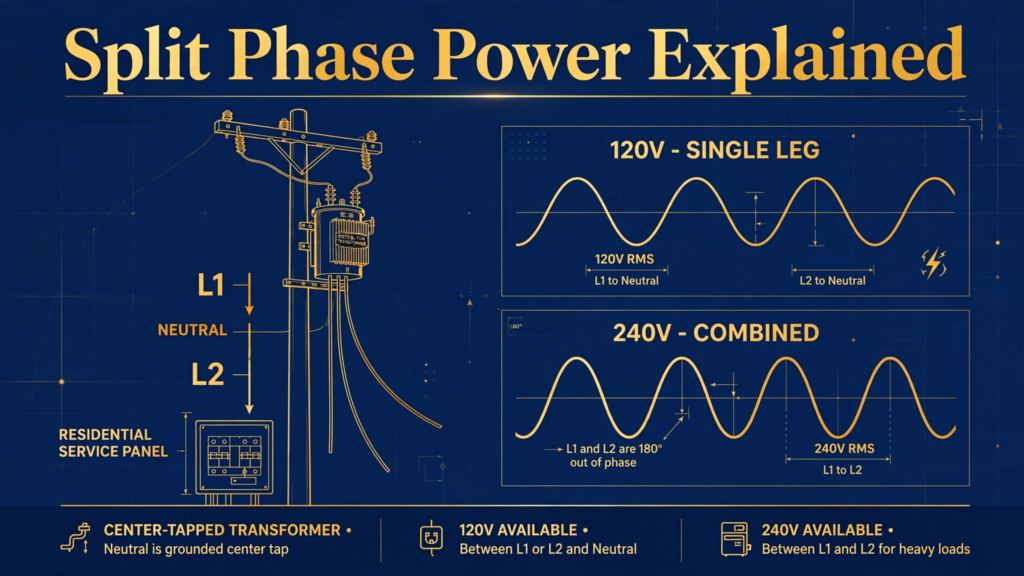

Every US home runs on a clever compromise: one electrical service that delivers both gentle 120-volt power for lamps and laptops and muscular 240-volt power for dryers and air conditioners. The system that makes this possible is called split-phase power — and despite the name, it is not two-phase power at all.
Here is how the center-tapped transformer on the pole outside your house splits one winding into two usable voltages, and why it matters for everything from your breaker panel to your EV charger.
Note: this article is about the split-phase supply system. If you are looking for the motor type, see our separate guide to what a split-phase motor is.
The Center-Tapped Transformer
It starts at the distribution transformer — the gray can on the utility pole or the green box on the pad. Its primary winding takes in high distribution voltage (typically 7.2 kV or 13.8 kV). Its secondary is a single winding with a tap connected at its exact center, and that center tap is grounded to become the neutral.
Three wires run from the transformer to your service entrance:
- L1 (hot leg) — one end of the secondary winding, 120V to neutral
- L2 (hot leg) — the other end of the winding, 120V to neutral
- Neutral — the grounded center tap, the common return path
A fourth conductor, the equipment grounding wire, bonds everything metal back to earth for safety but carries no current in normal operation. Our distribution transformer guide covers the pole-top hardware in more detail.
Why “Split Phase”? The 180-Degree Trick
The two hot legs come from opposite ends of the same winding, so relative to the neutral they are 180 degrees apart: when L1 swings positive, L2 swings negative. Measure either leg to neutral and you get 120 volts. Measure across the two legs and the voltages add: 120 + 120 = 240 volts.
Engineers call this “split phase” because one phase is split at its center — it is still single-phase power, just delivered on three wires. A true two-phase system (a historical curiosity today) would have phases 90 degrees apart and can produce a rotating magnetic field; split phase cannot, which is why your panel cannot run three-phase motors. See our single-phase vs three-phase comparison for how they differ.
What Each Voltage Powers
| Connection | Voltage | Typical Loads |
|---|---|---|
| L1 to neutral | 120V | Lighting, receptacles, small appliances, electronics |
| L2 to neutral | 120V | Lighting, receptacles, small appliances, electronics |
| L1 to L2 | 240V | Electric range, dryer, water heater, central AC, EV charger, workshop tools |
The genius of the arrangement is balance: 120-volt loads are split across both legs in the panel, so the neutral only carries the difference between them. If L1 feeds 10 amps of lights and L2 feeds 10 amps of receptacles, the neutral carries nearly zero — the currents cancel. That is why a 240-volt dryer circuit needs no neutral current at all when its heating elements draw equally from both legs.
Why Not Just 240V for Everything, Like Much of the World?
History and safety trade-offs. The US standardized early on ~110–120V for lighting when that was the practical lamp voltage, and the split-phase system grew around it: keep the familiar safer-to-touch 120V for everyday outlets while delivering 240V where power density matters. Running a 5,500-watt dryer element at 120V would need ~46 amps and fat, expensive wire; at 240V it needs ~23 amps on ordinary 10 AWG. Higher voltage for heavy loads means smaller conductors, less voltage drop, and lower losses — the same reason transmission lines run at kilovolts. For the broader AC/DC story, see AC vs DC current.
Split Phase vs. Commercial 120/208V
Do not confuse residential split phase with the 120/208V “wye” system common in commercial buildings. That system has three phases 120 degrees apart, and any two give 208V (120 × √3), not 240V. Equipment labeled 240V will run on 208V but with reduced output — a dryer that is sluggish in an apartment building is often a 208V supply story. Always check the nameplate, and our phase meaning article explains the terminology.
Service sizes
A modern US home typically has 100-amp or 200-amp split-phase service (older homes may still have 60-amp). At 240V, a 200-amp service can theoretically deliver 48,000 watts — the panel’s main breaker and the service conductors are sized to that. Adding an EV charger or heat pump can push an older 100-amp service to its limit, which is when a service upgrade enters the conversation.
FAQs
Is split-phase power the same as two-phase power?
No. Split phase is single-phase power from one center-tapped transformer winding, with the two legs 180° apart relative to neutral. True two-phase power (90° apart) is essentially obsolete. Split phase cannot produce a rotating magnetic field on its own.
Why do I measure 240V between the two hot legs?
Because the legs are opposite ends of the same winding: when one is +120V relative to the center-tapped neutral, the other is −120V, so the difference across them is 240V.
What happens if the neutral wire breaks?
This is the dangerous failure mode electricians warn about: with an open neutral, the two 120V legs are no longer anchored, and voltage divides unevenly across your loads — some outlets can see near 240V, destroying electronics and starting fires. If lights are mysteriously bright in one room and dim in another, kill the main and call the utility and an electrician immediately.
Can I get three-phase power at home?
Usually not from the utility — residential neighborhoods are served single-phase. Options include a phase converter or a variable-frequency drive for a specific three-phase motor, but the house service itself stays split phase.
Is 220V the same as 240V?
Effectively, yes in conversation. The US nominal standard is 120/240V (older references say 110/220V). Modern equipment rated “220–240V” is designed for this supply.
Conclusion
Split-phase power is the elegant reason one US service delivers two voltages: a center-tapped transformer creates two 120-volt legs 180° apart, giving 120V leg-to-neutral for everyday circuits and 240V leg-to-leg for heavy appliances, with a balanced neutral carrying only the difference. It is single-phase, three-wire power — not two-phase — and understanding it explains everything from your panel layout to why your dryer needs a double-pole breaker. For panel work or service upgrades, consult a licensed electrician and follow your locally adopted NEC edition.


