
Imagine switching on a small air compressor, washing machine, or workshop grinder. As soon as you press the power button, the motor starts rotating smoothly and powers the machine without any manual assistance. Many household and light industrial machines achieve this reliable starting performance using a Split Phase Motor. Although it may appear to be a simple electric motor, its design allows it to generate the starting torque needed to begin rotation from a single-phase power supply.
Understanding what a Split Phase Motor is is important for electrical students, engineers, technicians, and beginners because it is one of the most widely used types of single-phase induction motors. It provides a practical introduction to motor starting methods and helps build a strong foundation for learning more advanced AC motors.
In this guide, you will learn what a Split Phase Motor is, its working principle, different types, construction, applications, advantages and disadvantages, common problems, and how it compares with similar motors. By the end of this article, you will clearly understand how this motor operates and why it remains an important part of modern electrical systems.
What Is a Split Phase Motor?
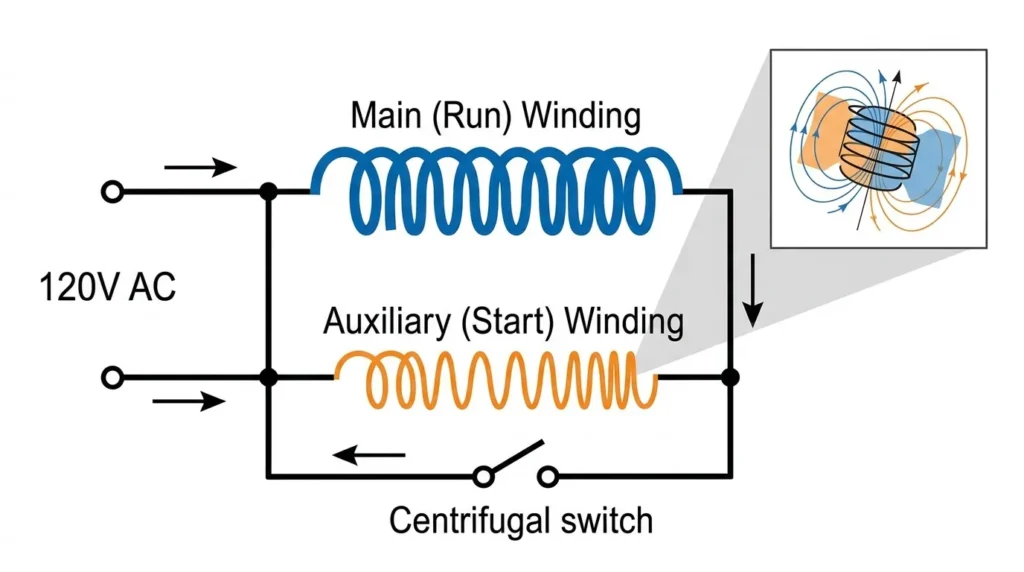
A Split Phase Motor is a single-phase induction motor that uses two separate stator windings—a main (running) winding and a starting (auxiliary) winding—to create the phase difference required for starting. This phase difference produces a rotating magnetic field that starts the motor automatically.
Once the motor reaches approximately 70% to 80% of its rated speed, a centrifugal switch disconnects the starting winding, and the motor continues running using only the main winding.
In simple words, a Split Phase Motor is an electric motor that starts by using two windings and then continues operating with only one winding.
Simple Explanation
A single-phase power supply alone cannot produce enough rotating magnetic field to start an induction motor. The Split Phase Motor solves this problem by adding an auxiliary winding with different electrical characteristics.
The slight phase difference between the currents flowing through the two windings creates the starting torque needed to rotate the rotor.
Practical Example
A bench grinder in a workshop is a common example of a Split Phase Motor application. When the power switch is turned on, the auxiliary winding helps the motor start quickly. After reaching normal speed, the centrifugal switch disconnects the starting winding, allowing the grinder to operate efficiently using only the main winding.
Other examples include small water pumps, blowers, and washing machines.
Split Phase Motor Working Principle
The Split Phase Motor working principle is based on creating a temporary phase difference between two stator windings. This phase difference generates a rotating magnetic field, producing enough starting torque to rotate the rotor.
Although the motor is supplied with single-phase AC power, the combination of the main and auxiliary windings creates conditions similar to a two-phase supply during starting.
Step 1: Single-Phase AC Supply Is Applied
When the motor is connected to a single-phase AC supply, electricity flows through both the main winding and the starting winding.
Since the two windings have different resistance and reactance values, the currents flowing through them are slightly out of phase.
Step 2: Phase Difference Is Created
The auxiliary winding has higher resistance than the main winding.
Because of this difference, the current in the starting winding reaches its peak slightly earlier than the current in the running winding.
This small phase difference creates two magnetic fields that combine to produce a rotating magnetic field.
Step 3: Starting Torque Is Produced
The rotating magnetic field interacts with the rotor conductors.
This interaction induces current in the rotor and generates electromagnetic torque, causing the rotor to begin rotating.
The starting torque of a Split Phase Motor is moderate, making it suitable for loads that do not require heavy starting torque.
Step 4: Rotor Accelerates
As the rotor gains speed, it approaches approximately 70% to 80% of its rated speed.
During this stage, both windings continue operating together to provide smooth acceleration.
Step 5: Starting Winding Disconnects
A centrifugal switch automatically opens when the motor reaches its operating speed.
This disconnects the auxiliary winding from the circuit.
Only the main winding remains energized, and the motor continues running efficiently.
Easy Analogy
Imagine pushing a bicycle.
At the beginning, you give the bicycle an extra push to help it start moving. Once it gains enough speed, you stop pushing because it continues moving on its own.
A Split Phase Motor works in a similar way:
- The starting winding provides the initial push.
- The main winding keeps the motor running after startup.
- The centrifugal switch removes the starting winding once it is no longer needed.
Key Points of the Split Phase Motor Working Principle
- Operates using a single-phase AC power supply.
- Uses both main and auxiliary windings during startup.
- Creates a temporary phase difference.
- Produces a rotating magnetic field.
- Generates moderate starting torque.
- Automatically disconnects the starting winding.
- Continues running on the main winding only.
Types of Split Phase Motor
Split Phase Motors can be classified according to their starting method and intended application. While all operate on the same basic principle, their designs are optimized for different performance requirements.
Resistance Start Split Phase Motor
The Resistance Start Split Phase Motor is the most common and traditional type.
It uses an auxiliary winding with relatively high resistance to create the phase difference required for starting. A centrifugal switch disconnects the starting winding after the motor reaches normal operating speed.
Features
- Moderate starting torque.
- Simple construction.
- Low manufacturing cost.
- Easy maintenance.
- Suitable for light starting loads.
Common Applications
- Bench grinders
- Fans
- Blowers
- Washing machines
- Small pumps
- Office equipment
Capacitor-Assisted Split Phase Motor
Some split phase motors use a capacitor in combination with the auxiliary winding to improve starting performance. The capacitor increases the phase difference between the currents in the two windings, resulting in higher starting torque.
Although these motors are closely related to capacitor-start motors, they are often considered an improved version of the basic split phase design for applications requiring better starting characteristics.
Features
- Higher starting torque.
- Improved starting efficiency.
- Reduced starting current.
- Smoother acceleration.
- Better performance under moderate loads.
Common Applications
- Air compressors
- Refrigeration equipment
- Small industrial machines
- Water pumps
- Agricultural equipment
Application-Based Classification
Split Phase Motors are also grouped according to their intended use.
Household Split Phase Motors
These motors are designed for light-duty domestic appliances.
Examples include:
- Washing machines
- Exhaust fans
- Kitchen appliances
- Small blowers
Commercial Split Phase Motors
Commercial motors operate equipment in offices, workshops, and small businesses.
Examples include:
- Air blowers
- Small compressors
- Ventilation systems
- Printing equipment
Industrial Split Phase Motors
Industrial models are used for machinery that requires reliable starting under light to moderate loads.
Examples include:
- Conveyor systems
- Machine tools
- Small production equipment
- Packaging machines
- Workshop machinery
Main Components of a Split Phase Motor
A Split Phase Motor consists of several important components that work together to convert electrical energy into mechanical motion. Each part has a specific function that ensures the motor starts smoothly, runs efficiently, and operates safely. Understanding these components helps students and technicians troubleshoot motor problems and perform proper maintenance.
Stator
The stator is the stationary part of the motor that houses both the main winding and the starting winding. It produces the magnetic field required to rotate the rotor.
Functions of the Stator
- Supports the motor windings.
- Produces the magnetic field.
- Transfers electrical energy to the rotor through electromagnetic induction.
- Provides a rigid frame for the motor.
Main (Running) Winding
The main winding, also called the running winding, remains energized throughout the motor’s operation. It produces the magnetic field required to keep the motor running after startup.
Functions of the Main Winding
- Maintains continuous motor operation.
- Produces the primary magnetic field.
- Delivers steady running performance.
- Improves overall motor efficiency.
Starting (Auxiliary) Winding
The starting winding is connected only during startup. It has a higher resistance than the main winding, creating a phase difference that generates the starting torque.
Once the motor reaches approximately 70% to 80% of its rated speed, the auxiliary winding is disconnected by the centrifugal switch.
Functions of the Starting Winding
- Creates the starting phase difference.
- Produces starting torque.
- Assists in rotor acceleration.
- Disconnects automatically after startup.
Rotor
The rotor is the rotating part of the Split Phase Motor. It is usually a squirrel cage rotor made from aluminum or copper bars joined by end rings.
The rotating magnetic field produced by the stator induces current in the rotor, causing it to rotate.
Functions of the Rotor
- Converts electrical energy into mechanical rotation.
- Drives the connected load.
- Produces output torque.
- Rotates at a speed slightly lower than synchronous speed.
Centrifugal Switch
The centrifugal switch is a mechanical switching device mounted on the motor shaft. It automatically disconnects the starting winding after the motor reaches its operating speed.
This prevents the auxiliary winding from overheating during continuous operation.
Functions of the Centrifugal Switch
- Disconnects the starting winding.
- Protects the auxiliary winding.
- Improves motor efficiency.
- Reduces unnecessary power consumption.
Motor Shaft
The motor shaft transfers the mechanical rotation produced by the rotor to the connected machine or equipment.
Functions of the Motor Shaft
- Delivers mechanical power.
- Supports the rotor.
- Connects the motor to the driven load.
- Ensures smooth rotation.
Bearings
Bearings support the rotating shaft and reduce friction between moving parts.
High-quality bearings increase motor efficiency and extend service life.
Functions of Bearings
- Reduce friction.
- Support smooth shaft rotation.
- Minimize vibration.
- Improve reliability.
Motor Frame
The motor frame protects internal components from dust, moisture, and mechanical damage.
It also helps dissipate heat generated during operation.
Functions of the Motor Frame
- Protects internal components.
- Provides structural strength.
- Supports heat dissipation.
- Improves durability.
Advantages of a Split Phase Motor
The Split Phase Motor advantages and disadvantages should be understood before selecting this motor for any application. One of its biggest strengths is its simple construction and dependable performance in light-duty applications.
Some major advantages of a Split Phase Motor include:
- Simple and reliable construction.
- Low manufacturing cost.
- Easy installation and maintenance.
- Automatic starting without manual assistance.
- Suitable for single-phase power supplies.
- Smooth and quiet operation.
- Good running efficiency after startup.
- Compact design for small spaces.
- Widely available and economical.
- Long service life with proper maintenance.
Because of these advantages, Split Phase Motors are commonly used in homes, workshops, and light industrial equipment.
Disadvantages and Limitations of a Split Phase Motor
Although Split Phase Motors are reliable and affordable, they are not suitable for every application. Their starting torque is lower than that of capacitor-start motors, making them unsuitable for heavy starting loads.
Some common Split Phase Motor disadvantages include:
- Moderate starting torque.
- Not suitable for heavy-duty machinery.
- Starting winding can overheat if the centrifugal switch fails.
- Higher starting current compared to some other motor types.
- Lower starting performance than capacitor-start motors.
- Requires periodic inspection of the centrifugal switch.
- Not recommended for frequent start-stop operations.
- Less efficient during startup than capacitor-assisted motors.
Understanding these limitations helps engineers choose the correct motor for a specific application.
Split Phase Motor Applications
The Split Phase Motor applications cover a wide range of residential, commercial, and light industrial equipment. Since these motors provide moderate starting torque and reliable operation, they are ideal for machines that start under light loads.
Residential Applications
Split Phase Motors are widely used in homes because they operate efficiently from a standard single-phase electrical supply.
Common household applications include:
- Washing machines
- Ceiling and exhaust fans
- Water pumps
- Air coolers
- Kitchen appliances
- Small air compressors
- Vacuum cleaners
Commercial Applications
Commercial buildings use Split Phase Motors in equipment that requires dependable performance with moderate starting torque.
Examples include:
- Ventilation systems
- Office air blowers
- Printing machines
- Small refrigeration equipment
- Workshop machinery
- Display equipment
Industrial Applications
Although they are not designed for heavy industrial loads, Split Phase Motors are widely used in light industrial environments.
Typical industrial applications include:
- Bench grinders
- Belt-driven machinery
- Packaging machines
- Conveyor systems
- Small drilling machines
- Polishing equipment
- Agricultural machines
Educational Applications
Educational institutions and technical laboratories frequently use Split Phase Motors for practical demonstrations.
Applications include:
- Electrical engineering laboratories
- Motor training kits
- Industrial training centers
- Technical workshops
Difference Between Split Phase Motor and Capacitor Start Motor
Many beginners confuse these two motors because both are single-phase induction motors with starting windings. However, their starting methods and performance differ significantly.
| Feature | Split Phase Motor | Capacitor Start Motor |
|---|---|---|
| Starting Method | Resistance-based auxiliary winding | Auxiliary winding with capacitor |
| Starting Torque | Moderate | High |
| Starting Current | Higher | Lower |
| Starting Performance | Good | Excellent |
| Cost | Lower | Higher |
| Efficiency | Moderate | Higher |
| Maintenance | Simple | Slightly higher |
| Best Applications | Fans, blowers, grinders | Compressors, pumps, refrigerators |
| Suitable for Heavy Loads | No | Yes |
The difference between Split Phase Motor and Capacitor Start Motor mainly lies in their starting method and the amount of starting torque they produce.
Selection Guide: How to Choose the Right Split Phase Motor
Choosing the correct Split Phase Motor improves performance, energy efficiency, and equipment reliability. Before purchasing or installing a motor, consider the following factors.
Determine the Load Requirement
Split Phase Motors are best suited for equipment that starts under light or moderate loads.
Avoid using them for machines that require high starting torque.
Check the Power Rating
Select a motor with the correct horsepower (HP) or kilowatt (kW) rating based on the equipment requirements.
An undersized motor may overheat, while an oversized motor wastes energy.
Verify the Supply Voltage
Ensure the motor voltage matches the available electrical supply.
Most Split Phase Motors are designed for standard single-phase AC voltage.
Consider the Operating Environment
Choose a motor with the appropriate enclosure for the installation location.
For dusty or humid environments, use motors with improved environmental protection.
Evaluate Duty Cycle
If the motor starts and stops frequently, consider whether another motor type, such as a capacitor-start motor, would provide better long-term performance.
Choose a Reliable Manufacturer
Always purchase motors from trusted manufacturers that comply with recognized electrical standards. A quality motor provides better efficiency, longer service life, improved safety, and easier access to replacement parts and technical support.
Common Problems & Solutions
Like all electrical machines, a Split Phase Motor may develop faults due to poor maintenance, overloading, aging components, or improper installation. Identifying these problems early helps prevent costly repairs and extends the motor’s service life.
Why Is the Split Phase Motor Not Starting?
A motor that fails to start is one of the most common issues encountered in residential and industrial applications.
Common Causes
- No electrical power supply.
- Faulty centrifugal switch.
- Damaged starting winding.
- Loose wiring connections.
- Low supply voltage.
- Seized bearings.
Solutions
- Check the incoming power supply.
- Inspect the centrifugal switch for proper operation.
- Test the starting winding using a multimeter.
- Tighten all electrical connections.
- Verify the supply voltage.
- Replace worn bearings if necessary.
Why Is the Motor Overheating?
Overheating reduces insulation life and may eventually cause motor failure.
Common Causes
- Motor overload.
- Continuous starting and stopping.
- Poor ventilation.
- Bearing friction.
- Low voltage.
- Dirty cooling vents.
Solutions
- Reduce the mechanical load.
- Clean cooling passages regularly.
- Ensure adequate airflow around the motor.
- Lubricate or replace bearings.
- Maintain the correct supply voltage.
- Avoid excessive start-stop cycles.
Why Is the Motor Producing Unusual Noise?
Abnormal noise often indicates mechanical wear or loose internal components.
Common Causes
- Worn bearings.
- Loose mounting bolts.
- Rotor rubbing against the stator.
- Shaft misalignment.
- Damaged cooling fan.
Solutions
- Replace damaged bearings.
- Tighten all mounting hardware.
- Inspect rotor alignment.
- Balance the shaft if required.
- Replace broken cooling fans.
Why Is the Motor Vibrating Excessively?
Excessive vibration decreases efficiency and shortens the motor’s lifespan.
Common Causes
- Misaligned shaft.
- Bent motor shaft.
- Loose foundation.
- Unbalanced rotor.
- Bearing wear.
Solutions
- Align the motor and driven equipment.
- Tighten the mounting base.
- Replace bent shafts.
- Balance the rotor.
- Install new bearings if worn.
Why Does the Centrifugal Switch Fail?
The centrifugal switch is essential for disconnecting the starting winding after startup.
Common Causes
- Dust accumulation.
- Mechanical wear.
- Broken contacts.
- Weak spring mechanism.
- Lack of maintenance.
Solutions
- Clean the switch mechanism.
- Replace damaged contacts.
- Inspect spring tension.
- Replace the switch if necessary.
- Perform regular preventive maintenance.
Why Is the Motor Running Slowly?
A motor operating below its normal speed often indicates electrical or mechanical problems.
Common Causes
- Low supply voltage.
- Overloaded equipment.
- Faulty winding.
- High mechanical friction.
- Bearing damage.
Solutions
- Measure the supply voltage.
- Reduce the connected load.
- Test the windings.
- Inspect bearings.
- Repair mechanical faults promptly.
Maintenance Tips for a Split Phase Motor
Regular maintenance improves efficiency, reduces unexpected failures, and extends the operating life of the motor.
Routine Maintenance Checklist
- Clean dust and dirt from the motor housing.
- Inspect electrical terminals regularly.
- Check the centrifugal switch for smooth operation.
- Lubricate bearings according to the manufacturer’s recommendations.
- Monitor motor temperature during operation.
- Listen for unusual vibration or noise.
- Check insulation resistance periodically.
- Ensure proper ventilation around the motor.
- Tighten loose mounting bolts.
- Replace damaged components immediately.
Proper preventive maintenance reduces downtime and improves long-term reliability.
Future Trends in Split Phase Motor Technology (2026)
Although modern capacitor motors and brushless motors are becoming more common, Split Phase Motors continue to evolve with improved materials, higher efficiency, and better manufacturing techniques. Future developments focus on reducing energy consumption, increasing reliability, and supporting smarter electrical systems.
High-Efficiency Motor Designs
Manufacturers are developing motors with improved magnetic materials and optimized winding designs to reduce energy losses and improve overall efficiency.
Better Insulation Materials
Advanced insulation systems can withstand higher temperatures, increasing motor life and improving operational safety.
Improved Bearing Technology
Modern sealed bearings reduce maintenance requirements, minimize friction, and provide smoother operation.
Enhanced Cooling Systems
Improved ventilation designs and advanced cooling materials help maintain lower operating temperatures, increasing efficiency and extending component life.
Smart Motor Monitoring
New monitoring systems use sensors to track:
- Temperature
- Vibration
- Current
- Voltage
- Running hours
This data allows predictive maintenance before failures occur.
Energy-Efficient Manufacturing
Manufacturers are adopting environmentally friendly production methods while improving motor efficiency to meet global energy-saving standards.
Integration with Industrial Automation
Split Phase Motors are increasingly used alongside automation systems where light-duty single-phase equipment requires reliable and economical operation.
Longer Service Life
Improved materials, precision manufacturing, and better quality control are extending the operational lifespan of modern Split Phase Motors while reducing maintenance costs.
Conclusion
The Split Phase Motor remains one of the most reliable and widely used single-phase induction motors for light- and medium-duty applications. Its simple construction, economical design, and dependable starting performance make it an excellent choice for household appliances, workshop equipment, pumps, blowers, and small industrial machines. Understanding the Split Phase Motor working principle, construction, types, Split Phase Motor applications, and Split Phase Motor advantages and disadvantages provides a strong foundation for anyone studying electrical engineering or working with AC motors. Although newer motor technologies offer higher starting torque and greater efficiency for demanding applications, the Split Phase Motor continues to be valued for its affordability, ease of maintenance, and long service life. Mastering this motor helps students and technicians better understand the operation of single-phase electrical machines and prepares them for more advanced motor technologies.