
Introduction
When your electrician asks whether you need a single phase or a three phase connection, the question can sound confusing. It matters more than you think. The answer affects your electricity bill, the machines you can run, and how smoothly your motors work.
Imagine a small apartment with fans, lights, a refrigerator, and a washing machine — easily handled by single phase. Now picture a factory running large motors, welders, and heavy compressors: jobs that demand three phase power.
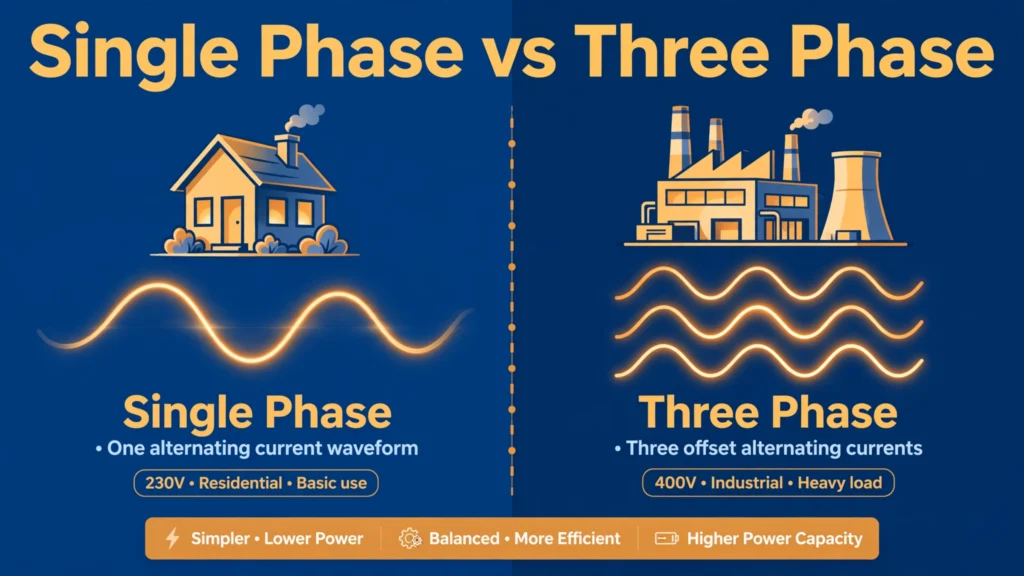
The difference comes down to how electrical energy is delivered. Single phase carries power through one alternating waveform. Three phase delivers power through three waveforms, spaced evenly apart, working together.
In this article, we explain the difference between single phase and three phase power in simple words. You will learn how each system works, their types, components, advantages, disadvantages, and applications. By the end, you will know which one suits your home or business.
What Is Single Phase vs Three Phase?
Single phase power is the simplest form of alternating current (AC) electricity. It uses two wires: one live wire (phase) and one neutral wire. The voltage rises and falls in one sine wave, reaching zero 100 or 120 times per second depending on frequency.
Most homes receive single phase at 230 volts (or 120 volts in some regions) — enough for lighting, fans, refrigerators, and small appliances like phone chargers.
Three phase power is a more powerful system used for heavy loads. It uses three live wires (sometimes plus a neutral). Each wire carries an alternating current, but the three waveforms are offset by 120 degrees. This means they never all reach zero at the same moment.
A practical example: a single phase motor shakes slightly each time the wave hits zero, like a bicycle pedaled by one leg. A three phase motor gets continuous pushes from three sides, like a bicycle with three riders pedaling in turn. The result is smoother, stronger, and more efficient power delivery.
Line-to-line voltage is typically 400 volts (or 208 volts in some regions), making three phase the default choice for factories and industrial motors.
Working Principle
The working principle of both systems rests on alternating current. In AC, the voltage direction changes back and forth many times per second. Let us look at each system step by step.
How single phase works:
- An AC generator produces one voltage waveform that goes up and down like a wave.
- The current flows through the live wire to your appliance and returns through the neutral wire.
- Twice per cycle, the voltage passes through zero, so power delivery pulses — fine for small loads, not ideal for large motors.
How three phase works:
- An AC generator has three separate coil windings, spaced 120 degrees apart around the rotor.
- As the rotor spins, it produces three voltage waveforms, each starting one third of a cycle after the previous one.
- Because of the 120-degree offset, the total power delivered stays nearly constant — when one phase is at zero, the other two carry the load.
- The three currents return through each other, so in a balanced system, very little current flows in the neutral wire.
A helpful analogy: single phase is like one person pushing a cart with rhythmic shoves, while three phase is three people pushing in steady rotation, so the cart moves without jerks. That smooth, continuous push is why three phase motors run quietly and efficiently.
Types of Single Phase vs Three Phase
Single Phase Power
Single phase power comes in a few common forms. The basic two-wire single phase system uses one live wire and one neutral. This is the standard supply for homes and small offices, delivering 230 volts (or 120 volts in some countries).
Some regions use a single phase three-wire system (also called split phase in North America). It provides two hot wires and a neutral, giving both 120 volts and 240 volts. Small appliances use the lower voltage, while heavy home appliances like electric dryers and ovens use the higher voltage.
Single phase is simple and cheap to install, but it comfortably delivers only a few kilowatts — and its pulsating power makes large motors vibrate.
Three Phase Power
Three phase comes as a three-wire system (three live wires, no neutral) for industrial use, or a four-wire system with a neutral wire that supplies both 400-volt three phase and 230-volt single phase loads.
In star, the windings meet at a common neutral point; in delta, they form a closed triangle with no neutral. Motors can be started in star and switched to delta to reduce the starting current — a common technique called star-delta starting.
Split Phase
Split phase is a special single phase arrangement common in North American homes. A center-tapped transformer creates two 120-volt supplies that are 180 degrees apart, plus a neutral. It is not true three phase, but it gives homes access to 240 volts for heavy appliances while keeping 120 volts for normal outlets.
Split phase sits between the two worlds: simpler and cheaper than three phase, but more capable than basic single phase — though it still delivers pulsating power.
Main Components
Both systems share some basic parts, but three phase needs extra conductors and protection.
- Generator or alternator: produces the AC voltage. A three phase generator has three windings instead of one.
- Transformer: steps voltage up for long-distance transmission and down for safe use. Three phase transformers handle all three phases together.
- Live (phase) conductors: one wire in single phase, three wires in three phase. These carry current to the load.
- Neutral wire: provides the return path in single phase and in unbalanced three phase four-wire systems.
- Circuit breakers and fuses: protect against overload and short circuit. Three phase uses three-pole breakers that trip all phases together.
- Energy meter: measures power consumption. Three phase meters track all three phases.
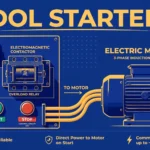
- Motor starter: used with three phase motors to control starting current and protect the motor.
In three phase installations, electricians spread single phase loads evenly across the three phases (phase balancing) so no single phase gets overloaded while others sit idle.
Advantages
Advantages of single phase:
- Simple and cheap to install, with fewer wires and basic protection devices.
- Perfect for homes and small shops where loads are light.
- Easy to understand, wire, and repair — most electricians handle it routinely.
- Lower connection and equipment costs from the utility company.
Advantages of three phase:
- Delivers about 1.73 times more power than single phase with only one extra wire, making it very efficient.
- Power delivery is nearly constant, so motors run smoothly with less vibration and noise.
- Three phase motors are smaller, lighter, and cheaper than single phase motors of the same power rating.
- Three phase motors are self-starting — they do not need extra starting capacitors or windings.
- Less copper is needed per unit of power transmitted, which lowers the cost of cables.
Disadvantages and Limitations
Disadvantages of single phase:
- Power delivery drops to zero twice per cycle, causing vibration in motors and flicker in sensitive equipment.
- Limited power capacity — struggling above a few kilowatts, making it unsuitable for heavy machinery.
- Single phase motors above 1–2 HP need starting capacitors or auxiliary windings, adding cost and failure points.
- Higher current for the same power means thicker, more expensive cables at high loads.
Disadvantages of three phase:
- Higher installation cost: more wires, three-pole breakers, and skilled labor.
- Overkill for a normal home — most household appliances cannot use three phase power directly.
- Higher voltages (400 V between phases) demand stricter safety measures and insulation.
- Unbalanced loads across phases cause neutral current, heating, and wasted energy.
Applications
Where single phase is used: homes, small offices, and shops. Lighting, ceiling fans, refrigerators, washing machines, air conditioners up to about 2 tons, televisions, computers, and phone chargers all run on single phase. Small workshops with light tools like drills also use it.
Where three phase is used: factories, manufacturing plants, and large commercial buildings. Three phase induction motors drive pumps, compressors, conveyor belts, lathes, and milling machines. Large HVAC systems, elevators, and escalators run on three phase. Agricultural tube wells and irrigation pumps commonly use three phase motors.
Modern and growing uses: electric vehicle fast chargers often need three phase supply for high power. Data centers use three phase distribution for efficiency, and solar plants generate three phase AC through their inverters. Some large homes with multiple air conditioners or a home workshop now request three phase to handle the total load comfortably.
Single Phase vs Three Phase Comparison
| Feature | Single Phase | Three Phase |
|---|---|---|
| Number of live wires | 1 | 3 |
| Typical voltage | 230 V (line to neutral) | 400 V (line to line) |
| Power delivery | Pulsating, drops to zero twice per cycle | Nearly constant, smooth |
| Power capacity | Low, up to a few kW | High, from a few kW to megawatts |
| Efficiency | Lower for motor loads | Higher, less copper per kW |
| Motor starting | Needs capacitor or auxiliary winding | Self-starting |
| Installation cost | Low | Higher |
| Best suited for | Homes, small offices, light loads | Industry, large buildings, heavy motors |
| Waveform count | One sine wave | Three sine waves, 120° apart |
How to Choose the Right Single Phase vs Three Phase
Choosing between the two depends on your load, budget, and future plans. Follow these beginner-friendly tips.
- Add up your load: list all appliances and machines with their watt ratings. If the total stays under 5–7 kW and includes no large motors, single phase is enough.
- Check your motors: any motor above 3–5 HP almost always needs three phase. Running a large motor on single phase causes overheating and poor performance.
- Think about growth: if you plan to add heavy machines, a workshop, or EV charging later, getting a three phase connection now is cheaper than upgrading later.
- Ask your electrician: they can check what supply is available on your street and whether your wiring supports an upgrade.
- Balance the phases: with three phase, distribute single phase loads (lights, sockets) evenly across all three phases to avoid overloading one of them.
Rule of thumb: homes and small shops stay with single phase; factories and large farms go with three phase.
Common Problems and Solutions
Q1: Can I run a three phase motor on a single phase supply?
Yes, but with limits. A variable frequency drive (VFD) can convert single phase input to three phase output for small motors. Capacitor-based tricks exist but reduce power and efficiency. For full performance, a real three phase supply is best.
Q2: Why does my three phase motor overheat?
Common causes are unbalanced phase voltages, a loose connection on one phase (single phasing), or overloading. Check all three line voltages with a multimeter — they should be nearly equal. Tighten connections and reduce the load if needed.
Q3: One phase of my three phase supply keeps tripping. What should I do?
This usually means the load is unbalanced — too many appliances connected to one phase. Redistribute circuits across the three phases. If the problem continues, call an electrician to inspect for a faulty breaker or damaged cable.
Q4: Is three phase supply more dangerous than single phase?
The line-to-line voltage (400 V) is higher than single phase (230 V), so the shock hazard between phases is greater. With proper insulation, earthing, and qualified installation, it is just as safe. Never work on it without training.
Q5: Can a home have both single and three phase?
Yes. A three phase four-wire connection gives you three phase for heavy machines plus 230 V single phase (any phase to neutral) for normal home circuits. This is common in large homes and small commercial buildings.
Q6: Why do my lights flicker on single phase?
Light flicker can come from loose connections, an overloaded circuit, or voltage drops when a large appliance starts. Tighten terminals and have the supply voltage checked.
Future Trends
The world is moving toward smarter and more flexible power systems. Variable frequency drives are becoming cheaper, letting even small users get three phase-like motor control from a single phase supply. Smart meters now monitor each phase separately, helping utilities and users spot imbalance early.
Renewable energy is changing the picture too. Rooftop solar inverters increasingly support three phase output for homes with high consumption. Electric vehicle chargers, heat pumps, and battery storage all favor three phase connections for faster, more efficient operation.
In industry, the trend is toward higher efficiency motors and digital monitoring of all three phases.
Conclusion
Single phase and three phase are two ways of delivering AC power, each suited to different jobs. Single phase is simple, cheap, and perfect for homes, offices, and light loads. Three phase delivers the smooth, efficient, high-capacity power that factories, large buildings, and heavy motors depend on every day.
The key difference is continuity: single phase pulses, three phase flows steadily. That steady flow makes motors smaller, quieter, and more efficient. Remember that a three phase four-wire supply can also feed ordinary single phase circuits, so larger homes and small businesses can enjoy the best of both. Choose based on your real load today and your plans for tomorrow, and consult a qualified electrician before upgrading — the right choice saves money, protects equipment, and keeps your power running smoothly.