
Imagine you are charging your mobile phone at home. You plug the charger into the wall socket, and your phone starts charging. Inside this simple action, two types of electricity are working together: AC and DC current. The electricity coming from your wall socket is AC, but your phone battery needs DC. The charger converts AC into DC for safe charging.
Many electrical students, technicians, and beginners use electrical systems every day but do not fully understand the difference between AC and DC current. This lack of knowledge can lead to wrong equipment selection, safety risks, and poor system performance.
Understanding “AC vs DC Current – Complete Comparison” is very important for anyone working in electrical and electronic fields. In this article, you will learn the basic definition, working principle, types, components, advantages, disadvantages, and applications of AC and DC. You will also see a detailed comparison, selection guide, common problems, and future trends. By the end, you will have clear and practical knowledge to use in real-life work.
2. What is AC vs DC Current?
Definition
AC vs DC current refers to the comparison between Alternating Current (AC) and Direct Current (DC), which are the two main types of electrical current.
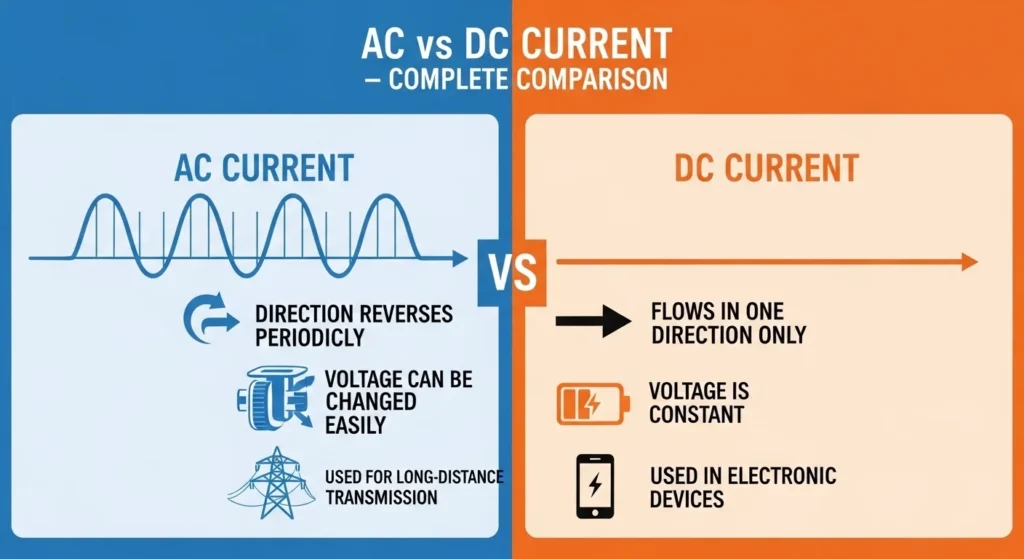
- AC changes its direction again and again.
- DC flows in only one direction.
Simple Explanation
AC is like water that flows forward and backward in a pipe.
DC is like water that flows in only one direction.
In electrical systems, AC is mainly used for power distribution, while DC is used for electronic devices.
Practical Example
- Home socket supply = AC current
- Mobile battery = DC current
When you charge your phone, AC is converted into DC inside the charger.
3. Working Principle of AC vs DC Current
Step-by-Step Explanation
AC Working Principle
- Power station generates AC voltage.
- Direction of current changes many times per second.
- Electricity travels through transmission lines.
- It reaches homes and industries.
- Devices use this power.
DC Working Principle
- Battery or DC source produces voltage.
- Electrons move in one direction.
- Current flows through circuit.
- Device consumes energy.
- Circuit completes and returns.
Easy Analogy
AC is like a swing that moves forward and backward.
DC is like a car moving on a straight road.
Key Points
- AC changes direction.
- DC flows in one direction.
- AC is easy to transmit.
- DC is stable and smooth.
- Both need closed circuits.
This explains the AC vs DC current working principle.
4. Types / Classification of AC and DC Current
Single Phase AC
Single-phase AC is a type of alternating current power supply commonly used in homes, offices, shops, and small commercial buildings. In this system, electrical power is supplied through a single alternating voltage waveform. The current and voltage change direction continuously with time, usually at a frequency of 50 Hz or 60 Hz depending on the country’s electrical standard.
A single-phase AC system mainly consists of two wires:
- Phase wire (Live wire)
- Neutral wire
The voltage is supplied between these two wires to operate electrical appliances. In many countries, the standard single-phase voltage for domestic supply is around 220V to 240V, while some countries use 110V to 120V systems.
The waveform of single-phase AC is sinusoidal, meaning the voltage rises and falls smoothly in a repeating cycle. The basic expression for AC voltage is:
[
V = V_m \sin \omega t
]
Where:
- (V) = Instantaneous voltage
- (V_m) = Maximum voltage
- (\omega) = Angular frequency
- (t) = Time
Single-phase AC is widely used because it is simple, economical, and suitable for low-power applications. It powers devices such as fans, lights, televisions, refrigerators, washing machines, air conditioners, and small motors.
One major advantage of single-phase AC is easy installation and lower wiring cost. It is ideal for residential use where power demand is moderate. Transformers can also easily increase or decrease voltage levels for efficient distribution.
However, single-phase AC has some limitations. It is less efficient for heavy industrial loads and large motors because the power delivery is not constant. Large industrial equipment usually requires three-phase power for smoother and more efficient operation.
Despite these limitations, single-phase AC remains the most common electrical supply system for domestic and small commercial applications around the world.
In conclusion, single-phase AC is a simple and widely used electrical power system that provides reliable alternating current for everyday household and light commercial electrical needs.
Single-phase AC is used in homes.
Features:
- Simple system
- Low cost
- Used for small loads
Example: House wiring.
Three Phase AC
Three-phase AC is a type of alternating current power system widely used in industries, factories, power plants, and large commercial buildings. In this system, three separate AC voltages are generated with the same frequency and magnitude but with a phase difference of 120 degrees between each waveform. This arrangement provides continuous and efficient power transfer compared to single-phase systems.
A three-phase AC system usually consists of:
- Three phase wires (R, Y, B)
- One neutral wire (optional in some systems)
The three alternating voltages work together to produce smooth and balanced power delivery. Because the power flow remains nearly constant, three-phase systems are highly suitable for operating heavy electrical machines and motors.
The power in a three-phase system is calculated using the formula:
[
P = \sqrt{3} \times V \times I \times \cos \phi
]
Where:
- (P) = Power
- (V) = Line voltage
- (I) = Line current
- (\cos \phi) = Power factor
Three-phase AC is mainly used in:
- Industrial motors
- Pumps and compressors
- Manufacturing equipment
- Large air conditioning systems
- Power transmission networks
One of the biggest advantages of three-phase AC is its high efficiency. It can transmit more power using less conductor material compared to single-phase systems. Three-phase motors also operate more smoothly, produce better torque, and require less maintenance.
There are two common three-phase connections:
- Star (Wye) Connection
- Delta Connection
These connections are selected according to voltage and load requirements.
Although three-phase systems are highly efficient, they are more complex and expensive to install than single-phase systems. Proper balancing of loads is also important to avoid voltage imbalance and overheating.
Three-phase AC forms the backbone of modern industrial power systems and electrical grids worldwide. Its ability to efficiently generate, transmit, and distribute large amounts of electrical energy makes it essential for heavy electrical applications.
In conclusion, three-phase AC is a powerful and efficient electrical system that provides smooth, reliable, and continuous power for industrial and large-scale electrical operations.
Three-phase AC is used in industries.
Features:
- High efficiency
- Smooth power
- Used for heavy machines
Example: Industrial motors.
Pure DC
Pure DC (Direct Current) is a type of electrical current that flows in only one constant direction with a steady magnitude and no fluctuations. It is also called steady DC or constant DC because both voltage and current remain stable over time. Unlike pulsating DC or AC, pure DC does not vary in waveform and provides a smooth, continuous supply of electrical energy.
Pure DC is mainly produced by sources such as batteries, DC power supplies, and solar cells with proper filtering and regulation. In electronic circuits, rectifiers and filters are used to convert AC into pure DC by removing ripples and unwanted variations.
A key feature of pure DC is its stable voltage level, which makes it highly suitable for sensitive electronic devices. It is widely used in computers, mobile phones, microcontrollers, communication systems, and digital electronics where consistent power is required for accurate performance.
In conclusion, pure DC is a smooth, constant form of electric current that is essential for modern electronics, providing stable and reliable power for sensitive devices and systems.
Pure DC comes from batteries.
Features:
- Stable output
- No fluctuation
- Used in electronics
Example: Mobile battery.
Pulsating DC
Pulsating DC is a type of direct current that flows in only one direction but does not have a smooth or constant value. Instead, its magnitude continuously rises and falls with time. This makes it different from pure DC, which remains steady and constant.
Pulsating DC is mainly produced when AC is converted into DC using a rectifier circuit without proper filtering. The output of the rectifier allows current to flow in one direction only, but the waveform still contains ripples. These ripples cause the current to fluctuate above zero but never reverse direction.
A simple example of pulsating DC can be seen in basic power supplies where AC is passed through a diode bridge. The output is unidirectional but not smooth until a filter capacitor is added.
Pulsating DC is widely used in electronic circuits as an intermediate stage before obtaining pure DC. It is important in power supply design, battery charging systems, and electronic devices.
In conclusion, pulsating DC is an unsteady form of direct current that flows in one direction but varies in magnitude, and it is commonly used as a step in converting AC to stable DC power.
Pulsating DC comes from rectifiers.
Features:
- Slight ripple
- Converted from AC
- Used in power supplies
Example: Adapter output.
5. Main Components of AC and DC Systems
1. Power Source
Provides electrical energy.
- AC source: Power station, generator
- DC source: Battery, solar panel
2. Conductors
Carry current.
Examples:
- Copper wires
- Aluminum cables
3. Load
Uses electricity.
Examples:
- Bulb
- Motor
- Laptop
4. Switch and Control Devices
Control current flow.
Examples:
- Switch
- Relay
- Contactor
5. Protection Devices
Protect from damage.
Examples:
- Fuse
- MCB
- Circuit breaker
6. Conversion Devices
Convert AC to DC or DC to AC.
Examples:
- Rectifier
- Inverter
- Charger
Each component plays an important role in system performance.
6. Advantages of AC and DC Current
Advantages of AC Current
- Easy transmission over long distance
- Low power loss
- Voltage can be increased or decreased easily
- Cheaper distribution system
- Suitable for heavy loads
Advantages of DC Current
- Stable voltage
- No frequency problem
- Better for electronics
- High efficiency in batteries
- Good for renewable systems
Real-World Benefits
- AC supports national power grids.
- DC supports smartphones and laptops.
These points explain AC vs DC current advantages and disadvantages clearly.
7. Disadvantages / Limitations of AC and DC Current
Disadvantages of AC
- Not suitable for electronics directly
- Causes power loss in transformers
- More electromagnetic interference
- Needs conversion for batteries
Disadvantages of DC
- Difficult to transmit long distance
- Voltage change is costly
- High transmission loss
- Expensive equipment
Practical Limitations
Wrong selection of AC or DC can damage devices. Proper planning is required.
8. Applications of AC vs DC Current
Home Applications
- Lighting
- Fans
- Refrigerator
- Air conditioner
(Mainly AC)
Industrial Applications
- Motors
- Machines
- Welding systems
- Compressors
(Mainly AC)
Electronic Applications
- Computers
- Mobiles
- Cameras
- Routers
(Mainly DC)
Renewable Energy Applications
- Solar panels (DC)
- Inverters (AC)
- Battery storage (DC)
Modern Technology Uses
- Electric vehicles
- Data centers
- Smart devices
- Robotics
These examples show wide AC vs DC current applications.
9. Comparison Section: AC vs DC Current
Comparison Table
| Feature | AC Current | DC Current |
| Direction | Changes continuously | One direction |
| Source | Power station | Battery |
| Transmission | Easy | Difficult |
| Voltage Change | Easy | Hard |
| Usage | Homes, industries | Electronics |
| Cost | Low | High |
| Stability | Less stable | More stable |
| Storage | Difficult | Easy |
Explanation
AC is best for power distribution.
DC is best for electronic devices.
This explains the difference between AC and DC.
10. Selection Guide for Beginners
How to Choose the Right Current
For Home Wiring
- Choose AC supply
- Use safety devices
- Follow standards
For Electronics
- Choose DC supply
- Use regulated adapter
- Check voltage rating
For Solar Systems
- Use DC panels
- Install inverter
- Use good batteries
For Industries
- Use three-phase AC
- Install protection systems
- Maintain regularly
Tips for Beginners
- Never mix AC and DC without converter.
- Check device rating.
- Use proper insulation.
- Follow safety rules.
- Ask experts when unsure.
11. Common Problems & Solutions (FAQs)
Q1: Why Does My Charger Heat Up?
Problem:
Many users notice that their mobile or laptop charger becomes warm during use. Slight heating is normal, but excessive heat may indicate a problem.
Possible Causes
- Using a poor-quality or counterfeit charger.
- Charging multiple devices with the same adapter.
- Overloading the charger beyond its rated capacity.
- Poor ventilation around the charger.
- Damaged charging cable or connector.
Step-by-Step Solution
Step 1: Disconnect the charger and allow it to cool down.
Step 2: Check whether you are using the original charger supplied by the manufacturer.
Step 3: Inspect the charging cable for cuts, loose connections, or burn marks.
Step 4: Ensure the charger is placed in an open area with proper airflow.
Step 5: Replace the charger immediately if it continues to overheat.
Safety Tip: Never cover a charger with cloth or place it under pillows while charging.
Q2: Why Does My Inverter Trip Frequently?
Problem:
An inverter that trips repeatedly interrupts the power supply and can affect connected appliances.
Possible Causes
- Overloading the inverter.
- Weak or damaged battery.
- Short circuit in connected loads.
- Loose wiring connections.
- Fault in the inverter protection circuit.
Step-by-Step Solution
Step 1: Turn off the inverter and disconnect unnecessary loads.
Step 2: Calculate the total connected load and ensure it does not exceed the inverter’s rating.
Step 3: Check the battery voltage and electrolyte level (for lead-acid batteries).
Step 4: Inspect all wiring connections for looseness or damage.
Step 5: Restart the inverter and observe its operation.
Step 6: If the problem persists, consult a qualified technician.
Safety Tip: Avoid connecting heavy appliances such as air conditioners or large motors to a small inverter.
Q3: Why Is My Motor Vibrating?
Problem:
Excessive motor vibration can reduce efficiency and damage bearings, shafts, and connected equipment.
Possible Causes
- Voltage imbalance in the three-phase supply.
- Misalignment between the motor and load.
- Worn-out bearings.
- Loose mounting bolts.
- Mechanical imbalance in rotating parts.
Step-by-Step Solution
Step 1: Switch off the motor before inspection.
Step 2: Measure the three-phase supply voltage and check for imbalance.
Step 3: Tighten all mounting bolts and foundation fasteners.
Step 4: Inspect bearings for wear or unusual noise.
Step 5: Check shaft alignment and coupling condition.
Step 6: Perform balancing of rotating components if required.
Safety Tip: Never touch moving parts while the motor is operating.
Q4: Why Is My Battery Not Charging?
Problem:
A battery that does not charge properly can affect the performance of UPS systems, inverters, and backup power equipment.
Possible Causes
- Faulty rectifier or charging circuit.
- Low input supply voltage.
- Corroded battery terminals.
- Defective battery cells.
- Loose battery connections.
Step-by-Step Solution
Step 1: Verify that the input power supply is available and within the required voltage range.
Step 2: Check battery terminals for corrosion and clean them carefully.
Step 3: Ensure all battery connections are tight.
Step 4: Measure the battery voltage using a multimeter.
Step 5: Inspect the rectifier or charging unit for faults.
Step 6: Replace the battery if it fails to hold a charge.
Safety Tip: Wear protective gloves and avoid direct contact with battery chemicals.
Q5: Why Is My Power Supply Unstable?
Problem:
An unstable power supply can cause flickering lights, malfunctioning equipment, and reduced appliance life.
Possible Causes
- Poor wiring installation.
- Weak or improper grounding.
- Loose electrical connections.
- Voltage fluctuations from the utility supply.
- Overloaded electrical circuits.
Step-by-Step Solution
Step 1: Turn off the main supply before inspecting the system.
Step 2: Check all wiring connections and tighten any loose terminals.
Step 3: Inspect the grounding system and ensure proper earthing.
Step 4: Reduce the load on overloaded circuits.
Step 5: Use a voltage stabilizer if supply fluctuations are frequent.
Step 6: Contact a licensed electrician if the issue continues.
Safety Tip: Proper wiring and grounding are essential for both equipment protection and personal safety.
Final Advice
Most electrical problems can be prevented through regular inspection, proper installation, and the use of quality components. Always follow safety procedures before troubleshooting electrical equipment. If you are unsure about any repair, seek assistance from a qualified electrician or technician to avoid accidents and equipment damage.
12. Future Trends in AC and DC Systems
New Technologies
- Smart grids
- HVDC transmission
- Wireless charging
- Fast chargers
- Energy storage systems
Industry Direction
Future systems will be:
- More digital
- More efficient
- Environment-friendly
- AI controlled
- Cost effective
DC microgrids and renewable systems will grow rapidly. AC systems will become smarter and safer.
13. Conclusion
AC and DC current are the foundation of modern electrical and electronic systems. AC is mainly used for power transmission and industrial work, while DC is essential for electronic devices and energy storage. In this complete comparison, we explained their definition, working principle, types, components, advantages, disadvantages, and applications. We also discussed their differences, selection tips, common problems, and future trends.
For beginners, understanding AC vs DC current is very important. It helps you choose the right system, work safely, and improve technical skills. As a student, technician, or engineer, strong basicknowledge will make you confident and professional.
Keep learning, practicing, and following safety standards. This knowledge will help you build a successful career in the electrical field.