
Imagine a large city on a hot summer day. Thousands of homes, offices, factories, and shopping centers are using electricity at the same time. Air conditioners, lighting systems, computers, and industrial machines all depend on a steady power supply. The electricity generated hundreds of miles away must travel through transmission lines and reach consumers safely and efficiently. But how much power can a transmission line carry without becoming unstable or overloaded? This is where Power Transfer Capability becomes important.
Power Transfer Capability is one of the most critical concepts in electrical power systems. It helps engineers determine the maximum amount of electrical power that can be transferred from one location to another while maintaining system stability, reliability, and safety.
Understanding this topic is essential for electrical students, engineers, technicians, and beginners because modern power systems depend heavily on efficient energy transmission. In this article, you will learn the Power Transfer Capability working principle, types, components, advantages, limitations, applications, comparison methods, troubleshooting techniques, future trends, and practical engineering considerations in simple and easy-to-understand language.
What is Power Transfer Capability?
Power Transfer Capability (PTC) refers to the maximum amount of electrical power that can be transmitted through a power system or transmission network while maintaining safe and stable operation.
In simple terms, it tells us how much electricity can move from a power generation source to consumers without causing:
- Overloading
- Voltage instability
- Equipment damage
- System failure
Simple Explanation
Think of a highway carrying vehicles.
- The vehicles represent electrical power.
- The highway represents transmission lines.
- The traffic limit represents power transfer capability.
If too many vehicles enter the highway, traffic congestion occurs. Similarly, if too much electrical power flows through transmission lines, system problems can occur.
Practical Example
Suppose a transmission line is designed to safely carry 500 MW (megawatts) of power.
If engineers attempt to transmit 700 MW through the same line, the system may experience:
- Excessive heating
- Voltage drop
- Stability issues
- Equipment damage
Therefore, the transmission line’s power transfer capability must be respected.
Power Transfer Capability Working Principle
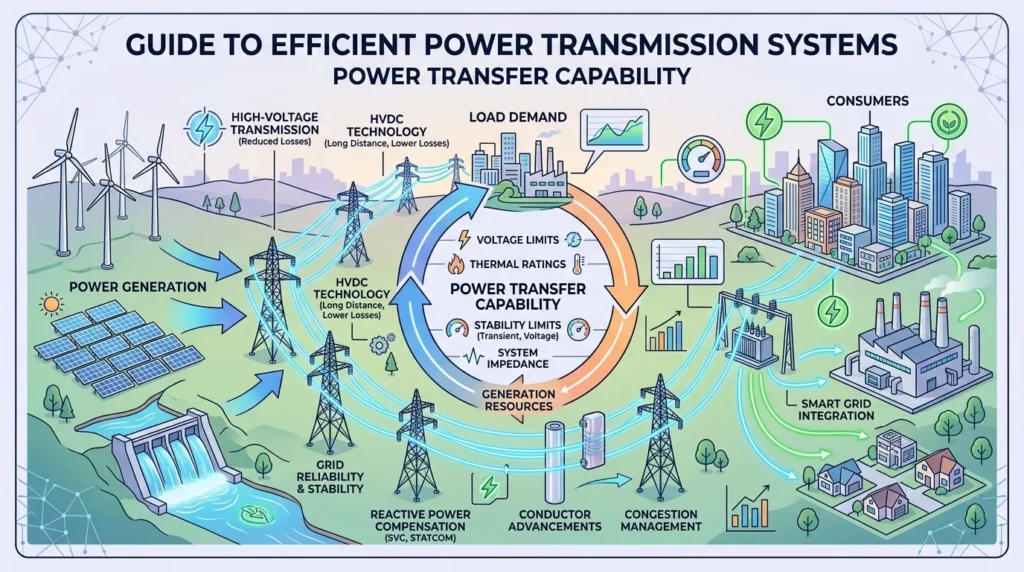
The Power Transfer Capability working principle is based on the relationship between voltage, current, transmission line parameters, and system stability.
Step 1: Power Generation
Electricity is generated at power plants.
Examples include:
- Thermal power stations
- Hydroelectric plants
- Solar farms
- Wind farms
Step 2: Voltage Increase
Transformers increase voltage levels for efficient transmission.
Higher voltage reduces transmission losses.
Step 3: Power Transmission
Electricity flows through transmission lines.
The amount of power transferred depends on:
- Voltage levels
- Line impedance
- Phase angle difference
- System stability
Step 4: Distribution
Electricity reaches substations and is distributed to consumers.
Step 5: Load Consumption
Homes, industries, and commercial facilities consume electrical power.
Factors Affecting Power Transfer Capability
Several factors determine how much power a transmission system can safely transfer.
Voltage Level
Higher voltage generally increases transfer capability.
Transmission Line Length
Longer transmission lines often have lower transfer capability due to losses.
Thermal Limits
Conductors can only carry a certain amount of current before overheating.
Stability Limits
The power system must remain synchronized during operation.
Voltage Constraints
Voltage levels must remain within acceptable limits.
Environmental Conditions
Weather conditions can affect transmission line performance.
Types / Classification of Power Transfer Capability
Power Transfer Capability can be classified into several categories.
Thermal Power Transfer Capability
Thermal limits are determined by conductor heating.
If excessive current flows:
- Temperature increases
- Conductors sag
- Equipment damage may occur
Thermal capability represents the maximum power that can be transferred without overheating.
Voltage Stability Limited Capability
Voltage stability refers to the system’s ability to maintain acceptable voltage levels.
If power transfer exceeds this limit:
- Voltage collapse may occur
- System reliability decreases
Transient Stability Limited Capability
This limit relates to sudden disturbances such as:
- Faults
- Lightning strikes
- Generator outages
The system must remain stable after such events.
Dynamic Stability Limited Capability
Dynamic stability considers system behavior over longer periods.
It focuses on maintaining synchronization between generators.
Transfer Capability Based on Operating Conditions
Capability changes depending on:
- Load demand
- Generation availability
- Network configuration
Main Components Affecting Power Transfer Capability
Several power system components directly influence transfer capability.
Generators
Generators produce electrical power.
Their output affects system capability.
Transformers
Transformers adjust voltage levels.
Higher transmission voltages improve transfer efficiency.
Transmission Lines
Transmission lines are the primary paths for power flow.
Their characteristics significantly affect capability.
Substations
Substations manage power routing and voltage regulation.
Circuit Breakers
Circuit breakers protect equipment from faults.
Reactive Power Compensation Devices
These devices improve voltage stability.
Examples include:
- Capacitor banks
- Static VAR compensators
- Synchronous condensers
Protection Systems
Protection equipment ensures safe operation during abnormal conditions.
Advantages of Power Transfer Capability Analysis
Understanding Power Transfer Capability provides many benefits.
Improved System Reliability
- Reduces power outages
- Supports stable operation
Better Planning
- Assists network expansion decisions
- Improves infrastructure investments
Increased Efficiency
- Maximizes existing transmission resources
Enhanced Safety
- Prevents equipment overload
Economic Benefits
- Reduces operational costs
- Improves energy delivery efficiency
Renewable Energy Integration
- Supports solar and wind power integration
Disadvantages / Limitations
Like any engineering concept, Power Transfer Capability has limitations.
Complex Calculations
Accurate analysis often requires advanced software.
Changing Conditions
Transfer capability varies continuously.
Weather Dependence
Environmental conditions influence line performance.
High Monitoring Requirements
Modern systems require constant monitoring.
Infrastructure Constraints
Older transmission systems may limit capability improvements.
Investment Costs
Upgrading systems to increase capability can be expensive.
Power Transfer Capability Applications
Power Transfer Capability applications are found throughout modern electrical systems.
Power Utilities
Utilities use capability analysis for network planning.
Transmission System Operation
Operators monitor power flow continuously.
Renewable Energy Projects
Wind and solar farms require capability studies before connection.
Industrial Power Systems
Large industries rely on stable power transfer.
Smart Grid Systems
Modern smart grids use real-time capability calculations.
Interconnected Power Networks
Countries often exchange electricity through interconnected grids.
Power transfer capability helps manage these exchanges safely.
Difference Between Power Transfer Capability and Transmission Capacity
Many beginners confuse these terms.
Comparison Table
| Feature | Power Transfer Capability | Transmission Capacity |
|---|---|---|
| Definition | Maximum transferable power under system conditions | Physical carrying ability of equipment |
| Focus | System stability and operation | Equipment rating |
| Depends On | Voltage, stability, operating conditions | Conductor size and design |
| Dynamic or Static | Dynamic | Mostly static |
| Usage | Power system analysis | Equipment specification |
| Safety Consideration | High | High |
This explains the difference between transmission capacity and power transfer capability.
Selection Guide
Choosing the appropriate Power Transfer Capability assessment method depends on several factors.
For Students
Focus on:
- Basic power flow analysis
- Stability concepts
- Transmission fundamentals
For Utility Engineers
Consider:
- Real-time operating conditions
- Contingency analysis
- Grid reliability
For Renewable Projects
Evaluate:
- Grid connection limits
- Voltage stability
- Transmission availability
For Industrial Facilities
Consider:
- Load growth
- Future expansion
- Reliability requirements
Beginner Tips
Always analyze:
- Thermal limits
- Voltage limits
- Stability limits
Never rely on only one factor.
Common Problems & Solutions
Problem: Transmission Line Overloading
Cause:
Excessive power demand.
Solution:
- Redistribute loads
- Upgrade transmission lines
- Add parallel circuits
Problem: Voltage Drop
Cause:
Long transmission distances.
Solution:
- Install capacitor banks
- Improve voltage support
Problem: Stability Issues
Cause:
High power transfer levels.
Solution:
- Use advanced control systems
- Reduce loading
Problem: Equipment Heating
Cause:
Current exceeds thermal limits.
Solution:
- Monitor conductor temperatures
- Upgrade conductors
Problem: Renewable Energy Variability
Cause:
Changing solar and wind generation.
Solution:
- Energy storage systems
- Smart grid controls
Frequently Asked Questions
What is Power Transfer Capability?
It is the maximum electrical power that can be transferred safely through a power system.
Why is it important?
It ensures reliability, safety, and efficient operation.
What limits Power Transfer Capability?
Thermal, voltage, and stability constraints.
Can Power Transfer Capability change?
Yes. It varies depending on operating conditions and system configuration.
How do engineers calculate it?
Using power flow studies, stability analysis, and specialized software.
Future Trends in Power Transfer Capability
The power industry is evolving rapidly.
Smart Grids
Smart grids provide real-time monitoring and control.
Dynamic Line Rating
This technology adjusts transmission capability based on actual weather conditions.
Artificial Intelligence Applications
Advanced analytics improve forecasting and decision-making.
Renewable Energy Integration
Future systems will accommodate larger amounts of renewable energy.
Flexible AC Transmission Systems (FACTS)
FACTS devices increase transmission efficiency and stability.
High Voltage Direct Current (HVDC)
HVDC systems allow efficient long-distance power transfer.
Digital Substations
Digital technologies improve system monitoring and control.
Conclusion
Power Transfer Capability is one of the most important concepts in electrical power engineering. It determines how much electrical power can be safely and efficiently transmitted through a network while maintaining stability, reliability, and equipment protection. Understanding the Power Transfer Capability working principle helps engineers design, operate, and expand power systems more effectively.
Factors such as thermal limits, voltage stability, transmission line characteristics, and system operating conditions all influence transfer capability. Proper analysis helps prevent overloads, improve efficiency, and support modern technologies such as renewable energy and smart grids. Although capability assessment can be complex, it remains essential for maintaining a reliable electrical infrastructure.
For students, technicians, and engineers, mastering Power Transfer Capability provides a strong foundation for understanding modern power systems and preparing for future developments in electrical engineering.