
Imagine you are using a computer at home, and suddenly the voltage from the power supply drops or rises unexpectedly. The screen may flicker, the system may restart, or sensitive electronic components could even get damaged. Similar situations occur in factories, hospitals, and communication systems where stable voltage is essential for reliable operation.
This is where Voltage Regulation becomes important. Voltage regulation ensures that electrical equipment receives a constant and stable voltage despite changes in load conditions or supply fluctuations. Without proper voltage regulation, electrical devices may perform poorly, operate inefficiently, or suffer permanent damage.
Voltage regulation is one of the most important concepts in electrical engineering because it directly affects the performance, safety, and lifespan of electrical systems. Whether you are an electrical student, engineer, technician, or beginner, understanding voltage regulation is essential for working with power systems and electronic circuits.
In this article, you will learn the definition of voltage regulation, the voltage regulation working principle, types of voltage regulation methods, main components, applications, advantages and disadvantages, troubleshooting methods, and future developments in this important field.
What is Voltage Regulation?
Voltage Regulation is the process of maintaining a constant output voltage even when the input voltage or load conditions change.
In simple words, voltage regulation keeps the voltage supplied to a device within a desired range so that the device operates correctly and safely.
Simple Explanation
Electrical loads continuously change. For example:
- Motors start and stop.
- Air conditioners switch on and off.
- Industrial machines operate at different loads.
These changes can cause voltage fluctuations. Voltage regulation automatically adjusts the system to maintain a stable voltage level.
Practical Example
Consider a smartphone charger.
Even if the voltage from the wall outlet changes slightly, the charger provides a stable output voltage to safely charge the phone. This stability is achieved through voltage regulation.
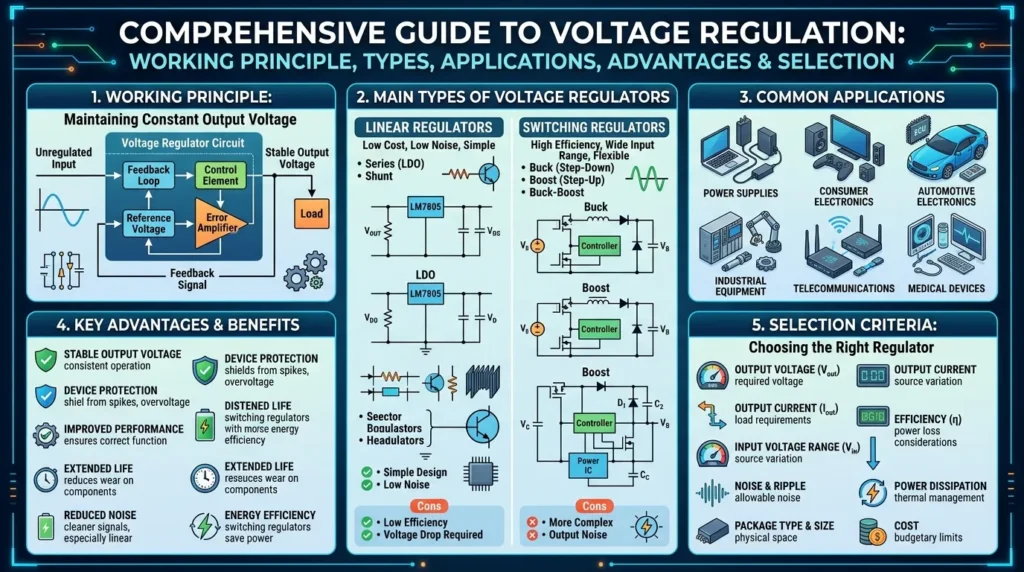
Voltage Regulation Working Principle
The voltage regulation working principle is based on continuously monitoring output voltage and correcting any deviation from the desired value.
Step-by-Step Process
- Input voltage enters the system.
- The regulator measures the output voltage.
- The output is compared with a reference voltage.
- Any difference is detected.
- The regulator adjusts the circuit.
- Stable voltage is delivered to the load.
Easy Water Tank Analogy
Think of a water tank supplying water to a house.
- The desired water level represents the desired voltage.
- A float valve monitors the water level.
- If water drops, the valve opens.
- If water rises, the valve closes.
Similarly, a voltage regulator continuously adjusts electrical conditions to maintain the required voltage level.
Key Functions
- Detect voltage changes
- Compare actual and desired voltage
- Correct voltage deviations
- Protect connected equipment
Types of Voltage Regulation
Different methods are used depending on system requirements.
Series Voltage Regulation
In this method, a regulating device is connected in series with the load.
Features
- High accuracy
- Good output stability
- Common in electronic circuits
Applications
- Power supplies
- Communication equipment
- Laboratory instruments
Shunt Voltage Regulation
A regulating element is connected parallel to the load.
Features
- Simple design
- Lower cost
- Suitable for low-power circuits
Applications
- Small electronic devices
- Reference voltage circuits
Linear Voltage Regulation
Linear regulators control voltage by operating a transistor in its active region.
Features
- Simple operation
- Low electrical noise
- Easy implementation
Limitations
- Lower efficiency
- Generates heat
Switching Voltage Regulation
Switching regulators use high-speed switching devices to control voltage.
Features
- High efficiency
- Compact design
- Lower power loss
Applications
- Computers
- Mobile chargers
- Industrial electronics
Automatic Voltage Regulation (AVR)
AVR systems automatically adjust voltage levels in generators and power systems.
Applications
- Power plants
- Industrial generators
- Transmission systems
Main Components of Voltage Regulation Systems
Several components work together to achieve voltage regulation.
Voltage Sensor
Measures output voltage continuously.
Function
- Detects voltage variations
- Provides feedback to the controller
Reference Voltage Source
Provides a stable comparison voltage.
Function
- Serves as the target voltage level
- Maintains accuracy
Error Detector
Compares actual voltage with reference voltage.
Function
- Identifies voltage differences
- Generates correction signals
Control Circuit
Processes feedback information.
Function
- Determines required adjustments
- Controls regulating devices
Regulating Element
Performs voltage correction.
Examples
- Transistors
- MOSFETs
- Thyristors
Output Filter
Removes unwanted fluctuations.
Function
- Smooths output voltage
- Reduces electrical noise
Advantages of Voltage Regulation
Voltage regulation offers numerous benefits in electrical systems.
Major Advantages
- Maintains stable output voltage
- Protects sensitive equipment
- Improves system reliability
- Extends equipment lifespan
- Reduces electrical stress
- Enhances energy efficiency
- Supports accurate device operation
- Improves power quality
- Minimizes performance fluctuations
- Essential for modern electronics
Real-World Benefits
A stable voltage supply helps prevent:
- Equipment failures
- Data loss
- Production interruptions
- Maintenance costs
Disadvantages / Limitations
Like any technology, voltage regulation has some limitations.
Common Limitations
- Additional system cost
- Increased circuit complexity
- Maintenance requirements
- Heat generation in linear regulators
- Efficiency losses in some designs
- Space requirements for larger systems
- Component aging over time
Practical Considerations
Engineers must balance performance, efficiency, cost, and reliability when selecting voltage regulation systems.
Voltage Regulation Applications
Voltage regulation applications are found almost everywhere in modern electrical systems.
Home Applications
- Television sets
- Refrigerators
- Computers
- Air conditioners
- Mobile chargers
Industrial Applications
- Manufacturing equipment
- CNC machines
- Motor drives
- Automation systems
- Process control equipment
Commercial Applications
- Office equipment
- Data centers
- Elevators
- Lighting systems
Power System Applications
- Transmission networks
- Distribution systems
- Substations
- Generator control systems
Modern Technology Applications
- Electric vehicles
- Renewable energy systems
- Solar inverters
- Wind turbines
- Telecommunications equipment
Comparison Section
Difference Between Linear and Switching Voltage Regulation
| Feature | Linear Regulation | Switching Regulation |
|---|---|---|
| Efficiency | Lower | Higher |
| Heat Generation | High | Low |
| Circuit Complexity | Simple | More Complex |
| Size | Larger Heat Sink Required | Compact |
| Cost | Lower | Slightly Higher |
| Noise Level | Very Low | Moderate |
| Applications | Sensitive Electronics | Power Systems |
Difference Between Voltage Regulation and Voltage Stabilization
| Feature | Voltage Regulation | Voltage Stabilization |
|---|---|---|
| Purpose | Maintain constant voltage | Reduce fluctuations |
| Accuracy | High | Moderate |
| Response Speed | Fast | Slower |
| Common Use | Electronics | Power Supply Systems |
Selection Guide
Choosing the right voltage regulator depends on the application.
Consider Load Requirements
Determine:
- Voltage rating
- Current requirement
- Power consumption
Evaluate Efficiency
For battery-powered systems, high efficiency is important.
Check Environmental Conditions
Consider:
- Temperature
- Humidity
- Dust levels
Analyze Cost
Balance:
- Initial cost
- Operating cost
- Maintenance expenses
Beginner Tips
- Start with application requirements.
- Choose reliable manufacturers.
- Consider future expansion.
- Prioritize safety standards.
Common Problems & Solutions
Why Is the Output Voltage Fluctuating?
Possible Causes
- Faulty regulator
- Loose connections
- Overloaded circuit
Solution
- Inspect connections
- Reduce load
- Replace defective components
Why Is the Regulator Overheating?
Possible Causes
- Excessive load current
- Poor ventilation
- Component failure
Solution
- Improve cooling
- Check load conditions
- Replace damaged parts
Why Is the Output Voltage Too Low?
Possible Causes
- Input voltage drop
- Regulator malfunction
- Excessive load demand
Solution
- Verify input supply
- Test regulator operation
- Reduce load
Why Is There Electrical Noise?
Possible Causes
- Switching frequency interference
- Poor filtering
Solution
- Improve filtering circuits
- Use proper shielding
Future Trends in Voltage Regulation
Technology continues to improve voltage regulation systems.
Smart Voltage Regulators
Modern regulators can:
- Monitor performance
- Communicate data
- Support remote control
AI-Based Power Management
Artificial intelligence is improving:
- Voltage prediction
- System optimization
- Fault detection
Renewable Energy Integration
Advanced voltage regulation is becoming essential for:
- Solar power systems
- Wind energy systems
- Smart grids
Wide-Bandgap Semiconductor Devices
Materials such as silicon carbide and gallium nitride provide:
- Higher efficiency
- Faster switching
- Reduced energy losses
Digital Control Systems
Digital regulation offers:
- Better precision
- Faster response
- Enhanced flexibility
Conclusion
Voltage Regulation is a critical part of modern electrical and electronic systems. It ensures that equipment receives a stable voltage supply regardless of changes in load or input conditions. From household appliances and industrial machines to renewable energy systems and advanced electronics, voltage regulation plays a major role in maintaining safety, efficiency, and reliability.
Understanding the voltage regulation working principle, types, components, applications, and voltage regulation advantages and disadvantages helps engineers and technicians design and maintain better electrical systems. As technology continues to evolve, smart regulators, digital control systems, and renewable energy integration will make voltage regulation even more important. For students and beginners, mastering this topic provides a strong foundation for understanding power systems and electrical engineering concepts.