
Have you ever heard someone say, “She is very smart,” while another person says, “He is highly intelligent”? At first, these words seem to mean the same thing. However, smart vs intelligent is a common English comparison because the two words have different meanings in many situations. Choosing the right word can improve your writing, speaking, and professional communication.
People search for smart vs intelligent because they want to know whether these words are interchangeable, which one is more appropriate, and how native English speakers use them. The confusion becomes even greater when discussing students, technology, workplace skills, or personal abilities.
In this guide, you’ll learn the exact difference between smart and intelligent, where each word comes from, whether British and American English spell them differently, and which one you should use in different situations. You’ll also find comparison tables, everyday examples, common mistakes, FAQs, and practical tips to help you use both words confidently in daily conversations and formal writing.
Smart vs Intelligent – Quick Answer
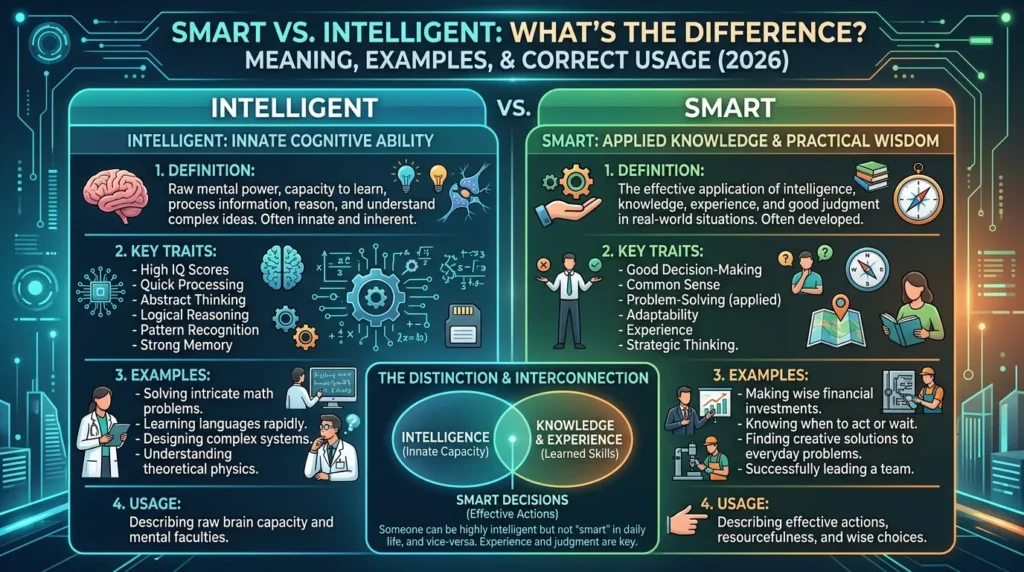
The main difference between smart and intelligent is how they describe a person’s abilities.
- Smart usually means someone is quick to learn, solve problems, or make practical decisions.
- Intelligent refers to a person’s natural ability to think, understand, reason, and learn complex ideas.
Simple Examples
- She is smart enough to fix the computer quickly.
- He is highly intelligent and enjoys solving difficult math problems.
A smart person often applies knowledge effectively, while an intelligent person has strong reasoning and learning abilities. Many people are both smart and intelligent.
The Origin of Smart vs Intelligent
Understanding the history of these words helps explain why they are used differently today.
Origin of “Smart”
The word smart comes from the Old English word smeart, which originally meant “causing pain” or “sharp.” Over time, its meaning changed to describe someone who is clever, quick-thinking, or stylish.
Today, smart commonly describes people, devices, clothing, and technology.
Examples:
- Smart student
- Smart decision
- Smart phone
- Smart home
Origin of “Intelligent”
The word intelligent comes from the Latin word intelligere, meaning “to understand” or “to perceive.”
It has always referred to mental ability, reasoning, and understanding.
Examples:
- Intelligent scientist
- Intelligent child
- Intelligent discussion
- Artificial intelligence
Why There Are No Spelling Differences
Unlike words such as color/colour or center/centre, both smart and intelligent have exactly the same spelling in British and American English.
British English vs American English Spelling
There is no spelling difference between smart and intelligent in British English and American English.
Examples
British English
- She is a smart engineer.
- He is an intelligent researcher.
American English
- She is a smart engineer.
- He is an intelligent researcher.
Comparison Table
| Word | British English | American English |
|---|---|---|
| Smart | Smart | Smart |
| Intelligent | Intelligent | Intelligent |
The only differences appear in surrounding words.
| British English | American English |
|---|---|
| Analyse | Analyze |
| Organise | Organize |
| Programme | Program |
| Centre | Center |
Which Spelling Should You Use?
Since both words have identical spellings worldwide, you simply write:
- Smart
- Intelligent
For US Readers
Use American English grammar and vocabulary around these words.
Example:
“The software is smart and efficient.”
For UK Readers
Use British English grammar while keeping the same spelling.
Example:
“The student is intelligent and organised.”
For Global Readers
Both words are universally accepted in business, education, science, and everyday English.
Common Mistakes with Smart vs Intelligent
Many English learners confuse these two words.
Mistake 1
Smart always means intelligent.
✅ Correct:
Smart often refers to practical thinking or quick learning.
Mistake 2
Intelligent people are always smart in every situation.
✅ Correct:
An intelligent person may know many facts but may not always make practical decisions.
Mistake 3
Smart only describes people.
✅ Correct:
Smart also describes technology.
Examples:
- Smart TV
- Smart watch
- Smart phone
Mistake 4
Intelligent can describe every electronic device.
✅ Correct:
Most electronic devices are called smart, not intelligent.
Example:
- Smart speaker ✅
- Intelligent speaker (less common)
Mistake 5
Both words should always be interchangeable.
✅ Correct:
Choose the word that best fits the context.
Smart vs Intelligent in Everyday Examples
“Our new employee is smart, learns quickly, and solves problems efficiently.”
News
“Researchers developed an intelligent system capable of recognizing human speech.”
Social Media
“My new smart watch tracks my fitness all day.”
Formal Writing
“Intelligent decision-making requires critical thinking, while smart actions often involve practical judgment.”
Smart vs Intelligent – Google Trends & Usage Data
The keyword smart vs intelligent is searched worldwide by English learners, students, teachers, and professionals.
Popular Search Queries
- Smart vs intelligent
- Difference between smart and intelligent
- Smart meaning
- Intelligent meaning
- Smart person vs intelligent person
- Smart or intelligent
Countries with High Search Interest
- United States
- India
- United Kingdom
- Canada
- Australia
Interest remains steady because these words appear in education, psychology, technology, and everyday communication.
Smart vs Intelligent Comparison Table
| Feature | Smart | Intelligent |
|---|---|---|
| Meaning | Practical ability | Mental ability |
| Focus | Quick thinking | Deep understanding |
| Learning | Learns efficiently | Understands deeply |
| Problem Solving | Practical | Analytical |
| Technology Use | Very common | Less common |
| Everyday Speech | Very common | Common |
| Formal Writing | Common | Very common |
Keyword Variations
| Search Keyword | Meaning |
|---|---|
| Smart vs Intelligent | Main comparison |
| Intelligent vs Smart | Same comparison |
| Difference between smart and intelligent | Definition |
| Smart meaning | Word explanation |
| Intelligent meaning | Word explanation |
| Smart or intelligent | Usage comparison |
| Smart person vs intelligent person | Personality comparison |
Frequently Asked Questions (FAQs)
1. What is the main difference between smart and intelligent?
A smart person applies knowledge effectively, while an intelligent person naturally understands and learns complex ideas.
2. Can someone be both smart and intelligent?
Yes. Many successful people are both intelligent thinkers and smart decision-makers.
3. Is “smart” more informal than “intelligent”?
Yes. Smart is more common in everyday conversations, while intelligent often sounds more formal.
4. Which word should I use in a resume?
Intelligent is suitable when describing analytical ability, but avoid using either word to describe yourself directly. Instead, demonstrate your skills through achievements.
5. Why are phones called smart phones instead of intelligent phones?
Because they perform practical tasks automatically using software and internet connectivity.
6. Is a smart child always intelligent?
Not necessarily. A child may learn quickly and solve practical problems without showing exceptional analytical ability.
7. Which word is better in professional writing?
It depends on the context. Use intelligent for reasoning and analysis, and smart for practical solutions or technology.
Conclusion
Understanding smart vs intelligent helps you choose the right word in different situations. Although both words describe positive qualities, they focus on different abilities. Smart usually refers to practical thinking, quick learning, and making good decisions in everyday life. It is also commonly used to describe modern technology, such as smart phones and smart homes. Intelligent, however, emphasizes deeper reasoning, understanding, and analytical ability. Both British and American English use the same spelling, making these words easy to use internationally. By learning the difference between smart and intelligent, you can improve your communication, avoid common mistakes, and express your ideas more accurately. Whether you are writing an email, preparing a report, or speaking in daily conversation, choosing the correct word will make your English sound more natural and professional.