
Imagine you are working on a construction site or camping in a remote area where there is no electricity available. You still need power to run lights, tools, or charge electronic devices. In such situations, a portable generator becomes extremely useful. It can provide temporary electrical power anytime and anywhere.
Portable generators are widely used for homes, outdoor activities, construction projects, and emergency backup power. When the main electricity supply fails due to storms, maintenance, or grid problems, these generators help keep essential equipment running. However, many beginners think all portable generators are the same. In reality, there are several portable generator types, and each type is designed for different power needs and applications.
Understanding these types is very important for electrical students, engineers, and technicians. Choosing the correct generator type improves efficiency, safety, and reliability of the electrical system.
In this article, you will learn about portable generator types, portable generator working principle, portable generator applications, and portable generator advantages and disadvantages. The goal is to explain this topic in a simple way, just like a senior electrical engineer teaching a junior technician.
What is a Portable Generator?
A portable generator is a compact, movable electrical machine that converts mechanical energy into electrical energy to provide temporary power wherever it is needed. It is powered by a small internal combustion engine that typically runs on gasoline, diesel, propane, or natural gas. The engine drives an alternator, which generates electricity to operate electrical appliances, tools, and equipment.
Unlike permanently installed standby generators, portable generators are lightweight or equipped with wheels and handles, making them easy to transport between different locations. They are commonly used during power outages, at construction sites, for outdoor events, camping trips, and in remote areas where access to the electrical grid is limited or unavailable.
Portable generators are available in various power capacities, allowing users to choose a model that meets their specific electrical needs. They provide a reliable and convenient source of backup power for both residential and commercial applications.
Simple Explanation
Think of a portable generator as a mobile power station. It uses fuel to run a small engine, and the engine rotates an alternator to generate electricity. This electricity can then be used to power lights, refrigerators, fans, power tools, computers, and many other electrical devices when utility power is unavailable.
Because portable generators are compact and easy to move, they are ideal for temporary power requirements at different locations.
Practical Examples
Portable generators are used in many everyday situations, including:
- Home Backup Power: Keeping essential appliances such as lights, refrigerators, fans, and water pumps running during power outages.
- Construction Sites: Supplying electricity to power drills, saws, welding machines, compressors, and other portable tools where grid power is unavailable.
- Outdoor Events: Operating lighting systems, sound equipment, food stalls, and electronic devices during festivals, exhibitions, and public gatherings.
- Camping and Recreational Activities: Providing electricity for portable lights, cooking equipment, phone chargers, and small appliances.
- Emergency and Disaster Relief: Supplying temporary power for rescue operations, medical equipment, and communication systems during natural disasters and emergencies.
Why is a Portable Generator Important?
A portable generator provides a dependable source of temporary electricity whenever the main power supply is unavailable or inaccessible. Its mobility, ease of use, and ability to deliver instant backup power make it an essential piece of equipment for homeowners, contractors, businesses, emergency response teams, and outdoor enthusiasts. Whether used for emergency backup or remote work, a portable generator ensures that essential electrical equipment continues to operate safely and efficiently.
Portable Generator Working Principle
The portable generator working principle is based on Faraday’s Law of Electromagnetic Induction, which states that electricity is generated when a conductor moves through a magnetic field. In a portable generator, the engine converts fuel energy into mechanical energy, and the alternator then converts this mechanical energy into electrical energy.
In simple terms, a portable generator does not create electricity from nothing. Instead, it converts the energy stored in fuel into usable electrical power through a series of mechanical and electromagnetic processes.
Step-by-Step Working Process
Step 1: Fuel Powers the Engine
The process begins when the generator’s engine is started. The engine is powered by a fuel source such as gasoline, diesel, propane, or natural gas. During combustion, the fuel releases energy that drives the engine.
Step 2: Engine Rotates the Alternator
As the engine runs, it rotates a shaft connected directly to the alternator. The alternator is the main component responsible for generating electricity.
Step 3: Rotating Magnetic Field is Created
Inside the alternator, the rotating rotor produces a continuously changing magnetic field. This rotating magnetic field is essential for generating electrical power.
Step 4: Electricity is Generated
As the magnetic field rotates around the stationary copper windings (stator), it induces an electric current according to the principle of electromagnetic induction. This process converts the engine’s mechanical energy into electrical energy.
Step 5: Voltage Regulation
The generated electricity passes through a voltage regulator, which maintains a stable output voltage. This protects connected electrical devices from voltage fluctuations and ensures a reliable power supply.
Step 6: Power is Delivered to Output Sockets
Finally, the regulated electrical power is supplied to the generator’s output outlets. Users can safely connect electrical appliances, lighting systems, power tools, and other equipment to these sockets for temporary power.
Simple Working Flow
Fuel → Engine → Alternator → Electromagnetic Induction → Voltage Regulation → AC Power Output
Simple Analogy
Think of a portable generator like a bicycle with a dynamo light. When you pedal the bicycle, your mechanical effort turns the dynamo, which generates electricity to power the light. Similarly, in a portable generator, the engine rotates the alternator, and this mechanical motion is converted into electrical energy that powers appliances and equipment.
Key Point
A portable generator converts mechanical energy into electrical energy using the principle of electromagnetic induction. The engine provides the mechanical motion, while the alternator generates AC electricity, making the generator a reliable source of temporary power during outages, outdoor activities, construction work, and emergency situations.
4. Types / Classification of Portable Generators
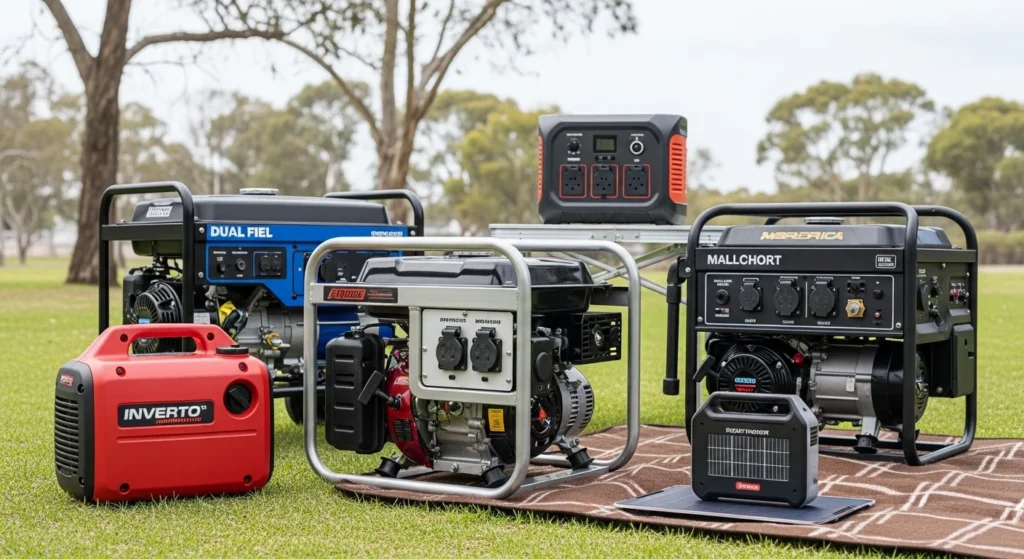
There are several portable generator types, each designed for specific power requirements and operating conditions.
What is a Conventional Portable Generator?
A Conventional Portable Generator, also known as a Standard Portable Generator, is the most widely used type of portable generator for supplying temporary electrical power. It uses an internal combustion engine to drive an alternator, which generates alternating current (AC) electricity. Unlike inverter generators, conventional generators operate at a constant engine speed—typically 3,000 RPM or 3,600 RPM, depending on the output frequency (50 Hz or 60 Hz).
Because the engine runs at a fixed speed regardless of the electrical load, conventional generators are well suited for powering heavy-duty equipment and multiple appliances simultaneously. They are commonly used on construction sites, during power outages, and at locations where a reliable temporary power source is required.
Although they are generally louder and consume more fuel than inverter generators, conventional portable generators are valued for their high power output, durability, and cost-effectiveness.
Key Features
- Operates at a constant engine speed
- Produces AC electricity directly through an alternator
- Available in a wide range of power ratings
- High power output for heavy electrical loads
- Suitable for continuous temporary power applications
- Rugged and durable construction
- Simple design for easy maintenance
- Can run on gasoline, diesel, propane, or natural gas (depending on the model)
- More affordable than inverter generators with similar power capacity
Advantages
- High starting and running power for large loads
- Suitable for powering multiple appliances simultaneously
- Reliable during extended power outages
- Lower purchase cost compared to inverter generators
- Durable and capable of operating in demanding environments
- Easy to maintain and repair
Limitations
- Produces more noise during operation
- Higher fuel consumption because the engine runs at a constant speed
- Heavier and less portable than inverter generators
- Voltage and frequency may fluctuate slightly under changing loads
- Not ideal for sensitive electronic devices without additional voltage regulation
Common Applications
Conventional portable generators are widely used wherever temporary, high-capacity electrical power is needed.
Typical applications include:
- Construction sites for operating power tools and machinery
- Home backup power during electrical outages
- Farms and agricultural equipment
- Workshops and small industrial facilities
- Outdoor events and festivals
- Emergency response and disaster relief operations
- Remote work locations without utility power
- Camping sites requiring higher power output
- Temporary lighting systems and water pumps
Best For
A Conventional Portable Generator is the best choice for users who need a powerful, reliable, and economical source of temporary electricity for heavy-duty applications. It is especially suitable for construction projects, emergency home backup, and outdoor work where high power output is more important than low noise or maximum fuel efficiency.
2. Inverter Portable Generators
Inverter portable generators are modern and advanced generators designed to produce clean, stable, and high-quality electrical power. Unlike conventional generators, they use advanced electronic circuits and inverter technology to regulate the output voltage and frequency. This makes them ideal for powering sensitive electronic devices that require a consistent electricity supply.
The generator first produces AC (Alternating Current), then converts it into DC (Direct Current), and finally changes it back into clean and stable AC electricity. This process ensures minimal voltage fluctuations and a pure sine wave output, protecting delicate electronic equipment from damage.
Features
- Converts AC to DC and Back to Clean AC
Uses inverter technology to generate a pure sine wave output, making the electricity safe for sensitive electronic devices. - Produces Stable Voltage
Maintains consistent voltage and frequency, preventing sudden power fluctuations that could damage equipment. - Very Quiet Operation
Equipped with sound-reducing technology and variable engine speed, making it much quieter than conventional generators. - Fuel-Efficient
Automatically adjusts engine speed according to the electrical load, reducing fuel consumption and extending runtime. - Lightweight and Portable
Compact design with built-in handles makes it easy to carry for outdoor activities and emergency use. - Low Harmonic Distortion (THD)
Produces clean electricity with very low Total Harmonic Distortion, making it suitable for computers, TVs, and medical equipment. - Eco Mode Available
Many inverter generators include an economy mode that further reduces fuel usage and engine noise during light loads.
Advantages
- Provides clean and stable power for sensitive electronics.
- Runs quietly, making it suitable for residential and recreational use.
- Consumes less fuel than traditional generators.
- Lightweight and easy to transport.
- Lower emissions and environmentally friendly operation.
- Ideal for both emergency backup and outdoor activities.
Disadvantages
- Higher initial purchase cost.
- Lower power output compared to large conventional generators.
- Not suitable for powering heavy industrial machinery or very large electrical loads.
- Repairs and maintenance can be more expensive due to advanced electronics.
Typical Uses
- Laptops and Computers – Safe power for work and data protection.
- Mobile Phones and Tablets – Reliable charging without voltage fluctuations.
- Camping Equipment – Powers lights, fans, portable refrigerators, and cooking appliances.
- Sensitive Electronic Devices – Suitable for televisions, gaming consoles, cameras, routers, and audio equipment.
- Medical Equipment – Can safely operate CPAP machines and other small medical devices.
- Home Backup Power – Ideal for running essential household appliances during power outages.
- Outdoor Events and RVs – Commonly used for recreational vehicles, picnics, and outdoor gatherings.
Common Power Range
Most inverter portable generators are available in capacities ranging from 1,000 watts to 4,500 watts, although larger models are also available for higher power requirements. They are best suited for small to medium electrical loads where clean, reliable, and quiet power is essential.
3. Diesel Portable Generators
Diesel portable generators are powerful generators that use a diesel engine to produce electricity instead of a gasoline engine. They are widely used in commercial, industrial, agricultural, and construction environments because they offer excellent fuel efficiency, high durability, and reliable performance under heavy loads. Diesel generators are designed to operate continuously for long periods, making them an ideal choice for demanding applications where dependable power is essential.
Compared to gasoline generators, diesel portable generators generally consume less fuel for the same power output and require less frequent maintenance. Their robust construction allows them to withstand harsh working conditions and deliver consistent performance over many years.
Features
- Higher Fuel Efficiency
Diesel engines consume less fuel than gasoline engines, reducing operating costs during extended use. - Longer Lifespan
Built with heavy-duty components, diesel generators are highly durable and can operate for thousands of hours with proper maintenance. - Suitable for Heavy Loads
Capable of powering large equipment, industrial machines, and multiple electrical devices simultaneously. - Reliable Continuous Operation
Designed to run for long periods without overheating, making them suitable for continuous power supply. - High Torque Performance
Diesel engines provide strong torque, allowing the generator to handle sudden increases in electrical load efficiently. - Robust Construction
Built to withstand tough environmental conditions such as construction sites, mining operations, and outdoor industrial work.
Advantages
- Excellent fuel economy and lower running costs.
- Longer service life than gasoline generators.
- High power output for demanding applications.
- Reliable performance during continuous operation.
- Lower maintenance frequency due to the absence of spark plugs and carburetors.
- Ideal for commercial and industrial use.
Disadvantages
- Higher initial purchase cost.
- Heavier and less portable than gasoline generators.
- Louder operation compared to inverter generators.
- Diesel engines produce more exhaust emissions if not equipped with modern emission-control systems.
- Cold weather starting may require additional equipment in some climates.
Typical Uses
- Construction Sites – Powers concrete mixers, welding machines, drills, compressors, and other heavy-duty equipment.
- Industrial Backup Power – Provides reliable emergency electricity for factories, warehouses, and manufacturing plants.
- Agricultural Equipment – Supplies power to irrigation pumps, grain dryers, feed mills, and farm machinery.
- Commercial Buildings – Used as backup power for offices, shopping centers, and workshops.
- Mining and Remote Locations – Delivers dependable electricity where grid power is unavailable.
- Large Outdoor Events – Supports lighting systems, sound equipment, and temporary facilities.
Common Power Range
Diesel portable generators are commonly available in capacities ranging from 3 kW to 15 kW for portable models, while larger stationary diesel generators can produce hundreds of kilowatts or even several megawatts for industrial and commercial applications. They are the preferred choice whenever high power output, long operating hours, and maximum reliability are required.
4. Gasoline Portable Generators
Gasoline portable generators are the most common and widely used type of portable generator for residential and light commercial applications. They are powered by gasoline (petrol) engines and are popular because of their affordable price, easy operation, and compact design. These generators are an excellent choice for homeowners, DIY users, campers, and small businesses that need temporary or emergency power.
Gasoline generators are generally easy to transport and require minimal setup. They are ideal for short-term use during power outages or outdoor activities. However, since gasoline is highly flammable and has a shorter storage life than diesel, proper fuel storage and handling are important for safe operation.
Features
- Easy to Start
Most gasoline generators start quickly using a recoil pull-start or an electric start system, making them convenient for everyday use. - Lower Initial Cost
Gasoline generators are usually more affordable than diesel and inverter generators, making them a budget-friendly option. - Lightweight Design
Their compact size and lighter weight make them easy to transport and store. - Widely Available Fuel
Gasoline is easily available at most fuel stations, making refueling simple and convenient. - Simple Maintenance
Basic maintenance tasks such as oil changes, spark plug replacement, and air filter cleaning are straightforward. - Portable Construction
Many models include wheels and foldable handles for easy movement between locations.
Advantages
- Affordable purchase price.
- Easy to operate and maintain.
- Lightweight and highly portable.
- Quick starting in most weather conditions.
- Suitable for occasional and emergency use.
- Gasoline is readily available in most areas.
Disadvantages
- Higher fuel consumption compared to diesel generators.
- Shorter engine lifespan than diesel models.
- Louder operation than inverter generators.
- Gasoline has a limited storage life and is highly flammable.
- Not recommended for continuous long-term operation.
Typical Uses
- Home Backup Power – Provides electricity for lights, fans, refrigerators, televisions, and other essential household appliances during power outages.
- Small Workshops – Powers electric drills, saws, grinders, and other portable power tools.
- Outdoor Events – Supplies electricity for lighting, speakers, food stalls, and event equipment.
- Camping and Recreational Activities – Runs portable appliances, chargers, and small cooking equipment.
- DIY Projects – Ideal for home improvement and repair work where grid power is unavailable.
- Emergency Power Supply – Serves as a reliable temporary power source during unexpected outages.
Common Power Range
Gasoline portable generators are commonly available in capacities ranging from 1 kW to 10 kW, making them suitable for small to medium electrical loads. They are an excellent choice for homeowners and users who need an affordable, portable, and reliable source of temporary power.
5. Dual-Fuel Portable Generators
Dual-fuel portable generators are versatile generators that can operate using two different fuel sources, typically gasoline and propane (LPG). Users can switch between the two fuels depending on availability, operating costs, or personal preference. This flexibility makes dual-fuel generators an excellent choice for emergency situations, home backup power, and outdoor applications where fuel availability may be uncertain.
These generators combine the convenience of gasoline with the cleaner-burning characteristics and longer storage life of propane. During power outages or natural disasters, if one fuel becomes unavailable, the generator can continue operating on the other fuel, ensuring a reliable power supply.
Features
- Run on Gasoline or Propane
Allows users to choose between gasoline and propane, providing greater flexibility and convenience. - Flexible Fuel Choice
Easily switch fuel sources depending on fuel availability, cost, or operating requirements. - Reliable Operation During Fuel Shortages
If one fuel type is unavailable, the generator can continue running on the alternative fuel. - Easy Fuel Switching
Many modern models include a simple fuel selector switch for quick and safe fuel changes. - Cleaner Operation on Propane
Propane burns more cleanly than gasoline, producing fewer carbon deposits and reducing engine wear. - Long Fuel Storage Capability
Propane can be stored for long periods without degrading, making it ideal for emergency preparedness.
Advantages
- Two fuel options provide greater operating flexibility.
- Reliable backup power during fuel shortages.
- Propane produces cleaner emissions and leaves fewer engine deposits.
- Longer fuel storage life when using propane.
- Reduced risk of running out of fuel during emergencies.
- Suitable for both residential and recreational use.
Disadvantages
- Higher purchase price than single-fuel generators.
- Slightly more complex fuel system.
- Propane generally produces lower power output than gasoline.
- Requires access to propane cylinders for LPG operation.
- Heavier than some standard gasoline generators.
Typical Uses
- Emergency Power Supply – Provides dependable electricity during power outages, natural disasters, and emergency situations.
- Residential Backup Systems – Powers essential household appliances such as refrigerators, lights, fans, water pumps, and communication devices.
- Camping and RV Trips – Offers flexible fuel options for outdoor recreation and travel.
- Construction Sites – Supplies temporary power where different fuel types may be available.
- Outdoor Events – Runs lighting, sound systems, and other electrical equipment.
- Remote Locations – Ideal for areas where gasoline or propane availability may vary.
Common Power Range
Dual-fuel portable generators are commonly available in capacities ranging from 2 kW to 12 kW. They are an excellent choice for homeowners, campers, contractors, and emergency preparedness because they combine fuel flexibility, dependable performance, and increased reliability in a single portable power solution.
5. Main Components of Portable Generators
A portable generator consists of several essential components that work together to convert fuel into electrical energy. Each part has a specific function, ensuring the generator operates safely, efficiently, and reliably. Understanding these components helps users perform proper maintenance, troubleshoot problems, and operate the generator correctly.
1. Engine
The engine is the primary power source of a portable generator. It burns fuel such as gasoline, diesel, propane, or natural gas to produce mechanical energy. This mechanical energy rotates the alternator, allowing the generator to produce electricity. The engine’s size and power determine the generator’s overall electrical output capacity.
Functions:
- Produces mechanical power.
- Drives the alternator.
- Determines the generator’s power output.
- Operates using gasoline, diesel, propane, or dual-fuel systems.
2. Alternator
The alternator, also known as the generator head, converts the engine’s mechanical energy into electrical energy using the principle of electromagnetic induction. It contains a rotating rotor and a stationary stator that generate alternating current (AC) electricity.
Functions:
- Converts mechanical energy into AC electricity.
- Produces stable electrical output.
- Supplies power to connected electrical devices.
- Works continuously while the engine is running.
3. Fuel Tank
The fuel tank stores the fuel required to operate the engine. Its capacity determines how long the generator can run before refueling. Larger fuel tanks provide longer operating times, making them suitable for extended power outages.
Functions:
- Stores gasoline, diesel, or other fuel.
- Supplies fuel continuously to the engine.
- Supports longer runtime depending on tank capacity.
- Designed to prevent fuel leakage and contamination.
4. Voltage Regulator
The voltage regulator maintains a constant output voltage regardless of changes in engine speed or electrical load. It protects connected appliances from voltage fluctuations that could damage sensitive equipment.
Functions:
- Maintains stable output voltage.
- Prevents overvoltage and undervoltage.
- Protects electrical appliances.
- Improves overall generator performance.
5. Cooling System
The cooling system removes excess heat generated by the engine and alternator during operation. Small portable generators usually use air cooling, while larger models may use liquid cooling for improved heat dissipation.
Functions:
- Prevents engine overheating.
- Maintains safe operating temperature.
- Extends engine life.
- Improves reliability during continuous operation.
6. Lubrication System
The lubrication system circulates engine oil to reduce friction between moving parts. Proper lubrication minimizes wear, improves efficiency, and extends the engine’s service life.
Functions:
- Reduces friction and wear.
- Cools internal engine parts.
- Extends engine lifespan.
- Ensures smooth engine operation.
7. Exhaust System
The exhaust system safely directs harmful exhaust gases away from the engine and helps reduce operating noise. Many generators include a muffler to make operation quieter.
Functions:
- Removes exhaust gases safely.
- Reduces engine noise.
- Improves environmental safety.
- Helps maintain efficient engine performance.
8. Control Panel
The control panel is the user interface of the generator. It contains switches, circuit breakers, power outlets, voltage indicators, and warning lights that allow users to monitor and control generator operation safely.
Functions:
- Provides AC power outlets.
- Contains the start/stop switch.
- Includes circuit breakers for overload protection.
- Displays operating status and warning indicators.
- Allows easy control of generator functions.
9. Battery (Electric Start Models)
Many modern portable generators include a battery to power the electric starter motor. This eliminates the need for manual pull-start operation and provides quick, convenient starting.
Functions:
- Powers the electric starting system.
- Supplies electricity to control circuits.
- Makes generator starting faster and easier.
10. Frame and Wheels
The frame protects all internal components and provides structural support, while wheels and handles make the generator easier to transport from one location to another.
Functions:
- Protects generator components.
- Provides stability during operation.
- Improves portability and transportation.
- Supports safe handling and storage.
Importance of Generator Components
Every component of a portable generator performs a vital role in producing safe and reliable electricity. The engine generates mechanical power, the alternator converts it into electrical energy, the fuel tank supplies fuel, the voltage regulator ensures stable voltage, the cooling and lubrication systems protect the engine, and the control panel allows safe operation and monitoring. When all these components work together efficiently, the generator delivers dependable performance, longer service life, and reliable backup power whenever it is needed.
6. Portable Generator Advantages
Understanding portable generator advantages and disadvantages helps users select the right generator.
Advantages
- Easy to transport and move
- Provides emergency backup power
- Simple to operate
- Affordable compared to standby generators
- Suitable for outdoor activities
- No permanent installation required
Real-World Benefits
Portable generators allow people to continue working even during power outages, making them extremely valuable for homes and businesses.
7. Portable Generator Disadvantages / Limitations
Despite their usefulness, portable generators also have some limitations.
Disadvantages
- Limited power capacity
- Requires regular refueling
- Produces noise during operation
- Emits exhaust gases
- Not suitable for large industrial loads
Proper maintenance and safe operation can minimize many of these issues.
8. Portable Generator Applications
Portable generators are widely used in residential, commercial, industrial, and recreational environments to provide temporary or backup electricity whenever the main power supply is unavailable. Their portability, ease of operation, and ability to deliver reliable electrical power make them valuable in many situations. From powering homes during blackouts to supporting emergency rescue operations, portable generators play an essential role in modern life.
1. Home Backup Power
One of the most common applications of portable generators is providing backup electricity during power outages. They keep essential household appliances running until the utility power is restored.
Common Uses:
- Powering refrigerators and freezers.
- Operating lights and ceiling fans.
- Running televisions and internet routers.
- Charging mobile phones and laptops.
- Supplying electricity to water pumps and small air conditioners.
Benefits:
- Prevents food spoilage.
- Maintains comfort during outages.
- Keeps communication devices operational.
- Provides reliable emergency power.
2. Construction Sites
Construction projects often take place in locations where utility electricity is not yet available. Portable generators provide a dependable power source for operating electrical equipment and heavy-duty tools.
Common Uses:
- Electric drills and hammer drills.
- Circular saws and grinders.
- Concrete mixers.
- Welding machines.
- Air compressors and lighting equipment.
Benefits:
- Enables work in remote locations.
- Improves productivity.
- Powers multiple construction tools simultaneously.
- Reduces project delays caused by lack of electricity.
3. Outdoor Events
Portable generators are commonly used to supply electricity for outdoor events where permanent electrical connections are unavailable.
Common Uses:
- Stage lighting systems.
- Public address and sound systems.
- LED display screens.
- Food stalls and catering equipment.
- Decorative lighting and event decorations.
Benefits:
- Provides reliable event power.
- Supports entertainment equipment.
- Easy to transport and install.
- Ensures uninterrupted event operation.
4. Camping and Outdoor Activities
Portable generators are popular among campers, RV owners, and outdoor enthusiasts because they provide convenient electricity in remote areas.
Common Uses:
- Charging smartphones and laptops.
- Operating portable refrigerators.
- Running camping lights and fans.
- Powering coffee makers and small cooking appliances.
- Supporting recreational vehicles (RVs).
Benefits:
- Increases outdoor comfort.
- Powers essential electronic devices.
- Quiet inverter models minimize noise.
- Provides reliable electricity away from the power grid.
5. Emergency Services
Emergency response organizations depend on portable generators when utility power fails during natural disasters, accidents, or rescue operations.
Common Uses:
- Emergency medical equipment.
- Rescue operation lighting.
- Communication systems.
- Mobile command centers.
- Temporary shelters and relief camps.
Benefits:
- Supports life-saving operations.
- Ensures continuous communication.
- Provides reliable power during disasters.
- Helps emergency teams work safely and efficiently.
6. Agricultural Operations
Farmers use portable generators to keep essential agricultural equipment operating during power failures or in remote farming areas.
Common Uses:
- Irrigation water pumps.
- Livestock ventilation systems.
- Grain dryers.
- Electric fences.
- Farm lighting.
Benefits:
- Protects crops and livestock.
- Maintains irrigation during outages.
- Supports daily farming activities.
- Increases productivity in remote locations.
7. Small Businesses and Commercial Use
Many small businesses rely on portable generators to continue operating during unexpected power interruptions.
Common Uses:
- Retail shops.
- Restaurants and cafés.
- Small offices.
- Workshops.
- Computer systems and payment terminals.
Benefits:
- Prevents business interruptions.
- Protects valuable inventory.
- Maintains customer service.
- Reduces financial losses during outages.
8. Industrial Maintenance and Field Work
Portable generators are frequently used by maintenance technicians and field engineers working in locations without access to the electrical grid.
Common Uses:
- Testing electrical equipment.
- Operating maintenance tools.
- Temporary power for repair work.
- Mobile service vehicles.
- Remote inspection sites.
Benefits:
- Improves work efficiency.
- Supports field operations.
- Provides reliable temporary power.
- Enables maintenance in remote locations.
Importance of Portable Generator Applications
Portable generators provide a reliable, flexible, and convenient source of electricity for a wide range of applications. Whether used for home backup power, construction sites, outdoor events, camping, emergency services, agriculture, commercial businesses, or industrial maintenance, they ensure that essential equipment and appliances continue to operate even when grid power is unavailable. Their versatility makes them an indispensable power solution for both everyday use and emergency situations.
9. Comparison Section
Understanding the difference between inverter generator and conventional generator helps users choose the right generator.
| Feature | Conventional Generator | Inverter Generator |
|---|---|---|
| Power Quality | Standard AC | Clean and stable AC |
| Noise Level | Higher | Lower |
| Fuel Efficiency | Moderate | High |
| Size | Larger | Compact |
| Suitable For | Heavy loads | Electronics |
Both generators are useful, but inverter generators are better for sensitive electronic devices.
10. Portable Generator Selection Guide
Choosing the right portable generator is essential for ensuring reliable performance, safety, and long-term value. The best generator depends on your power requirements, the type of equipment you plan to operate, fuel availability, portability needs, and budget. By carefully evaluating these factors, you can select a generator that meets your current and future electricity needs without unnecessary operating costs.
Important Factors to Consider
1. Power Capacity Requirement
The first step is determining how much electrical power you need. Calculate the starting (surge) watts and running watts of all the appliances you plan to operate simultaneously.
Consider:
- Total running wattage.
- Starting power for motors and compressors.
- Future power requirements.
- Continuous versus occasional use.
2. Type of Electrical Devices
Different electrical devices require different levels of power quality.
- Inverter generators are ideal for laptops, computers, televisions, smartphones, medical equipment, and other sensitive electronics because they provide clean and stable electricity.
- Conventional generators are suitable for power tools, pumps, lighting systems, and heavy-duty appliances.
3. Fuel Availability
Choose a generator based on the fuel that is easily available in your area.
Fuel Options:
- Gasoline – Convenient and widely available.
- Diesel – Fuel-efficient and suitable for heavy-duty operation.
- Propane (LPG) – Cleaner burning with a long storage life.
- Dual-Fuel – Offers flexibility by operating on gasoline or propane.
4. Noise Level
Noise is an important consideration, especially in residential neighborhoods, campsites, and outdoor events.
- Inverter generators are the quietest option.
- Conventional and diesel generators generally produce more noise.
- Look for models with built-in mufflers and noise-reduction technology.
5. Portability
If you need to move the generator frequently, consider its size, weight, and mobility features.
Look for:
- Built-in wheels.
- Foldable handles.
- Compact design.
- Lightweight construction.
6. Runtime and Fuel Tank Capacity
A larger fuel tank allows the generator to operate for longer periods before refueling.
Consider:
- Fuel consumption rate.
- Runtime at 50% load.
- Tank capacity.
- Refueling convenience.
7. Safety Features
Modern generators include important safety features that protect both the generator and connected equipment.
Recommended features include:
- Overload protection.
- Low-oil shutdown.
- Circuit breakers.
- Ground fault protection.
- Carbon monoxide (CO) detection and automatic shutdown.
8. Budget and Maintenance Costs
Consider both the initial purchase price and the long-term operating expenses.
Include:
- Fuel costs.
- Maintenance requirements.
- Spare parts availability.
- Warranty and service support.
Tips for Beginners
- Calculate the total power demand in watts before purchasing.
- Select a generator with 20–30% extra capacity to handle future loads and starting currents.
- Choose an inverter generator for sensitive electronic equipment.
- Compare fuel efficiency before making a decision.
- Consider the generator’s noise level if it will be used near homes or campsites.
- Purchase from a trusted manufacturer with reliable customer support.
- Follow the manufacturer’s maintenance schedule for longer service life.
Why Proper Generator Selection Matters
Selecting the right portable generator ensures safe operation, reliable performance, better fuel efficiency, and longer equipment life. A properly sized generator prevents overloads, protects connected appliances, reduces operating costs, and provides dependable electricity whenever it is needed.
11. Common Problems and Solutions
Even the most reliable portable generators can experience problems due to improper maintenance, fuel issues, excessive loading, or normal wear and tear. Understanding the common faults and their solutions helps users quickly restore generator operation while preventing costly damage.
1. Generator Not Starting
A generator that fails to start is one of the most common issues encountered by users.
Possible Causes
- Empty fuel tank.
- Old or contaminated fuel.
- Dead battery (electric start models).
- Clogged fuel filter.
- Dirty spark plug.
- Low engine oil (low-oil shutdown activated).
- Closed fuel valve.
Solutions
- Refill the fuel tank with fresh fuel.
- Check and recharge or replace the battery.
- Clean or replace the fuel filter.
- Inspect and replace the spark plug if necessary.
- Verify the engine oil level.
- Open the fuel valve and check fuel flow.
2. Generator Overheating
Overheating reduces generator efficiency and may permanently damage the engine.
Possible Causes
- Poor ventilation.
- Excessive electrical load.
- Dirty cooling fins or air filter.
- Low engine oil.
- Blocked airflow around the generator.
Solutions
- Reduce the connected load.
- Place the generator in a well-ventilated area.
- Clean the cooling system and air filter.
- Maintain the recommended oil level.
- Allow the generator to cool before restarting.
3. Low Output Voltage
Low voltage can prevent electrical appliances from operating correctly and may damage sensitive equipment.
Possible Causes
- Faulty voltage regulator.
- Worn alternator components.
- Loose electrical connections.
- Engine speed below the rated RPM.
Solutions
- Inspect the automatic voltage regulator (AVR).
- Tighten all electrical connections.
- Check engine speed according to the manufacturer’s specifications.
- Replace damaged electrical components if necessary.
4. Excessive Noise
Unusual noise often indicates a mechanical problem or loose components.
Possible Causes
- Loose bolts or fasteners.
- Damaged muffler.
- Engine wear.
- Loose mounting brackets.
- Internal mechanical problems.
Solutions
- Tighten all mounting bolts.
- Inspect and repair the exhaust system.
- Replace worn engine parts if required.
- Perform regular maintenance and lubrication.
5. Generator Produces No Power
Sometimes the engine runs normally, but no electrical power is available.
Possible Causes
- Tripped circuit breaker.
- Faulty alternator.
- Damaged wiring.
- Defective capacitor or AVR.
Solutions
- Reset the circuit breaker.
- Inspect wiring connections.
- Test the alternator.
- Replace faulty electrical components.
Preventive Maintenance Tips
Regular maintenance significantly reduces the chances of generator failure.
- Change engine oil at recommended intervals.
- Clean or replace the air filter regularly.
- Inspect fuel lines for leaks.
- Replace worn spark plugs.
- Check battery condition periodically.
- Store the generator in a dry, clean location.
- Test the generator regularly, even when not in use.
12. Future Trends in Portable Generators
Portable generator technology continues to evolve as manufacturers focus on improving efficiency, environmental sustainability, safety, and user convenience. Future generators will become quieter, cleaner, smarter, and more fuel-efficient while integrating renewable energy technologies.
1. Hybrid Generators
Hybrid portable generators combine a traditional fuel-powered engine with a rechargeable battery system. During low electrical demand, the battery supplies power, while the engine starts automatically when additional power is needed.
Benefits
- Lower fuel consumption.
- Reduced operating noise.
- Longer runtime.
- Lower emissions.
- Improved overall efficiency.
2. Solar Generator Integration
Modern portable generators are increasingly being designed to work alongside solar panels and battery storage systems. This hybrid approach reduces dependence on fossil fuels while providing a cleaner and more sustainable power solution.
Benefits
- Renewable energy support.
- Lower fuel costs.
- Reduced carbon emissions.
- Ideal for camping and off-grid applications.
- Silent daytime charging using solar energy.
3. Smart Monitoring Systems
Future portable generators are equipped with intelligent monitoring systems that allow users to monitor and control generator performance remotely using smartphones or tablets.
Smart Features
- Real-time power monitoring.
- Fuel level tracking.
- Maintenance reminders.
- Automatic fault detection.
- Remote start and stop functionality.
- Wireless connectivity through Wi-Fi or Bluetooth.
4. Low-Emission Engines
Environmental regulations are encouraging manufacturers to develop cleaner and more fuel-efficient engines that produce fewer harmful emissions.
Improvements Include
- Advanced fuel injection systems.
- Improved combustion efficiency.
- Lower carbon monoxide emissions.
- Reduced nitrogen oxide (NOx) emissions.
- Compliance with modern environmental standards.
5. Improved Battery Technology
Portable generators are increasingly incorporating advanced lithium-ion battery technology to improve energy storage and efficiency.
Advantages
- Faster charging.
- Longer battery life.
- Lower maintenance.
- Lightweight design.
- Better performance in portable power stations.
6. Quieter Operation
Noise reduction remains a major focus for manufacturers. Future generators will feature improved sound insulation, advanced mufflers, and optimized engine designs.
Expected Benefits
- Lower operating noise.
- Better residential compatibility.
- Enhanced camping and outdoor experience.
- Increased user comfort.
Future Outlook
The future of portable generators is focused on higher efficiency, cleaner energy, smarter technology, and greater user convenience. Innovations such as hybrid power systems, solar integration, smart monitoring, low-emission engines, improved battery storage, and quieter operation will make portable generators more reliable, environmentally friendly, and cost-effective for homes, businesses, emergency services, and outdoor applications. These advancements will continue to improve performance while supporting the growing demand for sustainable and dependable portable power solutions.
13. Conclusion
Portable generators are essential machines that provide temporary electrical power in many situations. Understanding portable generator types helps electrical students, engineers, and technicians choose the right generator for specific applications.
Each generator type, such as conventional, inverter, diesel, gasoline, and dual-fuel generators, offers different advantages depending on the required power, efficiency, and usage conditions. Learning the portable generator working principle, portable generator applications, and portable generator advantages and disadvantages is important for designing safe and reliable electrical systems.
For beginners in the electrical field, portable generators provide a practical example of how mechanical energy can be converted into electrical power. By selecting the correct generator type and following proper maintenance practices, users can ensure reliable power supply whenever and wherever it is needed.