
Have you ever read a news article, social media post, or school assignment and wondered whether the Fact vs Opinion: Meaning, Differences, Examples, and Common Mistakes
Is a statement a fact or simply someone’s opinion? This question matters whenever we read news, watch videos, browse social media, study a topic, or make everyday decisions. People encounter thousands of statements every day, but not every statement has the same level of evidence. Some can be checked and verified, while others express personal beliefs, feelings, preferences, or judgments.
Many people search for fact vs opinion because these two terms are often confused. A statement may sound convincing without being a proven fact. At the same time, an opinion is not necessarily wrong simply because it cannot be proven in the same way as a factual claim.
Understanding the difference is especially important for students, teachers, writers, journalists, researchers, and everyday readers. It helps people evaluate information, recognize unsupported claims, and communicate more clearly.
In this guide, you will learn the meaning of fact and opinion, their origins, British and American English usage, key differences, examples of fact and opinion sentences, common mistakes, real-life examples, and practical ways to identify each type of statement.
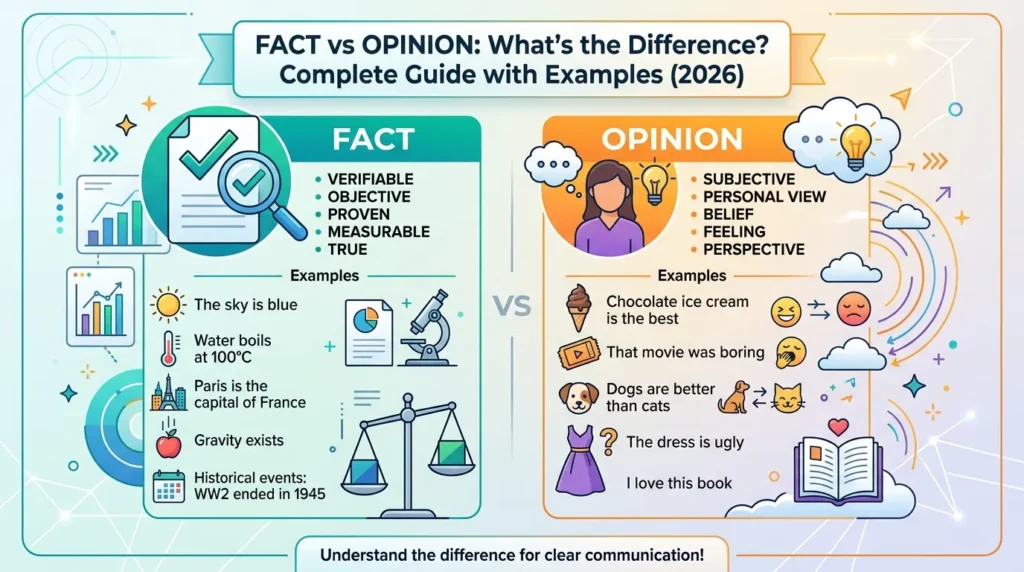
Fact vs Opinion – Quick Answer
A fact is a statement that can be verified or supported by reliable evidence.
An opinion is a personal belief, feeling, preference, or judgment that is not established as true simply because someone believes it.
Example of a Fact
Water freezes at 0°C (32°F) under standard atmospheric pressure.
This is a factual statement because it can be tested and verified under the stated conditions.
Example of an Opinion
Winter is the best season.
This is an opinion because people can have different preferences about the best season.
Quick Comparison
| Fact | Opinion |
|---|---|
| Can be verified with evidence | Expresses a belief, feeling, preference, or judgment |
| Based on evidence | Often based on personal experience or perspective |
| Can be independently checked | Cannot be established as universally true simply by agreement |
| Does not depend on personal preference | May differ from person to person |
| Common in scientific and historical claims | Common in reviews, preferences, and judgments |
The Origin of Fact and Opinion
The words fact and opinion have long histories and entered English from Latin through the development of European languages.
Fact
The word fact comes from the Latin factum, meaning something done, an act, or a thing made.
Over time, the English word developed its modern meaning of something regarded as true or established through evidence or observation.
Opinion
The word opinion comes from the Latin opinio, meaning belief, judgment, or way of thinking.
Today, opinion commonly refers to a person’s view, belief, preference, or judgment about a subject.
Why Are There No Spelling Differences?
The words fact and opinion are spelled the same in both British English and American English.
Some related words may have different spellings between the two varieties, but the spelling of fact and opinion does not change.
British English vs American English Spelling
Fact and opinion have the same spelling in British English and American English.
The difference can appear in surrounding words, particularly some verbs ending in -ise and -ize.
British English Examples
- Analyse the facts.
- Organise your opinions.
- Optimise your writing.
American English Examples
- Analyze the facts.
- Organize your opinions.
- Optimize your writing.
British English vs American English Comparison
| British English | American English |
|---|---|
| Fact | Fact |
| Opinion | Opinion |
| Analyse | Analyze |
| Organise | Organize |
| Optimise | Optimize |
| Programme | Program |
For fact vs opinion, there is no spelling change between British and American English. Writers should simply maintain a consistent English style throughout their work.
Which Spelling Should You Use for Fact and Opinion?
When writing about these concepts, use:
- Fact
- Opinion
These spellings are correct in both British and American English.
For US Readers
If your content follows American English, use American spellings in surrounding words.
Example:
Analyze the facts before sharing the information.
For UK Readers
If your content follows British English, use British spellings.
Example:
Analyse the facts before sharing the information.
For a Global Audience
Choose one English style and use it consistently. American English is widely used on international websites, while British English is commonly used in the UK and many other countries.
The important point is that the words fact and opinion themselves remain unchanged.
Fact vs Opinion: Key Differences
Understanding the difference between fact and opinion makes it easier to evaluate statements in books, articles, news reports, advertisements, social media posts, and everyday conversations.
Evidence
A fact is supported by evidence that can be checked. Evidence may include measurements, records, observations, research findings, official data, or other reliable information.
An opinion may be based on personal experience, preference, belief, values, or interpretation.
Verification
A factual claim can generally be investigated to determine whether the available evidence supports it.
An opinion usually expresses a person’s perspective rather than a claim that can be established as objectively true for everyone.
Objectivity
Facts are generally presented as information that can be independently verified.
Opinions can vary because people have different experiences, preferences, values, and perspectives.
Purpose
Facts are commonly used to provide information, describe events, report measurable results, or explain established findings.
Opinions are often used to express preferences, make judgments, interpret information, persuade readers, or start discussions.
Example
Fact:
The Earth orbits the Sun.
This is a factual statement because it can be supported by scientific evidence.
Opinion:
Space is the most interesting science topic.
This is an opinion because it expresses a personal judgment. Another person may find biology, chemistry, history, or another subject more interesting.
Examples of Fact and Opinion Sentences
Learning through examples is one of the easiest ways to understand the difference between fact and opinion.
Examples of Facts
1. The Earth orbits the Sun.
This is a fact because it can be supported and verified through scientific observation.
2. A week has seven days.
This is a fact based on the standard calendar system.
3. Water is composed of hydrogen and oxygen.
This is a scientific fact that can be established through scientific knowledge and evidence.
4. The Pacific Ocean is the largest ocean on Earth.
This can be verified using geographic information.
5. The human body has a heart that pumps blood through the circulatory system.
This can be supported through biological evidence.
Examples of Opinions
1. Summer is the best season.
This is an opinion because “best” depends on personal preference.
2. Chocolate ice cream tastes better than vanilla ice cream.
This expresses a personal preference.
3. Reading books is more enjoyable than watching television.
Different people may have different views.
4. Cricket is the most exciting sport.
This is a personal judgment rather than a universally verifiable fact.
5. Online learning is better than classroom learning.
This may depend on a person’s learning style, experience, and circumstances.
Fact and Opinion Sentence Comparison
| Sentence | Type | Reason |
|---|---|---|
| The Earth orbits the Sun. | Fact | It can be verified through scientific evidence. |
| Water contains hydrogen and oxygen. | Fact | It can be scientifically established. |
| Summer is the best season. | Opinion | “Best” expresses a personal judgment. |
| Chocolate ice cream tastes better than vanilla. | Opinion | Taste preference varies between people. |
| A week has seven days. | Fact | It can be verified using the standard calendar. |
| Cricket is the most exciting sport. | Opinion | Different people can have different preferences. |
Fact vs Opinion Comparison Table
| Feature | Fact | Opinion |
|---|---|---|
| Main basis | Evidence and verifiable information | Belief, preference, feeling, or judgment |
| Verification | Can generally be checked | Usually cannot be established as universally true |
| Personal preference | Not required | Often involved |
| Can differ between people? | The underlying factual claim does not depend on personal preference | Yes |
| Common examples | Scientific, historical, geographic, and measurable claims | Reviews, preferences, judgments, and interpretations |
| Example | The Earth orbits the Sun. | Space is fascinating. |
How to Identify a Fact or Opinion
When you are unsure whether a statement is a fact or an opinion, ask a few simple questions.
1. Can the Statement Be Verified?
Ask whether reliable evidence can confirm the statement.
If the answer is yes, the statement may be factual.
2. Does It Express a Personal Judgment?
Words such as best, worst, beautiful, boring, exciting, delicious, better, terrible, or amazing often indicate an opinion when they express personal judgment.
For example:
This is the best restaurant in the city.
The word best expresses a judgment and may indicate an opinion.
3. Is There Supporting Evidence?
Look for:
- Research
- Official records
- Measurements
- Statistics
- Direct observations
- Reliable documentation
Evidence can help determine whether a statement is supported.
4. Could Reasonable People Have Different Views?
If the statement depends mainly on personal preference or judgment, it is likely an opinion.
For example:
Blue is the most beautiful color.
People can reasonably disagree because beauty is subjective.
5. Separate the Claim From the Interpretation
Sometimes a sentence contains both factual information and interpretation.
For example:
The company increased sales by 20%, showing that its new strategy was highly successful.
The 20% increase may be a factual claim if supported by company records.
The statement that this proves the strategy was highly successful is an interpretation that may require additional evidence.
Common Mistakes About Fact vs Opinion
Many people confuse facts and opinions, especially when information appears in news reports, advertisements, social media posts, and everyday conversations.
Mistake 1: If Many People Believe Something, It Becomes a Fact
Incorrect idea:
If many people believe something, it becomes a fact.
Correction:
Popularity does not make a statement factual. A factual claim should be supported by evidence that can be checked. A widely held belief can still be an opinion.
Mistake 2: Opinions Are Always Wrong
Incorrect idea:
Opinions are always wrong.
Correction:
Opinions are personal views, preferences, beliefs, or judgments. They are not automatically right or wrong simply because they are opinions.
Mistake 3: Facts Never Change
Incorrect idea:
Facts never change.
Correction:
Facts are based on evidence, while scientific understanding can be refined when new evidence becomes available. A change in scientific understanding does not mean that evidence was irrelevant; it means knowledge can develop as better evidence becomes available.
Mistake 4: Everything in the News Is a Fact
Incorrect idea:
Everything reported in the news is a fact.
Correction:
News content can include factual reporting, analysis, quotations, interpretations, and opinions. Readers should distinguish verifiable claims from commentary and interpretation.
Mistake 5: Opinions Do Not Need Reasons
Incorrect idea:
Opinions do not need reasons.
Correction:
A person can hold an opinion without proving it, but a strong opinion can be supported with facts, evidence, examples, and logical reasoning. Supporting an opinion helps readers understand why someone holds that view.
Mistake 6: A Statement Is a Fact Because It Sounds Professional
Incorrect idea:
If a statement sounds confident or professional, it must be a fact.
Correction:
The tone of a statement does not determine whether it is factual. Claims should be evaluated based on evidence and reliable information.
Fact vs Opinion in Everyday Examples
The difference between fact and opinion becomes easier to understand when you see how both are used in everyday communication.
Fact and Opinion in an Email
Example:
According to the sales report, revenue increased by 12%. In my opinion, our marketing campaign contributed significantly to this increase.
The 12% increase is a factual claim if the sales report supports it.
The statement about the marketing campaign is an interpretation or opinion unless sufficient evidence establishes that the campaign caused the increase.
Fact and Opinion in the News
Fact:
The unemployment rate fell last month.
This can be checked against reliable economic data.
Opinion or interpretation:
The economy is improving quickly.
This involves interpretation because people may use different measures to determine what counts as rapid economic improvement.
Fact and Opinion on Social Media
Example:
Chocolate ice cream is the best flavor.
This is an opinion because it expresses a personal preference.
Another person may prefer vanilla, strawberry, or another flavor.
Fact and Opinion in Formal Writing
Example:
The study reported an increase in physical activity among participants. The author believes morning exercise is the most effective option.
The study’s reported finding is presented as a factual claim based on research.
The statement that morning exercise is the most effective option is a judgment or interpretation unless it is specifically established by appropriate evidence.
Fact vs Opinion in School and Education
Students regularly encounter facts and opinions in textbooks, essays, assignments, examinations, and classroom discussions.
Example of a Fact
The Moon orbits Earth.
This can be verified using scientific evidence.
Example of an Opinion
The Moon is the most beautiful object in the night sky.
This expresses a personal judgment.
Why Students Need to Know the Difference
Understanding fact and opinion helps students:
- Evaluate information
- Write stronger essays
- Support arguments with evidence
- Recognize unsupported claims
- Understand reading passages
- Develop critical-thinking skills
- Distinguish evidence from personal judgment
A student should not treat every statement in a source as equally factual. Instead, the student should consider what evidence supports the claim.
Fact vs Opinion in Media and Online Information
The internet makes it easy for factual claims and opinions to appear together.
A social media post may contain a statistic, a personal interpretation, and a recommendation in the same paragraph.
For example:
The product received 10,000 downloads last month, so it is clearly the best product available.
The 10,000 downloads may be a factual claim if reliable records support it.
The statement that the product is the best available is an opinion or judgment.
This is why readers should examine individual claims rather than accepting an entire post as either completely factual or completely opinion-based.
Fact vs Opinion Keyword Variations
People use different phrases when searching for information about facts and opinions.
| Keyword or Search Phrase | Search Intent |
|---|---|
| Fact vs opinion | Understand the difference |
| Difference between fact and opinion | Learn how the concepts differ |
| Fact and opinion examples | Find practical examples |
| Examples of fact and opinion sentences | Learn through sentences |
| Fact or opinion | Identify a statement |
| Fact vs opinion worksheet | Educational practice |
| Fact vs opinion for kids | Beginner-friendly explanation |
| Fact and opinion meaning | Learn definitions |
| How to identify facts and opinions | Learn identification methods |
The phrase “examples of fact and opinion sentences” is especially useful for readers looking for practical examples rather than only definitions.
Frequently Asked Questions About Fact and Opinion
What Is the Difference Between Fact and Opinion?
A fact is a statement that can be verified or supported by reliable evidence, while an opinion expresses a personal belief, feeling, preference, or judgment.
What Is an Example of a Fact and an Opinion?
Fact: The Earth orbits the Sun.
Opinion: Space is the most interesting science topic.
The first statement can be verified through scientific evidence, while the second expresses a personal judgment.
Can an Opinion Become a Fact?
An opinion does not become a fact simply because many people agree with it. A claim needs appropriate evidence to establish whether it is factual.
Why Is It Important to Know the Difference Between Fact and Opinion?
Knowing the difference helps people evaluate information, identify unsupported claims, think critically, and communicate more accurately.
Can an Opinion Include Facts?
Yes. An opinion can be supported by factual information.
For example:
The product costs $50, so I think it offers good value.
The price may be a factual claim, while the judgment about its value is an opinion.
Are Facts Always True?
A factual claim is presented as something that can be verified through evidence. However, scientific knowledge can be refined when new evidence becomes available. Therefore, it is important to consider the quality and current state of evidence.
How Can I Identify a Fact?
Ask whether the statement can be checked through reliable evidence, records, measurements, observation, research, or other trustworthy information.
How Can I Identify an Opinion?
Look for personal judgments, preferences, beliefs, feelings, or subjective language. Statements containing words such as best, worst, beautiful, boring, better, or amazing may express opinions when used as personal judgments.
Are Reviews Facts or Opinions?
Reviews can contain both. Product specifications, prices, dimensions, and other verifiable information may be factual, while statements about whether a product is enjoyable, attractive, useful, or worth buying are often opinions or judgments.
Can One Sentence Contain Both Fact and Opinion?
Yes. A sentence can combine a factual claim with an interpretation or judgment.
For example:
The phone has a 5,000 mAh battery, so it is the best phone for travel.
The battery capacity can be verified, while the best phone for travel is a judgment.
Why Fact vs Opinion Matters
Knowing the difference between fact and opinion is useful far beyond school assignments.
In Education
Students need to identify evidence, understand arguments, and distinguish information from personal judgment.
In Journalism and Media
Readers need to recognize the difference between reported information, analysis, commentary, and opinion.
In the Workplace
Employees may need to separate measurable results from personal interpretations when discussing projects, sales, performance, or business decisions.
On Social Media
Users encounter claims, recommendations, personal experiences, advertisements, and opinions every day. Understanding the difference can help them evaluate information more carefully.
In Everyday Decisions
Whether comparing products, reading reviews, choosing services, or discussing current events, recognizing facts and opinions helps people make decisions based on relevant evidence rather than unsupported claims.
Conclusion
Understanding fact vs opinion is an essential skill for students, professionals, and anyone who reads information online or in print. Facts are supported by evidence and can be verified, while opinions reflect personal beliefs, feelings, or judgments. Both have important roles in communication, but knowing the difference helps you evaluate information more carefully and avoid misinformation. Whether you’re writing an essay, reading the news, participating in discussions, or browsing social media, asking whether a statement is a fact or an opinion encourages critical thinking and better decision-making. By practicing this skill regularly, you’ll become a more informed reader, a stronger writer, and a more confident communicator. Always look forevidence before accepting a statement as fact, and remember that respectful opinions can still add value to conversations, even when people disagree.