
If you’ve ever set up a home Wi-Fi network, worked in an office, or studied computer networking, you’ve probably come across the terms LAN and WAN. At first, they may seem confusing because both refer to computer networks. However, they serve different purposes and operate on different scales. Understanding LAN vs WAN is essential for students, IT professionals, business owners, and anyone interested in networking.
People search for LAN vs WAN because they want to know which network is used at home, how the internet fits into the picture, and what makes one network different from the other. Many beginners assume they are the same, but the main difference lies in the size of the network and how devices communicate.
This guide explains LAN vs WAN in simple English. You’ll learn what each network is, how they work, their history, spelling rules, common mistakes, practical examples, and how they are used in real life. By the end, you’ll clearly understand the differences and know when to use a LAN or a WAN.
LAN vs WAN – Quick Answer
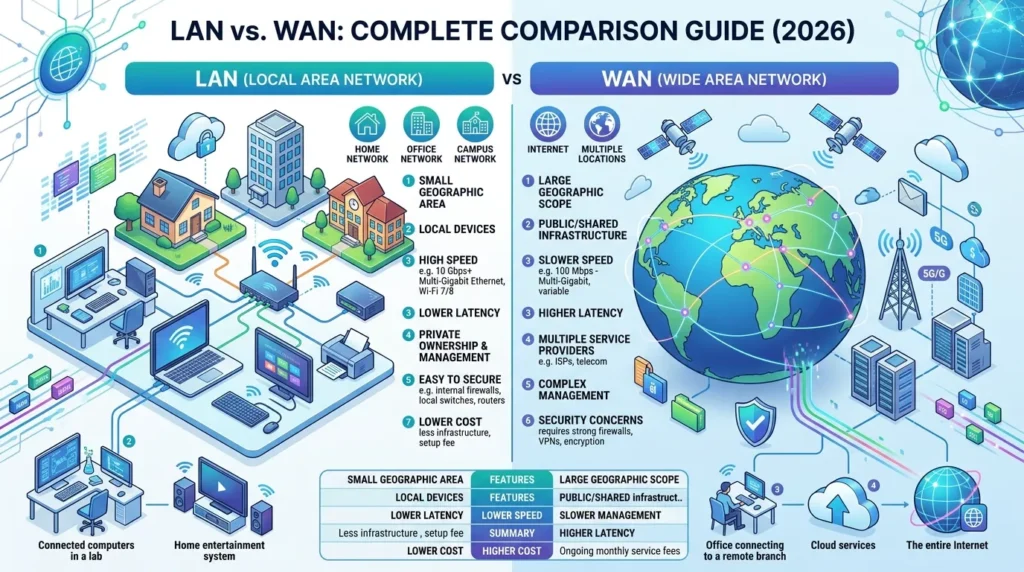
A LAN (Local Area Network) connects computers and devices within a small area, such as a home, school, or office.
A WAN (Wide Area Network) connects multiple LANs over large distances, such as cities, countries, or even the entire world.
Simple Example
- Your home Wi-Fi network is a LAN.
- The Internet is the largest example of a WAN.
Quick Comparison
| Feature | LAN | WAN |
|---|---|---|
| Full Form | Local Area Network | Wide Area Network |
| Coverage | Small area | Large area |
| Speed | Faster | Usually slower |
| Ownership | Individual or organization | Multiple providers |
| Example | Home network | Internet |
The Origin of LAN vs WAN
The terms LAN and WAN were created as computer networking expanded in the 1970s and 1980s.
LAN
LAN stands for Local Area Network.
- Local means a limited or nearby area.
- Area refers to a specific location.
- Network means connected devices sharing data.
LANs were developed to allow computers in the same building to communicate and share resources.
WAN
WAN stands for Wide Area Network.
- Wide means covering a large distance.
- Area refers to a broad geographic region.
- Network means connected systems.
WANs were introduced to connect multiple LANs across cities, countries, and continents.
Why There Are No Spelling Differences
LAN and WAN are technical acronyms.
Their spelling is the same in British English, American English, and all other forms of English.
British English vs American English Spelling
The acronyms LAN and WAN never change spelling.
Only surrounding English words differ.
Examples
British English
- Organise the LAN network.
- Analyse WAN traffic.
American English
- Organize the LAN network.
- Analyze WAN traffic.
Comparison Table
| British English | American English |
|---|---|
| LAN | LAN |
| WAN | WAN |
| Organise | Organize |
| Analyse | Analyze |
| Optimise | Optimize |
| Programme | Program (software) |
Which Spelling Should You Use?
Always write the networking terms as:
- LAN
- WAN
Never change their spelling.
For US Readers
Use American English.
Example:
- Optimize your LAN performance.
For UK Readers
Use British English.
Example:
- Optimise your LAN performance.
For a Global Audience
American English is more common in IT documentation, networking certifications, and technology websites. However, British English is equally correct if used consistently.
LAN vs WAN: Key Differences
Coverage Area
A LAN covers a small physical area.
A WAN connects devices over much larger geographic distances.
Speed
LANs generally provide faster communication because devices are physically close.
WANs often have higher latency because data travels over longer distances.
Ownership
A LAN is usually owned by a home user, school, or company.
A WAN is often managed by multiple internet service providers and telecommunications companies.
Cost
LANs are relatively inexpensive to build and maintain.
WANs require more infrastructure and are generally more expensive.
Security
LANs are easier to secure because they operate within a controlled environment.
WANs require stronger security measures since they connect over public or shared networks.
LAN vs WAN Comparison Table
| Feature | LAN | WAN |
|---|---|---|
| Full Form | Local Area Network | Wide Area Network |
| Geographic Area | Small | Large |
| Typical Speed | High | Moderate |
| Setup Cost | Low | High |
| Ownership | Private | Shared or Multiple Organizations |
| Security | Easier | More Complex |
| Internet Required | No | Usually Yes |
| Example | Home Wi-Fi | Internet |
Common Mistakes with LAN vs WAN
Many beginners confuse these networking terms.
Mistake 1
LAN and WAN are the same.
✅ Correction:
A LAN covers a small area, while a WAN connects networks across large distances.
Mistake 2
The Internet is a LAN.
✅ Correction:
The Internet is the world’s largest WAN.
Mistake 3
Every office network is a WAN.
✅ Correction:
Most office networks are LANs.
Mistake 4
WAN is always slower than LAN.
✅ Correction:
LANs are usually faster, but modern WAN technologies can still provide high-speed connections.
Mistake 5
LAN always requires Wi-Fi.
✅ Correction:
A LAN can use Ethernet cables, Wi-Fi, or both.
LAN vs WAN in Everyday Examples
“Our office LAN is working, but the WAN connection to the headquarters is unavailable.”
News
“Businesses continue investing in secure WAN solutions to connect remote offices.”
Social Media
“I finally understand the difference between a LAN and a WAN after upgrading my home network.”
Formal Writing
“A LAN connects devices within a limited area, whereas a WAN links multiple local networks across wider geographic regions.”
LAN vs WAN – Google Trends & Usage Data
Search interest in LAN vs WAN remains high because networking is an essential part of education, business, and IT certifications.
LAN
Common searches include:
- What is LAN?
- LAN examples
- LAN cable
- LAN setup
WAN
Popular searches include:
- What is WAN?
- WAN examples
- WAN connection
- WAN port
Countries with strong search interest include:
- United States
- India
- United Kingdom
- Canada
- Australia
Many students preparing for networking certifications such as CompTIA Network+, Cisco CCNA, and other IT exams frequently search for this topic.
LAN vs WAN Keyword Variations
| Search Term | Meaning |
|---|---|
| LAN vs WAN | Main comparison |
| WAN vs LAN | Same comparison, reversed |
| Difference between LAN and WAN | General explanation |
| LAN and WAN difference | Beginner guide |
| LAN vs WAN examples | Practical comparison |
| LAN vs WAN networking | Networking concepts |
| LAN or WAN | Choosing the correct network type |
| LAN and WAN explained | Easy explanation |
FAQs
What is the main difference between LAN and WAN?
A LAN connects devices within a small area, while a WAN connects multiple LANs across large geographic regions.
Is the Internet a LAN or a WAN?
The Internet is the world’s largest WAN because it connects millions of smaller networks worldwide.
Which is faster, LAN or WAN?
LAN is generally faster because devices are located close together and data travels shorter distances.
Can a LAN work without the Internet?
Yes. A LAN can function independently for sharing files, printers, and other local resources without internet access.
Who owns a WAN?
WANs are usually operated by internet service providers, telecommunications companies, or large organizations.
Can a company have both LAN and WAN?
Yes. Most businesses use LANs inside offices and WANs to connect multiple office locations.
Is Wi-Fi considered a LAN?
Yes. A home or office Wi-Fi network is usually part of a wireless LAN (WLAN).
Conclusion
Understanding LAN vs WAN is an important step in learning computer networking. Although both networks connect devices, they are designed for different purposes. A LAN (Local Area Network) is ideal for connecting computers, printers, and other devices within a small area such as a home, school, or office. A WAN (Wide Area Network) connects multiple LANs across larger geographic regions, making global communication and internet access possible. Knowing the difference helps students, IT professionals, and business owners choose the right network for their needs. Whether you’re preparing for a networking certification, setting up a home network, or simply improving your technical knowledge, understanding LAN and WAN provides a strong foundation. As networking technologies continue to evolve, these two core concepts will remain essential in both personal and professional environments.