
Many beginners think Java and JavaScript are the same programming language because their names look almost identical. This is one of the biggest misconceptions in programming. In reality, Java vs JavaScript is a comparison between two completely different languages that serve different purposes.
People search for Java vs JavaScript when deciding which language to learn, preparing for coding interviews, building websites, or starting a software development career. Understanding the difference can save you time and help you choose the right language for your goals.
In this guide, you’ll learn what Java and JavaScript are, how they differ, where they are used, and which one is best for beginners. We’ll also explain their origins, clear up common myths, compare British and American English spelling, review popularity trends, answer frequently asked questions, and provide practical examples. By the end, you’ll have a clear understanding of when to use Java, when to use JavaScript, and why their similar names don’t mean they are the same language.
Java vs JavaScript – Quick Answer
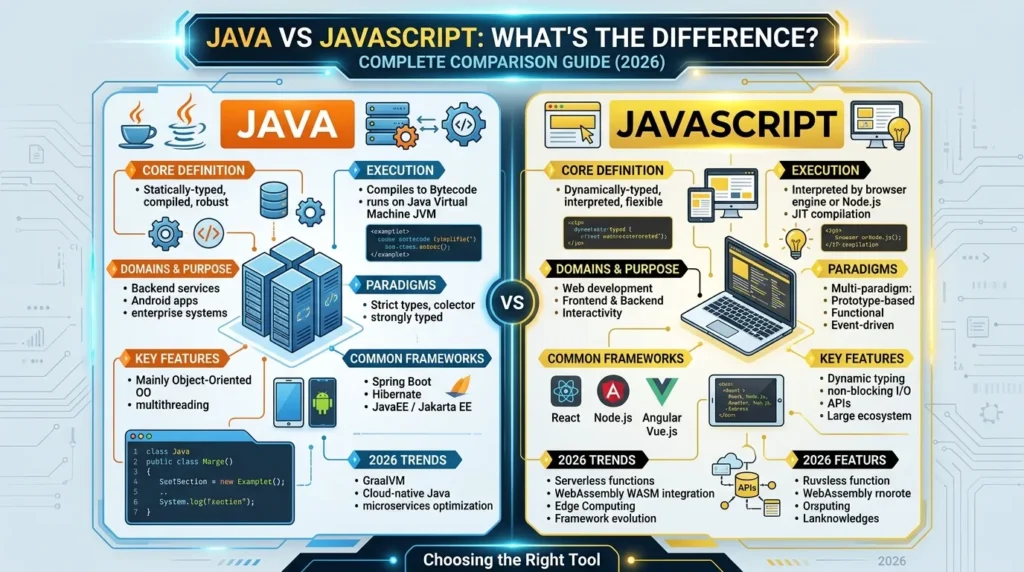
Java is a general-purpose, object-oriented programming language mainly used for enterprise software, Android development, desktop applications, and backend systems.
JavaScript is a scripting language primarily used to make websites interactive. It also powers server-side applications, mobile apps, and desktop software through modern frameworks.
Quick Example
- Java: Build an Android banking app.
- JavaScript: Create an interactive website with animations and forms.
Quick Comparison
| Feature | Java | JavaScript |
|---|---|---|
| Type | Programming language | Scripting language |
| Main Use | Enterprise apps, Android | Web development |
| Runs On | Java Virtual Machine (JVM) | Web browser & Node.js |
| Learning Difficulty | Moderate | Easy to Moderate |
| Performance | High | High for web applications |
The Origin of Java vs JavaScript
Although their names are similar, Java and JavaScript were created separately for different reasons.
Java
Java was developed by James Gosling and his team at Sun Microsystems in 1995.
It was first called Oak, but the name was changed to Java, inspired by Java coffee.
Its goal was to create software that could run on different operating systems without modification.
JavaScript
JavaScript was created by Brendan Eich in 1995 while working at Netscape.
It was developed in just 10 days to make websites interactive.
The language was originally called Mocha, then LiveScript, and finally JavaScript for marketing reasons because Java was becoming very popular.
Why Do They Have Similar Names?
The similarity is mainly due to branding.
Despite their names, Java and JavaScript are different languages with different syntax, features, and use cases.
British English vs American English Spelling
There are no spelling differences between Java and JavaScript in British English and American English.
These are official programming language names and always use the same spelling.
The only differences appear in surrounding English words.
Examples
British English
- Optimise Java code.
- Analyse JavaScript performance.
- Organise your project.
American English
- Optimize Java code.
- Analyze JavaScript performance.
- Organize your project.
Comparison Table
| British English | American English |
|---|---|
| Java | Java |
| JavaScript | JavaScript |
| Optimise | Optimize |
| Analyse | Analyze |
| Organise | Organize |
| Programme | Program (software) |
Which Spelling Should You Use?
Always write the language names exactly as:
- Java
- JavaScript
Never change their spelling.
For US Readers
Use American English around the language names.
Example:
- Optimize your Java application.
For UK Readers
Use British English.
Example:
- Optimise your Java application.
For a Global Audience
American English is the most common style in programming documentation, tutorials, and developer communities.
Whichever style you choose, remain consistent throughout your writing.
Java vs JavaScript: Key Differences
Purpose
Java is designed for building large, secure, and reliable software applications.
JavaScript is designed to make websites interactive and dynamic.
Execution
Java programs run on the Java Virtual Machine (JVM).
JavaScript runs directly inside web browsers and can also run on servers using Node.js.
Syntax
Java requires more structured code.
JavaScript offers greater flexibility and requires less code for many tasks.
Performance
Java generally performs better for large enterprise applications.
JavaScript performs exceptionally well for modern web development.
Learning Curve
Java introduces object-oriented programming concepts early.
JavaScript is usually easier to start with, especially for web development.
Java vs JavaScript Comparison Table
| Feature | Java | JavaScript |
|---|---|---|
| Release Year | 1995 | 1995 |
| Creator | James Gosling | Brendan Eich |
| Main Use | Enterprise Software | Interactive Websites |
| Platform | JVM | Browser & Node.js |
| Android Development | Yes | Limited |
| Front-End Development | No | Yes |
| Back-End Development | Yes | Yes (Node.js) |
| Mobile Apps | Yes | Yes (Frameworks) |
| Desktop Apps | Yes | Yes |
| Learning Difficulty | Moderate | Easy to Moderate |
Common Mistakes with Java vs JavaScript
Many beginners misunderstand these two languages.
Mistake 1
Java and JavaScript are the same language.
✅ Correction:
They are completely different programming languages.
Mistake 2
JavaScript requires Java.
✅ Correction:
JavaScript works independently and does not require Java.
Mistake 3
Java is only for Android development.
✅ Correction:
Java is also widely used for enterprise software, web servers, cloud systems, and desktop applications.
Mistake 4
JavaScript only works in browsers.
✅ Correction:
JavaScript also runs on servers using Node.js and powers many modern applications.
Mistake 5
JavaScript is easier because it’s less powerful.
✅ Correction:
JavaScript is one of the world’s most powerful and widely used programming languages.
Java vs JavaScript in Everyday Examples
“Our website uses JavaScript for interactive forms, while the backend services run on Java.”
News
“Many businesses continue using Java for enterprise software while adopting JavaScript for modern web applications.”
Social Media
“I’m learning JavaScript first because I want to become a front-end developer.”
Formal Writing
“Java remains a leading enterprise programming language, while JavaScript dominates interactive web development.”
Java vs JavaScript – Google Trends & Usage Data
Both languages remain among the world’s most popular programming technologies.
Java
Popular in:
- Enterprise software
- Banking
- Government systems
- Android development
- Cloud computing
Countries with high usage include:
- India
- United States
- Germany
- Brazil
- Japan
JavaScript
Popular in:
- Web development
- Front-end frameworks
- Full-stack development
- Mobile apps
- Interactive websites
Countries with strong adoption include:
- United States
- India
- Canada
- United Kingdom
- Australia
JavaScript consistently ranks among the most widely used programming languages because nearly every modern website uses it.
Java vs JavaScript Keyword Variations
| Search Term | Meaning |
|---|---|
| Java vs JavaScript | Main comparison |
| JavaScript vs Java | Same comparison, reversed |
| Difference between Java and JavaScript | General comparison |
| Java or JavaScript | Choosing a language |
| Java vs JavaScript for beginners | Learning comparison |
| Java vs JavaScript performance | Speed comparison |
| Java vs JavaScript syntax | Code comparison |
| Java vs JavaScript career | Job opportunities |
FAQs
Is Java the same as JavaScript?
No. They are two different programming languages with different purposes and features.
Which is easier to learn, Java or JavaScript?
JavaScript is generally easier for beginners interested in web development, while Java has a steeper learning curve.
Can JavaScript replace Java?
No. Each language has different strengths and is used in different types of projects.
Should I learn Java or JavaScript first?
If you want to build websites, start with JavaScript. If you’re interested in Android apps or enterprise software, Java is a great choice.
Does JavaScript need Java installed?
No. JavaScript runs independently and does not require Java.
Which language offers better career opportunities?
Both offer excellent career opportunities. The right choice depends on your interests and the type of software you want to build.
Can I learn both Java and JavaScript?
Yes. Many professional developers learn both languages because they are useful for different kinds of projects.
Conclusion
Choosing between Java vs JavaScript depends on what you want to create. Despite their similar names, they are separate programming languages with different purposes. Java is ideal for enterprise applications, Android development, large-scale software, and systems that require high performance and reliability. JavaScript is the foundation of modern web development, enabling interactive websites and supporting both front-end and back-end development through technologies like Node.js. If your goal is to become a web developer, JavaScript is an excellent place to start. If you plan to work on enterprise software, Android apps, or large business systems, Java is a strong choice. Many developers eventually learn both languages because together they cover a wide range of software development needs. Understanding their differences will help you choose the right path and build the skills that match your career goals.