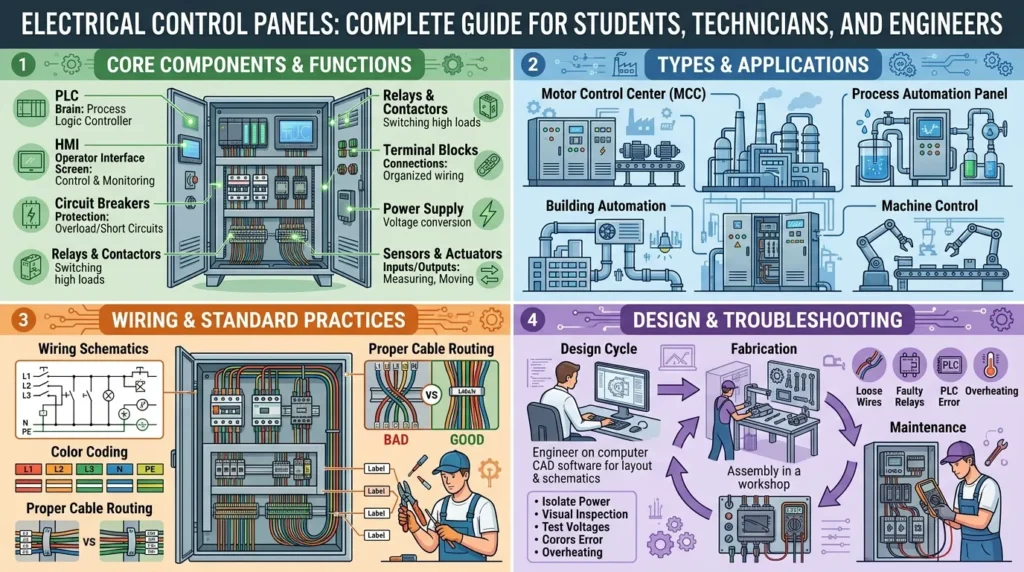

Imagine walking into a large factory where hundreds of machines are running smoothly at the same time. Conveyor belts move products, motors control pumps, and safety systems respond instantly when needed. Behind all this smooth operation is one hidden but powerful system — electrical control panels.
These panels are the “brain” of electrical systems. Without them, machines would not start, stop, or operate safely. From small residential buildings to large industrial plants, control panels play a critical role in managing electricity and automation.
Understanding electrical control panels is very important for electrical students, engineers, and technicians because they are widely used in real-world applications. If you want to work in industries like manufacturing, power plants, automation, or building maintenance, this knowledge is essential.
In this article, you will learn what electrical control panels are, how they work, their types, components, advantages, disadvantages, applications, and future trends. The goal is to make the topic simple, practical, and easy to understand even for beginners.
2. What is Electrical Control Panels?
An electrical control panel is a metal box that contains electrical devices used to control and monitor electrical equipment.
Simple Definition:
It is a system that controls machines, motors, and electrical processes safely and efficiently.
Easy Explanation:
Think of it like a “control room” inside a box. Just like a TV remote controls a television, a control panel controls electrical machines.
Practical Example:
In a water pumping system, the control panel:
- Starts the pump automatically when water level drops
- Stops the pump when the tank is full
- Protects the motor from overload or damage
This makes the system automatic, safe, and reliable.
3. Working Principle of Electrical Control Panels
The working principle of electrical control panels working principle is based on receiving signals, processing them, and controlling output devices.
Step-by-Step Working:
- Power Input
- Electrical supply enters the panel.
- Control Signal Detection
- Sensors or switches send signals (e.g., temperature, pressure, level).
- Processing
- Devices like relays, timers, or PLCs analyze the signal.
- Decision Making
- The system decides whether to turn ON or OFF a machine.
- Output Action
- Motors, lights, or equipment are controlled accordingly.
Simple Analogy:
Think of the human brain:
- Eyes = sensors
- Brain = control system
- Hands/legs = machines
The control panel works the same way — it “sees,” “decides,” and “acts.”
4. Types / Classification of Electrical Control Panels
4.1 Power Control Panels
These panels manage electrical power distribution in industrial systems.
- Used for controlling heavy loads
- Found in factories and plants
4.2 Motor Control Center (MCC) Panels
These are used to control electric motors.
- Start/stop motor operations
- Protect motors from overload
- Used in manufacturing industries
4.3 PLC Control Panels
PLC stands for Programmable Logic Controller.
- Fully automated control systems
- Used in modern industries
- High accuracy and flexibility
4.4 Automatic Control Panels
These work without human intervention.
- Used in water pumps, generators, HVAC systems
- Operate based on sensors
4.5 Lighting Control Panels
Used for controlling lighting systems in buildings.
- Energy saving
- Smart lighting control
5. Main Components of Electrical Control Panels
5.1 Circuit Breakers
- Protect the system from overload and short circuits
5.2 Contactors
- Switch electrical loads ON and OFF
5.3 Relays
- Control circuits using small signals
5.4 PLC (if used)
- Brain of automation systems
5.5 Fuses
- Protect circuits by breaking current flow
5.6 Power Supply Unit
- Provides required voltage to control devices
5.7 Busbars
- Distribute electrical power inside the panel
5.8 Terminal Blocks
- Connect wires safely and neatly
Each component has a specific role, and together they ensure safe and reliable operation.
6. Advantages of Electrical Control Panels
- Improves safety of electrical systems
- Automates machine operations
- Reduces human effort
- Increases efficiency and productivity
- Protects equipment from damage
- Easy monitoring and control
- Suitable for large-scale industries
- Saves energy in modern systems
These benefits make them essential in modern electrical engineering.
7. Disadvantages / Limitations
- High initial installation cost
- Requires skilled technicians for maintenance
- Complex wiring in advanced systems
- Fault detection can be difficult
- Needs regular servicing
Despite these limitations, the benefits are much greater in industrial use.
8. Applications of Electrical Control Panels
The electrical control panels applications are wide and important in daily life.
Residential Use:
- Water pump control
- Home automation systems
- Generator control
Industrial Use:
- Manufacturing plants
- Conveyor systems
- Motor control in factories
Commercial Use:
- Shopping malls
- Office buildings
- HVAC systems
Modern Technology:
- Smart homes
- IoT-based automation
- Renewable energy systems (solar panels, wind turbines)
9. Comparison: Electrical Control Panels vs Distribution Boards
| Feature | Electrical Control Panels | Distribution Boards |
|---|---|---|
| Function | Controls machines and processes | Distributes electricity |
| Complexity | High | Simple |
| Automation | Yes (often) | No |
| Components | Relays, PLCs, contactors | Breakers, fuses |
| Usage | Industrial systems | Homes and buildings |
Difference between electrical control panels and distribution boards:
Control panels manage operations, while distribution boards only distribute power.
10. Selection Guide (How to Choose the Right Control Panel)
When selecting a control panel, consider:
- Type of load (motor, lighting, machinery)
- Voltage and current rating
- Environment (dust, heat, moisture)
- Level of automation required
- Safety requirements
- Future expansion needs
Beginner Tips:
- Start with basic knowledge of wiring diagrams
- Understand component functions
- Learn safety standards first
- Practice with small control systems
11. Common Problems & Solutions
Problem 1: Panel overheating
- Cause: Overload or poor ventilation
- Solution: Improve cooling and reduce load
Problem 2: Equipment not starting
- Cause: Faulty relay or wiring issue
- Solution: Check connections and replace faulty parts
Problem 3: Frequent tripping
- Cause: Short circuit or overload
- Solution: Inspect circuit and balance load
Problem 4: PLC communication failure
- Cause: Wiring or software issue
- Solution: Reset system and check connections
Problem 5: Noise in contactors
- Cause: Loose parts or voltage fluctuation
- Solution: Tighten connections and stabilize supply
12. Future Trends in Electrical Control Panels
The future of control panels is moving toward smart and digital systems.
Key Trends:
- Smart IoT-based control panels
- AI-powered automation systems
- Remote monitoring via mobile apps
- Energy-efficient designs
- Compact and modular panels
- Integration with renewable energy systems
Industries are shifting toward fully automated systems where human involvement is minimal.
13. Conclusion
Electrical control panels are a vital part of modern electrical systems. They act as the central control unit for machines, ensuring safe, efficient, and automated operation. From simple motor control to advanced industrial automation, their role is extremely important.
For students and beginners, understanding control panels is the foundation of a successful electrical engineering career. For engineers and technicians, this knowledge helps in designing, troubleshooting, and maintaining complex systems.
As technology evolves, control panels are becoming smarter, more compact, and highly automated. Learning this topic today will prepare you for the future of electrical and industrial automation.


fitte mou kalyaaa
????????????