
Imagine living in an apartment during a hot summer where installing a traditional wall-mounted air conditioner is not allowed. The room becomes uncomfortable, especially during the afternoon heat. In such situations, many people use a Portable Air Conditioner to quickly cool the room without permanent installation.
Portable air conditioners have become increasingly popular because they are easy to install, movable, and suitable for temporary cooling needs. Unlike fixed air conditioning systems, these units can be placed anywhere in the room and moved from one location to another. For renters, small offices, and temporary workspaces, portable AC systems provide a practical and flexible cooling solution.
For electrical students, engineers, and technicians, understanding portable air conditioners is important because these systems combine refrigeration technology with compact design and simple installation. Knowing their operation helps in troubleshooting, maintenance, and proper system selection.
In this article, you will learn the portable air conditioner working principle, its types, main components, advantages and disadvantages, and practical applications. By the end, you will clearly understand how portable AC systems work and when they are the best cooling option.
What is a Portable Air Conditioner?
A Portable Air Conditioner is a compact air conditioning unit designed to cool a room without permanent installation. The entire cooling system is contained in a single movable unit that can be placed on the floor.
The unit draws warm air from the room, removes heat using a refrigeration cycle, and releases the hot air outside through an exhaust hose connected to a window.
In simple terms, a portable air conditioner works like a small movable version of a traditional air conditioner.
Practical Example
Consider a rented apartment where installing a split air conditioner is not possible. A portable AC can be placed near a window, connected to an exhaust hose, and used immediately for cooling.
Portable air conditioners are commonly used in:
- Small apartments
- Temporary offices
- Computer rooms
- Dormitories
- Rental homes
Because of their mobility and simple installation, portable AC units are very convenient for temporary cooling needs.
Selection Guide
Choosing the right air conditioner requires more than simply selecting a model based on price. Consider the room size, cooling requirements, energy consumption, installation conditions, noise level, and available features before making a decision.
Cooling Capacity
Cooling capacity is usually measured in BTUs or tons. Choose a capacity that matches the size of the room. An undersized unit may struggle to cool the space, while an oversized unit can consume more energy and cycle on and off too frequently.
Energy Efficiency
Check the unit’s Energy Efficiency Ratio (EER) and other efficiency ratings. Inverter air conditioners can also help reduce electricity consumption by adjusting compressor speed according to the cooling demand.
Installation Requirements
Check the available space and installation conditions for both the indoor and outdoor units. Proper installation, ventilation, drainage, and adequate clearance are essential for efficient and reliable operation.
Noise Level
Noise level is especially important for bedrooms, offices, libraries, and other quiet spaces. Choose an air conditioner with a low-noise indoor and outdoor unit for greater comfort.
Smart Features
Modern air conditioners may include convenient features such as:
- Remote control
- Wi-Fi connectivity
- Smartphone app control
- Smart temperature adjustment
- Timer and scheduling functions
These features provide greater control, convenience, and flexibility in everyday use.
Common Problems and Solutions
Air conditioners can develop performance issues because of poor maintenance, restricted airflow, refrigerant problems, drainage blockages, electrical faults, or control-system issues. Some problems are simple to resolve, while others require inspection by a qualified HVAC technician. Regular cleaning and preventive maintenance can help identify minor problems before they affect cooling performance or increase energy consumption.
Why Is the Air Conditioner Not Cooling Properly?
Common causes include:
- Dirty or clogged air filters
- Low refrigerant charge
- Dirty evaporator or condenser coils
- Restricted airflow
Solution: Clean the filters and coils, check airflow, and have the refrigerant system inspected by a qualified technician if the charge may be low.
If the unit continues to provide weak cooling after cleaning, the technician should also check the evaporator and condenser fans, compressor operation, refrigerant pressure, and electrical connections. Running an air conditioner with a serious airflow or refrigerant problem for an extended period can reduce efficiency and place additional stress on the system.
Why Is Water Leaking From the Indoor Unit?
A blocked condensate drain, dirty drain pan, or improper drainage can cause water to leak from the indoor unit.
Solution: Inspect and clean the condensate drain line and drain pan, and verify that the drainage system has the correct slope.
Regularly cleaning the drain system is particularly important in humid environments because algae, dust, and other debris can gradually restrict condensate flow. If water continues to leak after the drain is cleaned, the indoor coil, drain pan, insulation, and installation level should be inspected for other possible causes.
Why Is the Air Conditioner Making Unusual Noise?
Unusual sounds may result from loose mounting components, a dirty or obstructed fan, worn bearings, or debris inside the unit.
Solution: Inspect the mounting hardware, fan assembly, and surrounding components. Disconnect power before carrying out physical inspections.
Different sounds can indicate different problems. Rattling may point to loose panels or fasteners, while grinding or squealing can indicate a mechanical problem with a fan motor or bearing. Clicking, buzzing, or repeated electrical sounds may require professional inspection of the electrical and control components. Do not ignore sudden or unusually loud noises, especially when they are accompanied by reduced cooling performance.
Why Does the Air Conditioner Frequently Start and Stop?
Frequent cycling can be caused by an incorrect temperature setting, a dirty filter, an improperly sized unit, or a faulty thermostat or sensor.
Solution: Check the filter and settings first. If the problem continues, inspect the temperature sensor, controls, and system sizing.
Frequent short cycling can reduce comfort and increase wear on the compressor and other components. A technician may need to check the thermostat or temperature sensor, airflow, refrigerant condition, compressor operation, and whether the cooling capacity is appropriate for the space. Correct diagnosis is important because replacing a component without identifying the underlying cause may not solve the problem.
Why Is the Air Conditioner Turning On but Not Starting Properly?
If the indoor unit operates but the outdoor unit does not start, possible causes include a tripped protection device, faulty wiring, a damaged capacitor on applicable systems, a control-board problem, or an issue with the outdoor fan or compressor.
Solution: Check the basic power supply and protection devices first. If the outdoor unit still does not operate, electrical and refrigeration components should be tested by a qualified technician rather than repeatedly restarting the system.
Why Does the Air Conditioner Have Weak Airflow?
Weak airflow is commonly associated with dirty filters, blocked return or supply vents, a dirty evaporator coil, or a problem with the indoor fan. Restricted airflow can reduce cooling performance and may cause the system to operate inefficiently.
Solution: Clean or replace the air filters as recommended by the manufacturer and make sure vents are unobstructed. If airflow remains weak, the indoor fan, coil, ductwork, and other airflow components should be inspected.
Future Trends
Air conditioning technology is moving toward greater energy efficiency, smarter controls, improved indoor comfort, predictive maintenance, and lower environmental impact. Manufacturers are also focusing on better sensors, advanced compressors, connected controls, and refrigerants with lower environmental impact.
Smart and Connected Air Conditioners
Modern systems are increasingly equipped with Wi-Fi connectivity, mobile-app control, remote diagnostics, scheduling, and smart-home integration. Users can monitor temperature settings, adjust operating modes, and manage schedules remotely. Connected systems can also provide alerts when maintenance may be required or when unusual operating conditions are detected.
AI-Based Energy Optimization
Advanced control systems can analyze operating conditions, temperature patterns, outdoor conditions, and occupancy information to optimize cooling. AI-assisted controls may help the system adjust operation according to actual cooling demand instead of running at a constant level. This can improve comfort while reducing unnecessary energy use.
Eco-Friendly Refrigerants
The HVAC industry is moving toward refrigerants with lower environmental impact while maintaining safe and efficient cooling performance. Refrigerant selection will remain an important part of sustainable air-conditioning design, and future equipment will increasingly be designed around modern refrigerant requirements and environmental regulations.
Higher Energy Efficiency
Improved inverter compressors, heat exchangers, motors, sensors, and electronic control systems are expected to increase efficiency and reduce operating costs. Better variable-speed technology can allow air conditioners to match output more closely to the actual cooling load, reducing unnecessary starts and stops.
Predictive Maintenance
Future air conditioners will increasingly use sensors and connected monitoring systems to identify abnormal temperatures, airflow changes, vibration, power consumption, and other operating conditions. Predictive maintenance can help technicians detect developing problems earlier and schedule service before a major breakdown occurs.
Improved Indoor Air Quality
Newer air conditioning systems are also expected to place greater emphasis on indoor air quality. Improved filtration, air circulation, humidity management, and monitoring technologies can help create a more comfortable indoor environment while maintaining efficient cooling.
These developments are helping make modern air conditioners more efficient, connected, reliable, easier to maintain, and environmentally responsible. As technology continues to advance, homeowners and businesses can expect air conditioning systems to provide better cooling control while using energy more intelligently.
Portable Air Conditioner Working Principle
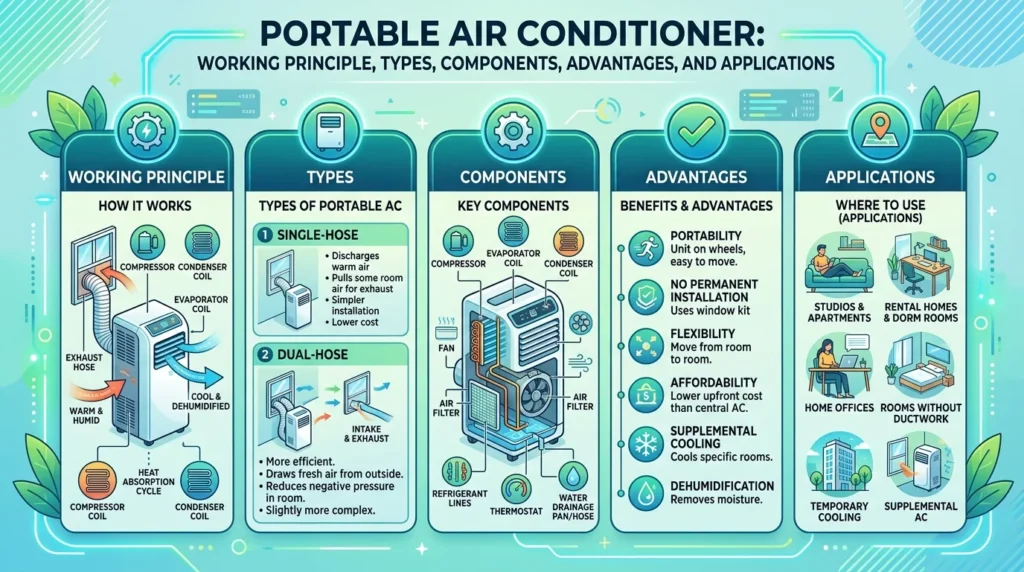
The portable air conditioner working principle is based on the vapor-compression refrigeration cycle used in many conventional air conditioning systems. Instead of cooling the entire building through a permanently installed system, a portable AC removes heat from the indoor air and transfers that heat outside through an exhaust system. This allows the unit to provide localized cooling without requiring a permanent outdoor condenser installation.
Step-by-Step Working Process
- Warm Air Intake
The portable air conditioner draws warm room air into the unit through an intake grille using an internal fan. Before entering the cooling section, the air normally passes through a filter that helps remove dust and other airborne particles.
- Air Cooling in the Evaporator Coil
The warm air passes over the cold evaporator coil. Low-pressure refrigerant flowing through the coil absorbs heat from the room air and changes from a liquid into a vapor. As heat is removed, the air temperature decreases.
- Cool Air Distribution
After passing over the evaporator coil, the cooled air is delivered back into the room through the discharge vents. The fan continuously circulates air so that the cooling effect can spread throughout the occupied space.
- Refrigerant Compression
The refrigerant vapor then enters the compressor. The compressor increases the refrigerant’s pressure and temperature, preparing it to release the absorbed heat through the condenser.
- Heat Rejection at the Condenser
The hot, high-pressure refrigerant flows through the condenser coil. A separate airflow path carries room or surrounding air across the condenser, allowing the refrigerant to release the heat it collected from the indoor air.
- Hot Air Exhaust
The heat removed from the room, along with heat produced by the refrigeration process, is discharged outside through an exhaust hose. The hose is commonly connected to a window kit so that hot air does not return to the room.
- Refrigerant Expansion
After releasing heat in the condenser, the high-pressure refrigerant passes through an expansion device. Its pressure drops, which also lowers its temperature. The refrigerant is then ready to absorb heat again in the evaporator.
- Continuous Cooling Cycle
The low-pressure, low-temperature refrigerant returns to the evaporator coil, where it absorbs heat from incoming room air. The compressor, condenser, expansion device, and evaporator continue operating as a cycle while cooling is required.
Role of the Exhaust Hose
The exhaust hose is an important part of a portable air conditioner because it carries hot air away from the room. If the hose is disconnected, poorly sealed, excessively long, or improperly installed, some of the rejected heat may return indoors. This can reduce cooling performance and increase energy consumption.
Condensate Removal
As warm and humid air passes over the cold evaporator coil, moisture can condense from the air. Depending on the portable AC design and operating conditions, this water may be collected in an internal tank or removed automatically through a drain or evaporation system. In humid conditions, the condensate system may require more frequent attention.
Simple Analogy
Think of a portable air conditioner as a heat pump inside a movable box. It does not simply create cold air; instead, it removes heat from the room and transfers that heat outside. The exhaust hose acts as the pathway for releasing the unwanted heat, while the refrigeration cycle continuously cools the air returning to the room.
Selection Guide
Choosing the right air conditioner requires more than simply selecting a model based on price. Consider the room size, cooling requirements, energy consumption, installation conditions, noise level, and available features before making a decision.
Cooling Capacity
Cooling capacity is usually measured in BTUs or tons. Choose a capacity that matches the size of the room. An undersized unit may struggle to cool the space, while an oversized unit can consume more energy and cycle on and off too frequently.
Energy Efficiency
Check the unit’s Energy Efficiency Ratio (EER) and other efficiency ratings. Inverter air conditioners can also help reduce electricity consumption by adjusting compressor speed according to the cooling demand.
Installation Requirements
Check the available space and installation conditions for both the indoor and outdoor units. Proper installation, ventilation, drainage, and adequate clearance are essential for efficient and reliable operation.
Noise Level
Noise level is especially important for bedrooms, offices, libraries, and other quiet spaces. Choose an air conditioner with a low-noise indoor and outdoor unit for greater comfort.
Smart Features
Modern air conditioners may include convenient features such as:
- Remote control
- Wi-Fi connectivity
- Smartphone app control
- Smart temperature adjustment
- Timer and scheduling functions
These features provide greater control, convenience, and flexibility in everyday use.
Common Problems and Solutions
Air conditioners can develop performance issues because of poor maintenance, restricted airflow, refrigerant problems, drainage blockages, electrical faults, or control-system issues. Some problems are simple to resolve, while others require inspection by a qualified HVAC technician. Regular cleaning and preventive maintenance can help identify minor problems before they affect cooling performance or increase energy consumption.
Why Is the Air Conditioner Not Cooling Properly?
Common causes include:
- Dirty or clogged air filters
- Low refrigerant charge
- Dirty evaporator or condenser coils
- Restricted airflow
Solution: Clean the filters and coils, check airflow, and have the refrigerant system inspected by a qualified technician if the charge may be low.
If the unit continues to provide weak cooling after cleaning, the technician should also check the evaporator and condenser fans, compressor operation, refrigerant pressure, and electrical connections. Running an air conditioner with a serious airflow or refrigerant problem for an extended period can reduce efficiency and place additional stress on the system.
Why Is Water Leaking From the Indoor Unit?
A blocked condensate drain, dirty drain pan, or improper drainage can cause water to leak from the indoor unit.
Solution: Inspect and clean the condensate drain line and drain pan, and verify that the drainage system has the correct slope.
Regularly cleaning the drain system is particularly important in humid environments because algae, dust, and other debris can gradually restrict condensate flow. If water continues to leak after the drain is cleaned, the indoor coil, drain pan, insulation, and installation level should be inspected for other possible causes.
Why Is the Air Conditioner Making Unusual Noise?
Unusual sounds may result from loose mounting components, a dirty or obstructed fan, worn bearings, or debris inside the unit.
Solution: Inspect the mounting hardware, fan assembly, and surrounding components. Disconnect power before carrying out physical inspections.
Different sounds can indicate different problems. Rattling may point to loose panels or fasteners, while grinding or squealing can indicate a mechanical problem with a fan motor or bearing. Clicking, buzzing, or repeated electrical sounds may require professional inspection of the electrical and control components. Do not ignore sudden or unusually loud noises, especially when they are accompanied by reduced cooling performance.
Why Does the Air Conditioner Frequently Start and Stop?
Frequent cycling can be caused by an incorrect temperature setting, a dirty filter, an improperly sized unit, or a faulty thermostat or sensor.
Solution: Check the filter and settings first. If the problem continues, inspect the temperature sensor, controls, and system sizing.
Frequent short cycling can reduce comfort and increase wear on the compressor and other components. A technician may need to check the thermostat or temperature sensor, airflow, refrigerant condition, compressor operation, and whether the cooling capacity is appropriate for the space. Correct diagnosis is important because replacing a component without identifying the underlying cause may not solve the problem.
Why Is the Air Conditioner Turning On but Not Starting Properly?
If the indoor unit operates but the outdoor unit does not start, possible causes include a tripped protection device, faulty wiring, a damaged capacitor on applicable systems, a control-board problem, or an issue with the outdoor fan or compressor.
Solution: Check the basic power supply and protection devices first. If the outdoor unit still does not operate, electrical and refrigeration components should be tested by a qualified technician rather than repeatedly restarting the system.
Why Does the Air Conditioner Have Weak Airflow?
Weak airflow is commonly associated with dirty filters, blocked return or supply vents, a dirty evaporator coil, or a problem with the indoor fan. Restricted airflow can reduce cooling performance and may cause the system to operate inefficiently.
Solution: Clean or replace the air filters as recommended by the manufacturer and make sure vents are unobstructed. If airflow remains weak, the indoor fan, coil, ductwork, and other airflow components should be inspected.
Future Trends
Air conditioning technology is moving toward greater energy efficiency, smarter controls, improved indoor comfort, predictive maintenance, and lower environmental impact. Manufacturers are also focusing on better sensors, advanced compressors, connected controls, and refrigerants with lower environmental impact.
Smart and Connected Air Conditioners
Modern systems are increasingly equipped with Wi-Fi connectivity, mobile-app control, remote diagnostics, scheduling, and smart-home integration. Users can monitor temperature settings, adjust operating modes, and manage schedules remotely. Connected systems can also provide alerts when maintenance may be required or when unusual operating conditions are detected.
AI-Based Energy Optimization
Advanced control systems can analyze operating conditions, temperature patterns, outdoor conditions, and occupancy information to optimize cooling. AI-assisted controls may help the system adjust operation according to actual cooling demand instead of running at a constant level. This can improve comfort while reducing unnecessary energy use.
Eco-Friendly Refrigerants
The HVAC industry is moving toward refrigerants with lower environmental impact while maintaining safe and efficient cooling performance. Refrigerant selection will remain an important part of sustainable air-conditioning design, and future equipment will increasingly be designed around modern refrigerant requirements and environmental regulations.
Higher Energy Efficiency
Improved inverter compressors, heat exchangers, motors, sensors, and electronic control systems are expected to increase efficiency and reduce operating costs. Better variable-speed technology can allow air conditioners to match output more closely to the actual cooling load, reducing unnecessary starts and stops.
Predictive Maintenance
Future air conditioners will increasingly use sensors and connected monitoring systems to identify abnormal temperatures, airflow changes, vibration, power consumption, and other operating conditions. Predictive maintenance can help technicians detect developing problems earlier and schedule service before a major breakdown occurs.
Improved Indoor Air Quality
Newer air conditioning systems are also expected to place greater emphasis on indoor air quality. Improved filtration, air circulation, humidity management, and monitoring technologies can help create a more comfortable indoor environment while maintaining efficient cooling.
These developments are helping make modern air conditioners more efficient, connected, reliable, easier to maintain, and environmentally responsible. As technology continues to advance, homeowners and businesses can expect air conditioning systems to provide better cooling control while using energy more intelligently.
Portable Air Conditioner Working Principle
The portable air conditioner working principle is based on the vapor-compression refrigeration cycle used in many conventional air conditioning systems. Instead of cooling the entire building through a permanently installed system, a portable AC removes heat from the indoor air and transfers that heat outside through an exhaust system. This allows the unit to provide localized cooling without requiring a permanent outdoor condenser installation.
Step-by-Step Working Process
- Warm Air Intake
The portable air conditioner draws warm room air into the unit through an intake grille using an internal fan. Before entering the cooling section, the air normally passes through a filter that helps remove dust and other airborne particles.
- Air Cooling in the Evaporator Coil
The warm air passes over the cold evaporator coil. Low-pressure refrigerant flowing through the coil absorbs heat from the room air and changes from a liquid into a vapor. As heat is removed, the air temperature decreases.
- Cool Air Distribution
After passing over the evaporator coil, the cooled air is delivered back into the room through the discharge vents. The fan continuously circulates air so that the cooling effect can spread throughout the occupied space.
- Refrigerant Compression
The refrigerant vapor then enters the compressor. The compressor increases the refrigerant’s pressure and temperature, preparing it to release the absorbed heat through the condenser.
- Heat Rejection at the Condenser
The hot, high-pressure refrigerant flows through the condenser coil. A separate airflow path carries room or surrounding air across the condenser, allowing the refrigerant to release the heat it collected from the indoor air.
- Hot Air Exhaust
The heat removed from the room, along with heat produced by the refrigeration process, is discharged outside through an exhaust hose. The hose is commonly connected to a window kit so that hot air does not return to the room.
- Refrigerant Expansion
After releasing heat in the condenser, the high-pressure refrigerant passes through an expansion device. Its pressure drops, which also lowers its temperature. The refrigerant is then ready to absorb heat again in the evaporator.
- Continuous Cooling Cycle
The low-pressure, low-temperature refrigerant returns to the evaporator coil, where it absorbs heat from incoming room air. The compressor, condenser, expansion device, and evaporator continue operating as a cycle while cooling is required.
Role of the Exhaust Hose
The exhaust hose is an important part of a portable air conditioner because it carries hot air away from the room. If the hose is disconnected, poorly sealed, excessively long, or improperly installed, some of the rejected heat may return indoors. This can reduce cooling performance and increase energy consumption.
Condensate Removal
As warm and humid air passes over the cold evaporator coil, moisture can condense from the air. Depending on the portable AC design and operating conditions, this water may be collected in an internal tank or removed automatically through a drain or evaporation system. In humid conditions, the condensate system may require more frequent attention.
Simple Analogy
Think of a portable air conditioner as a heat pump inside a movable box. It does not simply create cold air; instead, it removes heat from the room and transfers that heat outside. The exhaust hose acts as the pathway for releasing the unwanted heat, while the refrigeration cycle continuously cools the air returning to the room.
Types and Classification of Portable Air Conditioners
Portable air conditioners can be classified according to their airflow design, hose configuration, heating capability, and cooling method. Understanding these types makes it easier to select a unit that matches the room size, climate, installation conditions, and desired operating features.
Single-Hose Portable Air Conditioner
A single-hose portable air conditioner uses one flexible hose to discharge hot air from the condenser section to the outside. It is one of the most common portable AC designs because it is relatively simple to install and operate.
How It Works
- The unit draws warm indoor air into the air conditioner.
- The evaporator removes heat from the air.
- The cooled air is returned to the room.
- The condenser releases the collected heat into the exhaust air.
- The hot air is discharged outside through the single exhaust hose.
Main Features
- Simple installation
- Generally lower initial cost
- Easy to move between rooms
- Suitable for small and medium-sized spaces
- Requires a window or suitable opening for the exhaust hose
One limitation is that some single-hose designs can create negative pressure in the room. This may cause air from surrounding areas or outdoors to enter through small gaps, which can reduce overall cooling efficiency.
Dual-Hose Portable Air Conditioner
A dual-hose portable air conditioner uses two separate hoses to manage condenser airflow. One hose draws air from outside, while the second hose exhausts warm air back outside.
How It Works
- Outside air enters the unit through the intake hose.
- The outside air passes through the condenser section.
- Heat from the refrigerant is transferred to this air.
- The heated air is discharged outside through the exhaust hose.
- The indoor air is primarily used for the cooling process and is returned to the room after being cooled.
Main Features
- Better condenser airflow management
- Reduced dependence on room air for heat rejection
- Generally better suited to larger rooms or higher cooling demands
- Faster cooling under suitable operating conditions
- Two hoses require more installation space than a single-hose design
Dual-hose models can provide advantages where maintaining room pressure and efficient heat rejection are important. However, actual performance depends on the unit’s design, capacity, installation, and operating environment.
Portable Air Conditioner with Heat Pump
Some portable air conditioners include a heat pump function, allowing the same appliance to provide cooling during warm weather and heating during cooler periods.
How It Works
- During cooling mode, the system removes heat from the room and rejects it outside.
- In heating mode, the refrigeration cycle operates in reverse on systems designed for this function.
- Heat is transferred into the room through the indoor heat exchanger.
- The unit continues operating until the selected indoor temperature is reached.
Main Features
- Cooling and heating in one appliance
- Useful for year-round operation
- Can provide an efficient heating option in suitable climates
- Reduces the need for separate cooling and heating equipment
- Particularly useful where moderate heating is required
The heating performance of a portable heat-pump model depends on outdoor temperature, unit capacity, and manufacturer specifications. Users should check the rated heating range before relying on the unit as a primary heating source.
Portable Evaporative Air Conditioner
A portable evaporative air conditioner, commonly called an air cooler, uses water evaporation rather than a conventional refrigerant-based refrigeration cycle to reduce air temperature. It is therefore different from a portable compressor-based air conditioner.
How It Works
- Warm air is drawn into the unit by a fan.
- The air passes through water-moistened cooling pads.
- Some of the water evaporates into the moving air.
- Evaporation removes heat from the air.
- The cooled, more humid air is circulated into the room.
Main Features
- Simple cooling method
- Generally lower energy consumption than compressor-based AC systems
- Does not require a conventional refrigerant refrigeration cycle
- Requires a water supply or water tank
- Works best in dry climates with adequate ventilation
Evaporative coolers are not equivalent to refrigerant-based portable air conditioners. They increase indoor humidity and may provide limited cooling in already humid environments. They are often more suitable for dry climates and well-ventilated spaces.
Portable Air Conditioner with Dehumidification Mode
Many refrigerant-based portable air conditioners also include a dehumidification or dry mode. In this mode, the system focuses more on removing moisture from indoor air while providing some cooling.
Main Features
- Helps reduce excessive indoor humidity
- Can improve perceived comfort
- Useful during damp weather
- May require condensate drainage depending on the model and operating conditions
How to Choose Between Portable AC Types
The best type depends on the room, climate, installation conditions, and required features. A single-hose model may be practical when simple installation and portability are the main priorities. A dual-hose model may be preferable when condenser airflow and cooling performance are more important. A heat-pump model is useful when both heating and cooling are required, while an evaporative cooler is generally better suited to dry climates.
Main Components
A portable air conditioner contains several important components that perform the cooling process.
Compressor
The compressor increases the pressure and temperature of the refrigerant gas.
It is the main driving component of the refrigeration cycle.
Evaporator Coil
The evaporator coil absorbs heat from indoor air.
As warm air passes over this coil, the refrigerant inside absorbs heat and cools the air.
Condenser Coil
The condenser coil releases the absorbed heat outside the room through the exhaust hose.
Expansion Valve
The expansion valve controls refrigerant flow and reduces pressure before the refrigerant enters the evaporator coil.
Fan (Blower)
Fans circulate air through the evaporator and condenser coils.
They help move cool air into the room and push hot air outside.
Exhaust Hose
The exhaust hose is a flexible pipe that carries hot air from the AC unit to the outside environment.
Air Filters
Air filters remove dust and particles from the air before it enters the cooling system.
Water Collection Tank
Some portable AC units collect condensed water in a tank that must be emptied periodically.
Advantages
Understanding the portable air conditioner advantages and disadvantages is important when choosing a cooling system.
Advantages
- Easy installation with no permanent setup required
- Portable design allows movement between rooms
- Ideal for rented apartments or temporary spaces
- No major wall drilling required
- Suitable for small and medium rooms
- Can be stored easily when not in use
Disadvantages / Limitations
Despite many benefits, portable air conditioners also have limitations.
- Higher noise levels compared to split AC systems
- Limited cooling capacity for large spaces
- Requires a window for exhaust hose installation
- Water tank may need regular emptying
- Occupies floor space inside the room
Understanding these limitations helps users choose the right cooling solution.
Portable Air Conditioner Applications
There are many portable air conditioner applications in homes and commercial environments.
Residential Applications
- Apartments
- Bedrooms
- Rental homes
- Dorm rooms
Commercial Uses
- Small offices
- Temporary workspaces
- Server rooms
Industrial and Technical Uses
- Cooling electronic equipment
- Workshops
- Temporary cooling during maintenance work
Portable AC systems are particularly useful where permanent installation is not possible.
Comparison: Portable Air Conditioner vs Split Air Conditioner
Many people want to understand the difference between portable air conditioner and split air conditioner.
| Feature | Portable Air Conditioner | Split Air Conditioner |
|---|---|---|
| Installation | No permanent installation | Permanent wall installation |
| Mobility | Movable | Fixed |
| Cooling Capacity | Small to medium rooms | Medium to large rooms |
| Noise Level | Higher | Lower |
| Cost | Usually lower initial cost | Higher installation cost |
| Efficiency | Lower efficiency | Higher efficiency |
This comparison helps users determine which system best suits their needs.
Selection Guide
Choosing the right air conditioner requires more than simply selecting a model based on price. Consider the room size, cooling requirements, energy consumption, installation conditions, noise level, and available features before making a decision.
Cooling Capacity
Cooling capacity is usually measured in BTUs or tons. Choose a capacity that matches the size of the room. An undersized unit may struggle to cool the space, while an oversized unit can consume more energy and cycle on and off too frequently.
Energy Efficiency
Check the unit’s Energy Efficiency Ratio (EER) and other efficiency ratings. Inverter air conditioners can also help reduce electricity consumption by adjusting compressor speed according to the cooling demand.
Installation Requirements
Check the available space and installation conditions for both the indoor and outdoor units. Proper installation, ventilation, drainage, and adequate clearance are essential for efficient and reliable operation.
Noise Level
Noise level is especially important for bedrooms, offices, libraries, and other quiet spaces. Choose an air conditioner with a low-noise indoor and outdoor unit for greater comfort.
Smart Features
Modern air conditioners may include convenient features such as:
- Remote control
- Wi-Fi connectivity
- Smartphone app control
- Smart temperature adjustment
- Timer and scheduling functions
These features provide greater control, convenience, and flexibility in everyday use.
Common Problems and Solutions
Air conditioners can develop performance issues because of poor maintenance, restricted airflow, refrigerant problems, drainage blockages, electrical faults, or control-system issues. Some problems are simple to resolve, while others require inspection by a qualified HVAC technician. Regular cleaning and preventive maintenance can help identify minor problems before they affect cooling performance or increase energy consumption.
Why Is the Air Conditioner Not Cooling Properly?
Common causes include:
- Dirty or clogged air filters
- Low refrigerant charge
- Dirty evaporator or condenser coils
- Restricted airflow
Solution: Clean the filters and coils, check airflow, and have the refrigerant system inspected by a qualified technician if the charge may be low.
If the unit continues to provide weak cooling after cleaning, the technician should also check the evaporator and condenser fans, compressor operation, refrigerant pressure, and electrical connections. Running an air conditioner with a serious airflow or refrigerant problem for an extended period can reduce efficiency and place additional stress on the system.
Why Is Water Leaking From the Indoor Unit?
A blocked condensate drain, dirty drain pan, or improper drainage can cause water to leak from the indoor unit.
Solution: Inspect and clean the condensate drain line and drain pan, and verify that the drainage system has the correct slope.
Regularly cleaning the drain system is particularly important in humid environments because algae, dust, and other debris can gradually restrict condensate flow. If water continues to leak after the drain is cleaned, the indoor coil, drain pan, insulation, and installation level should be inspected for other possible causes.
Why Is the Air Conditioner Making Unusual Noise?
Unusual sounds may result from loose mounting components, a dirty or obstructed fan, worn bearings, or debris inside the unit.
Solution: Inspect the mounting hardware, fan assembly, and surrounding components. Disconnect power before carrying out physical inspections.
Different sounds can indicate different problems. Rattling may point to loose panels or fasteners, while grinding or squealing can indicate a mechanical problem with a fan motor or bearing. Clicking, buzzing, or repeated electrical sounds may require professional inspection of the electrical and control components. Do not ignore sudden or unusually loud noises, especially when they are accompanied by reduced cooling performance.
Why Does the Air Conditioner Frequently Start and Stop?
Frequent cycling can be caused by an incorrect temperature setting, a dirty filter, an improperly sized unit, or a faulty thermostat or sensor.
Solution: Check the filter and settings first. If the problem continues, inspect the temperature sensor, controls, and system sizing.
Frequent short cycling can reduce comfort and increase wear on the compressor and other components. A technician may need to check the thermostat or temperature sensor, airflow, refrigerant condition, compressor operation, and whether the cooling capacity is appropriate for the space. Correct diagnosis is important because replacing a component without identifying the underlying cause may not solve the problem.
Why Is the Air Conditioner Turning On but Not Starting Properly?
If the indoor unit operates but the outdoor unit does not start, possible causes include a tripped protection device, faulty wiring, a damaged capacitor on applicable systems, a control-board problem, or an issue with the outdoor fan or compressor.
Solution: Check the basic power supply and protection devices first. If the outdoor unit still does not operate, electrical and refrigeration components should be tested by a qualified technician rather than repeatedly restarting the system.
Why Does the Air Conditioner Have Weak Airflow?
Weak airflow is commonly associated with dirty filters, blocked return or supply vents, a dirty evaporator coil, or a problem with the indoor fan. Restricted airflow can reduce cooling performance and may cause the system to operate inefficiently.
Solution: Clean or replace the air filters as recommended by the manufacturer and make sure vents are unobstructed. If airflow remains weak, the indoor fan, coil, ductwork, and other airflow components should be inspected.
Future Trends
Air conditioning technology is moving toward greater energy efficiency, smarter controls, improved indoor comfort, predictive maintenance, and lower environmental impact. Manufacturers are also focusing on better sensors, advanced compressors, connected controls, and refrigerants with lower environmental impact.
Smart and Connected Air Conditioners
Modern systems are increasingly equipped with Wi-Fi connectivity, mobile-app control, remote diagnostics, scheduling, and smart-home integration. Users can monitor temperature settings, adjust operating modes, and manage schedules remotely. Connected systems can also provide alerts when maintenance may be required or when unusual operating conditions are detected.
AI-Based Energy Optimization
Advanced control systems can analyze operating conditions, temperature patterns, outdoor conditions, and occupancy information to optimize cooling. AI-assisted controls may help the system adjust operation according to actual cooling demand instead of running at a constant level. This can improve comfort while reducing unnecessary energy use.
Eco-Friendly Refrigerants
The HVAC industry is moving toward refrigerants with lower environmental impact while maintaining safe and efficient cooling performance. Refrigerant selection will remain an important part of sustainable air-conditioning design, and future equipment will increasingly be designed around modern refrigerant requirements and environmental regulations.
Higher Energy Efficiency
Improved inverter compressors, heat exchangers, motors, sensors, and electronic control systems are expected to increase efficiency and reduce operating costs. Better variable-speed technology can allow air conditioners to match output more closely to the actual cooling load, reducing unnecessary starts and stops.
Predictive Maintenance
Future air conditioners will increasingly use sensors and connected monitoring systems to identify abnormal temperatures, airflow changes, vibration, power consumption, and other operating conditions. Predictive maintenance can help technicians detect developing problems earlier and schedule service before a major breakdown occurs.
Improved Indoor Air Quality
Newer air conditioning systems are also expected to place greater emphasis on indoor air quality. Improved filtration, air circulation, humidity management, and monitoring technologies can help create a more comfortable indoor environment while maintaining efficient cooling.
These developments are helping make modern air conditioners more efficient, connected, reliable, easier to maintain, and environmentally responsible. As technology continues to advance, homeowners and businesses can expect air conditioning systems to provide better cooling control while using energy more intelligently.
Portable Air Conditioner Working Principle
The portable air conditioner working principle is based on the vapor-compression refrigeration cycle used in many conventional air conditioning systems. Instead of cooling the entire building through a permanently installed system, a portable AC removes heat from the indoor air and transfers that heat outside through an exhaust system. This allows the unit to provide localized cooling without requiring a permanent outdoor condenser installation.
Step-by-Step Working Process
- Warm Air Intake
The portable air conditioner draws warm room air into the unit through an intake grille using an internal fan. Before entering the cooling section, the air normally passes through a filter that helps remove dust and other airborne particles.
- Air Cooling in the Evaporator Coil
The warm air passes over the cold evaporator coil. Low-pressure refrigerant flowing through the coil absorbs heat from the room air and changes from a liquid into a vapor. As heat is removed, the air temperature decreases.
- Cool Air Distribution
After passing over the evaporator coil, the cooled air is delivered back into the room through the discharge vents. The fan continuously circulates air so that the cooling effect can spread throughout the occupied space.
- Refrigerant Compression
The refrigerant vapor then enters the compressor. The compressor increases the refrigerant’s pressure and temperature, preparing it to release the absorbed heat through the condenser.
- Heat Rejection at the Condenser
The hot, high-pressure refrigerant flows through the condenser coil. A separate airflow path carries room or surrounding air across the condenser, allowing the refrigerant to release the heat it collected from the indoor air.
- Hot Air Exhaust
The heat removed from the room, along with heat produced by the refrigeration process, is discharged outside through an exhaust hose. The hose is commonly connected to a window kit so that hot air does not return to the room.
- Refrigerant Expansion
After releasing heat in the condenser, the high-pressure refrigerant passes through an expansion device. Its pressure drops, which also lowers its temperature. The refrigerant is then ready to absorb heat again in the evaporator.
- Continuous Cooling Cycle
The low-pressure, low-temperature refrigerant returns to the evaporator coil, where it absorbs heat from incoming room air. The compressor, condenser, expansion device, and evaporator continue operating as a cycle while cooling is required.
Role of the Exhaust Hose
The exhaust hose is an important part of a portable air conditioner because it carries hot air away from the room. If the hose is disconnected, poorly sealed, excessively long, or improperly installed, some of the rejected heat may return indoors. This can reduce cooling performance and increase energy consumption.
Condensate Removal
As warm and humid air passes over the cold evaporator coil, moisture can condense from the air. Depending on the portable AC design and operating conditions, this water may be collected in an internal tank or removed automatically through a drain or evaporation system. In humid conditions, the condensate system may require more frequent attention.
Simple Analogy
Think of a portable air conditioner as a heat pump inside a movable box. It does not simply create cold air; instead, it removes heat from the room and transfers that heat outside. The exhaust hose acts as the pathway for releasing the unwanted heat, while the refrigeration cycle continuously cools the air returning to the room.
Types and Classification of Portable Air Conditioners
Portable air conditioners can be classified according to their airflow design, hose configuration, heating capability, and cooling method. Understanding these types makes it easier to select a unit that matches the room size, climate, installation conditions, and desired operating features.
Single-Hose Portable Air Conditioner
A single-hose portable air conditioner uses one flexible hose to discharge hot air from the condenser section to the outside. It is one of the most common portable AC designs because it is relatively simple to install and operate.
How It Works
- The unit draws warm indoor air into the air conditioner.
- The evaporator removes heat from the air.
- The cooled air is returned to the room.
- The condenser releases the collected heat into the exhaust air.
- The hot air is discharged outside through the single exhaust hose.
Main Features
- Simple installation
- Generally lower initial cost
- Easy to move between rooms
- Suitable for small and medium-sized spaces
- Requires a window or suitable opening for the exhaust hose
One limitation is that some single-hose designs can create negative pressure in the room. This may cause air from surrounding areas or outdoors to enter through small gaps, which can reduce overall cooling efficiency.
Dual-Hose Portable Air Conditioner
A dual-hose portable air conditioner uses two separate hoses to manage condenser airflow. One hose draws air from outside, while the second hose exhausts warm air back outside.
How It Works
- Outside air enters the unit through the intake hose.
- The outside air passes through the condenser section.
- Heat from the refrigerant is transferred to this air.
- The heated air is discharged outside through the exhaust hose.
- The indoor air is primarily used for the cooling process and is returned to the room after being cooled.
Main Features
- Better condenser airflow management
- Reduced dependence on room air for heat rejection
- Generally better suited to larger rooms or higher cooling demands
- Faster cooling under suitable operating conditions
- Two hoses require more installation space than a single-hose design
Dual-hose models can provide advantages where maintaining room pressure and efficient heat rejection are important. However, actual performance depends on the unit’s design, capacity, installation, and operating environment.
Portable Air Conditioner with Heat Pump
Some portable air conditioners include a heat pump function, allowing the same appliance to provide cooling during warm weather and heating during cooler periods.
How It Works
- During cooling mode, the system removes heat from the room and rejects it outside.
- In heating mode, the refrigeration cycle operates in reverse on systems designed for this function.
- Heat is transferred into the room through the indoor heat exchanger.
- The unit continues operating until the selected indoor temperature is reached.
Main Features
- Cooling and heating in one appliance
- Useful for year-round operation
- Can provide an efficient heating option in suitable climates
- Reduces the need for separate cooling and heating equipment
- Particularly useful where moderate heating is required
The heating performance of a portable heat-pump model depends on outdoor temperature, unit capacity, and manufacturer specifications. Users should check the rated heating range before relying on the unit as a primary heating source.
Portable Evaporative Air Conditioner
A portable evaporative air conditioner, commonly called an air cooler, uses water evaporation rather than a conventional refrigerant-based refrigeration cycle to reduce air temperature. It is therefore different from a portable compressor-based air conditioner.
How It Works
- Warm air is drawn into the unit by a fan.
- The air passes through water-moistened cooling pads.
- Some of the water evaporates into the moving air.
- Evaporation removes heat from the air.
- The cooled, more humid air is circulated into the room.
Main Features
- Simple cooling method
- Generally lower energy consumption than compressor-based AC systems
- Does not require a conventional refrigerant refrigeration cycle
- Requires a water supply or water tank
- Works best in dry climates with adequate ventilation
Evaporative coolers are not equivalent to refrigerant-based portable air conditioners. They increase indoor humidity and may provide limited cooling in already humid environments. They are often more suitable for dry climates and well-ventilated spaces.
Portable Air Conditioner with Dehumidification Mode
Many refrigerant-based portable air conditioners also include a dehumidification or dry mode. In this mode, the system focuses more on removing moisture from indoor air while providing some cooling.
Main Features
- Helps reduce excessive indoor humidity
- Can improve perceived comfort
- Useful during damp weather
- May require condensate drainage depending on the model and operating conditions
How to Choose Between Portable AC Types
The best type depends on the room, climate, installation conditions, and required features. A single-hose model may be practical when simple installation and portability are the main priorities. A dual-hose model may be preferable when condenser airflow and cooling performance are more important. A heat-pump model is useful when both heating and cooling are required, while an evaporative cooler is generally better suited to dry climates.
Portable Air Conditioner Selection Guide
Choosing the right portable air conditioner requires more than comparing prices or selecting the highest BTU rating. The ideal unit should match the room size, cooling demand, installation conditions, climate, energy requirements, noise preferences, and portability needs. Evaluating these factors before purchase can improve comfort, operating efficiency, and overall value.
Check the Room Size and Cooling Capacity
Start by checking the cooling capacity of the portable AC. Cooling capacity is commonly expressed in BTUs per hour (BTU/h). Larger rooms generally require greater cooling capacity, while smaller rooms can often be cooled effectively with a lower-capacity unit.
What to Consider
- Room floor area
- Ceiling height
- Number of windows and doors
- Direct sunlight exposure
- Number of people regularly using the room
- Heat produced by appliances and electronic equipment
Avoid choosing a unit based only on room size. The actual cooling requirement can change significantly depending on insulation, climate, sunlight, and internal heat sources.
Choose the Correct Hose Configuration
The exhaust arrangement is an important factor when selecting a portable AC. Single-hose models are generally simpler to install and move, while dual-hose models use separate intake and exhaust pathways for condenser airflow.
Single Hose vs Dual Hose
- Single hose: simpler installation and commonly lower initial cost
- Dual hose: separate intake and exhaust airflow for the condenser section
- Single hose: convenient for basic residential cooling
- Dual hose: may be preferable for higher cooling demands or larger spaces
The best choice depends on the unit design, room conditions, installation quality, and manufacturer specifications.
Consider Energy Efficiency
Portable air conditioners can consume a significant amount of electricity during extended operation. Check the available energy-efficiency information and compare models with similar cooling capacities rather than choosing a unit solely because it has a lower purchase price.
Energy-Saving Practices
- Use the correct cooling mode for the conditions.
- Keep doors and windows closed while cooling.
- Clean the air filter regularly.
- Seal gaps around the exhaust hose and window kit.
- Avoid unnecessarily low thermostat settings.
- Use timers or scheduling features when available.
Good installation and regular maintenance can also help the portable AC operate more efficiently.
Check the Noise Level
Noise is an important consideration for bedrooms, study rooms, offices, and other quiet spaces. Portable ACs contain fans and compressors, so some operating sound is normal.
What to Look For
Check the manufacturer’s stated noise level in decibels (dB) and, where possible, compare models under similar operating conditions. A lower rated noise level can provide a more comfortable environment, particularly during sleep or work.
Evaluate the Drainage System
Portable air conditioners remove moisture from indoor air during cooling. Depending on the design and operating conditions, condensate may be automatically evaporated, drained continuously, or collected in an internal tank.
Drainage Features to Consider
- Automatic condensate evaporation
- Internal water tank
- Continuous drain connection
- Full-tank warning or automatic shutdown
- Easy-to-access drain outlet
If the unit is used in a humid environment, a convenient drainage system can reduce maintenance and prevent interruptions caused by a full water tank.
Consider Portability and Installation
One of the main advantages of a portable AC is that it can be moved when cooling is needed in different areas. Look for sturdy caster wheels, practical handles, and a compact design that fits the intended space.
Installation Factors
- Available floor space
- Distance to a suitable window or exhaust opening
- Exhaust hose length and routing
- Window-kit compatibility
- Access to an electrical outlet
- Clearance around air intake and discharge areas
Do not place the unit where furniture, curtains, walls, or other objects block the airflow. Adequate clearance helps maintain proper performance.
Look for Useful Operating Features
Modern portable air conditioners may include several features that improve convenience and control.
Common Features
- Remote control
- Digital temperature display
- Timer and scheduling
- Sleep mode
- Fan-only mode
- Dehumidification mode
- Wi-Fi or smartphone control on selected models
- Adjustable air direction
Choose features based on how you plan to use the unit rather than paying extra for functions that are unlikely to be needed.
Consider the Climate
Climate can strongly influence portable AC performance. Refrigerant-based portable air conditioners are generally suitable for hot conditions, while evaporative coolers are often more effective in dry climates because they add moisture to the air.
Climate-Based Considerations
- Hot and humid areas: refrigerant-based AC is generally more suitable.
- Hot and dry areas: both refrigerant AC and evaporative cooling may be considered.
- Mild climates: a portable heat-pump model may provide additional heating functionality.
Check Maintenance Requirements
Before buying, consider how easy it is to clean and maintain the unit. A model with an accessible filter, simple drainage arrangement, and easy-to-clean components can be more convenient for long-term use.
Regular filter cleaning, condensate management, and inspection of the exhaust system can help maintain airflow and cooling performance.
Compare Warranty and After-Sales Support
Warranty coverage and access to service support are also important. Check the warranty period, covered components, availability of replacement filters and other parts, and access to authorized service technicians in your area.
Final Selection Checklist
Before purchasing a portable air conditioner, confirm that:
- The cooling capacity is suitable for the room.
- The hose configuration matches the installation requirements.
- Energy efficiency is acceptable for expected operating hours.
- The noise level is suitable for the intended room.
- The drainage system matches the local humidity conditions.
- The unit can be moved and installed conveniently.
- Required smart or operating features are available.
- Maintenance requirements are manageable.
- Warranty and service support are available.
Considering these factors helps beginners choose a portable air conditioner that provides suitable cooling, convenient operation, and reliable long-term performance.
Common Problems & Solutions
Why is the portable air conditioner not cooling properly?
Possible causes:
- Dirty air filters
- Incorrect room size for the AC capacity
- Blocked exhaust hose
Solution: Clean filters and ensure proper ventilation.
Why is water leaking from the unit?
Possible reasons:
- Full water tank
- Blocked drainage system
Solution: Empty the tank and check the drainage system.
Why is the AC making loud noise?
Possible causes:
- Loose internal parts
- Dirty fan blades
Solution: Inspect internal components and clean the fan.
Why does the room remain warm?
Possible causes:
- Poor window sealing around exhaust hose
- Large room size
Solution: Improve window sealing and ensure correct AC capacity.
Future Trends
Portable air conditioner technology continues to evolve.
Future developments may include:
- Smart Wi-Fi control systems
- Energy-efficient inverter compressors
- Eco-friendly refrigerants
- Improved noise reduction technology
- Advanced air purification features
These innovations will make portable AC systems more efficient and user-friendly.
Conclusion
Portable air conditioners provide a flexible and convenient cooling solution for situations where permanent air conditioning installation is not possible. These compact systems contain all the major components of a traditional air conditioner in a single movable unit.
Understanding the portable air conditioner working principle, components, and system operation helps electrical students and technicians properly install and maintain these systems. Although portable AC units may not match the efficiency of larger HVAC systems, they are extremely useful for temporary cooling, rented homes, and small spaces.
By learning about the portable air conditioner advantages and disadvantages, types, and applications, beginners can confidently choose the right unit for their needs. As technology continues to improve, portable air conditioners will become more efficient, quieter, and more environmentally friendly.