
To convert kW to amps, use this formula: amps equals (kW × 1,000) divided by volts for DC, and by (volts × power factor) for single-phase AC. For three-phase AC, divide by (1.73 × volts × power factor). So a 5 kW load at 230 volts single-phase draws 22 amps, while at 400 volts three-phase it draws about 8.5 amps.
What Is the kW to Amps Formula?
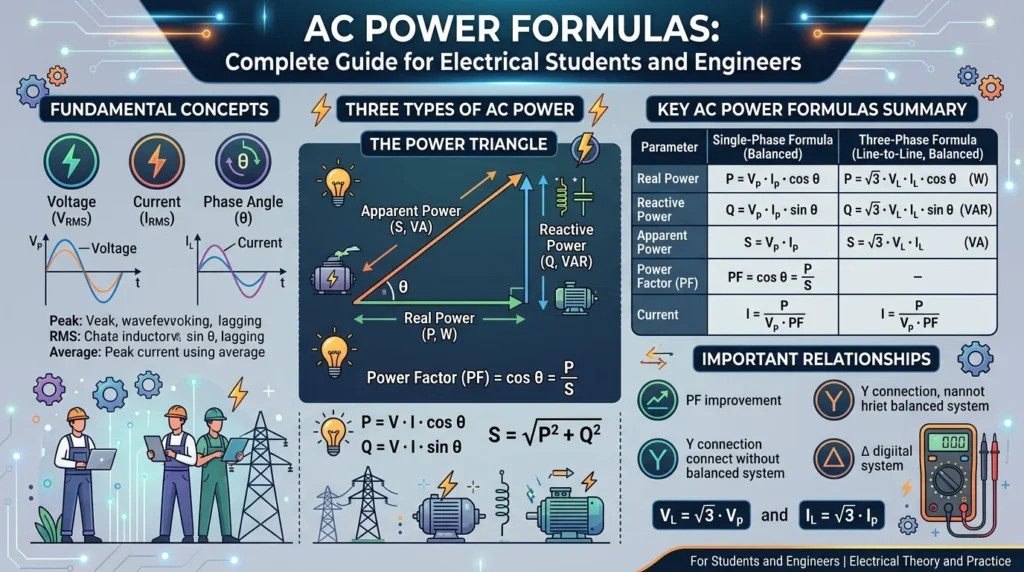
Kilowatts tell you the power a load uses, while amps tell you the current that flows to deliver it. To convert kW to amps, multiply the kilowatts by 1,000 to get watts, then divide by the voltage. For alternating current, also divide by the power factor, and for three-phase supplies divide by the square root of 3, which is 1.73.
DC: Amps = (kW × 1,000) ÷ Volts
Single-phase AC: Amps = (kW × 1,000) ÷ (Volts × Power factor)
Three-phase AC: Amps = (kW × 1,000) ÷ (1.73 × Volts × Power factor)
How Do You Convert kW to Amps for DC?
DC is the simplest case because there is no power factor. A 5 kW solar array at 48 volts draws 5,000 ÷ 48 = 104.2 amps. At 12 volts, the same 5 kW would draw 416.7 amps, which is why low-voltage DC needs very thick cables. A small 500-watt DC load at 24 volts draws 500 ÷ 24 = 20.8 amps. Always check the nameplate voltage first, because the same power at half the voltage means twice the current.
How Do You Convert kW to Amps for Single-Phase AC?
For single-phase AC you must know the power factor, which is 1.0 for a heater or kettle and about 0.85 for a typical motor. A 3 kW air conditioner at 230 volts with a power factor of 0.85 draws 3,000 ÷ (230 × 0.85) = 15.3 amps. A 2 kW water heater at 230 volts is a resistive load, so it draws 2,000 ÷ 230 = 8.7 amps. In North America, a 1.5 kW space heater at 120 volts draws 1,500 ÷ 120 = 12.5 amps, which is why it needs a 15-amp circuit.
How Do You Convert kW to Amps for Three-Phase AC?
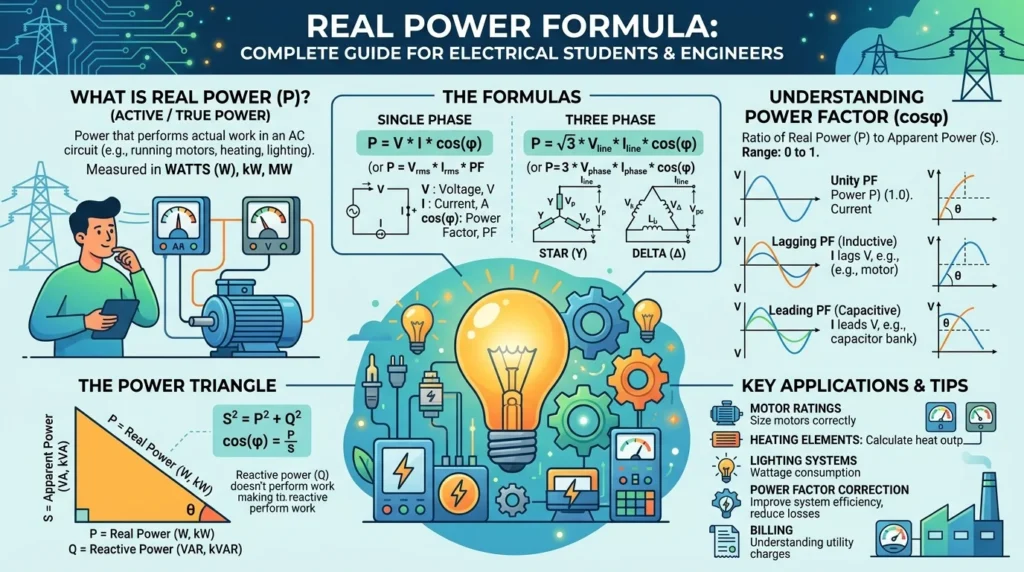
Three-phase power is shared across three lines, so the current is lower: the 1.73 factor comes from the square root of 3. A 15 kW motor at 400 volts with a power factor of 0.85 draws 15,000 ÷ (1.73 × 400 × 0.85) = 25.5 amps. The same 15 kW at 480 volts in North America draws 15,000 ÷ (1.73 × 480 × 0.85) = 21.3 amps. A 7.5 kW pump at 400 volts draws 7,500 ÷ (1.73 × 400 × 0.85) = 12.8 amps. Always use the line-to-line voltage, not the voltage to neutral, in this formula.
kW to Amps Chart
Use this chart for quick lookups. The DC column is for a 48-volt system, single-phase is for 230 volts with a power factor of 0.85, and three-phase is for 400 volts with a power factor of 0.85. All values come from the formulas above and are rounded to one decimal place.
| kW | DC 48 V (amps) | Single-phase 230 V (amps) | Three-phase 400 V (amps) |
| 0.5 | 10.4 | 2.6 | 0.9 |
| 1 | 20.8 | 5.1 | 1.7 |
| 2 | 41.7 | 10.2 | 3.4 |
| 3 | 62.5 | 15.3 | 5.1 |
| 5 | 104.2 | 25.6 | 8.5 |
| 7.5 | 156.3 | 38.4 | 12.8 |
| 10 | 208.3 | 51.2 | 17.0 |
| 15 | 312.5 | 76.7 | 25.5 |
Source: all values are calculated from the formulas above. The standard voltages, 48 V DC, 230 V single-phase and 400 V three-phase, follow IEC 60038, which sets 230/400 V as the standard low-voltage supply in most of the world, while North America uses 120/240 V single-phase and 480 V three-phase.
Why Does Power Factor Change the Answer?
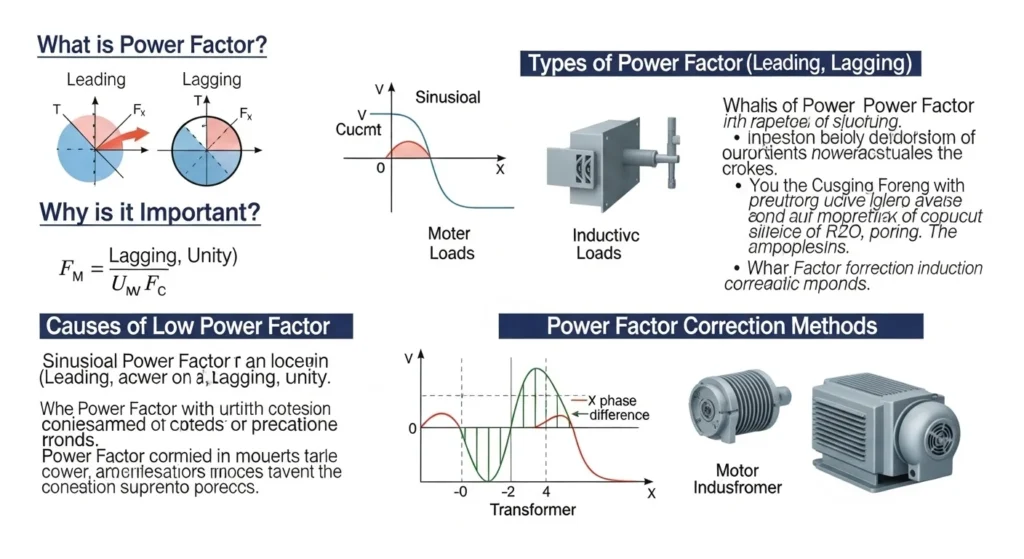
Power factor measures how much of the apparent power, in volt-amps, actually does useful work in kilowatts. A resistive load such as a heater has a power factor of 1.0, so kW and kVA are the same and the current is at its lowest. A typical induction motor runs at about 0.85, so for the same kilowatts it draws about 18 percent more current. That is why motor nameplates show the power factor: if you assume 1.0 for a motor, you will undersize the cable and breaker by about a fifth.
How Do You Size a Breaker and Wire from the Amps?
The NEC 125 percent rule says a continuous load needs a breaker and wire rated for 125 percent of the load current. Our 15 kW motor at 400 volts draws 25.5 amps, so the circuit needs 25.5 × 1.25 = 31.9 amps, which means a 32-amp breaker and at least 6 mm² copper wire (10 AWG). The 3 kW air conditioner at 15.3 amps needs 15.3 × 1.25 = 19.1 amps, so a 20-amp breaker and 2.5 mm² copper wire (12 AWG) are the usual choice. Always round up to the next standard breaker size.
Frequently Asked Questions
How Many Amps Is 1 kW?
It depends on the voltage and supply type. At 230 volts single-phase with a power factor of 1.0, 1 kW draws 4.3 amps. At 120 volts it draws 8.3 amps, and at 400 volts three-phase with a power factor of 0.85 it draws only 1.7 amps. So there is no single answer: always state the voltage, the phase and the power factor with the result.
Can I Convert kW to Amps Without the Power Factor?
Only by estimating. For a heater, use 1.0, and for a motor use about 0.85, which is a standard design value from manufacturers such as Siemens and ABB. The nameplate of a real motor usually lists the power factor, so use that number when it is printed there. If you assume 1.0 for a motor, the answer will be about 15 percent too low, which can lead to an undersized breaker.
What Is the Difference Between kW and kVA?
kW is the real power that does work, in kilowatts, while kVA is the apparent power, in kilovolt-amps, that the supply must carry. They are linked by the power factor: kW = kVA × power factor. So a 10 kVA generator at a power factor of 0.85 delivers only 8.5 kW of real power. For a resistive load the two are equal, but for a motor they are not, and that is why generator and transformer ratings always use kVA.
Can I Use the Same Formula for a Generator?
Yes, the same formulas apply to a generator, but you must also respect the generator’s kVA rating, which is its real limit. A 10 kW load at 400 volts three-phase with a power factor of 0.85 draws 17 amps, and a 10 kVA generator at 400 volts can supply 10,000 ÷ (1.73 × 400) = 14.4 amps in total. Always size the generator by kVA, not by kW, and keep a margin of about 20 percent for motor starting currents.
Is It Safe to Work Out Amps From the Nameplate kW?
Yes, the nameplate kW is the rated output power, and it is the right number to use for sizing, but it is a maximum, not a typical value. A motor rarely runs at full load, so the real current is usually lower than the nameplate calculation. The result is safe to use for choosing a breaker and cable, because the calculation gives the worst-case current, but always verify with a clamp meter when the circuit is already running.
Conclusion
Converting kW to amps is a matter of dividing power by voltage, and then by the power factor for AC, and by 1.73 for three-phase. Keep the chart in this article as a quick reference, and size the breaker and cable for 125 percent of the load current. To plan the circuit properly, see our guide to electrical panel design, and to understand US supply voltages, read 120V vs 240V: Why American Homes Have Both. For more background on electric power, see the article on electric power on Wikipedia.